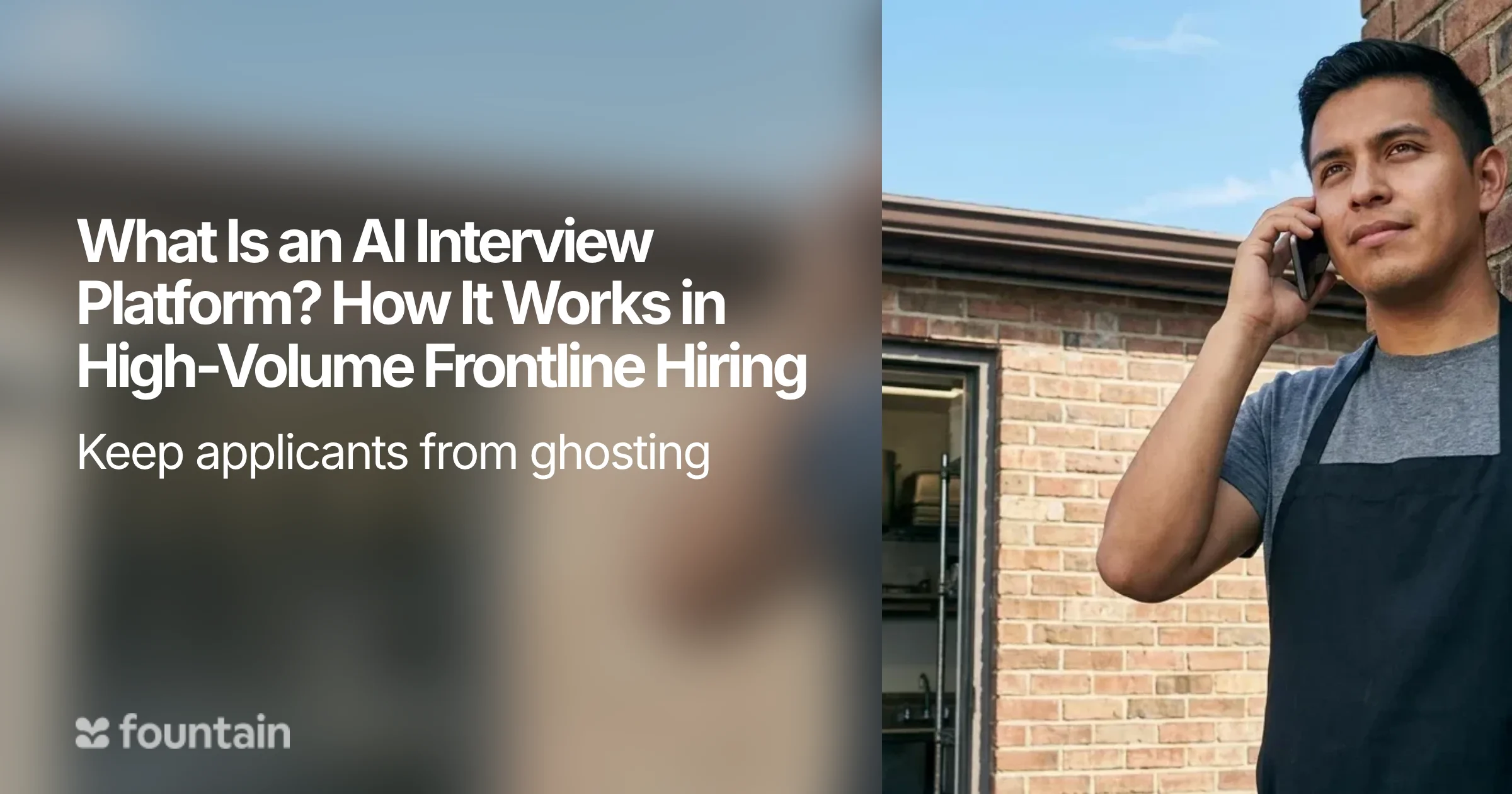
A line cook finishes a closing shift, applies to three restaurants from the bus at 11 p.m. and takes the first interview anyone offers. By the time a recruiter calls back at 10 the next morning, that applicant has often accepted another job.
In frontline hiring, that overnight gap repeats with every applicant, at every location, and manual phone screens can’t close it. Recruiters work business hours, applicants apply after their shifts, and the gap between the two can cost hires. An AI interview workflow moves the first interview to the moment someone applies.
What is an AI interview platform?
An AI interview platform asks first-round role questions, scores the answers against one rubric and sends recruiters a ranked, evidence-backed shortlist, with results saved in the applicant tracking system (ATS), the record of candidates and requisitions. Knockout forms, FAQ chatbots and one-way video tools can look similar on a careers page, but each does a different job.
AI interviews vs. knockout screening forms
Knockout forms check yes-or-no facts, such as work authorization, a valid driver’s license or weekend availability and flag applicants who don’t meet a rule. AI interviews keep those checks and add open questions and follow-ups about things a form can’t probe, such as why someone left a job or how they handle a lunch rush.
AI interviews vs. FAQ chatbots
A recruiting chatbot answers questions about pay, shift times and application status, and it may book a calendar slot. It produces no evaluation. An AI interviewer runs the screen itself and returns a score, a summary and a transcript tied to role criteria, which makes it one stage in a broader recruiting automation workflow.
AI interviews vs. one-way video recording tools
One-way video tools record answers to fixed prompts for later review. Conversational AI asks follow-ups based on each answer and evaluates the responses at the end of the interview.
Voice AI also differs from a scheduled phone screen. In a CESifo working paper dated September 2026, Jabarian and Henkel report a natural field experiment at a recruitment firm in the Philippines hiring for entry-level customer service jobs. Among 67,056 randomized applicants, those interviewed by AI agents were 12% more likely to receive a job offer and 18% more likely to start the job than those interviewed by human recruiters, and human recruiters made every hiring decision. Completion also varies by the format an applicant gets.
Voice, SMS or async video: choosing an AI interview format
The format affects who can complete the interview. A voice call works on almost any phone, and a text thread works on any phone that texts, while video needs a camera and a steady connection that many frontline applicants don’t have between shifts:
| Format | How it runs | Device and bandwidth needs | Fit for frontline roles |
|---|---|---|---|
| Voice | The AI calls the applicant, or the applicant opens a browser link and talks | Any phone for a call; microphone access for browser voice | Strong fit for customer-facing roles; works on basic phones |
| SMS or chat | The applicant types answers in a text thread or web chat, often untimed | Any phone that texts; light data for web chat | Strong fit for applicants with limited data or in noisy settings |
| Async video | The applicant records answers to fixed prompts | A camera, an app or browser, and a steady upload connection | Weaker fit for applicants with older phones or capped data |
Voice and text may reduce device and bandwidth barriers, so compare completion rates by channel before making one the default. Whichever format an applicant uses, the interview runs through the same sequence once they start.
How an AI interview works, step by step
An AI interview can take an applicant from a mobile application to a scored, routed record in one session, with a person making the hiring decision:
- Mobile apply: Applicants complete a short phone application without a resume or account.
- Immediate interview: Applicants start on submission or on demand, without calendar coordination.
- Role-specific questions: The AI asks about shift availability, lifting, cash handling or customer conflict and follows up on thin answers.
- Rubric scoring: The software scores each answer against consistent role criteria and summarizes the supporting evidence.
- ATS write-back: Scores, summaries, transcripts and status updates post to the candidate record in your ATS.
- Routing and scheduling: Your workflow routes qualified applicants to the right recruiter or location manager with a self-scheduling link for the next step.
- Human decision: A recruiter or hiring manager reviews the evaluation and decides on advancement, offers, and rejections; overrides are recorded.
AI surfaces structured evidence. Recruiters and hiring managers make final advancement and rejection decisions, with review and override controls configured by the employer. When an applicant finishes a screen in the same session, recruiters can review the record before the next shift starts.
Why AI interviews fit high-volume frontline hiring
High-volume hiring means filling hundreds or thousands of similar roles quickly, usually across many locations. AI interviews fit for two reasons: how frontline applicants apply and how much screening recruiting teams can handle.
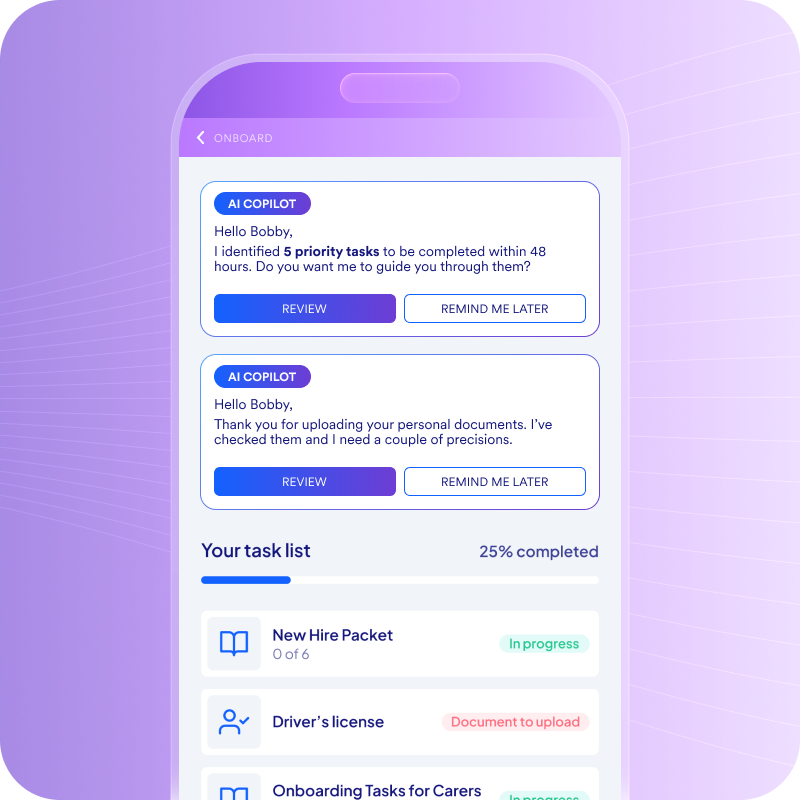
Faster ramp-up. Lower early attrition. AI onboarding built for speed, scale, and retention.
Top employers are already using Fountain’s Frontline OS to:
✅ Reduce turnover in the first 60 days
✅ Eliminate manual paperwork and task delays
✅ Accelerate new hire productivity with smarter workflows
Curious what smarter onboarding could unlock for your team?
Applicants apply after their shifts, so the interview has to run after hours
AI interviews reach frontline applicants when they apply, which is often after a shift ends. In its 2026 Hiring & Staffing report, produced with support from Workday, the National Restaurant Association found that 54% of applications on Workday’s platform arrive during evenings or weekends. A 9-to-5 phone screen reaches those applicants the next business day at the earliest, while a 24/7 AI interview reaches them while they’re still holding their phone.
An interview at application shortens the wait before first review
Starting the interview at application can shorten the gap between applying and first review. Every day between applying and a first conversation can give an applicant time to accept another offer, and manual scheduling often stretches that gap across several days. Track the hours from application to completed interview for one role to see how long yours runs.
Phone-only applicants can finish the interview on the device they have
AI interviews by voice or text work on the phone an applicant already owns, with no laptop or home internet needed. Pew Research Center’s January 2026 analysis found that about a third of adults in households earning less than $30,000 a year are smartphone dependent, meaning they have a smartphone and no home broadband.
Recruiters can’t screen thousands of applicants by hand
AI interviews take first-round screening off recruiters’ calendars, so screening capacity no longer depends on recruiter hours during seasonal surges. SHRM’s 2025 Recruiting Executives Benchmarking report gives a median of 20 requisitions per recruiter a year among organizations with in-house recruiters, rising to 50 at employers with 500 to 4,999 employees and 60 at those with 5,000 or more. One frontline requisition can cover dozens of openings, and 1,000 ten-minute phone screens alone would take more than 160 recruiter hours.
Every location screens applicants against the same criteria
AI interviews ask every applicant the same structured questions and score them on the same rubric, so results compare across sites instead of varying manager by manager. A 2022 Journal of Applied Psychology reanalysis by Sackett and colleagues ranked structured interviews as the top selection procedure for predicting job performance.
That consistency holds only as long as the workflow is set up with the right guardrails, and setup is where AI interview problems often start.
Where AI interview deployments go wrong
AI interview problems often trace back to setup decisions rather than the interview itself. Three come up often.
Treating the AI evaluation as the hiring decision
Have a named reviewer approve advancement and rejection, and record overrides. Shared questions and criteria keep evaluations consistent, and transcripts let reviewers check the evidence behind each score. Spot-check low scores as carefully as high ones.
Skipping a human fallback
Some applicants can’t finish a voice interview: someone who is deaf, a worker who has run out of data for the month, someone whose call drops halfway. Give each of them a visible path, such as a text version of the questions, a recruiter callback or a way to resume where they stopped. Track completion rate by channel and location so that drop-off shows up as a number.
Ignoring identity and cheating signals
Remote interviews open the door to proxy candidates and synthetic voices. Gartner’s July 2025 press release reports that 6% of 3,000 job candidates surveyed in the second quarter of 2025 admitted to interview fraud, either posing as someone else or having someone pose as them. Treat any identity signal as optional input for a trained reviewer, never as grounds for automatic rejection. Signals such as a phone number or email address reused across applicants, long pauses that may suggest scripted answers, or a mismatch between the interview record and the ID collected at onboarding can each have an innocent explanation, such as a shared family phone. Have a person follow up with the applicant before acting, and review consent and privacy with your legal team before turning any of these checks on.
Avoiding these problems starts before you sign, with the questions you put to a vendor.
What to look for in an AI interview platform
Evaluate applicant access, scoring, ATS handoffs, human controls and security evidence, then compare pricing:
- Voice and SMS support: Confirm which phones applicants can use for voice interviews and text engagement.
- 24/7 availability: Interviews run nights and weekends without a recruiter online.
- Structured evaluation: Each answer receives an evidence-backed score against your role criteria.
- ATS write-back: Scores, summaries, transcripts and status changes post automatically to candidate records.
- Configurable routing: Qualified applicants reach the right recruiter, location or priority queue.
- Human review: People approve advancement and rejection, and the system records overrides.
- Multi-language support: Applicants interview in the language they’re most comfortable in.
- SOC 2 report: Ask for the vendor’s SOC 2 Type II report, which covers how its security controls are designed and how they operated over a defined period.
Ask vendors to demonstrate these controls with your own screening criteria for a real role.
Run first-round interviews around the clock with Anna
After-shift applicants often wait until the next business day for a first screen. Anna, Fountain’s AI Recruiter, interviews them when they’re ready.
- Interviews at application: Anna runs structured voice interviews by phone or browser 24/7, including on-demand interviews during the application window.
- Checkable evaluations: Anna scores answers against role criteria and returns summaries, transcripts and recordings for review.
- Faster handoff: Cue, Fountain’s Frontline Superintelligence, runs Anna, and your workflow routes qualified applicants to recruiters.
Alto cut time-to-hire from about 12 days to 9 and raised conversion from 38% to 55% with Anna.
“We consider Anna a member of our team. She’s my fifth recruiter,” says Fiona Maguire, VP of Growth at Alto.
Anna makes no hiring decisions, and hiring managers keep the final say.
Put the interview at the moment of application
Start the interview while the applicant is still engaged. Then route the completed record to a recruiter for review.
Fountain’s Frontline Superintelligence runs that flow across sourcing, screening, scheduling and onboarding, with approval checkpoints you configure and hiring managers making the final call.
Pick one high-volume role at one location, record its current time-to-hire and drop-off, and book a demo to compare a pilot with that baseline.
Frequently asked questions about AI interview platforms
How long does an AI interview take for a frontline role?
In Jabarian and Henkel’s field experiment with 67,056 randomized applicants for entry-level customer service jobs at a Philippines recruitment firm, full AI voice interviews took 10 to 20 minutes and covered up to 14 topics. Those topics mixed verification and open-ended questions, so they don’t map to a fixed question count.
Can applicants pause or retake an AI interview?
Retake settings vary: some vendors let you allow or block another attempt, while others show attempt counts to hiring managers. Configure completion windows and retake limits separately, check whether a new attempt resets application progress, and keep practice questions apart from the scored interview.
Which frontline roles are a poor fit for AI interviews?
Roles that depend on physical or documentary evidence fit poorly, such as forklift operation, line cooking, other hands-on skills and professional license checks. An AI interview can cover availability and fit, but a practical test or credential check should assess what determines suitability.
How should recruiters review AI interview results?
Review responses against the rubric’s proficiency levels and behavioral examples rather than treating an overall score as a complete assessment. Ask subject-matter experts to help calibrate those levels, and when reviewers disagree, compare how they applied each question’s scoring guidance before changing the rubric.