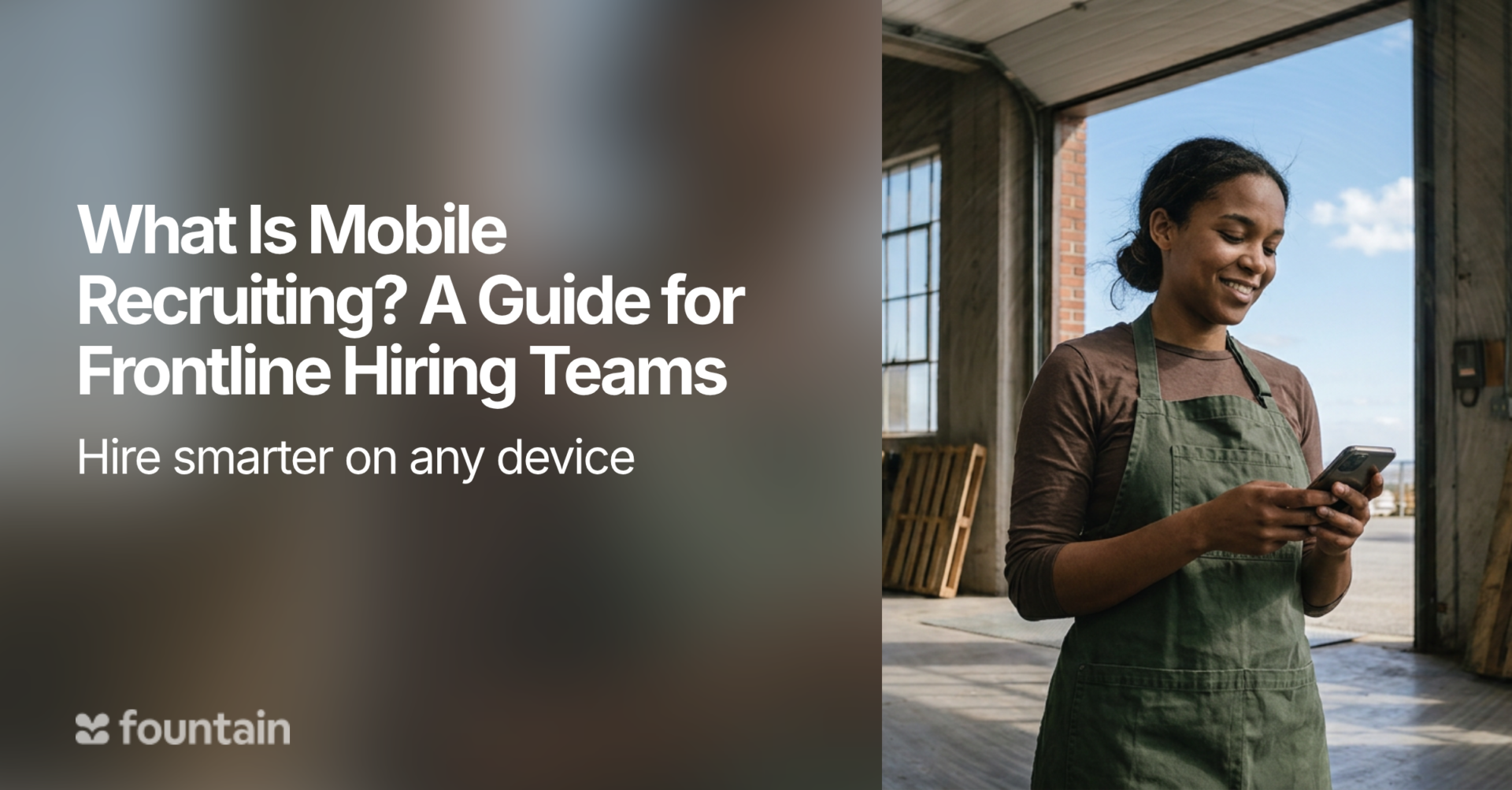
Frontline candidates search, apply, and reply on their phones. Mobile applications now outpace desktop applications, so teams should test every hiring stage on a phone rather than treating responsive display as sufficient. Most hiring processes, meanwhile, were designed desktop first, for people who sit at desks.
For an hourly candidate applying during a short break, the phone can be the most practical channel. Night and weekend applications are common, when candidates may be away from a laptop, so keep mobile screening, SMS communication, and self-scheduling available outside business hours.
What gets called mobile recruiting may still be a desktop process retrofitted to fit a smaller screen.
What is mobile recruiting?
Mobile recruiting is hiring designed to run end to end on the candidate’s phone, from job discovery through application, screening, interview scheduling, offer, and Day 1 paperwork. No desktop needed, and no resume upload or account creation before a candidate can start.
The candidate who scans a QR code on a store window should be able to reach a signed offer and a completed I-9 without ever opening a laptop.
Online recruitment moves hiring onto digital channels. Mobile recruiting is the device-level discipline within it: whether every hiring step actually works on a phone for someone applying during a short break.
Why mobile recruiting matters for frontline hiring
Mobile recruiting matters because candidates job-hunt on smartphones, apply between shifts, and may take a workable offer before a slow employer responds. Mobile candidates can complete fewer applications and spend longer on each than desktop candidates, so friction on a phone is a direct source of funnel loss.
The fix is to shorten the form and remove the resume and account-creation gates that cost the most candidates.
Speed matters as much as friction. A funnel that takes a week to respond is competing for people who may have already started somewhere else. A slow hiring process is a top frustration for 57% of frontline candidates in Fountain’s 2025 Frontline Report, a survey of about 2,000 frontline workers.
Ghosting rates at restaurants and casinos reach 50%, so candidate follow-through is a major source of funnel loss too. Track interview show rates by location, and use self-scheduling and SMS reminders where no-shows run highest.
Frontline job searches skew heavily mobile, which is why corporate hiring playbooks transfer so poorly. Corporate processes often assume a prepared resume, a laptop, and an applicant who will tolerate a multi-week timeline.
An hourly applicant has a phone and a decision window that may be measured in hours.
Re-engage qualified candidates already in your system.
Re-engage high-fit candidates already in your system with Fountain Pool.
Rediscover and rehire faster with a solution built for frontline hiring at scale.
Fountain Pool helps reduce time-to-fill, lower sourcing costs, and eliminate repetitive outreach by making past candidates easy to find, tag, and re-engage. Get ahead of seasonal and high-volume demands by tapping into talent you’ve already vetted. Stop letting strong candidates slip through the cracks and start rediscovering with Pool.
Mobile recruiting vs. mobile-friendly recruiting
Responsive-only recruiting makes a desktop process render on a phone. True mobile recruiting redesigns the process for the device. The difference is not cosmetic: a long application still has the same fields on a phone, only smaller, and 60% abandon online applications they find too long or complex.
Responsive design solves the display problem and leaves the design problem untouched, so the fix is to shorten the form, not resize it.
Designed for the device means the application asks fewer questions, phone-friendly input works, and updates arrive on channels candidates check. When Home Depot let candidates book interviews on phones, 80% used it, and applicant numbers rose 50%, so self-scheduling within the same mobile flow removes a real bottleneck.
Humana shows the same gap on a narrower scale. Its screening emails were filtered as spam, and candidates said they never received them. After the identical link went out by SMS instead, completion rose to 84%, with 97% responding within the first hour. Only the delivery channel changed.
Teams losing candidates to filtered email should test SMS delivery before rebuilding the screening step.
How to build a mobile recruiting strategy
Start with an audit: apply to one of your own postings from a personal phone, on cellular data, during a simulated 10-minute break. Wherever you give up first is where candidates give up too, and that step is the one to fix before you add anything new.
The build is five components, and each one is a place candidates currently fall out:
- A fast mobile career site and postings: Use career pages that load quickly on cellular connections and state pay and schedule up front, so candidates can self-select before they invest any time.
- A short, no-app application: Keep it resume-free, enable phone autofill, open it through QR codes and text-to-apply, and make it finishable in under five minutes so a candidate on a break does not abandon it.
- Text-based communication: Send status updates, screening questions, and interview reminders over SMS, the channel frontline candidates actually check.
- Mobile self-scheduling: Let candidates book interviews from the same text thread, which closes the phone-tag gap where drop-off concentrates.
- Mobile onboarding: Let new hires sign offer letters and complete Day 1 paperwork from the phone, with the same audit trail a desktop process would produce.
Corporate applicant tracking systems often lack high-volume capabilities such as scheduling and candidate communication, so the tools worth a shortlist are mobile-native rather than retrofitted: they run screening and scheduling around the clock with managers approving offers and exceptions, and they report by device and location instead of org-wide averages.
How to measure mobile recruiting (and where it goes wrong)
The most reliable way to measure mobile recruiting is to compare your own funnel over time by device, stage, and location, not against published recruiting benchmarks that are useful for direction but unreliable for goal-setting. Put this quarter’s funnel next to last quarter’s and read four things.
Mobile share of applications shows whether your entry points reach candidates where they are. Drop-off by device and stage locates the exact screen where mobile candidates quit. Time to first response is most honest as a median, since a few delayed cases distort an average, and it tells you whether the funnel moves at candidate speed.
Interview show rate closes the loop between a booking and an interview that actually happened. None of these numbers mean much until they are cut by location. Turnover can vary widely across locations in the same company, so an org-level average hides the sites that are failing.
The interview stage alone accounts for 25% of drop-off, more than any other, and no-show rates in high-volume hourly hiring can reach 30% to 50%, so prioritize mobile self-scheduling and reminders, then track show rate by location against your own baseline. If time-to-hire improves while 90-day attrition still runs near 43%, faster hiring has not bought you retention.
The failure modes repeat across companies. A desktop application gets a responsive skin and is declared mobile-ready. Nobody on the hiring team has actually completed the form on their own phone. Analytics report a blended completion rate that hides a wide gap between devices.
And documents collected outside a compliant onboarding system can miss the required audit trail that a review will eventually ask for.
How Fountain runs mobile recruiting for frontline teams
Candidates complete the whole process and book their own interview slots on a phone, while a mobile manager view lets managers review applications and approve decisions from theirs. Cue, the orchestration layer included in every Fountain product, turns plain-language instructions into application steps, SMS messages, scheduling rules, and reports.
A recruiting lead can type a goal like “Cut our driver application to under five minutes on mobile, add text-to-apply, and show me completion by device and location,” and Cue can help configure those steps and surface the reporting, with managers approving what goes live.
The agents Cue coordinates are all live today, and managers still approve every offer and exception:
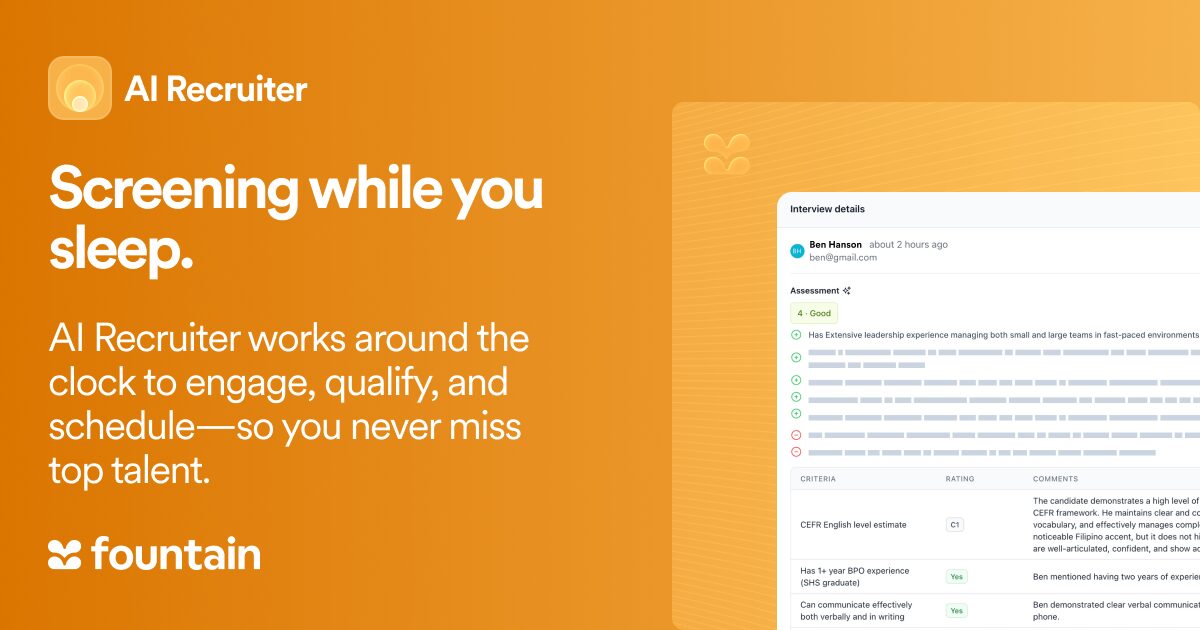
- Anna runs voice screening around the clock and passes scored, qualified applicants to hiring managers, so a candidate who applies at 11 p.m. can interview then.
- Emma answers candidate questions at any hour and walks new hires through I-9 and W-4 paperwork from the phone.
- Sam tracks post-hire engagement signals and surfaces retention risk before a no-show does.
Underneath, the ATS runs resume-free mobile applications, self-scheduling, and automated SMS at every stage, and Onboarding handles mobile I-9 completion, E-Verify, and offer signing with audit-ready document storage, so paperwork done on a phone holds up under review.
Because these run on one system, the process holds from a QR-code scan to a signed offer instead of breaking between tools. With Fountain, Fetch (a last-mile delivery platform whose previous ATS required resumes and was not built for mobile) reported a 95% decrease in average time-to-hire with Fountain AI, from 15 days to 6.5 hours.
Frontline candidates already search and apply on their phones; the open question is whether your hiring process matches how they use them. Book a demo to see Cue, Anna, and mobile onboarding run against your own funnel, from the first application to Day 1 paperwork.
Frequently asked questions about mobile recruiting
What is mobile recruiting?
Mobile recruiting is hiring built to run entirely on a candidate’s phone, covering job discovery, application, screening, interview scheduling, offer, and onboarding paperwork. Responsive design changes how a desktop process looks on a phone; mobile recruiting changes the process itself.
How is mobile recruiting different from text recruiting?
Text recruiting is one channel within mobile recruiting: SMS for outreach, status updates, and reminders. Mobile recruiting is the full discipline, spanning the career site, the application, scheduling, and onboarding as well as the messaging layer.
Do you need a recruiting app?
No. Few frontline candidates will install an employer’s app just to apply for an hourly job, and the mobile web plus SMS covers the entire flow, from a QR-code scan to a signed offer, without an install.