Candidates now use AI as readily as employers do. The same tools tailor resumes, draft interview answers, and submit applications at a volume no recruiter can read. In a CNBC and SurveyMonkey survey of 1,686 workers fielded in July 2026, 47% said they had used AI to apply to jobs. Polish is no longer a dependable screening shortcut.
Spotting every AI-written application is a losing game. Detectors misfire, candidates adapt, and even a correct flag tells a hiring manager nothing about whether the person can do the job. The better move is a screen built on evidence that polished materials can’t fake: whether a candidate can work the posted shifts, reach the site, hold the license the role requires, and start on the scheduled Day 1.
Frontline employers are better placed than anyone to make that move, because those signals were never on the resume.
The application stopped being evidence
AI has weakened the application as evidence because ordinary help, misrepresentation, and mass applying now produce equally polished materials. Most candidate AI use is ordinary: rewriting a resume to match a posting, fixing grammar, rehearsing answers, or translating from a first language.
In Gartner’s survey of 3,290 candidates, 39% had used AI during the application process. A smaller share crosses into misrepresentation, and auto-apply tools inflate volume without saying anything new about the person.
What AI removed was the effort that made resumes and cover letters useful. In Michael Spence’s 1973 paper on job-market signaling, an application reveals quality only when stronger candidates can produce it at lower cost.
Wharton economist Judd Kessler put it plainly to Fortune: the cover letter “was a costly signal that a job candidate could send that they were really interested in a particular role,” costly “because writing a good one was hard and took time, and you couldn’t do it for every firm.” AI collapsed that cost for everyone at once.
Galdin and Silbert’s labor-market model estimates the result: hiring becomes “significantly less meritocratic,” with top-quintile workers hired 19% less often and bottom-quintile workers 14% more often.
Authorship was never the thing being measured. The practical question is which job requirements still cost something to fake.
Why frontline hiring feels this differently
Resume polish never did much work in hourly hiring. A warehouse associate, line cook, or delivery driver has to meet concrete requirements: availability for the shifts, a workable commute, a valid license where the law requires one, readiness to start, and a realistic picture of the work. None of that gets more convincing with better prose.
The pressure shows up elsewhere. Appcast’s 2024 apply data puts the smartphone share of applicants at 72% in hospitality and 69% in warehousing and logistics, so the screen has to work on a phone, between shifts, at any hour. In Aptitude Research’s February 2026 study, 44% of employers named screening as their biggest frontline hiring bottleneck, and 41% still ran the same process for frontline and professional roles.
That gives frontline teams an advantage. Corporate hiring has to invent checks to replace the written ones, while frontline hiring mostly moves the checks it already runs to the front.
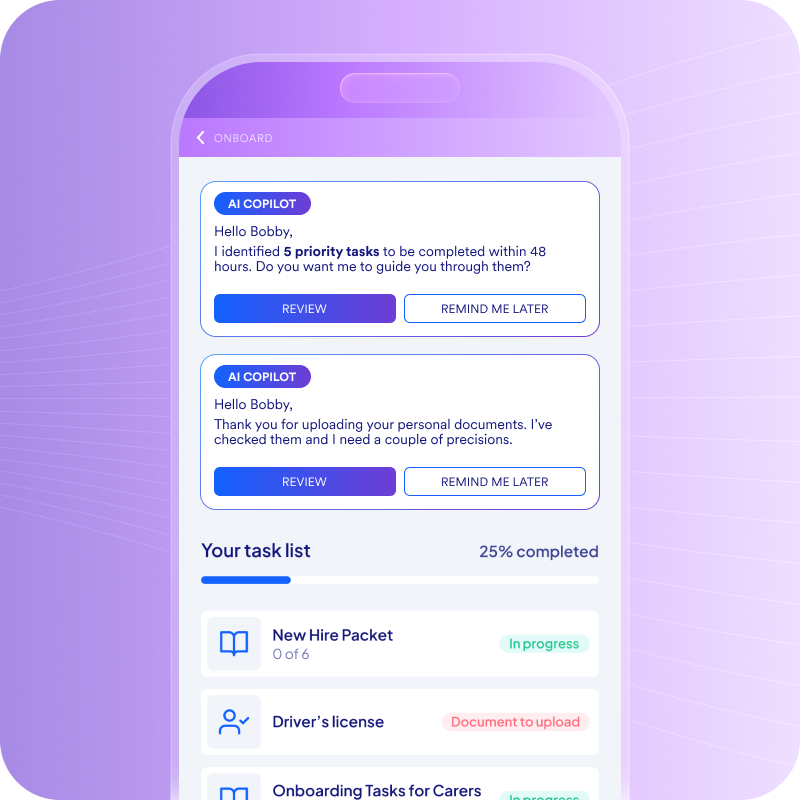
Faster ramp-up. Lower early attrition. AI onboarding built for speed, scale, and retention.
Top employers are already using Fountain’s Frontline OS to:
✅ Reduce turnover in the first 60 days
✅ Eliminate manual paperwork and task delays
✅ Accelerate new hire productivity with smarter workflows
Curious what smarter onboarding could unlock for your team?
What to screen for instead
An evidence-based screen is a short sequence of checks in which each layer tests something the job needs and nothing else. A 2022 meta-analysis by Sackett and colleagues ranked structured interviews as the strongest single predictor of job performance among the procedures it reviewed.
Start with one high-volume role and move its first three decisive checks to the top of the application:
- Minimum requirements: Confirm the basics, such as minimum age and work authorization, with simple yes/no questions. A 2022 technical-assistance letter from the Justice Department’s Immigrant and Employee Rights Section describes two pre-offer questions (work authorization and future sponsorship) as appropriate, and USCIS guidance places Form I-9 paperwork after a job offer is accepted, so document checks typically come later.
- Availability and location fit: Match the shifts the opening needs against what the candidate can work, plus their distance to the site.
- Structured job-relevant questions: Ask the same questions, in the same order, scored on the same scale for every applicant. A question about handling a frustrated customer tells you more than any resume line.
- A short scenario where the role justifies it: A refund dispute for a cashier or a missed delivery window for a driver earns its place. Elsewhere, it only adds time.
- Credential checks at the right stage: Ask up front whether the candidate holds a required forklift certification, commercial driver’s license, or food handler card, then verify it at offer or before Day 1.
- Human review: A recruiter or manager reads the structured summary and makes the call.
Together these layers should run in minutes on a phone, with the cheap, decisive checks first so nobody spends 10 minutes on a scenario before learning the shifts don’t fit.
Use AI to collect evidence, not to catch AI
Employer-side AI should collect evidence, not hunt for candidate AI use, because detectors can’t carry that weight.
When Liang and colleagues ran seven AI-writing detectors over essays by non-native English speakers, the average false-positive rate was 61.22%, against near-perfect accuracy on essays by U.S. eighth graders. Having ChatGPT enrich the same essays’ vocabulary cut the flag rate to 11.77%, so the tools penalized plain human writing more than AI-edited text.
The better job for AI is consistent evidence collection. Every applicant gets the same core questions, follow-up probes are scripted in advance rather than improvised, and the output is a structured summary with any contradiction between the application and the answers flagged for a person.
In a large experiment on AI phone screening of entry-level customer-service applicants in the Philippines, Jabarian and Henkel found the automated interviewer followed the interview guide more consistently than human recruiters did, which they call “controlled variance.” Human recruiters still made every hiring decision. Suspected AI authorship should never trigger automatic rejection. A contradiction earns a follow-up from a person, who decides.
Adding AI doesn’t shift accountability for the hiring decision. Anti-discrimination and disability laws, such as Title VII and the Americans with Disabilities Act (ADA), apply whether a person or a tool runs part of the screen.
Disclosure rules for automated hiring tools also vary by location and keep changing. Some places, such as New York City, already ask employers to tell candidates when these tools are in use. This is general context, not legal advice, so confirm specifics with counsel.
Responsible AI in hiring covers compliance in more depth.
Set candidate AI rules before the screen, not after
A candidate AI policy works when it is stage-based and visible before the stage it governs. Preparation and drafting are fine. Live screens and assessments are the candidate’s own work unless the instructions say otherwise.
Wayfair’s published candidate guidelines draw exactly that line, inviting candidates to “use all available resources to prepare,” including AI tools, while asking them to “refrain from using AI to enhance your performance during a live interview, unless explicitly instructed or permitted.” Few frontline employers have published an equivalent, so most will write their own.
A blanket ban across every stage tends to backfire. It looks like a double standard when the employer screens with automated tools, and it sweeps up translation, grammar correction, and the assistive tools some candidates rely on, which can raise accommodation questions under the ADA.
The notice belongs at the top of the application and again in the invitation to any live step.
A workable starting point reads like this.
We use AI to collect and summarize your answers at the screening stage. A person on our hiring team reviews those results and makes every hiring decision. You’re welcome to use AI tools to prepare, draft, translate, or proofread. During a live screening call or assessment, we ask that the answers be your own unless we tell you otherwise. If you need an accommodation for any part of this process, reply to this message and a person will set it up.
It tells candidates where AI is used, confirms that a person decides, and offers an accommodation route before they start. Adapt the wording to your process and locations.
How to know the new screen is working
Judge the new screen by whether it separates qualified candidates, not by applications processed. Export today’s baseline for one role and location, then track five measures at that level alongside your candidate experience metrics:
- Qualified-candidate rate: The share clearing requirements and availability should rise as the screen gets specific.
- Screen-to-interview conversion: This shows whether interview slots go to people who can take the shift.
- Day 1 show rate: This is where realistic expectations set during the screen first pay off.
- Early retention at 30 and 90 days: Quits in that window often trace to a bad availability match or a misleading job picture.
- Recruiter override rate: This records how often a person reverses the screen’s recommendation. With no published benchmark, treat a jump in either direction against your own range as a calibration problem.
The candidate-experience trade-off deserves a straight answer: some job seekers are walking away from hiring processes that use AI interviews. Choice changes the result.
Fountain’s Agentic AI for Frontline Workforces research found that 74% of frontline workers prefer an AI interview to waiting for a scheduled call, and in Jabarian and Henkel’s experiment, applicants interviewed by AI were 18% more likely to start the job. If the new screen takes longer than the old application did, one step is doing work the job doesn’t need.
Build the screen for evidence, speed, and scale
Frontline hiring needs all three, and a detector bolted onto the old application delivers none of them. Fountain is the platform. Cue is the intelligence. Cue runs the work across Fountain’s five products (Source, CRM, ATS, Onboarding, and Shift & Scheduling) and the talent agents inside them. A recruiter can ask, “Screen this week’s warehouse applicants for weekend availability and a current forklift certification,” approve the plan Cue proposes, and let Cue execute it.
Each stage of the screen then has an owner:
- Before the screen: Emma, Fountain’s AI 24/7 Support agent, answers candidate questions on web, SMS, and WhatsApp from the employer’s own content.
- During the screen: Anna, Fountain’s AI Recruiter, runs structured voice and chat interviews around the clock and scores every applicant on the same rubric.
- After the screen: Anna writes results back to the ATS, where a recruiter or location manager reviews the shortlist, overrides where shift or site context warrants, and makes the call.
Last-mile delivery company Fetch saw a 95% decrease in average time-to-hire with Fountain AI, from 15 days to 6.5 hours.
Candidates will keep using AI. A screen that asks everyone the same job-relevant questions works no matter who, or what, wrote the resume. See it on your own openings: Book a demo to watch Anna run a structured first screen, Emma field candidate questions, and a scored shortlist land in your ATS.
Frequently asked questions about candidates using AI
Is it OK for candidates to use AI to apply?
Yes, for preparation and drafting. Published guidelines such as Wayfair’s welcome AI for preparation and draw the line at live screens and assessments, where answers should be the candidate’s own.
Can employers tell if a resume was written with AI?
Not reliably. In the Stanford-led study, seven detectors misflagged 61% of essays by non-native English speakers on average, and no study we reviewed tested detectors on resumes or interview answers.
Should we ban AI in interviews?
Many employers draw the line at live screens and assessments, with the rule shown before that stage. A blanket ban penalizes translation, grammar, and accessibility help, and it looks like a double standard when the employer uses automated interview tools.