Demand for caregivers is outpacing the workforce that fills the roles. The BLS projects 18% employment growth for home health and personal care aides from 2025 to 2035, roughly 847,300 new jobs plus about 760,500 openings a year from workers leaving the occupation. Home care agencies and senior living operators need to plan recruiting capacity for new demand and replacement hiring at once, against candidates weighing these roles against other caregiving and hourly work.
Employers control the parts of caregiver recruitment that decide where candidates come from, how they’re screened, what compliance sits between offer and first shift, and how many make it past 90 days.
What caregiver recruitment is and why it’s different
Caregiver recruitment is the sourcing, screening, credentialing, and onboarding of frontline workers who provide hands-on care in a client’s home or a residential community: personal care aides, home health aides, certified nursing assistants, direct support professionals, and senior living staff such as resident assistants and medication technicians.
The credential ladder shapes who you can hire for what: home health aides at Medicare-certified agencies need at least 75 hours of training and a competency evaluation, while personal care aides have no federal floor, so the requirement is whatever the state sets.
Setting changes the job more than the title does: a home care aide may drive between clients and work alone with no coworker down the hall, while a senior living aide covers a fixed building through overnights, weekends, and multi-resident transfers. Turnover follows the setting, 75% in home care in 2024 against 38.4% for assisted living CNAs, so size your pipeline off home care’s own churn, not facility-side benchmarks.
A screen also has to weigh what a certificate doesn’t show: a workable commute radius, reliable attendance, and a caring disposition that earns a stranger’s trust on the first visit.
Why caregiver hiring is hard right now
Employers lose caregivers to other direct care employers and industries alike. PHI’s direct care mobility analysis finds that about 42% of personal care aides and nursing assistants, and 57% of home health aides, move into one of the other two direct care occupations each year, so benchmark pay and schedules against those adjacent roles too.
Wages drive much of that movement: home care providers paying above the 75th percentile saw 35.5% lower turnover, and with only 12.8% of applicants hired in that same data, forecast applicant volume backward from each hiring target.
Each vacancy shows up on the P&L before the recruiting report: 63.3% of providers turned down cases for lack of staff, and some nursing homes are limiting admissions for the same reason. The 18% growth projection sits on top of that churn, so plan for expansion and replacement hiring together.
How to hire for home care and senior living
1. Attract caregivers: where to source and how to post
The channel that sends the most applicants often isn’t the one that produces the best hires. McKnight’s benchmarks show Indeed supplies most applicants, agency websites produce a disproportionate share of hires, and in-person events, though lower-volume, convert best.
Retention runs the same way: Activated Insights’ 2024 benchmarking put turnover among Indeed-sourced hires at 88%, against 14.6% from employee referrals. Judge channels by hires and 90-day retention, not volume, and don’t rely on one job board.
Former employees and past applicants belong in that mix too, since re-engaging them is usually cheaper than sourcing cold; Fountain’s CRM reports about 35% faster time-to-fill and 60% lower sourcing spend for customers who tap that pool first (platform figures, results vary).
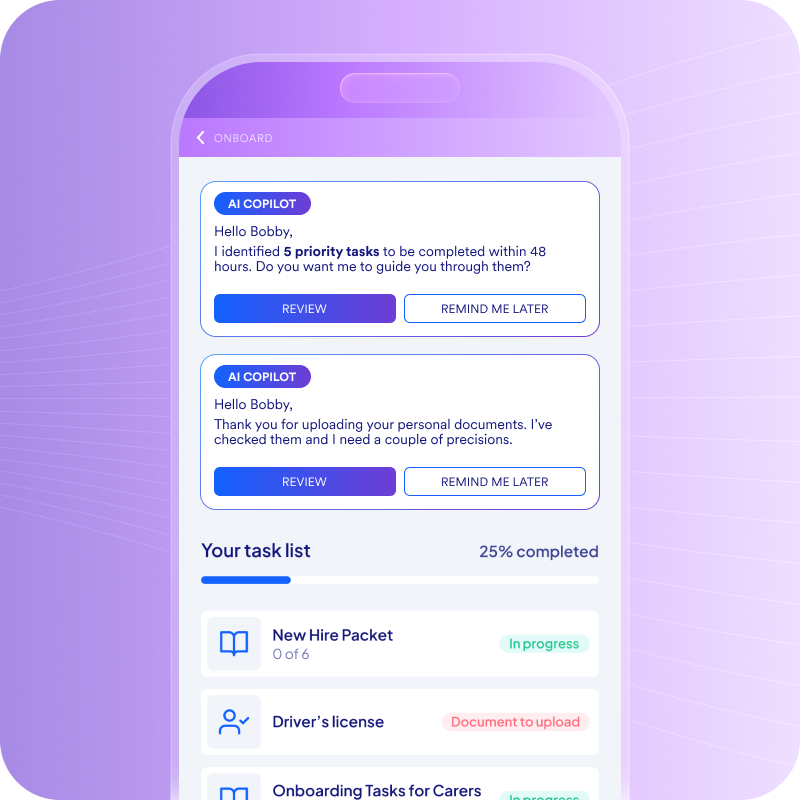
Faster ramp-up. Lower early attrition. AI onboarding built for speed, scale, and retention.
Top employers are already using Fountain’s Frontline OS to:
✅ Reduce turnover in the first 60 days
✅ Eliminate manual paperwork and task delays
✅ Accelerate new hire productivity with smarter workflows
Curious what smarter onboarding could unlock for your team?
Pay, schedule, and location rank among caregivers’ top considerations, so lead the posting with wage, travel radius, shift pattern, and guaranteed hours, then what a candidate must bring versus what you’ll train.
Update one posting in Sourcing and the ATS with those details, then publish it across at least two channels so you can compare qualified applicants and hires by source.
2. Reduce drop-off with a mobile-first candidate experience
A short, mobile-first application cuts real friction: long, complicated applications cause abandonment, so for entry-level roles, drop the resume in favor of knockout questions on name, contact, location, availability, transportation, and certification status.
Speed after the application matters as much as speed inside it. McKnight’s Home Care reports more than half of hires were interviewed within four days of applying; use that as a service target.
Text follow-up, self-scheduling, a morning-of reminder, and a post-interview status update each remove a reason to disappear. Candidates have said what they want here too: Agentic AI for Frontline Workforces research found 74% of frontline workers would rather do an AI interview than wait for a scheduled call, so offer agentic voice screening alongside scheduled calls, not instead of them.
Offer an accessible alternative, a live number a recruiter answers, for candidates with a disability, limited English, or a shared phone, so the format doesn’t screen out someone qualified.
3. Screen and interview for reliability and safety
First-pass screening should settle the disqualifiers with knockout questions and a short phone screen, before anyone spends interview time: work eligibility, credential and registry status, shift availability, distance, and transportation.
The interview then has to surface what the certificate doesn’t. Scenario questions beat a resume walk-through: ask how a candidate handled a client who refused care, or how they’d protect a resident’s dignity or hold their composure with an angry family member.
Asking every candidate the same questions on a shared rubric keeps the comparison consistent, and structured interviews predict performance better than an unstructured conversation.
Build the scenario questions and a shared rubric into the ATS, and let agentic voice screening run the first-pass phone check so recruiters spend their time on final review and edge cases.
Validate references, employment history, and credentials before the offer goes out; a recruiter still decides every close call.
4. Keep compliance checks from stalling the pipeline
Caregiver hiring compliance is where many hires stall between offer and first shift, usually because the checks run one after another and no one can see where a candidate is waiting. What applies varies by role, setting, payer, and state, and the window can include background screening, registry and exclusion checks, health screening, and employment eligibility verification.
Treated as a funnel stage, it gets measured like one: days from accepted offer to first shift, which check holds the most candidates, and how many can start in parallel instead of in sequence. A ready or not-ready status for each hire in Onboarding surfaces an incomplete file early, so it doesn’t show up as a Day 1 surprise, and the same view can sit next to time to hire and Day 1 show rate.
Requirements change and differ by state, so this article points to primary sources instead of summarizing them. As of October 2026, those include the CMS National Background Check Program, the HHS Office of Inspector General’s exclusion authorities page, and USCIS’s Form I-9 resources, alongside each state’s own agency. This is general information, not legal advice; confirm what applies to each role and location with counsel.
5. Onboard, retain, and measure what works
A long offer-to-shift delay raises the odds a caregiver starts elsewhere first, so compress it: move the required paperwork and checks into one mobile preboarding flow, covering the employment eligibility verification workflow, W-4, direct deposit, document uploads, and background check ordering, so hires don’t stall between steps, and set orientation before the call ends. Timing for the compliance steps varies, so confirm it with counsel.
Configuring the ATS and Onboarding to open that flow on acceptance starts the sequence without waiting on the next recruiter’s action. Early retention belongs on the recruiting scorecard. The risk of early caregiver turnover peaks in the first 90 days, so a hire who quits in week three is a failed hire for recruiting too.
Agencies offering at least eight hours of onboarding and 12 hours of ongoing training reported an average annual revenue increase of nearly $350,000 in 2025 benchmarking data, making onboarding capacity an operating investment, not overhead.
Track application completion and qualified-applicant rate to check the form and posting; applicant-to-interview conversion, no-show rate, and time to hire to catch delays; source-to-hire against 90-day retention by channel; and Day 1 show rate plus 30- and 90-day retention for early outcomes.
Where a published benchmark doesn’t exist, your own trend line is the baseline.
How Fountain runs caregiver hiring
Sourcing, screening, background checks, credential verification, I-9, and orientation often live in separate systems, and each handoff is a place a hire can stall. Fountain runs them as one flow, with a person reviewing what matters, which counts most for caregivers, who may stay on the market only days.
Cue, Fountain’s orchestration layer, launched April 2026 and turns a plain-language hiring goal into coordinated tasks across Sourcing, the ATS, Onboarding, and Shift & Scheduling.
Under it, Anna runs voice and SMS screens around the clock and routes qualified caregivers to a recruiter; Fountain’s healthcare hiring page reports customers filling roles in about 17 days against a 24- to 49-day industry norm, roughly 65% potential savings (platform figures, results vary).
Emma and Sam are both live too: Emma handles candidate questions plus I-9, W-4, and onboarding paperwork, where Fountain’s I-9 Center reports 40% fewer incomplete I-9s and a 99% E-Verify compliance rate; Sam tracks post-hire engagement so retention risk surfaces early.
Soar Autism Center, a healthcare provider hiring therapists at volume, used Fountain’s automated reminders to cut interview no-shows and grew hiring volume 116%, a healthcare-adjacent proxy for what fewer no-shows and faster scheduling do to a recruiter’s capacity (this result is from therapist hiring, not caregiving).
Hires flow into the HRIS you already run (UKG, ADP, Workday, SAP SuccessFactors), and background checks run through partners like Checkr, HireRight, Certn, and Accurate Background, with recurring checks for licensed or certified roles.
A caregiver-specific prompt to Cue might read: “Hire 25 home health aides within 20 miles of our Tampa office by October 15, run same-day phone screens, flag anyone whose registry check hasn’t cleared, and schedule orientation for every accepted offer.” Cue coordinates that across Sourcing, Anna, the ATS, and Onboarding; your team still decides and handles the exceptions.
If your caregiver pipeline is losing candidates to slow screens, stalled paperwork, or missed compliance steps, book a demo and see how Cue, Anna, and Emma would run your next 25 hires, from application to first shift.
Frequently asked questions about caregiver recruitment
What is caregiver recruitment?
The sourcing, screening, credentialing, and onboarding of frontline workers who provide hands-on care: personal care aides, home health aides, CNAs, direct support professionals, and senior living staff. It differs from general hourly hiring because credentials, registry checks, and compliance steps sit between offer and first shift.
How do you reduce caregiver applicant drop-off?
Use a short, mobile-first application with no resume requirement, then follow up fast with a same-day or next-day interview by text. Self-scheduling and reminders cut no-shows, and a human-assisted path keeps candidates who won’t use the automated route.
How are recruitment and retention connected?
Early caregiver turnover risk peaks in the first 90 days, so a caregiver who leaves in month one is a recruiting failure as much as a management one. Source, speed of hire, and offer-to-first-shift time all shape that window, which is why 30- and 90-day retention belong on the recruiting dashboard too.