Frontline workers are not anti-AI, but they want to know when it is used and who makes the final call; disclosing both preserves their trust. Americans as a whole are warier still: they oppose AI making final hiring decisions by a wide margin, 71% to 7%, per Pew Research Center’s 2023 survey. So keep final offers and rejections with authorized people, and say so up front.
That is harder than it sounds: the legal requirements change faster than most teams can adapt. A responsible program needs three things at once: current legal rules, stage-level bias audits, and evidence that a vendor’s controls actually work.
What responsible AI in hiring actually means
Responsible AI in hiring means the system’s fairness, explainability, human oversight, auditability, and data privacy can each be verified by an independent party:
- Fairness: The model has to be tested for adverse impact across protected groups.
- Explainability: Any score or recommendation traces to the inputs that produced it.
- Human oversight: A person with real authority can override the output.
- Auditability: The decision trail has to survive a records request.
- Data privacy: Candidate data is collected, retained, and used under documented rules.
A black-box tool returns a fit score with no traceable logic. If nobody can say why a candidate scored 62, nobody can defend that score to a regulator, a plaintiff’s attorney, or the candidate.
One screening model sits between millions of applications and a job, so a single flawed configuration repeats at a scale no recruiter’s judgment could. In frontline pools, plenty of strong applicants arrive without traditional credentials, so credential- and proxy-based screening does the most damage exactly here.
Start with one week of screening decisions: for each score, confirm its inputs, name the reviewer who can change it, and check the record caught any override.
Where AI belongs in the hiring funnel, and where a human decides
Human-in-the-loop by design means AI recommends candidates, routes work, and drafts messages, while people approve offers and exceptions. Ownership splits five ways across the funnel.
- Sourcing: AI widens and ranks the pool using criteria set by a human.
- Screening: AI qualifies and summarizes candidates, while a human reviews edge cases.
- Scheduling: AI books and reminds, which is lower-risk as long as it does not affect candidate evaluation or eligibility.
- Assessment: AI structures the inputs, while a human weighs the judgment calls.
- Offer: a human decides, always.
For frontline roles, the line between low-risk and high-risk automation is sharper than it looks. For a manager trying to cover 40 shifts before the weekend, the scheduling and reminders can run overnight unwatched, while every rejection at the screening step still needs a name on it.
Matching shift availability on objective, job-related criteria is lower-risk; scoring free-text answers for “culture fit” is a different category, because a rubric-free culture-fit field invites bias complaints and language models carry documented hiring bias straight into that kind of scoring.
The trust question is which steps AI touches and who owns the decision at each one.
Under GDPR Article 22, superficial human review does not necessarily remove a consequential automated decision from the rule’s scope; meaningful involvement requires override authority and data.
Smarter, faster, and more compliant from day one
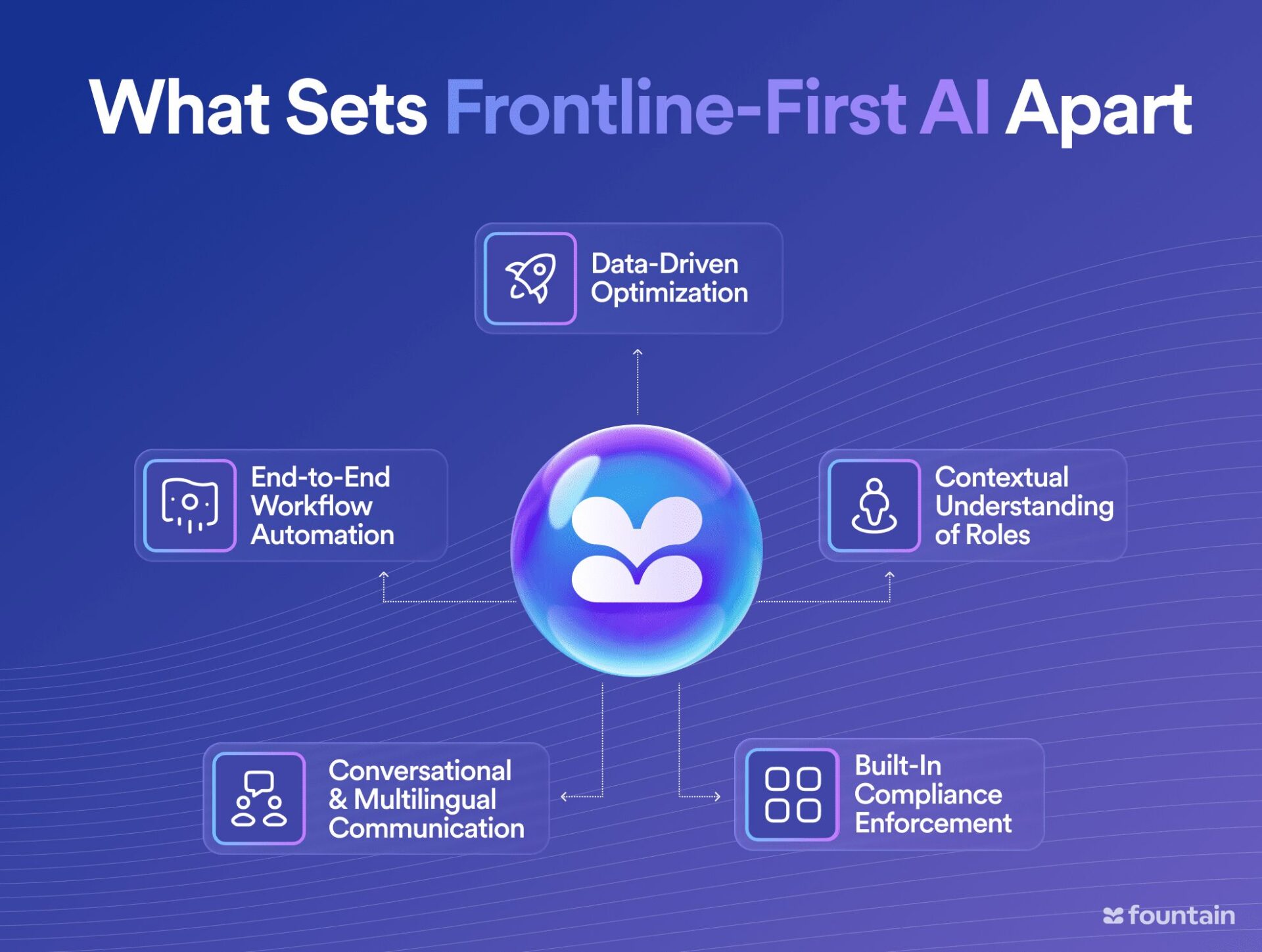
See how frontline-first AI helps you reduce time-to-hire, engage more candidates, and stay compliant at scale.
From instant chat-based screening to automated scheduling and built-in compliance, Fountain’s AI gives your team the tools to hire faster and smarter while maintaining accuracy and a great candidate experience.
Schedule a personalized demo and explore what’s possible.
Clicking approve on every AI rejection does not clear that bar, and the assigned reviewer must be able to reverse the result. A rubber stamp is not human oversight, so map each stage in your funnel and give screening rejections and offers a named human approver before you automate around them.
The rules that actually apply in 2026
In 2026, AI hiring is governed by NYC Local Law 144, a growing state-law patchwork, federal employment statutes, and, where applicable, GDPR and the EU AI Act.
The information below is general guidance, not legal advice; employment counsel should confirm current effective dates and scope:
- NYC Local Law 144 is in force and unchanged. It requires an annual independent bias audit of any automated employment decision tool, a published summary of results, and 10 business days’ notice to candidates before the tool is used. The vendor cannot audit its own tool, and the employer remains responsible. A December 2025 New York State Comptroller audit found 17 potential violations among 32 companies where the city’s regulator had found one, and called the complaint process ineffective. Keep audits, notices, and records ready for review.
- State requirements are changing quickly. Illinois’s HB 3773 took effect January 1, 2026, banning AI with discriminatory effects, prohibiting zip codes as proxies for protected classes, requiring notice, and creating a private right of action. California’s FEHA automated-decision regulations took effect October 1, 2025, with four-year recordkeeping and vendors acting on an employer’s behalf treated as its agents. California’s separate CPPA rules on automated decision-making add pre-use notice and opt-out requirements by January 1, 2027. Colorado repealed and reenacted its AI Act through SB 26-189, signed May 14, 2026, which narrowed the law and pushed its effective date to January 1, 2027. Texas’s TRAIGA took effect January 1, 2026 and focuses liability on intentional discrimination. Most of these regimes require some form of notice, and several add multi-year recordkeeping.
- Federal law still applies by statute. Title VII selection rules and ADA hiring obligations remain applicable to technology used in employment decisions. The DOJ’s ADA guidance tells employers to use an accessible test, or make adjustments, when a tool would screen out someone who can do the job, whoever built it.
- The EU AI Act classifies hiring as high-risk, but deployer obligations for employment AI were deferred to December 2, 2027 under the EU’s Digital Omnibus (Regulation (EU) 2026/1744). They matter only if you hire in the EU or use the system’s output there. GDPR Article 22 is not deferred, and it restricts solely automated decisions right now.
That 10-business-day notice window carries a real operational cost. If a warehouse shift fills in four days from application to Day 1, the notice has to precede use, and one permitted method is the job posting itself.
So add the jurisdiction-specific notices to your job-posting templates now, and calendar every required audit and retention window. And treat the law as a floor, not the finish line: once you have met the statutory requirements, use selection-rate evidence to test for the disparate outcomes those rules exist to catch.
How bias gets in, and whether AI reduces it or scales it
Whether AI reduces bias or scales it faster comes down to job-related criteria and stage-level selection-rate monitoring. A Stanford HAI field study of 3.4 million applications found that 26 percent of Black applicants faced a model that discriminated against their racial group, and that equal recommendation rates would have advanced 40,000 more applications.
Design decides the outcome, though: algorithms built to value exploration improved candidate quality and diversity at once.
Training data encodes past human decisions. That is how Amazon’s scrapped screening tool preferred male candidates after training on a decade of male-dominated resumes, so inspect training-data sources and require protected-group testing before deployment.
Proxy variables let a model discriminate indirectly through features correlated with protected traits, the practice addressed by the Illinois proxy ban. Enforcement is not hypothetical: the EEOC’s first AI-discrimination case, over explicit age cutoffs coded into iTutorGroup’s screening software, settled for $365,000.
Training data, proxies, and explicit thresholds are the visible entry points; two subtler ones are reviewer overrides and post-deployment configuration drift.
Overrides are the subtlest. A University of Washington study of 528 participants found that people working with moderately biased AI fully mirrored its racial preferences, while people without AI selected candidates at equal rates. Lead author Kyra Wilson put it plainly: “Unless bias is obvious, people were perfectly willing to accept the AI’s biases.” Human review only protects against a biased model when the human knows what to look for.
A real bias audit does four things:
- It calculates selection rates by protected group at every screening step and at final hire.
- It computes impact ratios against the four-fifths threshold in the federal Uniform Guidelines.
- It weighs whether disparities are statistically significant, because small samples can pass or fail that ratio by chance.
- It runs continuous monitoring, since models can change as data and configuration shift between annual reviews.
Most employers aren’t doing even the minimum. A Cornell, Data & Society, and Consumer Reports study of 391 employers found only 18 reports posted publicly, so common market practice is no compliance benchmark.
Start by calculating selection rates by protected group at each screening step, not just at final hire, and flag any ratio below four-fifths for review. Stage-level monitoring is what reveals where a disparity first enters the funnel.
How to verify a vendor, not just trust its principles
Self-declared “responsible AI principles” don’t survive procurement or legal review, because a principles page is marketing and a discrimination claim is discovery.
Procurement should require operational evidence rather than marketing materials:
- Bias testing: Require documented bias testing and data sources, with results across protected groups and including disability, and the independent audit itself for review.
- Contractual controls: Require contractual terms that state whether candidate data may train the model, require explicit consent before candidate inputs feed public or commercial models, and assign liability for discriminatory outcomes.
- Candidate explanations: Require candidate-level explanations and reject opaque fit scores that cannot be reviewed.
- Override records: Require a demonstration of the human-override workflow inside the product, with confirmation that every override is logged.
- Independent certification: Ask whether the vendor holds ISO/IEC 42001 certification or an equivalent accredited certification.
The same scrutiny separates a genuinely governed system from automation with a new label. ISO/IEC 42001 is the first international standard for AI management systems, but ISO itself certifies no one.
Certification comes from an independent body accredited by ANAB or a peer, which reviews whether the vendor’s management system and its controls, including AI impact assessments, actually operate in practice. Certification is not a legal safe harbor: Colorado’s reenacted AI law relies on developer documentation and deployer notice, and no state rule here designates ISO/IEC 42001 as a substitute for compliance.
Before you sign, require a working demonstration, not a slide: the independent audit, the protected-group results, candidate-level explanations, and the override log. Approve the evidence, not the principles page.
Responsible AI in hiring, built in and independently verified
Responsible AI works best as a foundation, not a layer, and independent verification beats any self-declared principle. We built Fountain’s agentic hiring products that way. Cue is the single interface to the agents that do the work: a manager can tell it to screen a week’s applicants and flag anyone a model rejected, and Cue routes the work while a person keeps approval.
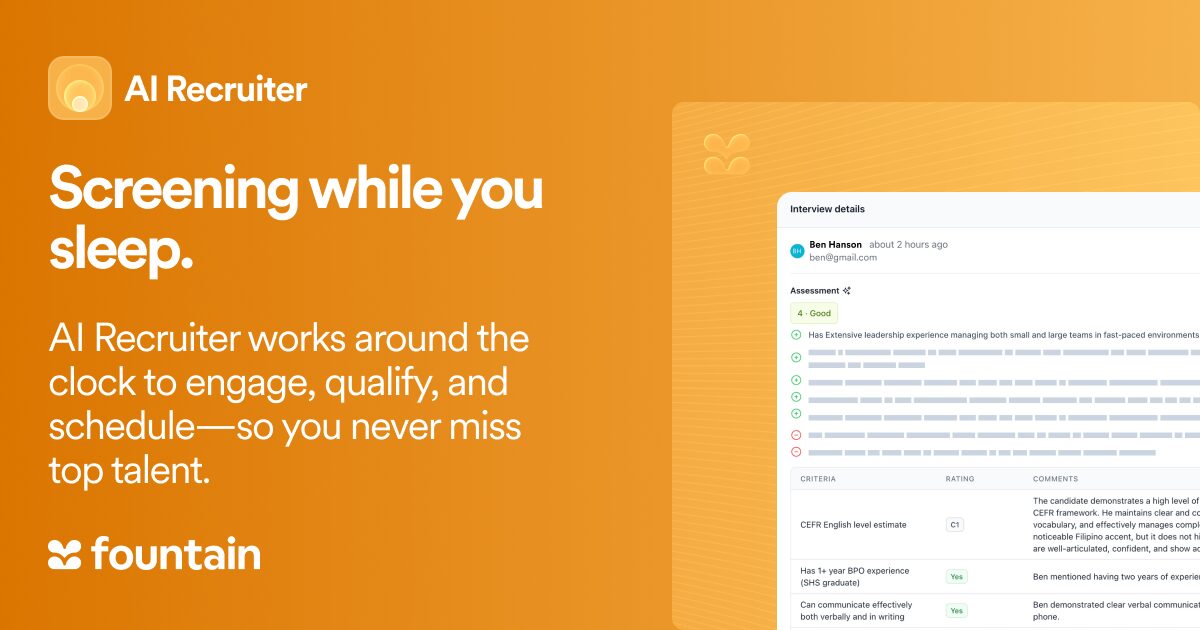
Anna, our AI recruiter, screens and evaluates candidates by voice; Emma handles candidate questions and I-9 and W-4 paperwork and helps clear completion blockers. An authorized reviewer can override any agent action, and Fountain records the override.
We bias-audit Anna’s screening across protected groups against fairness thresholds, cover GDPR and CCPA obligations including consent and data-subject requests, and log every agent action so an individual decision can be traced. Those are the same properties this article told you to demand of a vendor: human oversight, bias auditing, data privacy, explainable decisions.
And they are independently verified. Fountain holds ISO/IEC 42001 for AI governance alongside ISO/IEC 27001 and SOC 2 Type II, all reviewable in the Fountain Trust Center, which means outside auditors examine our security, privacy, and AI governance on a recurring schedule rather than once.
Certification covers how our system is built and run; you still test selection rates on your own applicant pools. That is what lets you tell a candidate exactly when AI is used and who makes the final call, and back it up. book a demo to see governed, agentic hiring on a live workflow, from voice screening through human-approved offers.
Frequently asked questions about responsible AI in hiring
What is the difference between ethical AI and responsible AI in hiring?
Ethical AI defines abstract principles such as fairness and privacy. Responsible AI turns those principles into accountable, transparent use that complies with regulations. In hiring, that means notifying candidates, testing for bias, and retaining the resulting decision records.
Can AI in hiring reduce bias, or does it just automate it faster?
Both outcomes are documented, and governance is the deciding variable. Unaudited tools trained on historical data can reproduce past discrimination, while structured, job-related screening under continuous auditing can do better. Which one a live funnel produces depends on the auditing cadence and whether reviewers can actually overturn a recommendation.
What should candidates be told when AI is used to screen them?
Candidates should be told which steps use AI, which qualifications it evaluates, which steps involve human review, where a person makes the final decision, and anything else the law requires. NYC mandates notice 10 business days before an automated tool is used, including the qualifications it will evaluate, and Illinois requires notice whenever AI touches a covered employment decision. Provided explanations improve candidates’ sense of fairness whether the decision came from an AI or a human.