The frontline talent market moves fast. Hourly workers make up roughly 60% of the U.S. workforce, yet most hiring processes weren’t built for them. The average time from application to offer is 27.5 days, and when you’re competing for candidates who need to start earning this week, that timeline is a dealbreaker. To back this up, the Fountain Frontline Report 2025 found that 57% of candidates say slow hiring is their top frustration.
That gap is where companies lose talent. In high-volume hiring, where you’re filling dozens to thousands of roles on tight deadlines, a slow process costs you the people you need most. Candidates move on, shifts go unfilled, overtime spikes, and revenue suffers.
The real issue is that strategies built for corporate hiring collapse under frontline volume. Different workforce, different speed requirements, different tools.
This article covers 10 strategies that actually work at scale, backed by data from companies hiring thousands.
What is a high volume hiring strategy?
A high volume hiring strategy is a structured approach to recruiting and hiring large numbers of workers quickly. We’re talking dozens to thousands of roles, often filled within days or weeks rather than months.
High-volume hiring (sometimes called high volume staffing) is most common in industries that depend on hourly and frontline workers. These roles have the highest turnover and the tightest time-to-fill windows. Think:
- Retail
- Logistics
- Quick-service restaurants
- Healthcare
- Hospitality
- Staffing
Traditional recruiting tactics simply don’t hold up under volume. Manual screening buries recruiters, candidates drop off, compliance gaps multiply, and every unfilled shift costs real revenue.
Retail and logistics companies, in particular, need the best high-volume hiring solutions because of seasonal surges and multi-location complexity.
Why your high volume hiring strategy matters more than ever
Frontline hiring has gotten more expensive, more competitive, and harder to get right. Per the 2025 Fountain Frontline Report, hiring costs have doubled since 2020. Additionally, 82% of employers say they struggle to hire. And replacing a single frontline worker costs between $6,500 and $7,000, roughly 40% of their annual pay.
At the same time, the penalty for slow or broken volume hiring keeps compounding. Every unfilled shift means overtime for existing staff, degraded customer experience, and revenue left on the table. Multiply that across dozens or hundreds of locations, and you’re dealing with an operations problem.
A strong high volume hiring strategy helps reduce the cost of turnover, improve candidate quality, and build a hiring engine that scales with your business instead of against it.
10 high volume hiring strategies that work at scale
The following strategies cover the full hiring funnel, from the first touchpoint through onboarding and beyond. Each one is grounded in real data and proven by companies hiring at scale. Start with the areas where your current process loses the most candidates, then build from there.
1. Shorten applications to under 5 minutes
Per Fountain’s research, 60% of applicants abandon applications that feel too long or aren’t mobile-optimized. Frontline applicants often apply between shifts or from their phones, so lengthy forms are a dealbreaker.
Strip the application down to essentials:
- Name
- Contact info
- Basic qualifications
- Availability
Move assessments, document uploads, and detailed background questions to post-application stages. You can screen candidates later, so aim to get them in the door first.
2. Design for mobile first, not mobile-friendly
Most frontline candidates apply from their phones. If your process was designed for desktop and adapted for mobile, candidates feel it because a form that “works on mobile” vs. was “built for mobile” work in fundamentally different ways.
Mobile-first means every step works on a 5-inch screen. Candidates should be able to schedule interviews with a tap, upload documents from their camera, and check their status without emailing a recruiter.
When candidates can move through the process on their own terms, from anywhere, completion rates rise.
3. Automate the repetitive work
High-volume recruiters shouldn’t spend their days sending scheduling emails and updating applicant statuses. Yet according to Fountain research, 70% of HR employees say they use three to six different apps just to complete a single task.
Start by identifying repetitive, high-frequency, low-judgment tasks taking up the most recruiter hours:
- Screening for basic qualifications
- Scheduling interviews
- Sending reminders
- Triggering background checks
- Collecting documents
Choose an automation tool like Fountain to take those tasks off recruiters’ plates. That way, they can focus on blah while your automations handle blah more accurately and efficiently.
For example, Centerfield automated their high-volume pipeline and saw an 80% decrease in manual recruiter actions and 88% fewer resumes to screen. Their recruiters didn’t lose their jobs. They shifted from pushing paper to actually talking to candidates.
4. Use AI to collapse time-to-hire
AI adoption in high-volume recruiting has nearly doubled in four years. According to Fountain’s Agentic AI research, 67% of recruiters already use AI tools, up from 35% in 2020. The results explain why.
The same research found that AI-driven screening and scheduling reduce hiring time by roughly 40%. AI scheduling alone delivers 79% faster time-to-interview. And according to the 2025 Fountain Frontline Report, 74% of frontline workers actually prefer AI-driven interviews over waiting for a human scheduler.
The key to getting value from AI is knowing where it adds leverage and where humans should stay in the loop. AI handles the high-volume pattern work: screening for qualifications, coordinating schedules across time zones, and sending follow-up messages. Humans handle judgment calls like culture fit assessments, complex edge cases, and final offers.
Fetch, a logistics company, implemented AI-powered screening and cut time-to-hire from 15 days to 6.5 hours. A 95% reduction. They simultaneously saw a 325% increase in applicant volume and 125% higher hire rate. This led to faster hires and better quality, not one or the other.
5. Build always-on talent pipelines
Starting every hiring cycle from zero is the most expensive mistake in high volume recruiting.
Build a talent pool by tagging and organizing past applicants who were qualified but not hired, former employees open to returning, and referral candidates. Segment them by role, location, and availability so when a position opens, you’re reactivating warm leads instead of starting cold.
These candidates already know your brand and your process, which means faster conversions and lower cost-per-hire.
Employee referral programs are a force multiplier here. Current employees become sourcing channels, and referred candidates are more likely to stay longer. The program doesn’t need to be complicated. A clear incentive structure and an easy submission process are enough.
6. Write job descriptions that actually convert
If your job post doesn’t state the pay range, schedule, location, and day-to-day duties upfront, qualified candidates will scroll past, and unqualified ones will apply anyway.
Frontline candidates make fast decisions. They’re scanning listings on their phone, often comparing multiple openings at once. Give them what they need to say yes:
- Clear requirements
- Realistic expectations
- A straightforward description of the role
Here’s what the difference looks like in practice.
Vague posting: “We’re looking for a motivated team player to join our fast-paced warehouse environment. Must be flexible and dependable. Competitive pay and benefits. Apply today!”
Posting that converts: “Warehouse Associate | $18.50/hr | Mon–Fri, 6am–2:30pm | Dallas, TX. You’ll pick, pack, and ship orders in a climate-controlled facility. Steel-toe boots required. No experience needed. We’ll train you. Apply in under 3 minutes from your phone.”
The second version answers every question a candidate has before they ask it. Pay, schedule, location, duties, requirements, and how long the application takes. That’s what converts.
The downstream benefit is fewer unqualified applicants, which means less time screening and faster time-to-hire.
7. Communicate fast and transparently
Speed of communication is a predictor of whether candidates accept your offer or disappear. Per the Fountain Frontline Report 2025, 52% of candidates cite ghosting or lack of updates as a top hiring frustration. And 25% of employees say turnaround time is the biggest influence, after pay, on whether they accept an offer, according to Fountain research.
The fix isn’t complicated. Automated status updates via SMS and WhatsApp keep candidates informed at every stage without adding work for recruiters. A simple “Your application is being reviewed” or “Your interview is confirmed for Thursday” costs nothing and prevents drop-off.
8. Bake compliance into the workflow
When you’re hiring at scale across multiple locations, compliance can’t be a separate checklist someone remembers to run. It has to be embedded in the process.
I-9 verification, background checks, certifications, and regional labor requirements all have strict deadlines. Section 2 of the I-9, for example, must be completed within 3 business days of hire. Miss it, and you’re looking at fines ranging from $288 to $2,861 per violation. That’s just for paperwork errors. Knowingly employing unauthorized workers can cost up to $28,619 per worker on a third offense.
The solution is to use a platform that builds compliance triggers directly into the hiring workflow. When a candidate reaches the offer stage, document collection, background checks, and verification steps should fire automatically. Fountain Onboard, for instance, automates I-9 completion, E-Verify submission, and document tracking. This prevents missed deadlines and the fines that come with them.
9. Fix onboarding before it costs you the hire
Most high volume hiring strategies end at the offer letter. But the offer is where retention starts.
You worked hard to get a candidate to say yes. But between the offer and their first shift, there’s a window where they can easily disappear because the next steps were unclear or the paperwork took too long. These are preventable losses, and they happen more often than most teams realize.
Strong onboarding closes that gap by starting ahead of time. A few things that make a real difference:
- Send digital documents for completion on their phone so paperwork is done before they arrive
- Give clear instructions on where to go, when to show up, and who to ask for
- Introduce their manager ahead of time so the new hire’s first day isn’t a room full of strangers
- Handle compliance training digitally so their first shift is about the job, not forms in a back office
The goal is simple: by the time a new hire starts, they shouldn’t feel completely lost. That feeling is what turns a hire into a retained employee. When employee onboarding is disorganized, confusing, or slow, new hires start questioning their decision before the first week is over. But when it’s smooth, they show up ready to work and far more likely to stay.
10. Measure what matters and keep optimizing
You can’t improve a high-volume hiring strategy without tracking the right data. And tracking data without acting on it is just reporting.
The metrics that matter for high volume hiring:
- Time-to-hire: days from application to start date.
- Cost-per-hire: total recruiting spend divided by hires made.
- Stage-by-stage conversion rates: where candidates advance vs. where they stall.
- Drop-off by device: mobile vs. desktop completion rates.
- Show rate: percentage of hired candidates who actually show up for day one.
- First-90-day retention: how many new hires are still working after three months.
Track these at the location level, not just company-wide. Most platforms with built-in analytics let you filter by location, role, and time period.
According to Fountain’s Agentic AI research, there’s 3x turnover variance across locations within the same company, which means your best locations are doing something your worst locations aren’t.
Funnel analytics show where candidates move forward and where they drop off at each stage of your hiring process. Review them regularly. Where are candidates dropping off? Which sourcing channels deliver hires that actually stay? Additionally, run simple experiments: A/B test job ad copy, application length, communication cadence, interview formats.
Then connect hiring metrics to business outcomes like reduced overtime, faster store openings, lower churn, and improved productivity. When you can tie hiring improvements to revenue impact, the investment in your strategy pays for itself.
How Fountain powers high volume hiring at scale
The strategies above work across any high volume hiring operation. But executing them consistently, across hundreds of locations and thousands of candidates, requires the right high-volume hiring solution.
Fountain is purpose-built for high-volume frontline hiring. Not enterprise software adapted for hourly roles. A system designed from the ground up for the speed, scale, and complexity of frontline recruiting.
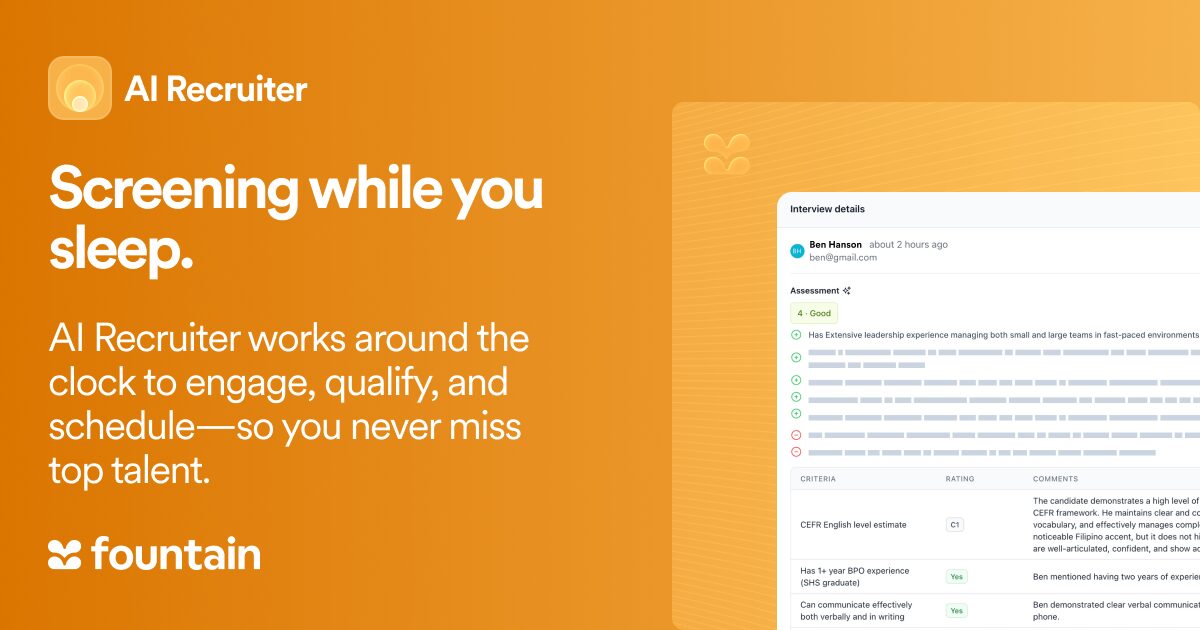
The platform covers the full funnel in one system: sourcing, screening, scheduling, offers, compliance, and onboarding. All mobile-first, all connected. AI-powered screening and scheduling through Anna, Fountain’s AI Recruiter, handles the volume work so recruiters focus on candidates, not admin.
If your current process can’t keep up with your hiring volume, book a demo to see how Fountain can help.
Frequently asked questions about high volume hiring strategy
What is high volume hiring?
High volume hiring is the process of recruiting and hiring large numbers of workers, from dozens to thousands, in compressed timelines.
It typically applies to hourly, frontline, and seasonal roles in industries like retail, logistics, QSR, healthcare, and hospitality. Unlike corporate recruiting, it demands speed, automation, and processes built for mobile-first candidates.
What are the most important high volume hiring metrics?
The key metrics are time-to-hire, cost-per-hire, application completion rate, stage-by-stage conversion rate, candidate drop-off by device, day-one show rate, and first-90-day retention. Tracking these at the location level reveals performance gaps that company-wide averages hide.
How can AI improve a high volume hiring strategy?
AI takes over the repetitive tasks that slow recruiters down: screening for basic qualifications, scheduling interviews across time zones, and sending status updates to candidates. This frees recruiters to focus on the work that actually requires human judgment, like assessing culture fit and making final offers.
The best results come from pairing AI with human decision-making, not replacing it. AI automates high-frequency tasks like screening, scheduling, and candidate communication, reducing hiring time and delivering faster time-to-interview.