Picking an ATS for high-volume hiring isn’t the same problem it was two years ago. Every platform on this list has the basics covered: workflows, integrations, mobile applications and compliance.
What separates them now is which agents do the work on top of the platform. Voice screening, candidate Q&A, scheduling and post-hire check-ins. Software is moving to the back end. Agents are moving to the front.
The nine platforms ranked below compete on whose agents actually run that work, and whether those agents coordinate across the funnel or stop at a single task.
What high-volume hiring actually demands from an ATS
High-volume hiring breaks the same way every time. Volume overwhelms recruiter capacity. Speed determines whether the candidate accepts your offer or a competitor’s. Mobile-first candidates abandon flows built for desktop.
Compliance and post-hire follow-up fall off entirely if no one designs for them. The right ATS has to solve all of this at once, not pick three of four.
- Volume: Thousands of applications a month, often per location. Manual screening collapses fast, and recruiter headcount can’t scale linearly with applicant flow.
- Speed: Frontline applicants take the first decent offer they get. Hiring measured in weeks loses to hiring measured in hours, and every step in the funnel that needs a recruiter to act is a step that costs you candidates.
- Mobile-first candidate flow: Applications happen between shifts, on phones. A flow that requires a desktop, a resume upload, or a multi-page form drops the funnel off the cliff.
- Compliance and post-hire follow-through: I-9, E-Verify, background checks, and Day 1 readiness can’t live in different systems. The same applies to the first weeks on the job, where most turnover happens.
- Agent depth: Voice screening, 24/7 candidate questions, scheduling, and post-hire check-ins now matter more than dashboard polish. The agent layer is where 2026 buying decisions actually happen.
Most platforms cover the first two well enough. The decision in 2026 sits in the last three. The tools that win are the ones that take work off recruiters’ plates without taking control out of their hands.
How we evaluated these platforms
We picked criteria that separate winners from losers in 2026, not 2020. The agentic shift is the dominant force in the category, so we lead with it.
The rest of the criteria address platform-level fit, so this remains a real ATS comparison, not a pure agent showcase.
- AI agent depth and orchestration: Named agents, what they actually do, whether they act on outcomes or just report them, and whether a coordinating layer ties multiple agents together across the funnel.
- Funnel coverage: Whether the platform spans sourcing, ATS, onboarding, and post-hire, or stops at one stage and hands off.
- Integration and compliance depth: HRIS connectors (Workday, UKG, ADP, SAP), I-9 and E-Verify automation, background checks, payroll.
- Mobile candidate experience: Whether the application is built mobile-first or adapted from a desktop flow.
- Proof at scale: Named customers operating at high volume with public outcome data.
- Vendor stability post-acquisition: Several platforms here just changed hands. Integration risk matters.
A tool had to clear most of these to land on the list. Tools that fall short on agent depth still made it if they win on platform fit for a specific use case.
Comparison table: high-volume ATS at a glance
| Platform | Best for | Funnel coverage | Named agents | Orchestration layer | Mobile candidate experience | Frontline fit |
|---|---|---|---|---|---|---|
| Fountain | Frontline employers hiring at scale across multiple locations | Sourcing, ATS, CRM, Onboarding, Shift & Scheduling, Post-hire | Anna (voice screening), Emma (24/7 candidate support), Sam (post-hire feedback) | Yes (Cue) | Mobile-first | High |
| iCIMS | Enterprise orgs with corporate + frontline hiring | ATS, CRM, career sites, onboarding | Frontline AI suite (screening, scheduling, conversational AI via Apli) | No | Enterprise-oriented | Medium |
| SmartRecruiters | SAP ecosystem enterprises | ATS, CRM, sourcing; onboarding standard | AI sourcing and screening assistants | No | Standard enterprise | Low |
| Paradox (Olivia) | Workday customers needing conversational AI | Conversational layer (screening, scheduling, Q&A) | Olivia (conversational AI) | No | SMS/chat-first | Medium (as overlay) |
| Workday Recruiting | Fortune 500 standardized on Workday HCM | ATS + HCM lifecycle; scheduling and compliance via modules | Olivia (via Paradox), HiredScore (matching) | No | Improving (via Paradox) | Low |
| Phenom | Enterprise talent teams wanting breadth | ATS, CRM, career site, internal mobility | X-Help, X-Reach, X-Sense, etc. | Emerging (Agent Center) | Standard enterprise | Medium |
| Eightfold | Skills-first workforce planning | Talent intelligence, matching; ATS-adjacent | AI Recruiter, AI Interviewer, Candidate Concierge | No | Standard | Low |
| Hireology | Franchise and multi-location businesses | Sourcing, ATS, basic onboarding | Automated prescreening; no named agents | No | Mobile app available | High |
| Workstream | QSR and hospitality operators | ATS, onboarding, payroll, scheduling | AI chatbot (OpenAI-integrated) | No | Text-to-apply, mobile-first | High |
1. Fountain
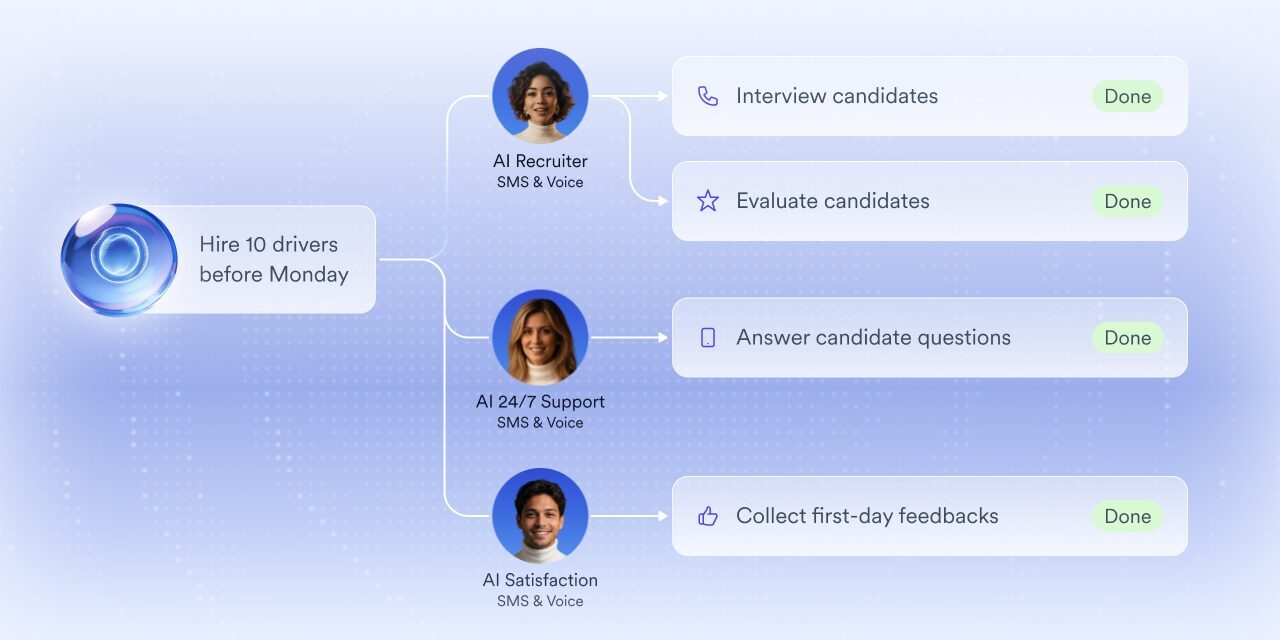
Fountain runs Frontline Superintelligence: an orchestration layer called Cue sitting above three named agents that operate on the full hiring and workforce platform. Cue is not an agent. It’s the single entry point that takes natural-language goals (like “hire 200 drivers before peak season”) and breaks them into cross-product tasks.
Under Cue, three live agents do the work. Anna handles voice and SMS interviews. Emma handles 24/7 candidate questions across SMS, voice, and chat. Sam runs post-hire check-ins to surface retention signals.
Underneath the agents sits the platform: ATS, Sourcing, CRM, Onboarding, and Shift & Scheduling, all built mobile-first for frontline workers.
Key features
Cue: the orchestration layer
- Cue is the entry point to every agent on the platform. It takes plain-English commands like “rehire our top-performing seasonal workers from last year, good standing only” and breaks them into cross-product tasks. It can set up products, operate them, and optimize them across all four agent modes (Setup, Operate, Support, Optimize).
The agents Cue orchestrates
- Anna (AI Recruiter): Voice and SMS interviews 24/7 with structured scoring. Based on Fountain’s platform data, 74% of applicants choose Anna over waiting for a scheduled call.
- Emma (AI 24/7 Support): Voice and SMS support across every funnel stage. Answers candidate questions instantly and supports Chat Apply on web, SMS, and WhatsApp.
- Sam (AI Satisfaction): Voice and SMS post-hire check-ins. Surfaces engagement and retention signals before turnover hits.
The platform the agents operate on
- ATS: Configurable workflows, automated screening, mobile-first candidate experience.
- Onboarding: Automated I-9 completion and E-Verify, OCR-based document processing, mobile document signing.
- Shift & Scheduling: AI-driven demand forecasting, real-time gap detection, mobile self-service swaps.
- CRM: Past-applicant rediscovery, automated re-engagement campaigns. Turns previous candidates into rapid hires.
- Sourcing: Multi-channel budget management, campaign tuning, predictive shortfall detection.
Best for: Frontline employers hiring at scale in logistics, retail, QSR, healthcare, and outsourced services. Especially strong fit for organizations operating across multiple locations where coordination, not just AI features, is the bottleneck.
2. iCIMS
iCIMS is an enterprise talent acquisition platform serving both corporate and frontline hiring use cases. It expanded into the frontline through the 2025 Apli acquisition, and Frontline AI launched in spring 2026.
Where it’s thin: Frontline AI launched recently, so public outcome data at a high-volume scale is limited.
Best for: Large enterprises with dedicated HR and IT staff managing both corporate and frontline hiring under one platform.
3. SmartRecruiters
SmartRecruiters is an enterprise recruiting platform acquired by SAP in 2025 and is being integrated with SAP SuccessFactors. The product covers ATS, CRM, and sourcing with an agentic AI roadmap still in development.
Where it’s thin: Less presence in the high-volume frontline category than in general TA Suites. Agentic AI is a roadmap, not shipped, and the SAP acquisition introduces pricing and integration risk that buyers should price into their evaluation.
Best for: Enterprise teams already in the SAP ecosystem where consolidation is the strategic priority.
4. Paradox (Olivia)
Paradox built Olivia, the conversational AI agent that handles candidate Q&A, screening, and interview scheduling through SMS, web chat, and messaging channels. Workday acquired Paradox on October 1, 2025.
Where it’s thin: Olivia is a conversational triage layer, not a full ATS. There’s no native onboarding, no shift coverage, no post-hire engagement.
Best for: Teams running Workday Recruiting that want a conversational AI overlay for candidate engagement.
5. Workday Recruiting
Workday Recruiting is the ATS module within Workday HCM. Most adopters land here because they already run Workday for HRIS, payroll, and workforce planning. The four-component AI hiring stack combines core recruiting with HiredScore (matching) and Paradox (conversational AI), with a conversational ATS component made available in January 2026.
Where it’s thin: Candidates must create a separate Workday account for each employer, which creates real friction in frontline applicant flows.
Best for: Large enterprises standardized on Workday for HCM where one system of record outweighs frontline-specific candidate experience.
6. Phenom
Phenom is a talent experience platform spanning candidate, employee, recruiter, and manager journeys. Phenom has rolled out AI agents embedded across CRM, ATS, and candidate experience surfaces.
Where it’s thin: Built for corporate talent experience, not frontline volume. Its agents provide breadth without a single orchestration layer to coordinate them, so each agent runs on its own surface, and the handoffs between them still sit with the recruiter.
Best for: Enterprise talent teams that want a single platform across the full talent experience and value agent count over orchestration depth.
7. Eightfold
Eightfold is a skills-first talent intelligence platform built on a profile dataset across different countries. The company is transforming from a talent intelligence platform into an agentic intelligence platform.
Where it’s thin: Eightfold operates as a talent intelligence and matching layer rather than a standalone ATS, so it typically sits alongside another hiring platform rather than replacing one. The skills-first model is built for enterprise workforce planning and internal mobility, not for frontline volume where the bottleneck is application-to-hire speed rather than skills matching.
Best for: Enterprises with skills-first hiring strategies where filling hundreds of frontline roles per week is not the primary need.
8. Hireology
Hireology is a recruiting platform for decentralized, multi-location industries. The product is built around prescreening, fast onboarding forms, and job board distribution for franchise-style operations.
Where it’s thin: Limited named-agent AI infrastructure compared to platforms with dedicated agent architectures, and no AI agent orchestration or voice screening capability.
Best for: Mid-market frontline employers in franchise models, particularly automotive and healthcare.
9. Workstream
Workstream is a hiring and HR platform aimed at QSR and hospitality operators. The product combines text-to-apply, candidate chat, and integrated payroll and scheduling, primarily for franchise operators and small-to-mid-market frontline employers.
Where it’s thin: Workstream sits in the small-to-mid-market segment, not the enterprise multi-thousand-location tier. The AI layer is a single chatbot rather than a set of named agents covering voice screening, candidate Q&A, and post-hire engagement. There’s no orchestration layer above it, and CRM and post-hire workflows aren’t core to the product.
Best for: QSR, hospitality, and small-to-mid-market frontline employers wanting a combined ATS, payroll, and scheduling platform.
How to choose the right ATS for your high-volume funnel
The split between standalone AI tools and coordinated agent architectures is the dividing line in high-volume hiring technology. The right choice comes down to a few questions about your workforce and your funnel.
- Is most of your hiring frontline, hourly, or shift-based? If yes, you need a platform built mobile-first, with text-to-apply, voice screening, and high-volume throughput as the default. Not features bolted onto an enterprise suite.
- Do you need full lifecycle coverage in one platform? Sourcing, ATS, onboarding, scheduling, and post-hire retention living in separate tools is the failure mode every frontline operator runs into eventually. A single platform that spans the lifecycle removes the handoffs.
- Is the screening funnel the bottleneck? Voice and SMS interviews 24/7 are the agent capability that moves the needle here. A screening agent that runs around the clock keeps the funnel moving while the team is offline, and most applicants prefer being interviewed now over waiting for a callback.
- Does post-hire retention matter as much as hiring speed? It should. A named agent that runs voice and SMS check-ins in the first weeks on the job catches retention risks before they cost you the rehire. Most platforms stop at the offer letter.
- Are you integrating with an existing HRIS or HCM? A frontline ATS should sit on top of Workday, UKG, SAP, or ADP, not replace them. The system of record stays where it is. The hiring layer runs on top.
Fountain is built for the answer set above: frontline-first, lifecycle coverage, agent-led screening, post-hire retention through Sam, and integration with the major HCM systems. Picking AI recruiting software for high-volume hiring is an architecture decision between a standalone agent bolted onto an ATS and a coordinated agent layer running the full lifecycle.
Once you’ve narrowed the field, the next question isn’t whose dashboard looks better. It’s whose agents do the work you don’t want recruiters doing.
Book a Fountain demo to see how Cue, Anna, Emma, and Sam handle high-volume hiring on a single platform.
Frequently asked questions about high-volume ATS software
What’s the difference between a high-volume ATS and a standard ATS?
A standard ATS manages structured workflows for corporate roles with desktop-oriented interfaces. But a high-volume ATS is purpose-built for thousands of applications per month, mobile-first candidate flows, and speed measured in hours, not weeks.
The candidate experience layer is also fundamentally different: text-first, no resume required, and built for applicants who are between shifts on a phone.
What’s the ROI of switching to an agent-led ATS?
The case sits on three numbers: speed, efficiency, and retention. Faster hiring recovers revenue from unfilled shifts. Automation cuts recruiter workload per hire.
Post-hire check-ins reduce turnover. At roughly 40 percent of annual salary per frontline replacement, even modest retention improvements compound across a large workforce.
How do AI agents handle bias and compliance?
Reputable agent platforms run bias auditing, explainability logs, and human-override protocols on sensitive workflows. Fountain’s agents, for example, are built on enterprise-grade AI infrastructure with Constitutional AI safeguards, full audit logs for every action, and bias auditing across protected groups.
Compliance frameworks (GDPR, CCPA, CPRA) and human-in-the-loop overrides are non-negotiable when evaluating any agent-led ATS.