A single shift-based role can draw hundreds or thousands of applicants, and the recruiter phone screen has long been the choke point between application and interview. Slow hiring is the top frustration frontline candidates name, cited by 57% in the 2025 Fountain Frontline Report.
For a last-mile delivery operator, a day in the queue is a day of uncovered routes, and a day the faster employer hires the person the recruiter was about to call. AI phone screening puts an automated voice agent on that first candidate call.
People still decide who gets hired: the agent handles the first-pass conversation that no team hiring at frontline volume can reach fast enough. The pressure is highest in high-volume, shift-based hiring across multiple locations.
What is AI phone screening?
AI phone screening is an automated voice conversation in which an AI agent calls or answers a job candidate, asks structured job-relevant questions, scores the spoken answers in real time, and passes a summary and score to the applicant tracking system. In its AI interviewer overview, SHRM groups these tools under AI interviewers, “conversational systems that conduct structured candidate interviews through chat, voice, or video.” The voice screen is the phone-native version, and for many high-volume employers it now replaces the recruiter phone screen as the first live touchpoint in the process.
Resume filters score documents without speaking to candidates. Chat-apply flows collect written answers over SMS or the web. Async video interviews record candidate responses for later review, while voice screens hold a live back-and-forth. The voice screen is the only method that carries a real-time spoken conversation and adapts to what the candidate says, and our candidate-screening overview maps where each method fits.
How AI voice agents screen candidates
AI voice agents screen candidates through a four-step loop: immediate outreach, a structured adaptive conversation, real-time transcription and scoring, and a scored handoff to the applicant tracking system.
In the funnel it sits between application and the human interview, so candidates apply, complete the voice screen, meet a manager, and receive an offer.
- Outreach or instant answer: The agent calls applicants within minutes of application, or picks up when a candidate calls in, at any hour and in unlimited parallel. A Saturday surge can be fully screened by Saturday night instead of becoming Monday’s backlog.
- A structured, adaptive conversation: The agent asks the questions you configured, such as availability, location, licenses, and work authorization, and adapts follow-ups to the answers. When a candidate asks about weekend requirements, it answers and moves on.
- Real-time transcription and scoring: Speech recognition converts the call to text, and the model scores answers against a rubric that should weigh the substance of the response. Ask each provider, in writing, whether its rubric excludes accent, tone, pace, and fluency.
- A scored handoff into the ATS: The transcript, score, and a short summary land on the candidate’s record, so a recruiter can review results and advance qualified candidates to interview scheduling.
Frontline candidates apply from their phones between shifts, often outside business hours, so keep the voice screen available around the clock. A shift worker who clocks out at midnight can finish one at midnight. Our hourly hiring guide covers how the screen fits the rest of a high-volume funnel.
Is AI phone screening fair, legal, and compliant?
Jurisdiction-specific employment, AI, telecom, and recording laws govern AI phone screening. The following is general information, not legal advice; ask your counsel how each rule applies to your locations.
What the state laws require
State AI hiring laws vary, but their requirements commonly include candidate notice, bias controls, nondiscrimination, and record retention.
New York City’s Local Law 144 requires an independent bias audit within the past year, public posting of the results, and candidate notice at least 10 business days before an automated employment decision tool is used; it covers video, voice, and other screening tools.
Illinois’s HB 3773, effective January 1, 2026, makes it a civil rights violation to use AI in recruitment without notifying candidates, and it specifically addresses ZIP code used as a proxy for a protected class.
Smarter, faster, and more compliant from day one
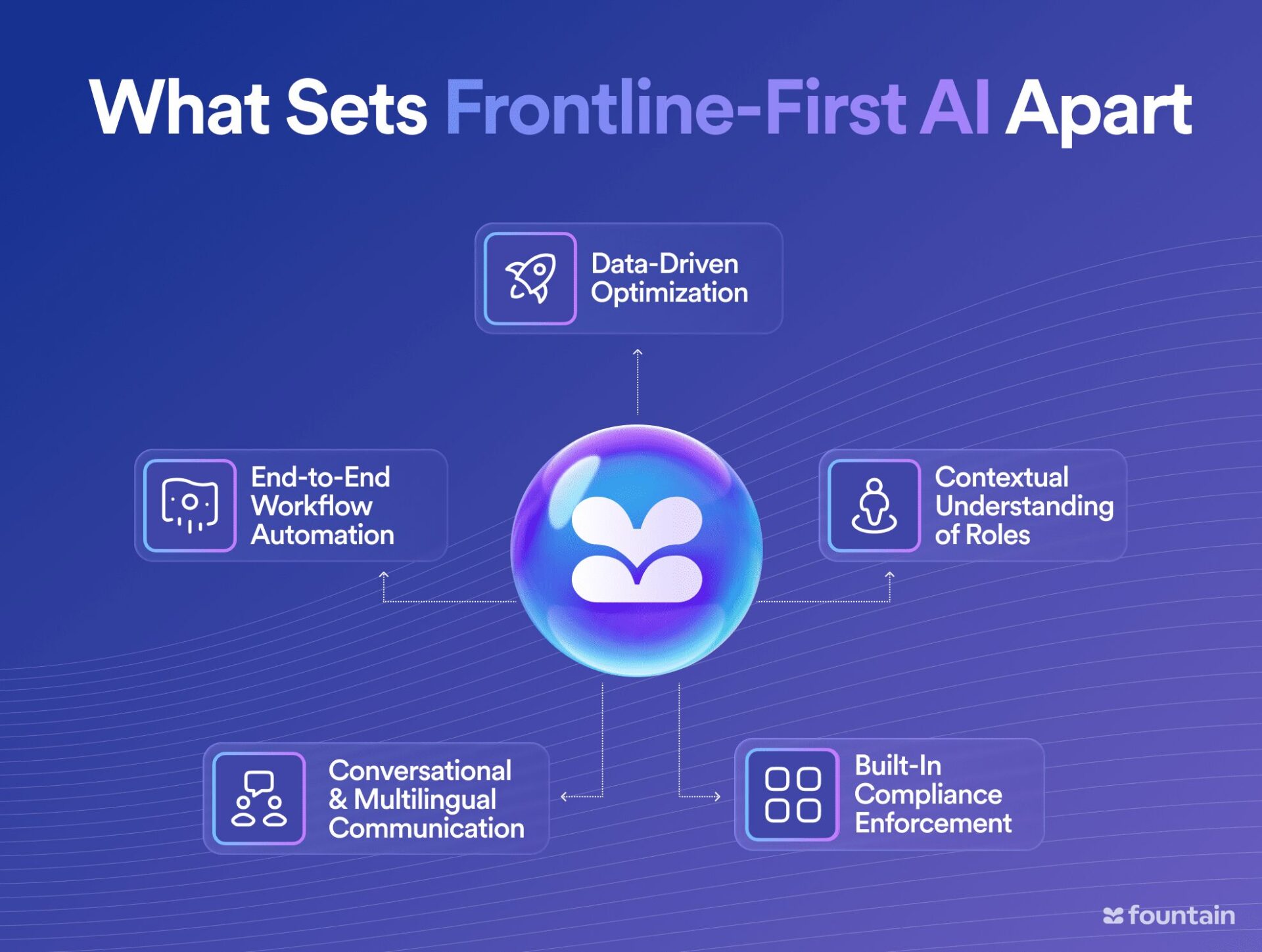
See how frontline-first AI helps you reduce time-to-hire, engage more candidates, and stay compliant at scale.
From instant chat-based screening to automated scheduling and built-in compliance, Fountain’s AI gives your team the tools to hire faster and smarter while maintaining accuracy and a great candidate experience.
Schedule a personalized demo and explore what’s possible.
California’s automated-decision system regulations, effective October 1, 2025, apply the state’s anti-discrimination law to any computational process used to support employment decisions and require four years of record retention. In these jurisdictions, employers generally calendar annual audits and advance notices, standardize AI-use notifications, and keep records available for the full retention period.
Colorado’s AI employment law takes effect January 1, 2027, and Connecticut’s SB 5 phases in through October 2026 and October 2027, with its hiring-technology notice due in 2027. Multi-state employers should map affected candidates and assign owners for notices, human-review requests, and records before those deadlines.
Employers posting in more than one state often design to the strictest applicable rule, and your counsel can confirm whether that fits your footprint. At the federal level, the Equal Employment Opportunity Commission (EEOC) removed its AI technical assistance documents in January 2025, while Title VII and the Americans with Disabilities Act (ADA) remain in force by statute.
A voice screen that filters out qualified candidates with speech or hearing disabilities is a real legal exposure. To keep scoring fair, configure the rubric to exclude accent, pace, and fluency so it scores only the substance of the answer, and give every candidate a clear way to request an alternative screening path, such as a live human screen.
Two phone-specific issues
AI phone screens raise two phone-specific compliance issues: how audio-only screening is classified under employment laws, and how calling and recording rules apply. Illinois’s AI Video Interview Act applies only to applicant-submitted videos, so audio-only screens fall under HB 3773’s broader framework instead.
A screen that transcribes speech without building a speaker-matching voiceprint also generally sits outside the voiceprint provision of Illinois’s Biometric Information Privacy Act (BIPA), though counsel should confirm.
Calling candidates raises telecom obligations of its own. The FCC’s AI-generated voice ruling confirmed in February 2024 that the Telephone Consumer Protection Act (TCPA) restrictions on artificial or prerecorded voices cover AI-generated voices.
Have counsel map recording-consent requirements for every state where candidates may take calls, based on the candidate’s physical location, and start every call with counsel-approved disclosure and consent language.
How adverse-impact testing works
You compare selection rates across race, ethnicity, and sex, and under the federal four-fifths rule, a group selected at less than 80% of the top group’s rate meets the threshold for an adverse-impact investigation.
NYC requires that analysis annually from an independent auditor, so covered employers schedule it as a recurring control rather than a one-time launch task. Employers running these programs well pair the audit with a person who reviews adverse outcomes, including samples of high-confidence rejections.
What candidates actually think about AI phone screens
Most candidates who get an actual choice pick the AI. In a field experiment that randomly assigned more than 70,000 applicants across 48 entry-level postings to human recruiters, AI voice agents, or their own pick, 78% of those given the choice took the AI voice agent. It was a decision they made with a live application on the line, not a survey opinion.
The roles were entry-level and high-volume, so U.S. frontline teams should still validate acceptance in their own funnel.
That openness is conditional, not blanket enthusiasm. Candidates are most guarded about AI on the screening step specifically, and their trust turns on whether the employer says up front that a screen is AI-run.
Comfort also rises after someone has actually completed an AI interview rather than reacting to the idea in the abstract, and when the AI is confined to the first pass with a human interview still to come.
So disclose the AI before the call, offer the screen as an explicitly labeled opt-in fast path, and keep it short with questions tied to the job. Give candidates a way to reach a person for unanswered questions and accommodation requests, and track completion and candidate feedback after launch.
The results high-volume teams see
First contact happens in minutes instead of days, at the hour the candidate is free rather than the hour a recruiter is at a desk. Set a design ceiling under 10 minutes and compare completion rates with longer calls to hold onto candidates applying between shifts.
Fountain’s Fetch customer story reports a 95% decrease in average time-to-hire (with Fountain AI), from 15 days to 6.5 hours, at a last-mile delivery platform handling 10,000 applicants a month. At that volume, screening supports same-day hiring only when scheduling and the downstream steps run on the same clock.
Retention holds up too: in the same field experiment, candidates screened by an AI voice agent showed about 17% better retention at four months than those screened by humans, with no drop in productivity, which makes four-month retention a fair ROI measure alongside time-to-hire.
On cost, an automated screen spends no recruiter time on the call itself, so the real comparison is the vendor fee against the recruiter hours recovered per completed screen, plus the review time each screen still needs.
Alto customer story shows the ceiling: 450 drivers hired in six months with a team of three recruiters, at a $300 average cost-per-hire against SHRM’s roughly $4,700 average. Measure your current recruiter minutes and cost per screen first, so the pilot has a baseline to beat.
How Fountain runs AI phone screening at frontline scale
We run AI phone screening as one piece of an integrated frontline workflow, because a faster screen only helps if the rest of the funnel keeps pace. A candidate whose screen a recruiter approves in an hour, then waits four days for an interview slot and another week for documents, is right back in the queue the fast screen was meant to clear. Scheduling and paperwork have to run on the same clock as the call.
Cue is the orchestration layer that turns a plain-language goal like “screen 200 drivers before Monday” into work across the platform, and it runs the agents that move hiring forward.
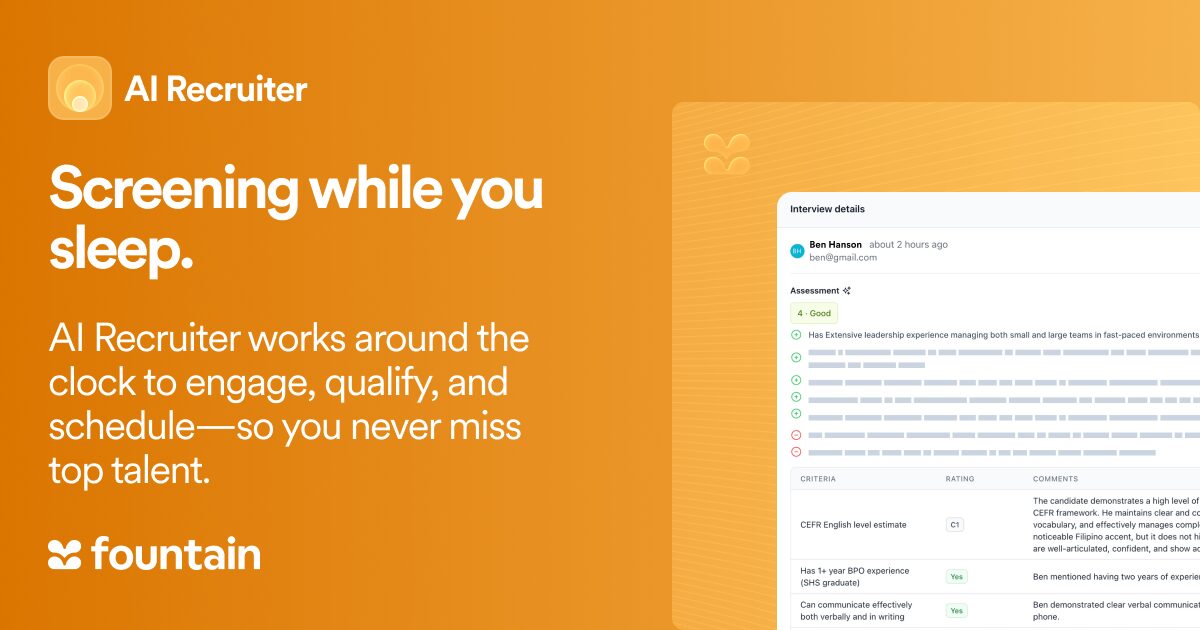
Anna, the AI Recruiter, calls candidates or answers their calls around the clock, runs the voice screen, scores answers against your criteria, and sends each scored record to recruiters in the ATS. Emma, the 24/7 support agent, answers candidate questions in the same flow, and Sam watches early retention signals after the hire.
The CRM, Onboarding, and Shift & Scheduling products keep the rest in one system, so a candidate a recruiter approves books an interview, completes documents, and lands on a schedule without switching tools. Recruiters review the scores, approve who advances, and people make every hire decision.
With the first-pass call handled and the steps behind it running on the same clock, the phone screen stops being the place a frontline funnel stalls.
See it in action: book a demo to watch the voice screen call candidates, score answers, and hand recruiters a ready-to-review shortlist inside your ATS.
Frequently asked questions about AI phone screening
How is an AI phone screen different from a recruiter phone screen?
An AI screen happens immediately, at any hour, and in unlimited parallel, so no candidate waits days for a callback. It also asks every candidate the same core rubric-scored questions, which tends to produce more consistent inputs than notes from dozens of separate recruiter calls.
Is AI phone screening legal and compliant?
Jurisdiction-specific employment, AI, telecom, and recording laws govern AI phone screening. New York City requires annual independent bias audits and advance candidate notice, Illinois requires candidate notice, and California prohibits discriminatory use and requires four years of records. Calendar recurring audits, configure jurisdiction-specific notices, and preserve records for the required period. Title VII and the ADA apply everywhere by statute, and call-recording consent and AI disclosure language are worth confirming with counsel.
Does a human still decide who gets hired?
Yes. The AI conducts and scores the first conversation, while recruiters and hiring managers review the results, approve who advances, run the interviews, and make every offer. A person also reviews adverse outcomes, including samples of high-confidence rejections.