The difference between filling a shift and losing a candidate to a competitor often comes down to hours. According to the 2025 Fountain Frontline Report, 57% of frontline candidates cite slow hiring as their top frustration. Screening is where many high-volume pipelines stall, and where automation has the greatest operational impact.
AI-powered candidate screening assesses applicants against role-specific criteria at the point of application. It surfaces scores, rankings, and next-step recommendations for recruiter review.
For frontline employers processing thousands of applications per week, it replaces the manual phone screen bottleneck with instant, structured screening that helps teams move qualified candidates forward in minutes while humans make the final call.
This article breaks down what AI screening does, where each type fits in the funnel, how to design criteria that work, and what real results look like at scale.
What is AI-powered candidate screening?
AI-powered candidate screening uses technology to evaluate job applicants against structured, role-specific criteria automatically. Instead of a recruiter manually reviewing every resume or conducting phone screens one by one, the system handles initial qualification at the point of application.
There are a few forms this takes:
- Rules-based filters check binary requirements (valid CDL, night shift availability) as pass/fail
- Machine learning models score and rank candidates based on patterns from past successful hires
- Conversational AI conducts chat or voice interviews, captures responses, and generates scores for recruiter review.
The key distinction from traditional keyword matching is that AI screening evaluates fit against structured criteria tied to the role, not just whether a resume contains the right words. A keyword matcher flags “forklift” on a resume. AI screening can confirm whether the candidate holds a current forklift certification, is available for the night shift, and lives within commuting distance of the warehouse, then present that evaluation to a recruiter for review.
For frontline employers hiring hundreds or thousands of workers per month, AI screening replaces the slowest step in the pipeline with instant evaluation that runs 24/7.
The screening problem in high-volume hiring
When you’re managing 500 open roles across 200 locations, manual screening breaks down fast. Small HR teams hit capacity as application volumes reach the tens of thousands. Resume review backlogs pile up. Phone screens compound the problem because recruiters can only conduct so many calls per day, and many go to voicemail. Meanwhile, qualification standards drift across locations as different hiring managers apply different interpretations of “qualified.”
According to Fountain’s Redefining Frontline Operations white paper, 70% of HR employees use three to six apps just to complete a single task. That fragmentation slows every step. And per the same research, 60% of applicants abandon applications that feel too long or aren’t mobile-optimized. Every day a candidate waits is a day they accept another offer.
The cost shows up in unfilled shifts, overtime spending, and lost revenue. In frontline hiring, the employer who responds fastest usually wins.
Types of screening AI and where each fits
Most AI-powered candidate screening systems use one of four approaches. Each maps to a different point in the frontline hiring funnel, and in practice, teams combine them to cover the full pipeline.
1. Rules-based filters
Rules-based filters apply binary, if/then logic immediately after application. Must be available for night shifts? Yes or no. Hold a valid CDL? Yes or no.
These filters are fast and transparent, making them a strong fit for hard requirements like certifications, location proximity, minimum age, and shift availability. The limitation is that they can’t handle nuance. A candidate available for four of five required shifts might get the same rejection as someone available for zero.
Best for: Pass/fail qualification checks at the very top of the funnel.
2. Machine learning scoring models
ML scoring models rank candidates based on patterns from past successful hires. They assess work history, tenure patterns, and skills against profiles of employees who performed well in the role.
ML models adapt better than rules-based filters because they weigh multiple signals at once. But they require sufficient training data and ongoing monitoring. When trained on historically biased hiring decisions, they replicate those biases at scale.
That’s a reminder to build regular auditing into any ML-based screening program.
Best for: Ranking and prioritization in the middle of the funnel, where you need to sort a large qualified pool by likely fit.
3. Conversational screening
Conversational screening conducts AI chat or voice interviews that ask questions, capture responses, and generate scores in real time for recruiter review.
For high-volume frontline roles where phone screens are the bottleneck, this category delivers the biggest time savings. Per Fountain’s Agentic AI research, AI-driven screening and scheduling reduce hiring time by about 40%, and 74% of frontline workers prefer AI-driven interviews to waiting for a scheduled call.
Best for: Replacing the manual phone screen at scale while keeping human review in the loop.
4. Resume and application parsing
Resume and application parsers extract structured data from unstructured documents. They pull certifications, job titles, employment dates, and skills into standardized fields that other screening layers can evaluate.
Parsing on its own doesn’t make screening decisions. It feeds the other three types. Without it, rules-based filters and ML models are limited to whatever fields the candidate filled in on the application form. With it, the system can evaluate the full picture of what a candidate submitted.
Best for: Structuring incoming applicant data so the other screening layers have more to work with.
In practice, the strongest screening setups layer all four. Parsing structures the data. Rules-based filters remove candidates who don’t meet hard requirements. ML models rank the remaining pool.
Conversational screening replaces the phone screen for the top candidates. Each layer handles a different job, and together they compress what used to take days into minutes.
How to design screening criteria that actually work
Effective screening criteria begin with the role, not the resume. The question isn’t “what does the ideal candidate look like on paper?” It’s “what does someone need to succeed in week one?” Corporate screening criteria like degree requirements and years-of-experience thresholds shrink your qualified pool without improving frontline hiring outcomes.
Here’s how to build criteria that produce a useful shortlist instead of filtering out viable candidates:
- Start with the role’s day-one requirements: For a warehouse associate, that means availability for the posted shift, ability to lift 50 pounds, and proximity to the facility. For a delivery driver, it’s a valid license, a clean driving record, and availability during peak windows. If a requirement doesn’t predict on-the-job success, cut it.
- Classify each requirement as pass/fail or ranking: Some criteria are binary. Does the candidate hold a current forklift cert? Others work better as ranked signals: availability flexibility across multiple shifts, relevance of prior experience, or commute distance. Not everything belongs in the knockout bucket.
- Balance must-haves against nice-to-haves: Too many must-haves dry up the pipeline. And too few overwhelms hiring managers with unqualified volume. Start tight, then loosen pass/fail criteria one at a time if your qualified pool is too small.
- Test criteria against a recent applicant batch: Pull a sample of recent applicants and run your revised criteria against them. Does the qualified pool match the candidates who actually succeeded in the role? If not, adjust.
- Review and update regularly: Roles change, markets shift, and criteria that worked last quarter may screen out good candidates today. Build a quarterly review cadence.
Here’s what well-designed criteria produce at scale. Centerfield used knockout questions specific to each workflow and processed 23,000 applicants down to 2,600 qualifying candidates. That’s an 88% reduction in resumes requiring human review.
Their recruiters stopped drowning in volume and started spending time on candidates who could actually do the job.
Benefits frontline employers see from AI-powered screening
AI-powered candidate screening changes three things for high-volume hiring teams: how fast candidates move, how much recruiter time gets freed up, and how consistently the pipeline produces quality hires. Here’s where the impact shows up.
1. Speed to interview
The phone screen is one of the biggest bottlenecks in most frontline hiring pipelines. Recruiters can only make so many calls per day, candidates don’t pick up, and every hour of delay is an hour where that candidate is fielding offers from someone faster. AI-powered screening compresses this step from days to minutes.
Fetch, a last-mile delivery platform managing 10,000 monthly applicants with a three-person recruiting team, hit this wall hard. Their previous process took 15 days from application to hire. After implementing AI screening with Fountain, the time dropped to 6.5 hours. A 95% reduction.
The same three recruiters now operate at a 10,000:1 applicant-to-recruiter ratio because the screening layer handles qualification before a human ever touches the application.
2. Recruiter capacity
Most frontline HR teams are small relative to the volume they handle. When every applicant requires a manual review or phone screen, recruiters spend their days on qualification instead of relationship-building, complex decisions, and the work that actually requires human judgment.
AI-powered screening shifts that ratio. Liveops, a virtual contact center processing hundreds of thousands of applicants per year, reached a 44,000:1 applicant-to-recruiter ratio with Fountain.
They hit a 100% fill rate (up from 90%) and a 48% decrease in time-to-fill. That happened because their recruiters stopped spending time on initial qualification and started spending it on the candidates who were already screened and ready.
3. Candidate experience and match quality
Structured screening criteria produce more consistent results than ad hoc resume scanning. Every candidate gets evaluated against the same standards, which means qualification doesn’t drift across locations or shift depending on which recruiter happens to review the application.
That consistency also improves the candidate’s experience. Per Fountain’s Agentic AI research, 74% of candidates at Marsden Services chose an AI interview over waiting for a human interviewer. Candidates don’t want to wait three days for a phone screen. They want to know where they stand.
When a candidate applies at 10 p.m. on a Tuesday and gets screened, scored, and scheduled for an interview before morning, that’s a fundamentally different experience than hearing nothing for a week.
Edge cases matter here, too. When a candidate is borderline (available for four of five required shifts, or holds an expired certification that’s easily renewed), strong screening systems flag them for human review rather than auto-reject. That protects candidate experience and legal defensibility at the same time.
These three gains compound. Faster screening feeds faster hiring, which feeds better retention and lower cost-per-hire across every location. The employers who screen in minutes instead of days fill their shifts first.
Implementation steps for high-volume teams
The fastest way to fail with AI-powered screening is to roll it out everywhere at once. Teams that start with a single high-volume role, measure what matters, and expand based on data get to scale faster than teams that try to boil the ocean on day one. Here’s the rollout sequence that works.
- Pick the right pilot role: Choose a role with high application volume, clear qualification criteria, and measurable drop-off at the screening stage. Warehouse associate, delivery driver, or QSR crew member are strong candidates. Roles that require significant judgment-based evaluation warrant a more cautious, hybrid approach.
- Define success metrics before launch: What does “better screening” mean for your operation? Faster time-to-interview? Higher show rates? Fewer unqualified candidates reaching managers? Define targets in advance. If your current time-to-interview is 5 days, set a goal (under 24 hours, for example) and track it weekly. Results measured against real objectives are useful. Results inferred after the fact aren’t.
- Build screening logic and test against historical data: Screening criteria should derive from what actually predicts success in the role. For a warehouse associate, that means shift availability, physical requirements, and proximity to the facility, not degree requirements imported from corporate templates. Before going live, test your criteria against a recent batch of applicants. Does the qualified pool match the candidates who actually succeeded in the role? If not, adjust before launch.
- Roll out to one location first: Start with a single location or region. This limits blast radius if criteria need tuning, gives you a clean data set to evaluate against, and builds internal confidence before you scale.
- Monitor weekly in the first month: Track pass rates, drop-off at each stage, time-to-next-step, diversity metrics across screened populations, and candidate feedback. If your pass rate is below 5%, your must-have list is probably too restrictive. If hiring managers are rejecting 50%+ of screened candidates, your criteria aren’t predictive enough. Adjust based on what the data shows. A monitoring cadence that doesn’t lead to action is a compliance exercise, not an optimization program.
Most teams that follow this sequence have screening running across multiple roles and locations within 60 to 90 days. The key is starting narrow, proving the model works, and expanding with data behind you.
What AI screening looks like inside a frontline hiring system
The end state is screening built into the workflow, not bolted on. Candidates are evaluated at the point of application and automatically routed to the next step without manual handoff, with recruiters and hiring managers still able to review progression and make the final call.
Multilingual capability, real-time scoring against role criteria, and automatic routing to next steps are standard requirements for any system handling frontline screening at scale. The system should flex during seasonal surges without requiring additional recruiter headcount, and it should produce audit-ready records of every screening decision for compliance purposes.
Screening can’t live in isolation. It needs to connect to scheduling, onboarding, and workforce management so qualified candidates move through the entire pipeline without stalling.
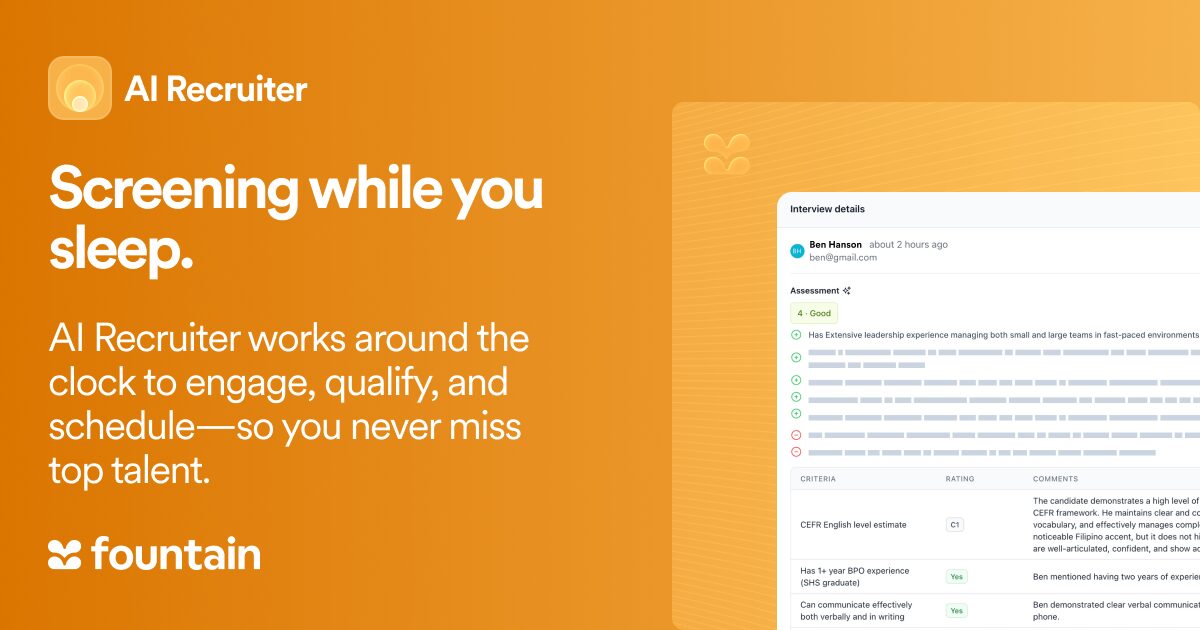
This is how Fountain operationalizes it. Anna, the AI Recruiter, conducts screening interviews, evaluates responses against role-specific criteria, and pushes decision-ready summaries to recruiters for review and advancement.
Cue, the Fountain Copilot, coordinates the workflow across all stages, from screening through onboarding and shift scheduling. This way, the system runs itself while your team focuses on the decisions that matter.
Book a demo to put Fountain’s AI-powered candidate screening to work. Screen, schedule, and advance candidates while your team focuses on the decisions that matter.
Frequently asked questions about AI-powered candidate screening
What is AI-powered candidate screening?
AI-powered candidate screening uses technology to assess applicants against role-specific criteria automatically at the point of application. It produces scores, rankings, or next-step recommendations for recruiter review, operating 24/7 to handle high applicant volumes.
Unlike keyword matching, ittions before r evaluates structured criteria tied to the role, including certifications, shift availability, and location proximity.
Is AI screening biased? How do you ensure fairness?
AI screening can embed bias when trained on historically biased hiring data. Best practices include testing for adverse impact across protected groups before deployment using the four-fifths rule, conducting regular bias audits, monitoring selection rates by demographic group on an ongoing basis, and maintaining human override authority at key decision points. Compliance responsibility rests with the employer, not the vendor.
Can AI screening handle frontline-specific requirements like shift availability and certifications?
Yes. Rules-based screening filters handle binary requirements (valid CDL, night shift availability, food handler’s permit) as pass/fail qualifiers at the top of the funnel. Scored criteria can rank candidates on factors like availability, flexibility across multiple shifts or proximity to the work location.
Conversational AI screening can also verify these requirements through interview questions and assess context that binary filters miss.