When a warehouse shift goes unfilled, the damage is immediate. The crew that showed up absorbs overtime. Shipments slip. Your best people burn out a little faster. And in an industry where turnover already outpaces most of the private sector, every slow hire makes the next one harder.
The core problem is speed. It takes an average of 27.5 days to move a candidate from application to offer in the U.S, per Fountain’s Redefining Frontline Operations white paper. Warehouse candidates don’t wait that long. They apply from their phones between shifts, weigh two or three offers at once, and accept whoever moves first.
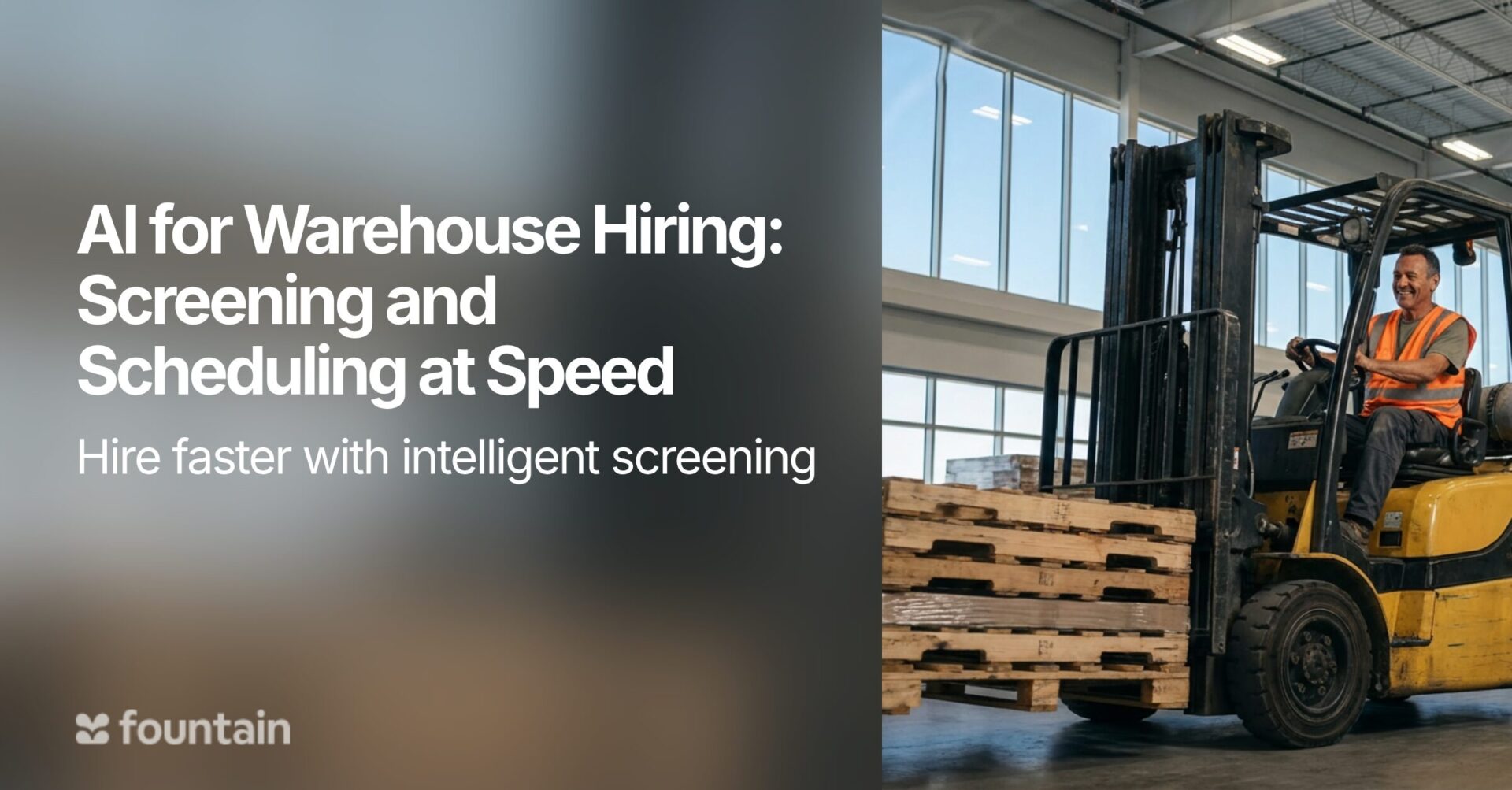
AI for warehouse hiring fixes the timing mismatch. It automates screening, scheduling, and candidate communication so your team can fill roles in days instead of weeks, while keeping final hiring decisions where they belong: with your managers.
This article covers what AI for warehouse hiring actually is, where it creates the most impact, how screening and scheduling automation work in practice, and what benefits ops leaders can expect.
What is AI for warehouse hiring
AI for warehouse hiring is the use of artificial intelligence tools to automate the high-volume, time-sensitive stages of recruiting warehouse workers. It does not replace recruiters or hiring managers.
Rather, it handles the repetitive, high-frequency coordination that bogs down warehouse hiring at scale, so your team spends time on judgment calls, safety decisions, and retention instead of chasing scheduling confirmations.
In practice, AI for warehouse hiring covers three core functions:
- Automated screening: Candidates answer qualification questions (forklift cert? available for second shift? within 30 minutes of this distribution center?) and get a pass/fail result in minutes, not days. Hiring teams review qualified candidates and decide who advances.
- Automated scheduling: Interview and orientation slots are offered based on manager availability and shift needs. Candidates pick a time from their phone. Confirmations and reminders go out automatically.
- Proactive communication: SMS and WhatsApp messages at known drop-off points (post-application silence, pre-interview gaps, offer-to-onboarding limbo) keep candidates informed and moving forward.
Agentic AI tools handle these functions across the full hiring workflow, from application intake through onboarding.
Benefits of AI for warehouse hiring
When AI handles screening, scheduling, and candidate communication, warehouse operations see improvements across the full hiring funnel:
- Faster time-to-hire: AI compresses hiring from weeks to days, or hours during peak season. Screening that used to take recruiters days happens in minutes. Scheduling that required back-and-forth emails happens in one text message.
- Higher day-one show rates: Automated reminders, clear instructions, and proactive communication at every stage keep candidates engaged through their first shift instead of ghosting after the offer.
- Lower overtime costs: Filling roles before overtime becomes the default breaks the cycle where understaffing drives overtime, which drives burnout, which drives more turnover.
- Reduced cost per hire: Recruiters spend less time per candidate on manual screening and scheduling. Fewer bad-fit hires means less re-hiring. Replacing a single frontline worker costs roughly $7,000, as seen in the 2025 Fountain Frontline Report.
- Faster onboarding: Compliance documents, training modules, and day-one logistics get pushed to candidates before they start, so new hires arrive floor-ready.
- Better candidate experience: 74% of frontline workers prefer AI-driven interviews over waiting for a scheduled call, per the 2025 Fountain Frontline Report. A faster process is a recruiting advantage, not just an operational one.
The sections below walk through how to set this up.
How to automate screening and scheduling for warehouse candidates
Screening and scheduling are the two biggest bottlenecks in warehouse hiring. Screening is where you lose the most candidates. Scheduling delays lose the ones who made it through.
A candidate who applies on Monday and doesn’t hear back until Thursday will probably accept an offer somewhere else. Here’s how to fix both.
1. Map your screening criteria
Start with your highest-volume roles. What “qualified” means for a warehouse position is concrete: shift availability, location proximity, start-date readiness, required certifications (forklift, hazmat, food safety), and physical requirements. For most distribution centers, it comes down to five or six binary questions.
These become your screening gates. A candidate either meets the criteria or doesn’t. There’s no subjective judgment required, which is exactly why AI handles this well.
2. Configure automated screening at application intake
Set up your AI screening tool to ask those qualification questions the moment a candidate applies. Candidates who meet all criteria get routed to the hiring team immediately. Results land in minutes, not days.
Don’t auto-reject candidates who miss one criterion but qualify elsewhere. A picker applicant who can’t work nights but qualifies for the day shift at a nearby facility is still a good hire. Build routing logic that surfaces these candidates for review instead of discarding them. Also, make your criteria adjustable. During peak season, loosen experience requirements while tightening on availability and start date. But during steady-state, shift toward retention indicators like commute distance and shift preference alignment. Your screening tool should support these changes without requiring a recruiter to rebuild the workflow.
Centerfield ran this approach and saw an 80% decrease in manual recruiter actions and 88% fewer resumes to screen. Their system processed 23,000 applicants and surfaced only 2,600 qualified candidates for recruiter review.
3. Set up automated interview scheduling
Once a candidate clears screening, the next step needs to happen immediately. Automated scheduling tools sync with manager calendars and offer available interview or orientation slots via SMS or a web link.
Candidates pick a time from their phone, managers get notified, and the interview is booked without anyone playing phone tag.
4. Build a reminder sequence to reduce no-shows
A single confirmation isn’t enough. Build a sequence:
- Day-before confirmation via SMS
- Morning-of reminder
- An easy reschedule link if something comes up
Include clear logistics (where to park, which entrance, who to ask for) so candidates don’t bail over uncertainty.
Stitch Fix deployed automated applicant routing and post-event communication at its national fulfillment centers. The result? Applicant conversion (the percentage who pass background checks and show up on day one) rose from 68% to 95%.
5. Close the gap between the offer and the first shift
The gap between “you’re hired” and “here’s when you start” is where post-offer ghosting lives. Extend the same automation to shift assignment and first-week scheduling.
Push day-one details (shift time, location, dress code, who to report to) via text message so new hires know exactly what to expect. A mailed packet doesn’t cut it for candidates who accepted the job from their phone.
6. Build compliance checks into the workflow
Don’t wait until onboarding to discover a candidate is missing a forklift cert or hasn’t completed hazmat training. Build compliance into screening and offer acceptance so gaps surface early, not after someone has already started.
At the screening stage, add certification and eligibility checks to your qualification gates. Forklift certification, hazmat credentials, food safety training, and age verification (federal law generally bans workers under 18 from operating forklifts) should filter candidates before they reach the interview stage.
Upon offer acceptance, trigger document collection and I-9 verification automatically. I-9 Section 2 must be completed within 3 business days of hire, per Fountain’s I-9 Audit Guide, and paperwork violations carry fines of $288 to $2,861 per violation.
Automating this on offer acceptance compresses the timeline instead of leaving it to a manager already covering two shifts.
Throughout the process, log every screening decision, certification check, and training assignment. When auditors arrive, you need documentation that holds up without scrambling to reconstruct what happened.
How to roll out AI in warehouse hiring
Start narrow. One distribution center, one role type: pickers for peak season, forklift operators at a high-turnover site. Define success metrics before launch: time-to-hire, day-one show rates, screening accuracy, and manager satisfaction.
Step 1: Audit your current funnel
Map where candidates drop off today. Is it between the application and screening? Between interview and offer? Between offer and Day 1? Your AI rollout should target the biggest leak first.
Step 2: Align site managers early
Managers need to understand what changes for them. The answer should be simple: less time on hiring admin, more time on operations. AI handles screening, scheduling, and candidate communication. Managers review candidates and make final decisions.
Step 3: Configure screening criteria for your pilot roles
Build the five or six qualification gates (shift availability, location, certifications, start date, physical requirements) and set up automated routing for candidates who qualify for adjacent roles.
Step 4: Launch with automated scheduling and a reminder sequence
Connect your scheduling tool to manager calendars so candidates can self-select interview or orientation slots via SMS or a web link. Then set up the reminder sequence, as covered earlier.
This is where most no-shows get prevented. If candidates know exactly what to expect and have an easy way to reschedule, they show up.
Step 5: Measure and expand
The metrics that matter to operations leadership are on-time shift fills, reduced overtime hours, and compliance completion rates before onboarding. Once screening and scheduling are proven at one site, roll out across the network.
Layer in demand forecasting to match hiring velocity to shipment volume, seasonal ramps, and attrition patterns.
How Fountain connects screening, scheduling, and onboarding for warehouse teams
The warehouse hiring flow from application through onboarding runs fastest when every stage connects without manual handoffs. A purpose-built frontline hiring platform should screen candidates against role-specific criteria in minutes, auto-schedule interviews without recruiter intervention, push compliance documentation on time, and keep candidates engaged with proactive communication at every drop-off point.
Fountain was built for the global frontline workforce. Each stage connects, so candidates move from application to onboarding without stalling.
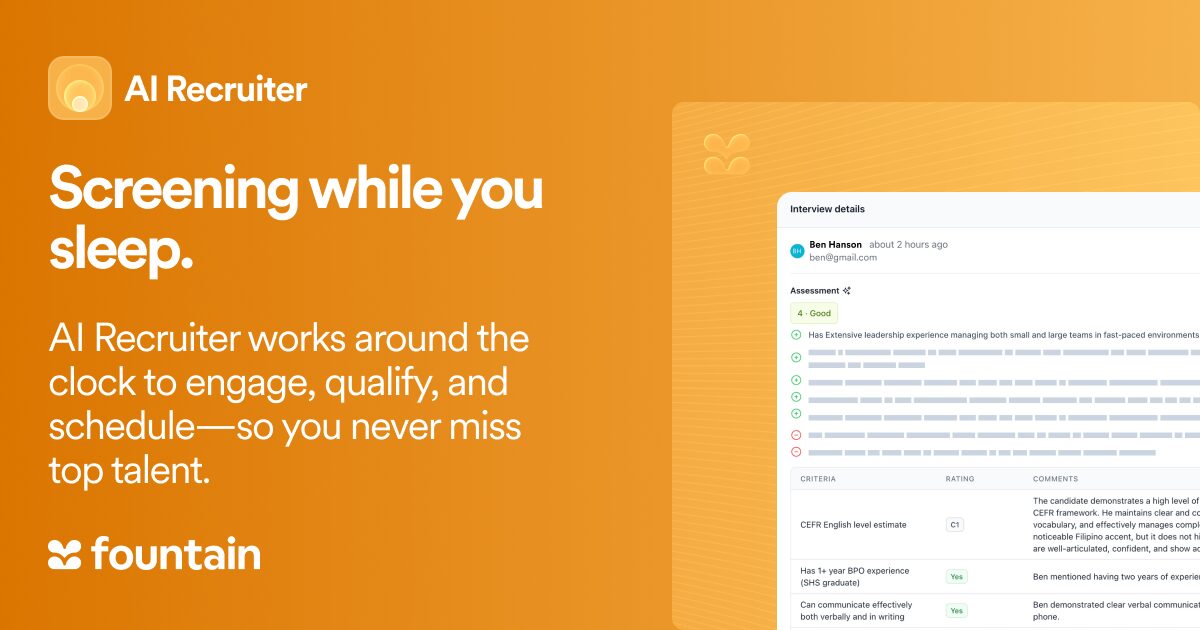
Anna, Fountain’s AI Recruiter, conducts voice interviews around the clock. She captures warehouse-specific qualification details (shift availability, certifications, location proximity) and surfaces qualified applicants for manager review.
Fountain’s Onboarding product handles document collection, I-9 verification, E-Verify submission, compliance tracking, and day-one readiness. For warehouse operations, this means new hires arrive floor-ready rather than sitting through paperwork while orders pile up.
Cue, Fountain’s Copilot, helps warehouse ops teams configure hiring workflows, adjust screening criteria for peak season, and diagnose funnel bottlenecks from natural-language prompts.
If your team is still managing this manually, book a demo to see how Fountain fills warehouse shifts at the speed your operation demands.
Frequently asked questions about AI for warehouse hiring
How does AI help with warehouse hiring?
AI automates the highest-volume, most time-sensitive stages of warehouse hiring. It screens candidates against role-specific criteria (shift availability, certifications, location), schedules interviews without back-and-forth, and sends timely communication at known drop-off points.
Can AI screen warehouse candidates for certifications and shift availability?
Yes. AI screening captures binary qualification signals (forklift certification, hazmat credentials, age verification, shift preferences, start-date availability) through structured questions or conversational flows and returns results within minutes.
Candidates who qualify for a different shift or location get routed for hiring-team review rather than being rejected.
What results should warehouse operations expect from AI hiring tools?
Faster time-to-hire, higher day-one show rates, lower overtime costs from consistent staffing, and reduced cost per hire from less manual recruiter work. The operational outcome is fewer unfilled shifts, fewer delayed shipments, and on-time orders.