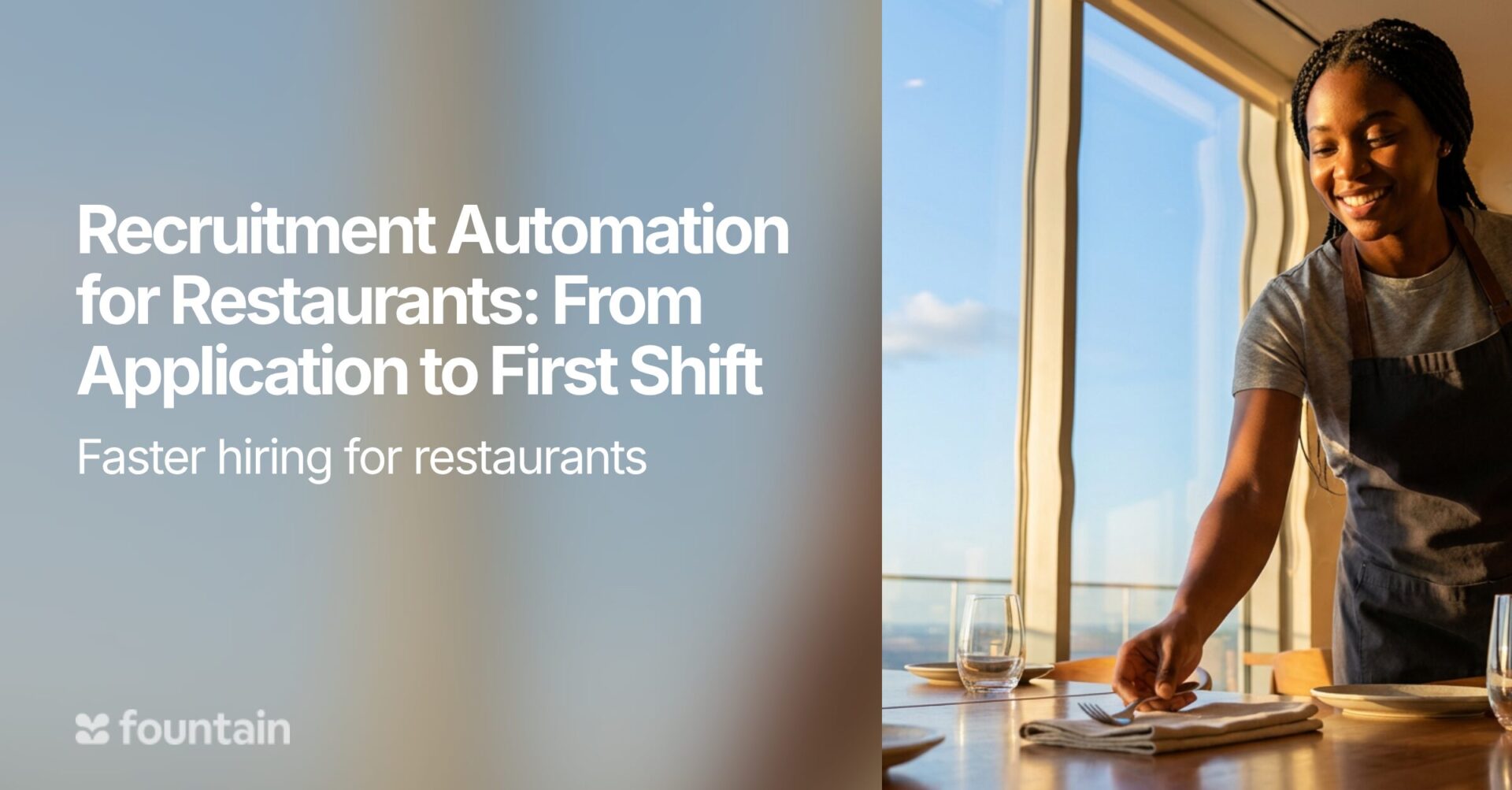
Recruitment automation for restaurants replaces the manual steps between a candidate tapping “apply” and walking through the door for their first shift. For multi-location restaurant groups running on spreadsheets, text threads, and overworked general managers (GMs), automation closes the gap between a fully staffed dinner rush and a short-handed scramble that costs revenue every hour.
The average frontline position takes 27.5 days from application to offer, according to Fountain’s Redefining Frontline Operations research. Every one of those days means overtime for remaining staff, degraded guest experience, and lost sales.
Restaurants that compress the apply-to-first-shift timeline from weeks to days fill roles before competitors even schedule an interview.
What is restaurant recruitment automation?
Restaurant recruitment automation is the use of technology to move restaurant candidates from application to first shift with minimal manual intervention. Instead of a GM toggling between job boards, text threads, and spreadsheets between service peaks, automated workflows handle screening, scheduling, messaging, document collection, and onboarding. These workflows are triggered by candidate actions rather than recruiter availability.
Here’s what that looks like in practice: a candidate scans a QR code on their lunch break, completes a mobile application in under three minutes, gets screened against role requirements, self-schedules an interview, and receives onboarding documents. All before the GM finishes the dinner rush.
That speed matters because most frontline candidates apply via mobile, often outside business hours. In addition, per Fountain’s Redefining Frontline Operations research, 60% of applicants abandon applications that feel too long or aren’t mobile-optimized.
An automated hiring workflow built for restaurants must be mobile-first, SMS-driven, and fast enough that a candidate who texts a keyword from a QR code can complete an application before their break ends.
Why restaurant recruiting can’t scale on manual processes
A GM running a kitchen during lunch rush isn’t reviewing applications. They’re expediting tickets, covering a no-show’s station, and managing a line out the door. Yet in most restaurant groups, the GM is the hiring manager. Recruiting is something they do between service peaks, if they get to it at all.
The math makes manual hiring hard to sustain. As specified by the 2025 Fountain Frontline Report, 82% of employers struggle to hire frontline workers. Meanwhile, Fountain’s Redefining Frontline Operations research shows 70% of HR employees use three to six different apps just to complete a single task.
For a restaurant group with 100 locations, each processing dozens of new hires per month, that fragmentation multiplies into thousands of hours lost to toggling between systems, re-entering data, and chasing candidates who already accepted an offer somewhere else.
Where manual processes break
Manual processes break under compounding pressure:
- Structural churn: The hiring pipeline never stops. QSR crews turn over more than once per year, which means your restaurant is constantly backfilling roles that were just filled last quarter. Manual processes can’t keep pace with that cycle.
- Unpredictable demand: Seasonal surges, new location openings, and sudden departures create hiring spikes that a GM with a phone and a spreadsheet can’t absorb.
- Multi-location complexity: Each location has different staffing needs, different labor laws and different peak hours. A centralized HR team can’t manually coordinate hiring across 50 or 500 stores without something falling through.
In restaurant hiring, the competitive window is measured in hours, not weeks. Candidates apply to multiple roles from their phones and typically accept the job that makes the fastest offer.
A long average time-to-hire loses candidates to every competitor with a faster process.
How to automate the restaurant hiring funnel
Each stage of the hiring funnel is a point where candidates either move forward or disappear. Here’s how to automate each step, from the moment someone sees your job posting to the moment they sit down for an interview.
Step 1: Open multiple application entry points
A careers page alone isn’t enough. You need several entry points feeding into a single system so candidates can apply however is easiest for them. QR codes on in-store signage, text-to-apply shortcodes, mobile-optimized career pages, and job board integrations all work simultaneously.
Some restaurant operators put QR codes on cups, napkins, and receipts paired with a text-to-apply feature that lets candidates search positions by ZIP code.
Don’t overlook your company careers page. Candidates who seek out your brand are already more interested than passive job board scrollers, which typically means higher-quality applicants.
Step 2: Screen candidates automatically at submission
Configure automated screening to filter for availability, proximity to the location, and role type as soon as an application arrives. Knockout questions disqualify candidates who don’t meet minimum requirements without a recruiter lifting a finger.
The goal is to accelerate human review, not replace human judgment. For restaurant roles, screen for shift availability and transportation access first. These are the top reasons new hires don’t work out. Reliability, coachability, pace tolerance, and situational judgment predict performance better than resume characteristics.
Step 3: Automate interview scheduling with reminders
Set up automated scheduling with calendar sync so candidates can self-book. When a candidate clears screening, they receive a link to self-schedule an interview within the GM’s availabe windows, followed by SMS reminders.
Aim for 24 to 48 hours from initial engagement to scheduled interview. Anything longer, and the candidate has often already confirmed a start date somewhere else.
The biggest interview killer in restaurants is phone tag. The GM is on the line during lunch, the candidate is working their current job during dinner, and neither connects. Self-scheduling removes the back-and-forth entirely. The candidate picks a slot that works, the GM gets a notification, and the interview happens without a single call to coordinate it.
Step 4: Send offer and collect documents before the first shift
Once the GM makes a hiring decision, the offer should go out immediately via SMS or the candidate portal. Don’t wait for someone at headquarters to draft a letter. Use pre-built offer templates by role and location so the candidate gets a confirmation within minutes of the interview ending.
Pair the offer with automated document collection. Tax forms, direct deposit setup, food handler certification instructions, and policy acknowledgments can all go to the candidate’s phone the moment they accept.
When a new hire walks in on their first day already paperwork-complete, they start training instead of sitting in the back office filling out forms. That first impression matters. It’s the difference between a new hire who feels ready and one who’s already wondering if this was the right call.
Keeping new hires engaged between offer and first shift
The period between offer acceptance and the first shift is where restaurant groups sometimes lose new hires they have already invested in. Candidates who accept offers may still be interviewing elsewhere, and many take the first confirmed start date that arrives.
As seen in the 2025 Fountain Frontline Report, 43% of new hires leave within 90 days. The window between offer and first shift is an early test of whether a new hire will stay, and many restaurants still handle it with silence.
Automated pre-boarding in practice
Automated pre-boarding closes the silence gap with three actions:
- Immediate confirmation messaging: The moment a candidate accepts, they receive directions to the location, uniform requirements, parking instructions, and the name of the manager who will greet them. No waiting for a GM to find 10 minutes between rushes to send a text.
- Milestone check-ins: Automated messages at day 1, day 10, and day 30 maintain connection during the highest-attrition window. New hires who hear nothing between offer and first shift start wondering if they made the right choice. Consistent check-ins answer that question before a competitor does.
- Manager introductions before the first shift: An automated text or short video from the GM introducing themselves, explaining what the first day looks like, and telling the new hire who to ask for when they walk in. This turns an anonymous start into a personal one, and it costs the GM two minutes to record once and use for every new hire.
These pre-boarding actions replace silence with consistent communication, keeping the new hire engaged before a competitor re-enters the picture.
The ROI of restaurant recruitment automation for operators and HR
The return on recruitment automation shows up in two places: the hiring pipeline moves faster, and the people managing it get their time back.
Faster staffing supports covered shifts. A Black Box Intelligence study found that full-service restaurants with lower hourly turnover generated 2.6% more guest traffic than their higher-turnover peers. Limited-service brands saw 0.9% more traffic and 21.3% lower hourly turnover. The takeaway here is that staffing stability drives service quality, and service quality drives revenue.
For GMs, automation reclaims the hours spent writing job ads, sorting applications, scheduling interviews, and chasing paperwork. The NRA reports that ATS automation reduces administrative work such as collecting applicant information and scheduling interviews, allowing managers to spend more time interviewing, assessing, and hiring candidates rather than managing the process around them. Those reclaimed hours go back to coaching staff and managing service quality.
An example of restaurant recruitment automation in action is Bojangles, a QSR chain with 750 locations across the Southeast. They compressed time-to-hire from 30 days to 5.8 days after automating screening and messaging through Fountain’s ATS.
That 80% reduction meant locations filled roles before competitors scheduled a first interview. Job board spend dropped 86% because faster hiring meant less time paying for job postings, and recruiters saved 230 hours in a single year through automated messaging alone.
Another great example is Turas Group, a staffing agency that hires for 20+ Chick-fil-A locations, which faced a different version of the same problem. Their recruiters were manually logging into each franchisee’s ATS to pull applicant information, and qualified candidates waited up to two weeks for a response.
After consolidating to Fountain, time-to-hire dropped from 14 days to 3 days, a 78% reduction. They filled 200+ positions in four months with a single recruiter managing a 1,600:1 applicant-to-recruiter ratio.
The pattern across both is the same: consolidating to a single automated workflow eliminates the handoffs and delays that lose candidates. Fewer systems, fewer manual steps, fewer places for people to fall out of the process.
Compliance and brand consistency across locations
Multi-location restaurant groups face a compliance matrix that manual processes can’t reliably manage. I-9 verification, minor labor law restrictions, tip credit documentation, food safety certification deadlines, and predictive scheduling requirements all vary by jurisdiction, and the enforcement consequences are escalating.
ICE has increased enforcement attention on Form I-9 compliance, including penalties for substantive violations. Mistakes previously treated as correctable clerical errors now trigger immediate monetary penalties.
Per Fountain’s I-9 Audit Guide, fines range from $288 to $2,861 per paperwork violation, and up to $28,619 per worker for knowingly employing unauthorized workers on a third offense. For restaurant groups managing I-9s through disconnected processes across many locations, the exposure is significant.
Standardized workflows bake compliance into the hiring process. Every location follows the same I-9 completion sequence, the same minor labor law checks, and the same document collection steps, configured for that location’s specific jurisdictional requirements.
Shared templates for job posts and candidate communications maintain brand consistency while ensuring each location meets its local obligations.
How Fountain powers restaurant hiring automation
Fountain runs the entire apply-to-first-shift pipeline through one platform, orchestrated by Cue, the single entry point to all of Fountain’s AI agents. A restaurant group opening five new locations can type a prompt like “Set up crew member hiring workflows for our new Dallas locations, include Spanish-language applications and food handler certification tracking,” and Cue configures the workflows, sourcing strategy, compliance steps, and onboarding journey. Minutes instead of weeks.
Behind Cue, specialized agents handle the volume. Anna, Fountain’s AI Recruiter, conducts voice-based screening interviews around the clock, scores candidates against role criteria, and surfaces qualified applicants before the recruiting team logs in the next morning. Humans make the final call. Anna handles the volume. Fountain’s Candidate AI Agent answers candidate questions over SMS (“What should I wear?” “Where do I park?”) without pulling a manager off the floor.
Onboarding triggers automatically at offer acceptance. Tax forms, direct deposit, food handler certifications, and I-9/E-Verify completion all happen on the candidate’s phone before their first shift. The new hire walks in ready to train, not ready to fill out paperwork.
For rehiring proven seasonal workers, a prompt like “Rehire our top seasonal crew from last summer, good standing only” activates Fountain’s CRM to surface qualified candidates and push them directly into the hiring flow. No sourcing spend required.
Book a demo to see how Fountain compresses your hiring timeline, keeps candidates from dropping off, and gets new hires on the floor ready to work.
Frequently asked questions about restaurant recruitment automation
How do restaurants automate hiring?
Restaurants automate hiring by implementing workflows that trigger screening, scheduling, candidate messaging, and onboarding tasks based on candidate actions rather than recruiter availability.
A candidate applies via mobile, gets screened against role requirements automatically, self-schedules an interview through a calendar link, and completes pre-boarding documents from their phone before their first day.
What is the fastest way to hire restaurant staff?
Mobile-first applications combined with automated screening and same-day interview scheduling. The fastest-hiring restaurant teams complete hires in as few as three days compared to 13 days for the slowest.
Reducing the steps between application and offer (and making every step completable from a phone) eliminates the delays that push candidates to competitors.
How do you reduce turnover in restaurants?
Structured onboarding is the highest-leverage intervention. As found in the 2025 Fountain Frontline Report, employees who describe onboarding as “messy” are 9x more likely to plan their exit.
Automated check-ins during the first 90 days, clear first-day expectations, and consistent manager communication address the primary drivers of early attrition.