Frontline applications rose more than 45% in the past year, with LinkedIn now averaging 11,000 applications per minute, per Redefining Frontline Operations. At that volume, the screening bottleneck compounds by the hour, and every extra day moves candidates closer to a competitor’s offer. According to the 2025 Fountain Frontline Report, 57% of frontline candidates rate slow hiring as their top frustration and 52% point to ghosting or lack of updates.
Pre-employment screening at scale requires automating every step between application and first shift without sacrificing Fair Credit Reporting Act (FCRA) compliance or candidate conversion. Screening is where most employers lose both. The same checks that were manageable for 100 hires multiply into legal exposure and abandoned funnels at 10,000.
This guide covers what pre-employment screening includes, where it breaks at volume, the legal framework no employer can skip, and what to change before the next peak season.
What is pre-employment screening?
Pre-employment screening covers everything between application and first shift that verifies a candidate is who they say they are and suitable for the role. The scope includes identity verification, criminal background checks, employment and education verification, drug screening, reference checks, credit checks (role-dependent), and pre-hire assessments covering cognitive, behavioral, and skills dimensions.
A background check verifies a candidate’s history. Pre-employment screening is the broader category that includes background checks plus assessments predicting future performance, drug testing, and identity verification. The same compliance obligations and candidate friction can show up across the process.
Why pre-employment screening breaks down at high volume
At scale, screening fails operationally and legally. Four patterns recur across frontline industries:
- Manual screening labor compounds with volume. Screening 1,000 candidates by hand costs a recruiter 80-plus hours before any decisions get made, and the cost grows faster than the applicant pool.
- Slow, multi-step verification flows lose candidates. Per Fountain’s Redefining Frontline Operations, 60% of applicants abandon applications that feel too long or aren’t mobile-optimized, and 42% withdraw if scheduling takes too long.
- Compliance gaps multiply across locations. Missed deadlines, incomplete consent documentation, and inconsistent adverse action notices create exposure that grows with every new market the employer enters.
- Long hiring cycles lose candidates to faster competitors. In 2023, 25% of employees said turnaround time had the greatest influence on their decision to accept an offer aside from pay, up from 22% in 2022, and the share keeps climbing.
These problems compound quickly when hiring ramps and manual steps stay in place.
The legal framework every employer must know
FCRA, the Equal Employment Opportunity Commission (EEOC), and state and local laws set the floor. The floor still applies when hiring scales.
FCRA basics
The FCRA sequence is non-negotiable. Written disclosure to the candidate as a standalone disclosure, signed consent before any check, a pre-adverse action notice with a copy of the report and the current Consumer Financial Protection Bureau (CFPB) Summary of Rights, a reasonable waiting window, then the final adverse action notice.
EEOC guidance
Criminal history screening must be job-relevant and narrowly tailored using the Green factors: nature and gravity of the offense, time elapsed, and nature of the job. Blanket disqualifications for any and all criminal conduct violate Title VII when they produce disparate impact.
State and local variations
State and local rules create a compliance patchwork no single national policy can fully cover. Ban-the-box laws now exist in 37 states and more than 150 cities and counties. Multi-location employers face a layered mix of local timing rules, notice requirements, salary history restrictions, marijuana protections, and fingerprinting rules.
How automation reshapes the screening process
The same legal sequence still applies under automation. The lever for time-to-hire compression is removing the manual handoff between each step, not speeding up the vendor.
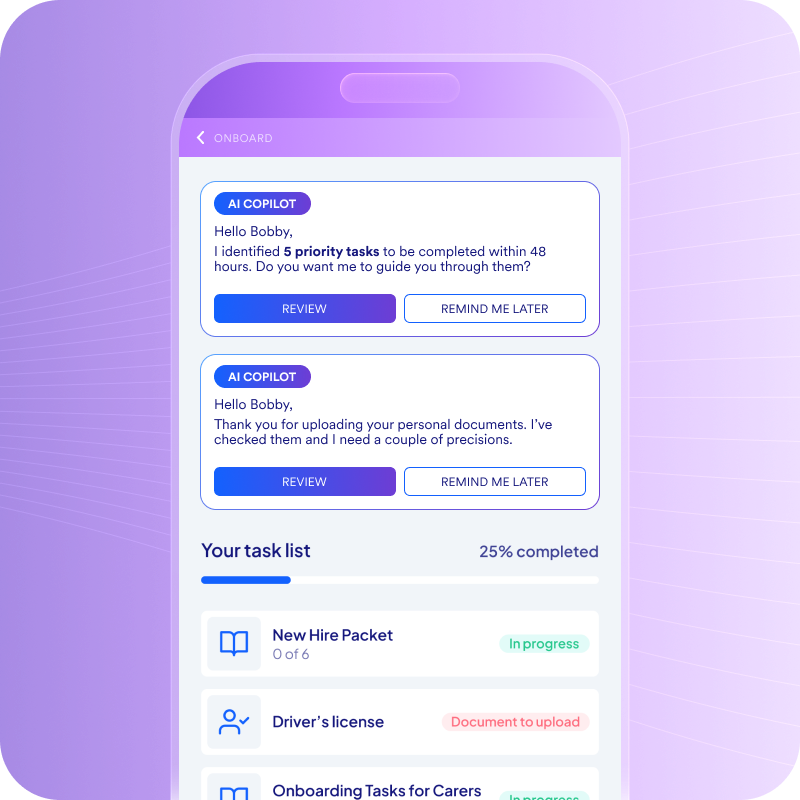
Consent delivery, document collection, check initiation, candidate status updates, and adverse action timing enforcement all run faster and more reliably when automated. A background check fires the moment the candidate hits the offer stage, not when a recruiter remembers to start it. The waiting period between pre-adverse and final adverse notices gets tracked in the workflow so teams do not move too early or lose track of the timeline.
Our complete guide to recruiting automation walks through how each handoff disappears end to end.
The preliminary decision, role-specific waiver reviews, and candidate communication on disqualification should not be fully automated. High-volume employers also face heightened risk when the pre-adverse and final adverse action notices are compressed without a meaningful waiting period.
Any borderline case, any candidate dispute, or any final decision to withdraw an offer should be reviewed before the workflow advances.
What has to change for high-volume hiring
Four workflow shifts separate employers who scale screening from employers who scrape by. Each one is a decision made before the vendor demo.
- Embed consent inside the application flow. Place the FCRA standalone disclosure on a dedicated screen between the apply form and submit, with the consent record stamped to the candidate file. Frontline candidates apply from their phone and won’t return to a desktop to sign a form later.
- Deliver every candidate-facing step on mobile. Document upload, identity verification, and drug-test scheduling all need to work on a phone screen, which usually means candidates scan and submit IDs from their device and drug-test scheduling surfaces only locations within a configurable radius of their address.
- Trigger each check automatically at the right funnel stage. The background check should fire the moment the candidate hits the offer stage, not when a recruiter remembers to start it. The I-9 should trigger at hire, with employer verification completed within 3 business days and no later than the employee’s first day of work.
- Standardize disqualification criteria across every location. Different rules per market create EEOC exposure, so run one policy across every candidate with state-specific legal variations layered on top through automated jurisdiction detection. Audit the rules quarterly, because each new state law shifts the floor.
Each of these is a workflow decision, not a vendor decision. Pick the wrong vendor and you cannot enforce any of them.
Types of pre-employment tests and assessments
Assessments add a predictive layer to screening when they connect to specific job requirements. Three categories cover most frontline hiring needs.
- Cognitive ability tests measure general reasoning and problem-solving. These can help predict job performance, but they also carry adverse impact risk and need to be validated against the specific role.
- Behavioral and personality assessments measure fit for high-churn frontline roles. Contextualized personality assessments are usually more useful than broad general inventories for hiring decisions because they tie traits to the actual conditions of the job.
- Skills tests and job simulations demonstrate the work itself. They are easier to connect directly to the role than broader cognitive or personality assessments, which makes them less vulnerable to challenges of validity.
At scale, assessments work best when they connect cleanly to the applicant tracking system and automate scoring. Without that, assessments become another manual bottleneck behind background checks.
Pre-employment screening across frontline industries
Legal floors are universal, but check mix and turnaround pressure shift by industry.
Logistics and warehouse
Screening usually centers on criminal history, drug testing, and motor vehicle records for commercial driver’s license (CDL) roles. The Department of Transportation requires a pre-employment drug test before a CDL driver performs safety-sensitive functions, and employers must run a Clearinghouse query before permitting those functions.
Consolidating document collection, background checks, and training in one workflow can shorten onboarding.
Quick-service restaurants (QSR) and food service
Screening combines food handler permits with health and drug screening, and jurisdiction requirements vary significantly from city to city. High turnover makes cycle time the variable that matters most.
Healthcare
Screening adds license verification against state boards, Office of Inspector General exclusion checks with civil monetary penalties up to $10,000 per claim for every excluded individual employed, and fingerprinting in some states. A single missed exclusion check exposes every claim that individual touches.
Retail
Screening focuses on identity verification, reference checks, and loss prevention checks for cash-handling roles, with state-level credit check restrictions and ban-the-box laws layered on top.
The vendor question is which combination of checks the role needs, and whether all of them can run in one workflow.
How to evaluate pre-employment screening vendors
The differences between screening vendors show up at volume.
- Compare median turnaround time by check type, not just SLA averages. Criminal checks, education verification, and employment verification have different ceilings, and service-level agreement (SLA) averages mask the long tail.
- Confirm FCRA compliance tooling covers disclosure, consent, and adverse action timing. Look for automatic disclosure delivery, consent capture, and configurable timing enforcement on pre-adverse and final adverse notices. The CFPB extended FCRA obligations to algorithmic scores used in hiring decisions, so any tool using algorithmic scoring needs the full disclosure and adverse action infrastructure too.
- Test ATS and onboarding integration depth before signing. Screening tools that run in a separate system recreate the manual handoff the employer was trying to remove, while integrated tools eliminate duplicate data entry and keep results stored centrally for audits.
- Verify multi-state compliance coverage and jurisdiction-specific form generation. The vendor should support configurable disqualification rules per location and form generation that updates automatically as state laws change.
- Insist on a mobile-native candidate experience. Every candidate-facing step, from consent to document upload to status checks, has to work on a phone screen without requiring desktop access.
The right questions to ask vendors are outcome-centric: “What percentage of checks complete within your stated SLA?” and “How does your system enforce the waiting period between pre-adverse and final adverse notices?” Vendor selection is where the outcome gets decided.
How Fountain runs pre-employment screening at scale
Screening fails at high volume when handoffs live in separate systems. Fountain, the Frontline Superintelligence for the global frontline workforce, runs it as one connected workflow. Cue is the orchestration layer above every agent on the platform: a prompt like “Screen and verify our top 200 warehouse applicants before Friday” becomes coordinated work across the funnel.
Under Cue, Anna runs first-round voice screening and Emma handles candidate questions across SMS and voice 24/7, while hiring teams keep the final call on every borderline decision.
At 11,000 applications per minute, every screening gate becomes either a flywheel or a leak. Employers running one workflow get the speed without the legal exposure; everyone else pays for both.
Book a demo to walk through Anna handling voice screening, Emma fielding candidate questions across SMS, and an FCRA-compliant background check pipeline running from a single plain-English prompt.
Frequently asked questions about pre-employment screening
What’s the difference between a background check and pre-employment screening?
A background check verifies a candidate’s history through criminal records, employment, and education confirmation. Pre-employment screening is the broader category that includes background checks plus assessments predicting future performance, drug testing, and identity verification. FCRA obligations apply to both, though some requirements can differ depending on the type of report involved.
How long does pre-employment screening take?
Criminal background checks typically take multiple business days. Education and employment verification can take longer. Drug tests may come back within days. Total cycle compresses under automation because handoffs disappear, not because individual checks run faster. Customers running unified screening and onboarding workflows have moved time-to-hire from 25 days to 15 days in three months, per Redefining Frontline Operations. The Fountain employee onboarding guide walks through how each step slots into a Day-1-ready workflow.
Can you automate pre-employment screening without violating FCRA?
Yes. Automate consent delivery, check initiation, and notice routing. If you use automation in adverse action decisions, ensure the process can still produce compliant, specific adverse action notices and preserves the required waiting window between pre-adverse and final adverse notices.