Frontline candidates take the first solid offer they get, and a slow hiring process is one of their top frustrations, according to the 2025 Fountain Frontline Report, a survey of nearly 2,000 frontline workers. For a 10-person startup, a two-week hiring delay is survivable. A company hiring 50 people a week across 200 locations cannot afford one: every uncovered route is an unfilled shift, an overtime line item, and lost revenue, and the candidate you wanted has already accepted somewhere faster.
Online recruitment is the fix most frontline teams reach for. It moves hiring online so job ads, mobile applications, screening, scheduling, offers, and onboarding all run through digital tools built for the volume these operations demand.
This guide covers what online recruitment is, how it works, where it beats traditional hiring, the trade-offs worth weighing, and the tools that run it.
What is online recruitment?
Online recruitment is the use of internet-based tools (job boards, social platforms, an applicant tracking system, video interviews, and SMS) to source, screen, and hire candidates from first click to first shift. It replaces the manual, offline steps of traditional hiring with digital workflows that run around the clock.
You’ll see the same idea under several names: e-recruitment, internet recruiting, digital hiring, web-based recruitment, and virtual recruitment all describe the shift from paper and phone to web and mobile. Adoption is now the default: online job boards were used for 79% of Canadian job vacancies in 2024, according to Statistics Canada data compiled by Indeed’s Hiring Lab, so if your frontline jobs are not visible and easy to apply to there, candidates may never enter your funnel.
The tooling spans the whole cycle, from sourcing and screening through interviewing, hiring, and onboarding.
The shift matters most when hiring volume is high. Filling one corporate role with a multi-week process is manageable. Filling 500 frontline roles across dozens of locations with manual screening, phone tag, and mailed offers is not.
How online recruitment works
Online recruitment runs as a connected sequence of stages, each handled by a digital tool instead of a manual step. Corporate hiring assumes a resume, a desktop, and a candidate willing to wait, but frontline hiring inverts all three, starting with applicants who search by phone rather than desktop.
Here is how the process typically flows:
- A job goes live across job boards and social channels, visible to candidates the moment it posts.
- Candidates apply from their phones, where resume-free flows fit frontline roles better than long forms. When an application runs too long or breaks on mobile, people quit: 60% of job seekers abandon applications that are too long or complicated, according to a CareerBuilder study reported by SHRM.
- Automated rules screen for fit, filtering for qualifications and availability so recruiters are not reading every resume by hand.
- Candidates self-schedule by text, which removes the email tag that turns a same-day hire into a week-long chase.
- Offers go out digitally, signed on a phone instead of printed and mailed.
- Onboarding completes on the phone, so paperwork is done before Day 1.
The biggest divergence from corporate hiring is at screening and scheduling, where speed decides everything. In high-volume hiring, the whole funnel compresses because candidates move toward the first process that is fast enough, so the fastest first move is to rebuild one high-volume role as a mobile-first flow with knockout questions and text self-scheduling.
That raises the obvious question: how does this compare with the traditional process it replaces?
Online recruitment vs. traditional recruitment
Traditional recruitment runs on newspaper ads, staffing agencies, manual resume review, and phone or postal communication. Online recruitment runs on job boards, an ATS, automated filtering, and SMS. The difference shows up most sharply in speed and reach.
Traditional methods carry agency fees, print costs, and manual coordination that get harder to absorb with every repeat frontline campaign. Online job boards cost less than print, which frees repeat-campaign budget for faster screening, SMS follow-up, or hard-to-fill locations. And phone calls, voicemail, and postal mail all slow candidate response next to SMS and automated messaging.
| Dimension | Traditional Recruitment | Online Recruitment |
| Job advertising | Newspaper, print, agency listings | Job boards, social, career site (24/7 apply window that captures after-hours candidates) |
| Screening | Manual resume review | Automated filtering, AI screening |
| Communication | Phone, voicemail, postal mail | SMS, email, automated messaging |
| Scheduling | Recruiter-coordinated phone tag | Self-scheduling via text invite |
| Reach | Local, active job seekers | National, 24-hour application window that keeps candidates entering the funnel after recruiter hours |
| Cost | Agency fees and print spending | Job board costs lower than print, freeing budget for repeat frontline campaigns |
One honest caveat: traditional methods still fit senior and niche hires. For executive and specialized roles, talent pools are small, and blasting the market with digital noise does not improve outcomes. Employee referrals can also stay useful when the right workers already know qualified candidates. For volume hiring, though, the math favors digital decisively.
The advantages of online recruitment for high-volume hiring
For frontline teams, online recruitment widens the applicant pool, schedules interviews faster, lowers repeat hiring costs, and keeps candidates responding before a competitor closes them. The gains are worth tracking by source: applicant volume, time-to-hire, cost-per-hire, response rate, compliance completion, and funnel drop-off.
- Wider reach and more applicants: Mobile-first apply meets candidates where they already are, especially in food services, transportation, and retail, where most job searches start on a phone. A desktop-bound application loses too much of that audience before they begin.
- Faster time-to-hire: Automation and self-scheduling compress the cycle from weeks to days in high-volume workflows. After switching to digital workflows, Bojangles cut time-to-hire from 30 days to 5.8 days, an 80% reduction per Fountain’s published case study, filling roles before competitors scheduled an interview.
- Lower cost-per-hire: Less reliance on agencies and print spend matters as hiring costs climb. Average cost-per-hire for nonexecutive roles hit $5,475 in SHRM’s 2025 benchmarking, so every avoidable agency handoff, rework loop, or abandoned application adds up quickly across hundreds of frontline hires.
- Better candidate communication: Text-based recruiting and automated updates keep candidates informed and reduce the silence that drives drop-off. People who know where they stand are far less likely to ghost.
- Built-in compliance tracking: Current I-9 forms stay tracked inside the hiring workflow, and background-check exceptions route to a human for review instead of a silent auto-reject.
- Real-time visibility: Funnel analytics surface drop-off by stage and location, so teams act before a staffing gap becomes a coverage crisis.
Stacked together, a larger applicant pool, faster scheduling, and steady SMS updates move more candidates toward the next shift instead of leaving managers scrambling to cover it.
The disadvantages of online recruitment
Online recruitment is not a clean win at every step, and an honest evaluation names the trade-offs. Three deserve attention before you commit budget.
- Automated filtering can screen out good people. Over-reliance on rigid rules can reject qualified candidates, and AI hiring systems can carry forward prior inequalities, which is why humans should review edge cases rather than trust automated rejection wholesale.
- The digital divide narrows your pool. Global internet access still left almost a third of the world offline in 2024, and a purely online process can exclude the lower-income and rural candidates you need for frontline roles.
- Privacy and compliance work grows. When automated tools influence hiring decisions, requirements vary by jurisdiction, so build disclosure, oversight, and legal review into the workflow from the start.
Two of these trade-offs share a legal dimension worth calling out: fairness. Wherever AI screening shapes a hiring decision, U.S. anti-discrimination law enforced by the EEOC holds the employer responsible if a tool creates an adverse impact on protected groups, even when a vendor built it.
Common practice is to validate screening criteria against the actual job, audit outcomes for bias, and keep a person reviewing rejections rather than auto-declining at scale. Treat this as general information, not legal advice, and confirm specifics with qualified employment counsel.
None of this argues against going digital. It argues for keeping humans in the loop: managers review the edge cases, non-digital pathways stay open when the candidate pool warrants them, and compliance steps trigger inside the workflow instead of sitting in a spreadsheet someone forgets to check.
What tools make online recruitment work?
The online recruitment stack spans job boards, an ATS or HCM, AI screening, video interview tools, SMS and conversational messaging, and background-check integrations. The ATS sits at the center as the candidate database and workflow engine, and the other tools feed and extend it.
Frontline teams need an ATS built for frontline hiring, not a corporate ATS stretched across thousands of applicants. A general-purpose ATS is evaluated on flexibility and configurability, with candidate processes that assume a resume and a multi-week timeline. A frontline-specific ATS has to answer a harder question: how do you screen thousands of candidates without burning out recruiters or lowering quality?
Hourly hiring is not corporate recruiting at higher volume, because roles fill quickly, applicants apply by phone, and slow follow-up loses people.
That is why frontline systems now absorb work corporate tools leave to recruiters, including after-hours screening, candidate support, sourcing, onboarding, and scheduling. AI voice screening and 24/7 candidate Q&A let someone who applies after a shift get answers before recruiter hours resume, so the funnel keeps moving without a person managing every step.
Online recruitment best practices for frontline teams
Frontline teams convert more applicants when every step works on a phone, status updates go out on their own, and recruiters are not stuck dialing candidates one by one. Four practices matter most.
- Build every step for the phone first. Short, mobile-first applications reduce friction and keep candidates moving while their intent is high. If a step is awkward on a phone, assume you are losing the people you most want to reach.
- Send automated status updates so no one goes dark. Text-based recruiting is common among top-rated employers because it keeps communication fast and visible. Automated SMS updates keep people warm through the funnel instead of guessing whether they are still in it.
- Trigger compliance steps inside the workflow. I-9 verification and background-check steps should fire automatically rather than living in a spreadsheet someone forgets to check, which is how compliance keeps pace with volume.
- Re-engage past applicants with a CRM. Former workers and silver-medal candidates are warm leads you already paid to source, and a CRM that re-activates them fills roles without new sourcing spend.
None of these is complicated to set up. Each one just needs a system that handles the repetitive work, so your team spends its time on the conversations and decisions that need human judgment.
How Fountain runs online recruitment at frontline scale
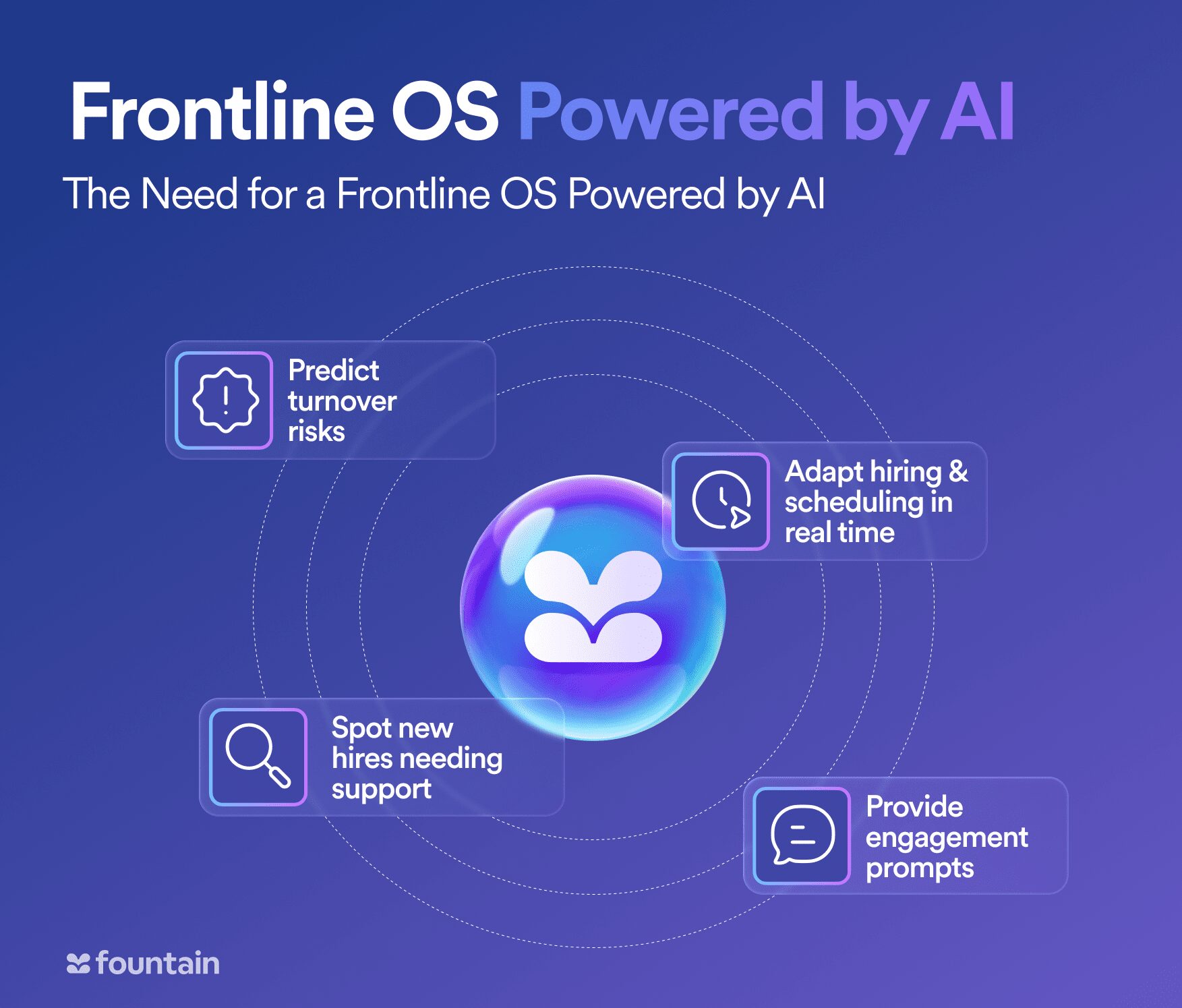
Speed and scale decide whether you staff the next shift or absorb the overtime. Fountain’s Frontline Superintelligence runs the whole cycle in one system, orchestrated by Cue: a prompt like “Hire 200 warehouse associates before peak” sets the plan in motion.
Underneath it, Anna runs voice interviews 24/7, Emma answers candidate questions around the clock, and Sam tracks post-hire retention, while people keep the final word. The same platform handles Sourcing, ATS, CRM, Onboarding, and Shift & Scheduling. Fetch cut time-to-hire from 15 days to 6.5 hours with Anna, a 95% reduction.
The candidates who rank slow hiring as their top frustration are the ones who take the first solid offer, so reaching them first is the whole game. If candidates keep accepting other offers, shorten the application, add text self-scheduling, and automate updates. Book a demo to see it run on one workflow.
Frequently asked questions about online recruitment
What is online recruitment?
Online recruitment is the use of internet-based tools (job boards, an applicant tracking system, video interviews, and SMS) to source, screen, and hire candidates end to end. It replaces offline steps like print ads and phone screening with digital workflows that run around the clock, so someone who applies after a shift can get next steps before recruiter hours resume. It is also called e-recruitment, internet recruiting, or digital hiring.
What is the difference between online and traditional recruitment?
Traditional recruitment relies on print ads, staffing agencies, manual resume review, and phone communication. Online recruitment uses job boards, automated screening, and SMS to reach candidates 24 hours a day, so after-hours applicants enter the funnel before they accept another offer. Traditional methods still fit senior and niche roles where talent pools are small, but online recruitment wins decisively for volume hiring.
Is online recruitment good for hourly and frontline hiring?
Yes, and for high-volume hiring it is essential. Frontline hiring runs on high volume, mobile applications, and candidates who move toward the first fast offer, so manual screening and phone tag cannot keep pace. Online recruitment with automated screening, self-scheduling, and SMS updates fills roles in days instead of weeks, and a frontline-specific platform handles it better than a corporate ATS adapted to higher volume.