
Applicant tracking systems are standard hiring infrastructure: Jobscan’s August 2026 research detected an ATS for 97.4% of Fortune 500 companies. Two audiences end up asking what this software actually does. Employers are deciding whether their current system fits their hiring, and candidates want to know what happens after they hit submit.
This guide covers what an ATS is, how it works across the hiring funnel, and where the standard version breaks for frontline volume, where the system automates the screening and scheduling that follow the apply step and routes candidates across locations, while managers keep approval on offers and exceptions.
What is an applicant tracking system?
An applicant tracking system (ATS) is software that collects, organizes, and moves job applications through every stage of hiring, from the first job posting to the signed offer. It replaces the scatter of job board inboxes and email threads with a single system where every candidate has a record and a next step.
SHRM describes it as “the backbone of recruiting technology, a core platform that collects and stores candidate resumes as well as automates job postings and other manual tasks common to the recruiting function.”
An ATS is not an HRIS, which takes over as the employee system of record after the hire, and it is not a black box rejecting resumes on its own: employers configure the rules that trigger automated rejection.
How does an ATS work across the hiring funnel?
An ATS posts a role to multiple job boards at once, often including a branded careers page, and collects every application into one pipeline. In resume-based corporate flows, intake means parsing: the system organizes application data, compares it against the job description, and may rank applicants based on configured criteria.
Your recruiters then review applications in order or apply filters to narrow the pool. The software organizes the queue, and humans work through it.
Hourly hiring can use different intake mechanics without requiring a resume. Candidates apply from a phone, often through text-to-apply or a short mobile form, and answer knockout questions about work authorization, required licenses, or years of experience.
Rules configured by the employer move qualified applicants to the next stage automatically. From there the ATS handles interview scheduling, letting candidates self-book against synced calendars instead of trading phone calls, and manages the offer. Depending on the employer’s configuration, a candidate’s acceptance can trigger the background check, and once that clears, the system can create the employee record in the HRIS and start automated onboarding.
From the candidate’s side, the same system produces two different experiences. A corporate applicant uploads a resume and waits for outreach, while an hourly applicant texts a keyword, answers a handful of questions, books an interview slot, and can move from application to offer within days.
Why do companies use an ATS?
Without an ATS, applications sit scattered across job board inboxes and spreadsheets, and candidates get lost in the gaps between them. A long form built for a desktop, with an account to create and a resume to upload, loses the candidate filling it out on a phone during a break: in Fountain’s Redefining Frontline Operations white paper, 60% of applicants abandon applications that are too long or not mobile-friendly.
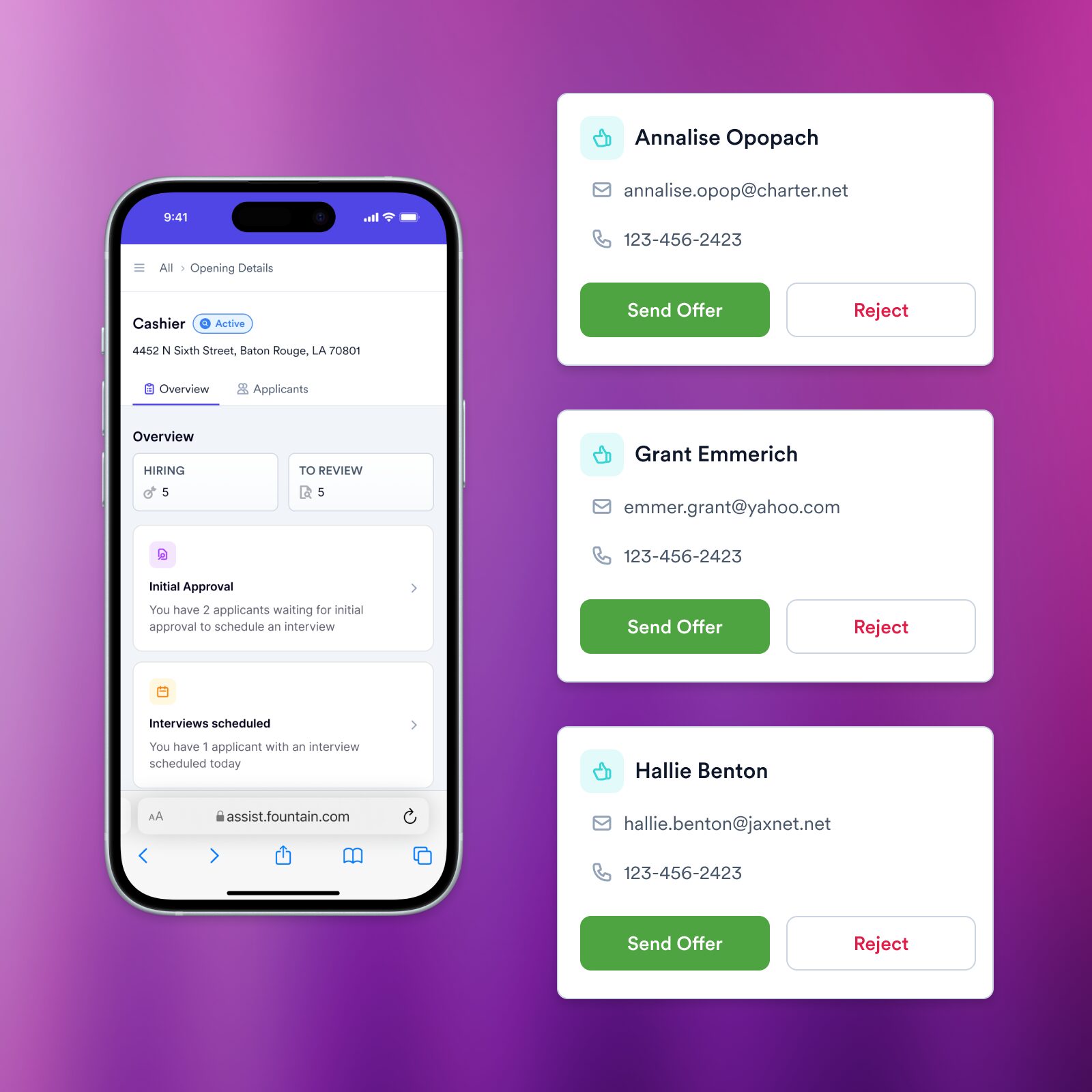
Your simple, smart, and speedy hiring solution.
Fountain knows hiring. We leverage our best in class AI to find and bring you top-tier, ready-to-work talent. We use our expertise to build personalized plans tailored specifically to your needs.
Candidates punish silence after submission too. In the 2025 Fountain Frontline Report, 57% of frontline candidates named slow hiring processes a top frustration, and 52% cited ghosting or a lack of updates.
An ATS plugs the leaks a manual process can’t: it acknowledges every application immediately, books interviews without a recruiter in the loop, and keeps thousands of applications moving at the same time, with fewer handoffs and fewer candidates lost in between.
The ATS also keeps the records employers need for compliance audits. EEOC recordkeeping rules require covered employers to retain every application, hired or not, for one year, and federal I-9 rules give employers three business days from a new hire’s first day to complete Section 2.
One location can manage that in a folder. Hundreds of locations that hire every month cannot. An ATS closes the gap: it timestamps every stage transition and automatically stores disposition records for every applicant.
Core features of a modern ATS
Feature lists blur together in demos. The real question is which capabilities hold up at your hiring volume and which add little value.
- Mobile-first applications: Candidates finish in minutes from a phone, with no account creation or resume upload wall.
- Automated screening and scheduling: Knockout questions, structured screens, and self-serve interview booking keep the funnel moving overnight.
- Multi-location pipelines: Hiring teams get one view across sites, brands, and franchises instead of a separate funnel per store.
- Compliance workflows: Document collection, timestamps, and audit trails are built into the flow rather than bolted on.
- Reporting and analytics: Source, stage-conversion, and time-to-fill data break out by location.
- Integrations: Hired records hand off cleanly to HRIS, payroll, and background check systems once a candidate accepts.
- Agentic AI layer: The newest systems execute multistep hiring tasks instead of only tracking them. They act on rules the employer configures, never on their own judgment, and managers still make the final call on offers and exceptions.
Weigh each against annual hires, role type, and number of locations. A team filling a few dozen corporate roles a year can live with desktop-first applications and manual scheduling; filling 500 hourly roles across 40 locations before a peak season is a different problem.
The criteria for choosing an ATS for hourly workers start with exactly that test: check mobile completion rates, and count how many screening and scheduling steps the system completes after the apply step before you sign.
ATS vs. HRIS vs. recruiting CRM
A recruiting CRM manages relationships before anyone applies, an ATS runs the application-to-hire workflow, and an HRIS becomes the employee system of record after the hire. Vendors muddy the naming by calling ATS-centered suites “recruiting platforms” or “hiring software,” but the division of labor holds.
A recruiting CRM sources passive talent and keeps candidate pools warm, including people who never submit an application. The ATS owns everything between a submitted application and an accepted offer. The HRIS stores employee data for payroll and benefits from hire through exit.
The three hand off in sequence: the CRM feeds interested candidates into the ATS when a role opens, and a hired status in the ATS can initiate the background check and payroll setup, with onboarding gated on the check clearing.
Without integrations between them, your HR team re-keys every candidate record by hand, and a new hire can turn up on day one before payroll setup is finished.
Does an ATS reject qualified candidates?
Qualified candidates do get screened out. In Harvard Business School’s two-year Hidden Workers study, 88% of employers said qualified high-skills candidates get vetted out of the process because they don’t match the exact criteria in the job description. For middle-skills workers, the figure rose to 94%.
Auto-rejection comes from employer-configured knockout questions (work authorization, required licenses, years of experience) and rigid resume filters. Nearly half of employers in the same study screened out any resume with an employment gap longer than six months, regardless of other qualifications.
The software enforces whatever rules the employer sets. A 2021 Forbes interview with a recruiter and ATS expert challenged automatic-rejection claims based solely on resume formatting or design; employer-configured criteria and human review determine the outcome.
Tight filters feel rigorous, but over-filtering shrinks your already thin funnel, and frontline employers draw from the middle-skills pool, where the study reported the 94% exclusion rate.
For candidates, many hourly flows skip resumes entirely, so formatting anxieties don’t apply there, and a rejection more likely traces to a specific configured criterion or a human decision than to independent machine judgment.
Why frontline and high-volume hiring needs a different ATS
Traditional ATS platforms often underserve hourly candidates and busy managers. Hourly openings can draw high application volume, employers often decide the same day, and frontline job searches happen disproportionately on smartphones. Delays are expensive here, because a slow funnel leaves locations understaffed.
Most organizations haven’t adjusted for that. In February 2026, Aptitude Research reported that 41% of organizations still ran the same hiring process for professional and frontline roles, and 42% used the same technology for both. A shared corporate workflow can slow same-day screening and push frontline candidates toward faster employers, so audit response times and candidate drop-off before assuming the system fits.
When the ATS is built for frontline hiring instead, screening happens the same day an application arrives, candidates route across locations from a single pipeline, and compliance steps like I-9 collection run at volume rather than location by location.
How Fountain runs the ATS for frontline hiring
Fountain’s ATS runs on frontline hiring patterns rather than corporate recruiting workflows: resume-free mobile applications, knockout screening, self-booked interviews, and one pipeline across locations and brands.
Cue, the orchestration layer across Fountain’s products, turns a plain-language goal, “Fill 40 open hourly roles across 12 locations by Friday,” into sourcing, screening rules, interview slots, and location routing, while managers keep approval on offers and exceptions.
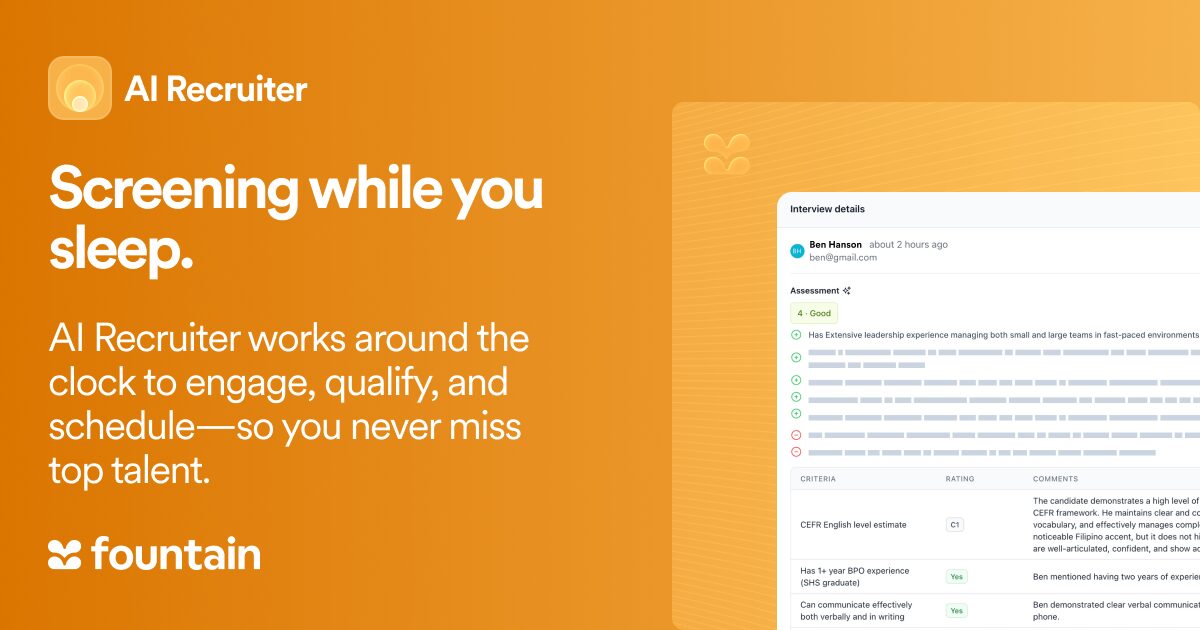
Three agents work that pipeline today. Anna runs voice screening interviews around the clock and pushes scored, qualified applicants to hiring teams. Emma answers candidate questions at any hour and walks new hires through I-9 and W-4 paperwork. Sam checks in after the start date and flags retention risk early. Each agent updates applicant records and advances stages in the ATS as it works.
After the offer, Onboarding collects compliance documents and hands the record to HRIS and background check systems, with Shift & Scheduling picking up from the first shift; Fountain integrates with the employer’s HRIS rather than replacing it.
In Fountain’s Stitch Fix case study, covering the retailer’s warehouse hiring, applicant conversion rate, or the percentage of applicants who pass background checks and show up on day one, increased from 68% to 95%, and median time-to-hire fell from about 3 weeks to 9.16 days.
Nearly every large employer already owns an ATS; the edge is how much of the work between application and first shift the system completes on its own. See the difference on your own roles: book a demo to watch same-day screening, self-booked interviews, and multi-location routing run on a live pipeline.
Frequently asked questions about applicant tracking systems
What does ATS stand for?
ATS stands for applicant tracking system, the software employers use to collect, organize, and advance job applications from posting through hire. ATS use is common among large enterprises, and cloud-based options have made the software accessible to smaller companies as well.
Is an ATS the same as an HRIS or a CRM?
No, the three cover different stretches of the hiring lifecycle. A recruiting CRM works before anyone applies; it builds talent pools and keeps passive candidates warm. The ATS owns the stretch from application to hire, and the HRIS picks up once someone is on payroll and holds employee records for pay and benefits through to exit.
Does an ATS automatically reject resumes?
An ATS automatically rejects applicants who fail employer-configured knockout questions or filters, such as work-authorization or license requirements. These rejections follow employer-configured rules rather than independent machine judgment. Resume formatting alone is less likely to determine the outcome, while configured criteria and human review shape the final decision.