This guide reflects publicly available product information as of July 2026; capabilities, acquisitions, and availability change, so verify with each vendor during evaluation.
Recruiting scheduling software closes the gap between application and confirmed interview. But in 2026 what separates these tools is not the calendar view but the agent layer: whether the software can screen candidates, book interviews, and answer applicant questions on its own.
Scheduling is becoming the back end of frontline hiring and agents the front end, and the real question is which platform can do that without a recruiter chasing anyone.
For high-volume frontline teams, calendar coordination is a capacity problem. No-show rates in high-volume hourly recruiting run fairly high, so automated reminders and one-tap rescheduling are operating controls, not conveniences, and candidates who wait days for a slot take the first firm offer somewhere else.
This guide is a shortlist of the seven platforms to consider, the criteria that matter at frontline volume, and how to match a tool to your volume and HCM.
TL;DR: the top recruiting scheduling platforms
- Fountain: frontline hiring platform pairing an orchestration layer and three live agents (voice screening, 24/7 candidate support, post-hire engagement) with mobile self-scheduling and calendar sync.
- Paradox (Olivia): conversational agent for high-volume frontline hiring, now distributed through Workday after its October 2025 acquisition.
- iCIMS: enterprise ATS with a Frontline AI solution built on its 2025 Apli acquisition; best fit for existing iCIMS customers.
- SmartRecruiters (SAP): enterprise recruiting platform with AI sourcing and screening assistants, folded into SAP SuccessFactors after its September 2025 acquisition.
- Phenom: talent-experience platform spreading 30+ agents across the hiring and development lifecycle.
- Harver: assessment-first volume-hiring platform with scheduling inside the assessment pipeline.
- Hireology: mid-market franchise ATS with interview scheduling and workflow automation, no dedicated agent.
Each trades off differently on agent depth, scheduling automation, and how much of the funnel it runs before a recruiter has to step in.
How to evaluate recruiting scheduling software for frontline volume
Frontline teams filling hundreds of roles across dozens of locations need scheduling that survives volume, not a calendar tool built for a recruiter managing 15 salaried roles from a desktop. Weigh any tool on this list against these criteria, agent depth first:
- Agent depth and human oversight: Does the platform have a named agent that screens candidates, books interviews, and answers questions, or is “AI” a feature bolted onto a dashboard? Screening is the bigger constraint: Aptitude Research found it is the top bottleneck at 44%, ahead of scheduling at 34%, so a tool that fixes only the calendar leaves the larger problem in place. Either way, a person should make the final hiring call.
- Mobile self-scheduling without app downloads: Candidates should be able to self-schedule interviews over SMS or WhatsApp, not a phone call during a shift. 60% of frontline candidates abandon applications that are not built for mobile, per Redefining Frontline Operations, so a scheduling flow adapted for desktop loses people before the first interview is confirmed.
- No-show reduction: Automated reminders and one-tap rescheduling matter more than calendar views. For multi-location employers they are shift-coverage controls, not calendar niceties.
- ATS and HRIS integration depth: Scheduling should trigger automatically from an ATS stage change and write back cleanly to UKG, ADP, Workday, or SAP, so recruiters are not retyping data across two systems. Integration is a named buyer decision point, not a footnote.
- Multi-location configurability: Individual locations need control over their own interview slots while a central talent-acquisition team holds workflow standards and reporting visibility.
Weight agent depth heaviest: a thin calendar integration is fixable with configuration, but a missing agent leaves the work manual. These are directional criteria, so validate any shortlist in a demo before committing.
7 recruiting scheduling platforms to evaluate for frontline teams
| Platform | Category | Named agents and depth | Scheduling approach | Best for |
| Fountain | Frontline hiring platform | Orchestration layer plus 3 live agents: voice screening, 24/7 support, post-hire engagement | Mobile self-scheduling with calendar sync, SMS and WhatsApp reminders, auto stage advance | High-volume frontline employers across many locations |
| Paradox | Conversational AI layer | Olivia; chat-led screening and scheduling | Chatbot-led text self-scheduling for 1:1, panel, and group | Enterprise restaurants, retail, hospitality on Workday |
| iCIMS | Enterprise ATS plus Frontline AI | Frontline AI solution; no single named agent | Self-scheduling templates via Digital Assistant | One ATS for corporate plus frontline |
| SmartRecruiters (SAP) | Enterprise recruiting, SAP | AI sourcing and screening assistants | Self-scheduling across multiple interviewers | SAP SuccessFactors shops |
| Phenom | Talent-experience platform | 30+ agents; verify scheduling depth | Interview-logistics automation across the suite | Enterprise corporate plus frontline pools |
| Harver | Assessment platform | Assessment AI, not agent orchestration | Scheduling inside the assessment pipeline | Assessment-first volume hiring |
| Hireology | Mid-market franchise ATS | None; workflow automation, limited AI | Candidate interview scheduling | Franchise and multi-site operators |
1. Fountain
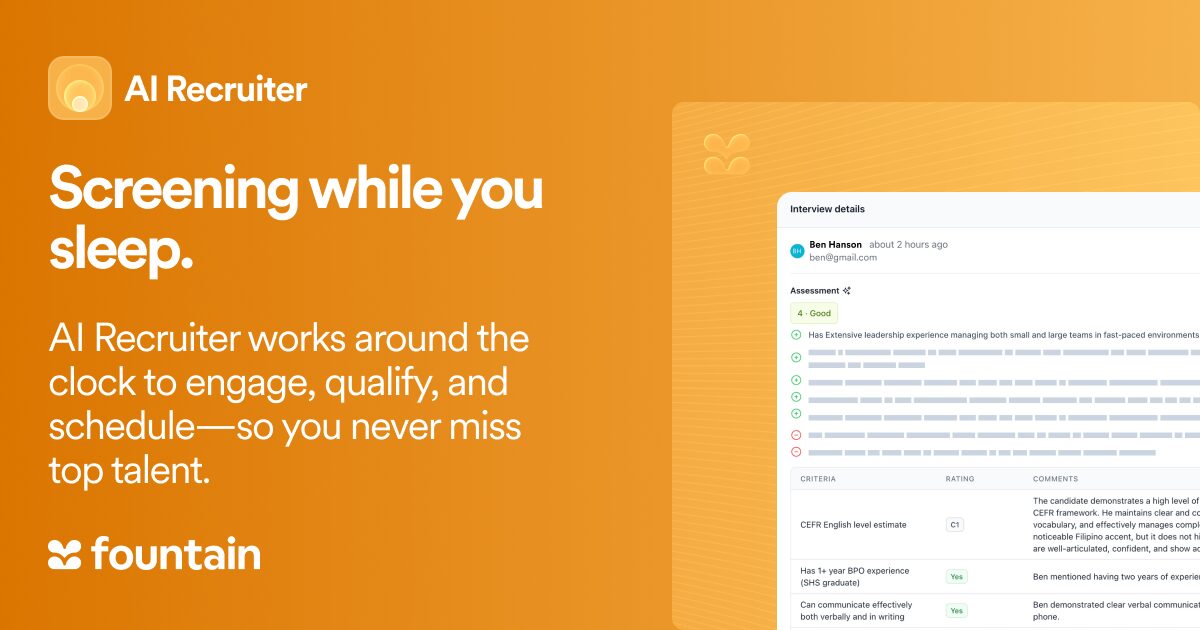
Fountain is a frontline hiring platform built around an orchestration layer and three live agents, the combination it calls Frontline Superintelligence. Voice screening runs real phone interviews 24/7, scores candidates against your criteria, and pushes qualified applicants to your team before manual review becomes the bottleneck.
A 24/7 support agent answers candidate questions over SMS, voice, and web chat through Day 1, and a post-hire agent flags retention risk early. Across all three, your team reviews the results and makes every hiring decision.
A smarter, connected way to hire, engage, and retain frontline teams
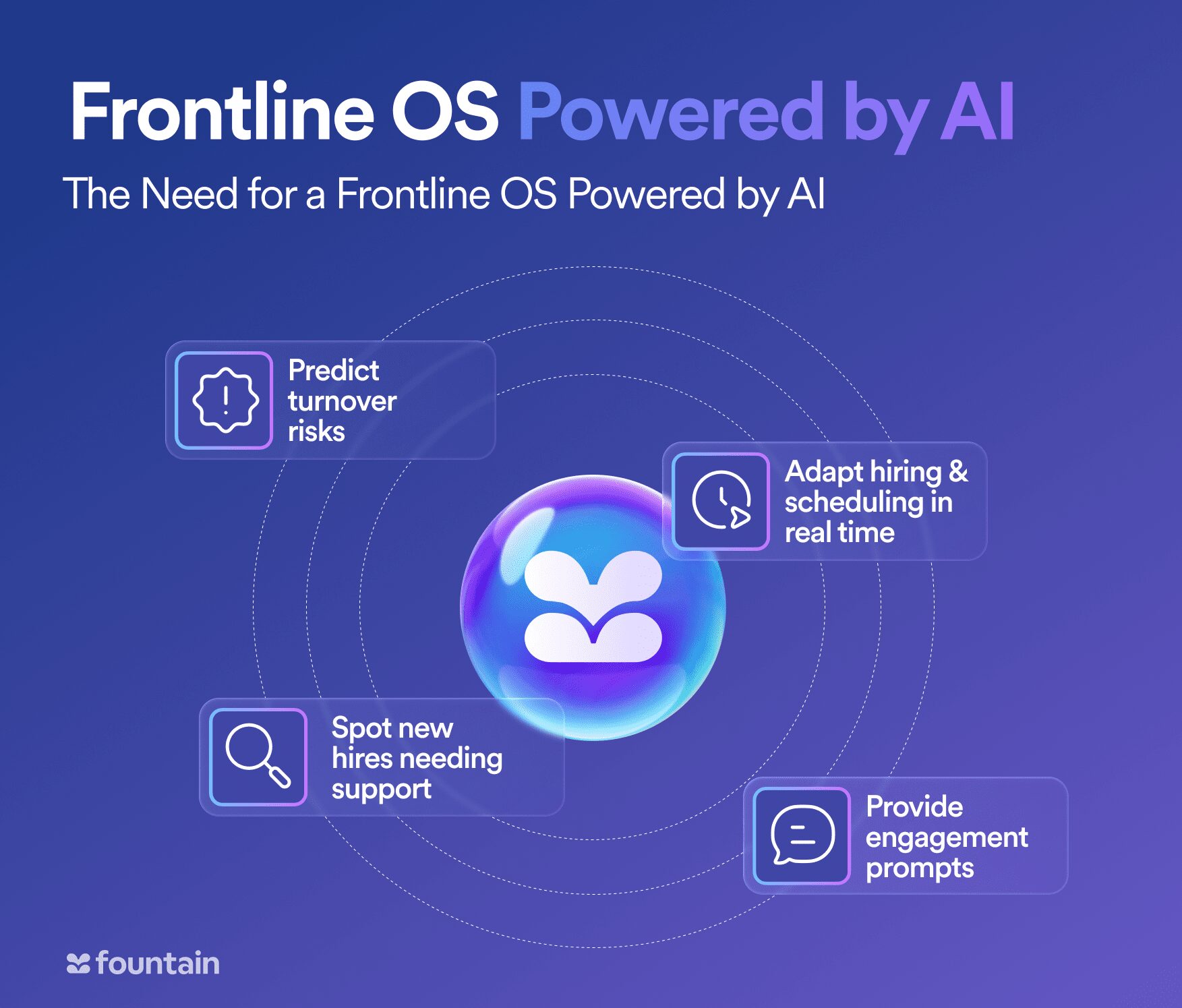
Centralize scheduling, hiring, onboarding, engagement, and analytics in one AI-powered platform built for the frontline workforce. Fountain OS gives leaders the real-time insights and tools they need to predict turnover, boost retention, and streamline high-volume operations.
Automate repetitive tasks, identify at-risk employees early, and make data-driven workforce decisions with a unified solution designed to help frontline teams thrive.
Scheduling does not sit in a silo. The orchestration layer connects it to screening, offers, onboarding, and shift coverage, so when a candidate clears screening the workflow moves them into interview booking at volume through calendar sync and automated SMS, email, and WhatsApp reminders. That closes the screen-to-schedule handoff where the most candidates leak, instead of leaving a recruiter to paste calendar links into an ATS.
Key features: The orchestration layer turns a plain-English goal, like “book interviews for everyone who passed screening this week and chase the no-shows,” into coordinated work across the platform. Underneath it, ATS, Sourcing, CRM, Onboarding, and Shift & Scheduling run as one system with mobile-first applications, calendar sync, and multi-location support, natively connected to UKG, ADP, SAP, and Workday rather than replacing them.
Proof points:
- MAPS Logistics, a UK courier hiring 2,000 drivers a year, cut candidate no-shows by 70% after replacing manual interview scheduling with calendar integration and SMS reminders.
- Stitch Fix lifted its Day 1 show rate from 68% to 95% after moving to mobile-first applications and automated screening.
Best for:
- High-volume frontline employers that want screening, scheduling, onboarding, and shift coverage in one system across many locations while keeping human hiring decisions.
- It is overkill for teams hiring mostly corporate roles at low volume, or anyone who just needs a lightweight calendar-link tool.
2. Paradox (Olivia)
Olivia is a conversational agent that screens, schedules, and messages candidates over SMS, WhatsApp, and web chat, and it moved inside Workday’s portfolio after Workday completed its acquisition of Paradox in October 2025. It is mature at chat-led self-scheduling for 1:1, panel, and group interviews with automated reminders, and it is a strong conversational layer for quick-service restaurant (QSR), retail, and hospitality employers already on Workday.
The catches:
- Olivia screens for rules and eligibility rather than running a full voice interview, and Paradox’s roadmap now runs through Workday, which matters if you are on a different HCM.
- Confirm integration scope and timeline before relying on it.
Best for:
- Multi-location QSR, retail, and hospitality employers on or moving to Workday.
3. iCIMS
iCIMS is a broad enterprise ATS that added frontline capability through its September 2025 acquisition of Apli, now its Frontline AI solution: self-scheduling templates via a Digital Assistant, trigger-based automation that auto-advances candidates, and text recruiting, unified in a High Volume Hiring workspace with embedded analytics.
Running corporate and hourly roles on one platform is a real advantage for teams already standardized on iCIMS.
The catches:
- The frontline layer is new and sits on an enterprise platform built for requisition-driven hiring, with no single named agent orchestrating the work end to end, so plan for configuration around store-level calendars, text reminders, and manager approvals.
Best for:
- Large enterprises that want one ATS covering both corporate and frontline hiring.
4. SmartRecruiters (SAP)
SmartRecruiters ships AI sourcing and screening assistants inside an enterprise recruiting platform, and SAP completed its acquisition in September 2025, folding it into SAP SuccessFactors. It offers interview self-scheduling across multiple interviewers and a High Volume plan with chat-based automation, and for SAP shops it pulls job families, cost centers, and locations from SuccessFactors so recruiters are not retyping org data.
The catches:
- It was built for knowledge-worker hiring first, so mobile and volume workflows read as adapted rather than native, and SAP fit does not automatically mean best frontline scheduling fit.
Best for:
- Enterprises consolidating a mixed corporate-and-frontline stack on SAP SuccessFactors.
5. Phenom
Phenom spreads more than 30 agents across an enterprise talent-experience platform covering hiring, internal mobility, and development, with scheduling automation for interview logistics and, more recently, frontline shift scheduling. Do not read agent count as frontline depth: in a demo, require the vendor to show candidate self-scheduling, reminders, rescheduling, and manager slot control for an actual frontline role.
The catches:
- The agents serve the broader suite rather than a dedicated frontline motion, shift scheduling is newer than the rest of the platform, and enterprise pricing can put it out of reach for mid-market operators.
Best for:
- Large enterprises that want one agent-led suite personalizing experiences across corporate and frontline talent pools.
6. Harver
Harver is a volume-hiring platform built around assessment, now including the former pymetrics behavioral games, with conversational apply, candidate Q&A, and scheduling shipped inside the assessment pipeline. Its strongest fit is programs that put structured assessment data before interview scheduling.
The catches:
- It is not a full ATS, assessment sits at the center of the architecture, and assessment length can slow down time-sensitive frontline candidates.
Best for:
- Employers that run structured behavioral assessments ahead of every interview and want scheduling attached to that pipeline.
7. Hireology
Hireology is a full ATS for decentralized, franchise, and field-managed businesses across automotive, healthcare, hospitality, and retail, with interview scheduling, two-way texting, prescreening, onboarding forms, and background checks.
The catches:
- It has no dedicated hiring agent and leans on workflow automation and limited AI, so weigh it against the agentic platforms above on screening and engagement, not just applicant tracking.
Best for:
- Franchise and multi-site operators with limited dedicated HR support.
How Fountain runs frontline scheduling
Fountain runs frontline scheduling through Cue, the orchestration layer behind everything above. Anna is the voice screening agent running those 24/7 phone interviews, Emma is the 24/7 support agent answering candidate questions from application through Day 1, and Sam is the post-hire agent watching for retention risk before it becomes a quit.
All three are live, and your team approves every final call.
The agents run on Fountain’s ATS, Sourcing, CRM, Onboarding, and Shift & Scheduling, natively connected to UKG, ADP, SAP, and Workday, so a candidate moves from screen to confirmed interview to Day 1 without manual chasing. Start with your annual frontline hires, number of locations, and current HCM: those three inputs decide whether you need a frontline-native platform and which tools make the shortlist.
Book a demo to see Cue run a real frontline scheduling workflow.
Frequently asked questions about recruiting scheduling software
What is recruiting scheduling software?
Recruiting scheduling software automates interview coordination between candidates and hiring teams: self-scheduling links, calendar sync, automated reminders, and rescheduling. For high-volume frontline employers, the defining capability is letting candidates book interviews entirely from a phone over SMS, with no app download or account to create.
How much can automated scheduling reduce interview no-shows?
No-show rates in high-volume hourly recruiting typically run 30% to 50%, which makes attendance recovery a core ROI metric for scheduling software. Automation moves the number through reminder cadence, one-tap rescheduling, and manager visibility, so test all three in a demo rather than trusting a headline reduction figure.
Should we buy a scheduling point tool or a platform with scheduling built in?
It depends on where the funnel breaks. If scheduling is the only gap in an otherwise working stack, a coordination layer on top of your existing ATS can close it. If candidates are also dropping off at application and screening, a platform that runs the full apply-to-interview flow removes more friction than a point tool can, because it fixes the screening bottleneck and the scheduling one in the same workflow.