Generative AI has spread through frontline recruiting faster than it has changed how long hiring takes. 67% of recruiters now use AI tools, up from 35% in 2020, per Fountain’s Agentic AI for Frontline Workforces research, while the average U.S. frontline hire still takes 27.5 days from application to offer, according to Redefining Frontline Operations.
The tools write job descriptions, answer applicant questions over SMS, and summarize interviews at the volume frontline hiring demands. Screening, interview booking, compliance checks, and workflow completion sit outside them.
That boundary decides whether a tool hands back a draft or posts the role, screens the applicant, and books the interview. Human sign-off on hiring decisions stays the working standard throughout, and in the EU it is a legal requirement.
What is generative AI in recruiting?
Generative AI in recruiting refers to models that produce new text on request: job descriptions, candidate messages, screening questions, and interview summaries. Given a role and a few requirements, a model returns a ready-to-edit posting in seconds, and it does the same for 200 locations with local variations, turning multi-store posting into review-and-approve work.
Two other things get called the same name. Predictive or matching AI scores and ranks candidates against role requirements to surface who looks strongest. Rules-based automation fires predefined actions on triggers, such as moving a candidate to the interview stage the moment a knockout question clears.
Generative AI drafts and converses. It does not decide who advances. That distinction resolves most of the confusion in vendor conversations, and it marks the legal boundary.
Where generative AI shows up in frontline hiring
Drafting is where AI use concentrates. Among organizations using AI to support recruiting, writing job descriptions is the most common application at 66%, per SHRM’s 2025 Talent Trends survey of 2,040 HR professionals.
Across the frontline funnel, that covers multi-location postings, replies to applicant questions over SMS and chat, role-specific screening question sets, interview documentation, and drafted offer messages. For an operator posting the same crew role across 200 stores, that writing used to consume recruiter hours by itself.
Three layers cover what vendors demo, and only the third moves the work:
- Content generation drafts job posts, messages, screening questions, summaries, and offers.
- Decisioning scores, ranks, or filters candidates, which puts it in a different risk category.
- Execution completes screening, scheduling, compliance checks, and stage changes once content is generated or a reviewed rule fires.
Sorting features into those three layers before a demo keeps the risk conversation ahead of the signature, because regulation concentrates on decisioning. Candidates apply from their phones between shifts in volumes no recruiter can work by hand, and a silent employer loses to one that answers the same day.
What generative AI can’t do, and why that matters at volume
Generation without execution produces more text faster and nothing else. More than 90% of companies surveyed by ManpowerGroup Talent Solutions and Everest Group in 2026 report using AI tools for recruiting, yet fewer than 5% describe the outcomes as “transformational” on any key metric. Drafting capacity added to a process full of manual handoffs does not move time-to-fill.
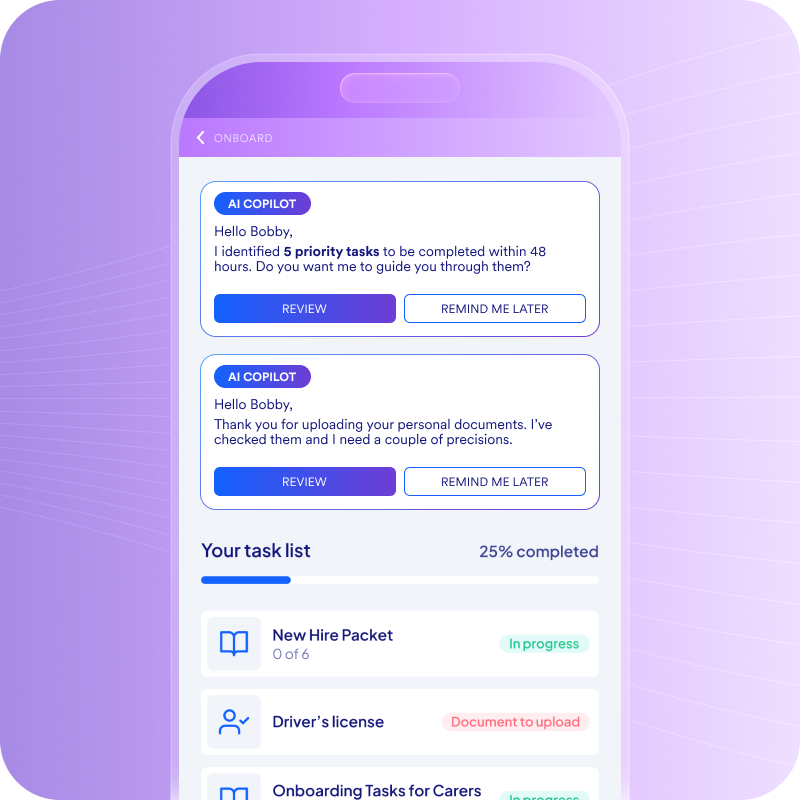
Faster ramp-up. Lower early attrition. AI onboarding built for speed, scale, and retention.
Top employers are already using Fountain’s Frontline OS to:
✅ Reduce turnover in the first 60 days
✅ Eliminate manual paperwork and task delays
✅ Accelerate new hire productivity with smarter workflows
Curious what smarter onboarding could unlock for your team?
Faster drafts do not save a slow funnel.
Put one crew role across 200 locations and a generation-only stack hands back 200 postings plus a queue of applicant replies, while recruiters route every screen, every interview slot, and every follow-up text through a person who works one shift a day.
Execution at that size means four things:
- The candidate record updates the moment a screen completes, not when someone gets around to it.
- Follow-up texts fire on a timer instead of when a recruiter remembers a name.
- A store manager’s calendar holds the interview slot the candidate picked.
- A human approves anything that decides a candidate’s outcome.
A single application shows what the gap costs. It lands at 11 p.m., and the screening question set, however well written, fires only when a recruiter opens the queue at 8 a.m.
The interview books two days later, once a store manager answers with availability, by which point the candidate has started somewhere else. Completing the workflow means the screen fires when the application lands, the interview books against a manager’s real calendar, and the record updates without anyone re-keying it.
And treat scoring and ranking as the harder boundary, because that is the layer a team has to defend in an audit.
Risks, oversight, and compliance
AI-generated recruiting content remains the employer’s legal responsibility, and scoring or ranking tools carry separate bias, notice, and audit exposure. At hundreds of locations, one flawed prompt can replicate the same discriminatory language across the whole hiring footprint, so generated postings need review before they publish.
Ranking carries the sharper risk. A University of Washington study of more than three million comparisons of language models ranking resumes found they favored white-associated names 85% of the time and never favored Black male-associated names over white male-associated ones.
At volume, a ranking layer scales that pattern across every applicant flow, so audit evidence and human review belong in the requirements before scoring goes live.
Jurisdictions regulate different parts of this, and enforcement varies. New York City’s Local Law 144 requires a bias audit within one year of a tool’s use plus candidate notice 10 business days before an automated employment decision tool runs, though a December 2025 State Comptroller audit found enforcement ineffective.
California’s automated-decision system regulations took effect October 1, 2025 for employers with five or more employees, counted inside and outside the state, and Illinois Public Act 103-0804 took effect January 1, 2026 covering generative AI explicitly.
Colorado’s SB 26-189 brings employment decisions in scope from January 1, 2027, currently stayed pending litigation, and in the EU Regulation (EU) 2026/1744 deferred high-risk obligations for employment AI to December 2, 2027.
Common practice is to build the controls into the workflow before a tool goes live:
- Document candidate notice and its timing before the AI step runs.
- Track bias-audit renewal dates so an audit never ages past its window.
- Assign human review checkpoints ahead of any decision-related step.
- Store exception, appeal, and decision logs with the workflow.
Keep hiring decisions, exceptions, accommodations, and appeals with people, and let AI handle the conversations and paperwork between those checkpoints.
Under the Americans with Disabilities Act, 29 C.F.R. § 1630.11 requires tests administered in a format that does not disadvantage a qualified applicant with a disability, meaning an alternative when a tool screens someone out. Candidates generally accept AI steps that get them faster answers, and an immediate AI interview often beats waiting days for a scheduled call, but they still expect to be told.
This is general information rather than legal advice, and requirements vary enough by jurisdiction that specifics are worth confirming with counsel.
How to evaluate a generative AI recruiting tool
Six criteria separate tools that generate text from tools that move frontline hiring, and the first will filter a shortlist fastest.
- Generation versus execution: Does the tool hand back a draft, or does it post the role, screen the applicant, book the interview, and update the record? A draft still needs a person to finish the work.
- Human-in-the-loop controls: Anything touching a hiring decision, from advancing to extending an offer, should require approval, with an override at every step.
- Auditability: Action logs and plain-language explanations are what you show a reviewer who asks why a candidate was rejected.
- Frontline-native design: Corporate tools adapted downmarket assume desktop applicants and multi-week timelines hourly candidates will not tolerate.
- Full-funnel fit: Generated content should hand off into screening, scheduling, and onboarding without a recruiter copying text between tools.
- Integration depth: Candidate data has to stay consistent across the tool, the ATS, and the HRIS.
Ask every vendor to demo one live path from generated posting to booked interview in one sitting; the ones that can are the short list. The same split separates an agentic ATS from a traditional one, and it divides the current crop of agentic recruiting tools.
How Fountain runs agentic AI for frontline hiring
Fountain runs this through Cue, the orchestration layer inside every Fountain product and the core of its Frontline Superintelligence. A regional operator types, “We’re launching in a new market next month and need drivers. Set up the job postings, screening questions, and onboarding flow,” and Cue configures that workflow inside Fountain rather than handing back text to turn into setup tasks.
Cue coordinates the agents that carry the work forward:
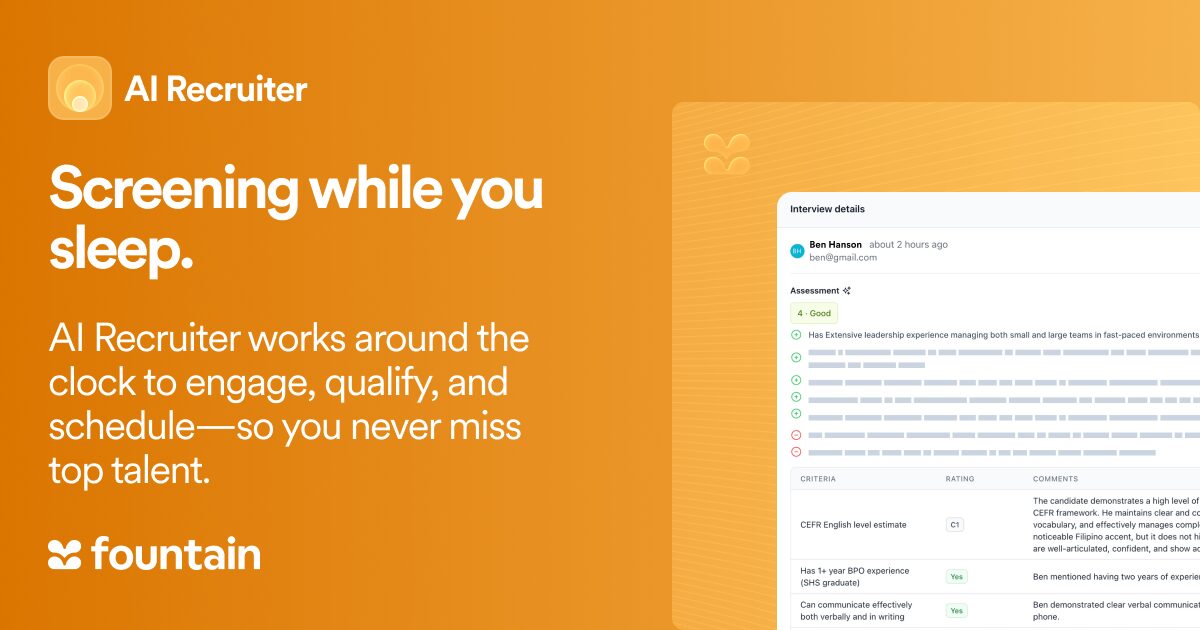
- Anna, the AI Recruiter, runs voice and SMS interviews around the clock and turns responses into structured evaluations hiring teams review, so an after-hours applicant finishes the first screen before the next recruiter shift starts.
- Emma, AI 24/7 Support, answers candidate questions and clears document blockers at every stage.
- Sam, AI Satisfaction, surfaces engagement and retention signals after the hire. Offer approvals and exceptions route to a manager, so decisions that would need defending in an audit stay human.
The agents act on the platform underneath:
- Fountain ATS logs stage changes and books interviews against real manager availability
- CRM holds the owned talent pool
- Onboarding carries a signed offer through to a completed I-9 without re-keying.
Alto used this stack to hire 450 drivers across five new markets in six months with a team of three recruiters, at a $300 average cost-per-hire and a time-to-offer of two to seven days.
Against a 27.5-day market average, Alto’s numbers point at the measure worth applying to any generative AI purchase: candidate movement, not drafting output. Drafting time has already collapsed, which makes screening, scheduling, and approvals the bottlenecks that decide whether a candidate is still available on Friday.
Book a demo to see the path from generated posting through a voice screen to a booked interview and a completed onboarding task.
Frequently asked questions about generative AI in recruiting
What is the difference between generative AI and agentic AI in recruiting?
Generative AI creates recruiting content, while agentic AI completes multistep recruiting work with human approval on decision-related steps. The test is whether a tool only hands back text or also completes the workflow.
Does generative AI make hiring decisions?
No. It drafts and converses, while scoring, ranking, and selection belong to predictive tools and, legally, to the employer. New York City’s Local Law 144 targets tools that substantially assist or replace decision-making, which content-writing tools do not do.
Will generative AI replace frontline recruiters?
No. It removes drafting and repetitive communication, and paired with agentic execution, much of the administrative handoff work between funnel stages. Recruiters still own judgment calls, exceptions, and final hiring decisions.