Software is becoming the back end. Agents are becoming the front end. The question that separates recruiting platforms in 2026 isn’t whose applicant tracking system (ATS) has the better dashboard, it’s whose agents actually screen candidates, schedule interviews, answer questions at 2 a.m., and keep onboarding moving without a recruiter touching the workflow.
Agentic AI receives a goal (“hire 50 drivers before Monday”), builds a plan, executes inside its permissions, asks for approval where needed, and reports back. Traditional ATS software stops at visibility. Agentic systems close the loop between knowing and doing.
That distinction matters most where it breaks first. Filling 500 warehouse roles across 40 locations while onboarding seasonal quick-service restaurant (QSR) staff and replacing churned drivers is a different problem from managing 15 salaried requisitions, and it calls for a different high-volume hiring strategy.
According to Fountain’s Redefining Frontline Operations research, 60% of applicants abandon applications that aren’t optimized for mobile, and the average U.S. time from application to job offer sits at 27.5 days. Every day of delay costs a hire to a competitor moving faster.
How to evaluate agentic AI for frontline recruiting
Six tests separate platforms built for frontline velocity from corporate tools adapted downmarket, with agent depth first because that’s where the real competitive sorting happens.
- Audit the named agents and the orchestration depth. An orchestrator that turns a natural-language goal into a multi-step plan is different in kind from a chatbot that answers one question at a time.
- Test the mobile-first candidate experience on the device candidates use. 85% of frontline candidates apply via mobile, so application UX, SMS and WhatsApp engagement, and a mobile manager interface matter more than desktop configurability.
- Benchmark speed to fill against the 27.5-day U.S. baseline. Every day of delay costs hires when candidates weigh multiple offers.
- Verify workforce management, payroll, and HRIS integration before signing. Modular connections to UKG, ADP, Workday, or SAP reduce migration risk; confirm native connectors versus middleware.
- Map post-hire lifecycle coverage from offer through retention. Onboarding, compliance (I-9, E-Verify, background checks), and shift scheduling inside the same platform reduce handoff failures.
- Demand compliance automation built into the workflow. Healthcare and government need Office of Federal Contract Compliance Programs (OFCCP), Equal Employment Opportunity Commission (EEOC), and multilingual support in the workflow, plus audit-ready storage.
A tool had to clear most of these criteria to land on the list. The comparison table maps each platform; the profiles go deeper.
| Platform | Primary fit | Mobile / SMS-first | Full ATS | Post-hire tools | Named agents and depth | Key tradeoff |
| Fountain | Frontline hiring at high volume (QSR, retail, logistics, staffing) | Mobile-first, SMS, WhatsApp | Purpose-built for high volume | Onboarding, Shift & Scheduling, CRM, engagement | Multi-agent orchestrator coordinating AI voice interviewing, 24/7 multi-channel candidate support, and post-hire feedback | Built for frontline, not knowledge-worker hiring |
| Paradox (Workday) | Enterprise frontline within Workday ecosystem | SMS, chat, WhatsApp | Conversational ATS | Limited, through Workday | Olivia: single conversational agent for screening and scheduling | Requires Workday ecosystem commitment |
| SmartRecruiters (SAP) | Mixed corporate + frontline, SAP ecosystem | Moderate | Full ATS | Limited | AI sourcing and screening assistants embedded in the ATS | SAP integration roadmap uncertainty |
| iCIMS | Compliance-heavy enterprise | Moderate | Full ATS | Limited | Frontline AI suite from Apli acquisition | Frontline AI is new; limited third-party validation |
| Sense | Staffing firms, engagement on top of existing ATS | SMS, WhatsApp | Not an ATS | None | AI Recruiter, AI Interviewer, candidate matching | Requires an existing ATS to plug into |
| Phenom | Large enterprise, full talent lifecycle | Moderate | Full ATS | Shift scheduling | 30+ agents, no single orchestrator | Over-engineered for frontline-only buyers |
| Workstream | Multi-location QSR franchises | SMS-first, QR code apply | Yes | Shift scheduling, payroll | SMS-driven automation, minimal named agents | SMB-to-mid scale |
| Humanly | Mid-market high-volume hiring | Chat, SMS, voice | Yes (post-acquisition) | Limited | Conversational AI across chat, SMS, voice, video | Triple-acquisition integration in progress |
Two patterns hold across the table: most competitors ship one or two standalone agents, and most stop at hire.
8 Best Agentic AI Tools for Recruiting in 2026
1. Fountain
Fountain is the AI-native platform for the global frontline workforce. A multi-agent orchestration layer turns natural-language goals into coordinated tasks across the products underneath, covering AI voice interviewing, 24/7 multi-channel candidate engagement, and post-hire sentiment tracking.
It runs on a mobile-first ATS, Onboarding with I-9 and E-Verify, Shift & Scheduling, CRM for talent reactivation, and Sourcing. Fountain calls the result Frontline Superintelligence: intelligence that runs frontline work rather than software that reports on it.
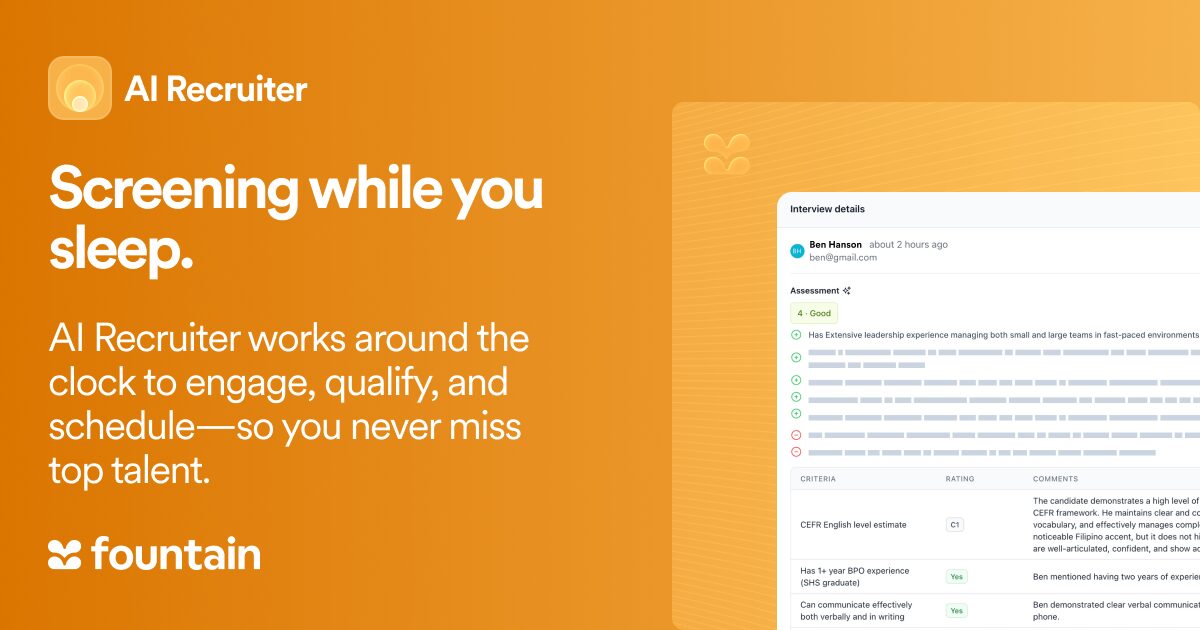
A TA director can type “Hire 50 drivers in Atlanta before Monday” and the orchestration layer breaks the request into sourcing campaigns, screening rules, interview slots, and onboarding triggers, asking for approval where it needs it. AI voice interviewing handles first-round screening 24/7 (74% of applicants choose voice over a scheduled call).
Multi-channel candidate support responds across SMS, voice, web chat, and WhatsApp at 2 a.m. Post-hire engagement intelligence checks in at Day 1, 10, 30, and 60 to flag retention risk before a worker quits. Most competitors stop at hire; Fountain keeps running.
Best for: Frontline employers hiring at high volume across multiple locations in QSR, retail, logistics, staffing, healthcare, and hospitality. The strongest fit is operators running thousands of hires across dozens or hundreds of locations.
Fit caveat: Knowledge-worker and corporate hiring sit outside the platform’s purpose-built scope.
Pricing: Custom pricing by hiring volume, with the ATS as entry point. AI voice interviewing is available standalone with a free trial.
2. Paradox (now “Paradox by Workday”)
Olivia is Paradox’s single conversational AI, coordinating screening, scheduling, and onboarding handoff across SMS, WhatsApp, email, and web chat. The Workday acquisition adds enterprise distribution at the cost of independence; AI features are licensed separately, and the consolidated product is still being built out as of early 2026.
Best for: Organizations on Workday HCM hiring high volumes of frontline workers, willing to standardize on a single conversational chatbot rather than a multi-agent platform.
3. SmartRecruiters (now “SmartRecruiters for SAP SuccessFactors”)
A 2025 Gartner Magic Quadrant Leader for Talent Acquisition Suites, now being integrated into SAP SuccessFactors. Built for knowledge-worker hiring first, with AI sourcing and screening assistants embedded in the ATS workflow. Mobile and SMS workflows feel adapted rather than purpose-built, and the SuccessFactors migration path creates roadmap uncertainty.
Best for: Mid-market to enterprise organizations in the SAP ecosystem managing mixed corporate and frontline hiring.
4. iCIMS
Frontline AI, launched Spring 2026 on the Apli acquisition, brings dedicated screening, multilingual outreach, and workflow automation to iCIMS’s enterprise ATS, with 300+ marketplace integrations plus OFCCP and EEOC support. The agent suite is a bolt-on rather than a coordinated orchestration layer.
Best for: Large enterprises in healthcare, government, and financial services that need heavy configurability and deep compliance tracking.
5. Sense
Sense is an AI engagement platform that layers on top of an existing ATS, with omnichannel engagement across SMS, WhatsApp, email, and chatbot plus AI Recruiter, AI Interviewer, and candidate matching agents. Sense is not itself a hiring platform; it requires two contracts, two integrations, and post-hire coverage stops short of onboarding.
Best for: Staffing firms and enterprise TA teams that already have an ATS and need a stronger engagement layer.
6. Phenom
Phenom has shipped 30+ AI agents across CRM, ATS, and candidate experience, with a Frontline Workforce Lifecycle and Shift Scheduling capability for mixed frontline and corporate hiring. The breadth is real, but the agents aren’t coordinated through a single orchestrator, and Capterra reviewers cite a long ramp to become a power user.
Best for: Large enterprises combining frontline hiring with internal mobility, workforce planning, and corporate TA in one platform.
7. Workstream
Workstream is an SMS-first HR, payroll, and hiring platform for hourly workers. Two-way SMS, QR-code applications, and text-to-apply work well for in-store recruiting, and payroll and onboarding sit in the same platform. There is no named agentic layer; SMS automation is rules-based.
Best for: Multi-location QSR franchises and small-to-mid retail operators hiring hourly workers in the U.S.
8. Humanly
Humanly engages candidates 24/7 via chat, SMS, voice, and video. Sprockets, Qualifi, and HourWork (acquired October 2025) consolidate conversational screening, voice, and re-engagement capabilities, but the integrated product is still a roadmap promise.
Best for: Mid-market organizations needing conversational AI for high-volume frontline hiring, with buyers verifying which capabilities from the triple acquisition are deployed.
How Fountain runs frontline hiring
Most platforms here bolt AI features onto a SaaS architecture designed for a different era. Fountain rebuilt the architecture for agentic AI for frontline hiring from the ground up. That’s what the company calls Frontline Superintelligence. Cue is the orchestration layer, the single entry point to every agent on the platform. A TA director types “Hire 50 drivers in Atlanta before Monday” and Cue breaks the request into sourcing, screening, interview slots, and onboarding triggers, asking for approval where it needs it.
Underneath Cue, three named agents handle the recurring work. There’s Anna, Fountain’s AI Recruiter, who interviews candidates by voice across thousands of openings, with 74% of applicants choosing her over a scheduled call. Then Emma, Fountain’s 24/7 candidate support, who answers questions across SMS, voice, web chat, and WhatsApp and routes answers back into the workflow.
And finally, Sam, Fountain’s post-hire engagement intelligence, who captures sentiment at Day 1, 10, 30, and 60 to flag retention risk before a worker quits. Every action is logged, traceable, and reviewable, with override protocols and bias auditing across protected groups.
If your operation is ready to compress time-to-hire and close the post-hire gap, book a demo to see Cue orchestrating Anna, Emma, and Sam on your hiring data.
Frequently asked questions about agentic AI recruiting tools
What makes agentic AI different from a recruiting chatbot?
A chatbot responds to individual candidate queries inside a single conversation. Agentic AI coordinates multi-step workflows across systems: screening, scheduling, onboarding triggers, multi-channel questions, manager notifications. The shorthand: a chatbot answers, an agent acts.
Will AI replace recruiters?
No. Agentic AI handles the high-volume mechanical work (screening, scheduling, multi-channel candidate communication, onboarding triggers, post-hire check-ins) while humans stay in control of final hiring decisions, judgment calls, and the relationships that matter. The agents log every action, ask for approval on sensitive steps, and route exceptions to recruiters. The shift is from recruiters doing the work to recruiters directing the work.
How should buyers validate agentic AI claims from vendors?
Deployment readiness matters more than slideware. Confirm which agents are already running for reference customers, what workflows they handle, how managers stay in control of final decisions, and what measured outcomes those customers can share at similar hiring volumes. A live demo on the buyer’s own hiring data is worth more than any analyst quadrant position.