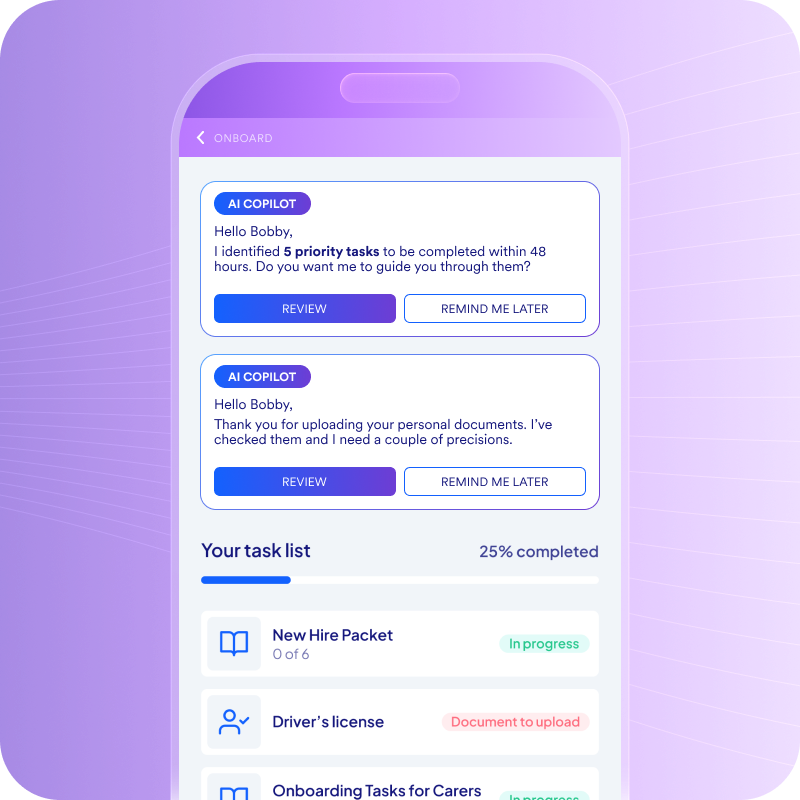
For many high-volume frontline teams, the best ATS is the one whose agents do the work between application and Day 1. Software has become the back end that records the workflow. Agents have become the front end that screens applicants, schedules interviews, sends reminders, collects documents, and moves qualified people forward while people keep decision authority.
High-volume hiring breaks in the handoffs. Fountain’s Frontline Report finds roughly 60 percent of frontline workers abandon job applications, most of them citing long or time-consuming forms. Mitratech’s 2025 benchmarks put average time-to-hire at about 44 days, up 33 percent from 33 days in 2021. Filling 500 roles across 200 locations needs always-on execution, and most talent acquisition software was built for 20 corporate roles run from one recruiter’s desk.
Gartner projects that 40 percent of enterprise applications will feature task-specific AI agents by the end of 2026, up from less than 5 percent a year earlier, with screening, scheduling, and candidate evaluation among the proven early uses. The 10 platforms below are sorted by what their agents complete without a recruiter, alongside mobile experience, integrations, and post-hire fit.
Last updated July 13, 2026. Platform capabilities, agent rosters, and acquisition and ownership details in this guide are drawn from public vendor documentation and third-party sources as of that date, with citations on the underlying data. Vendor products and ownership change often, so confirm contract-critical capabilities, roadmap items, agent availability, integrations, and post-acquisition support terms directly with each vendor before purchase.
TL;DR: the platforms at a glance
The frontline hiring market has 10 leading platforms, and they differ most in whether they run real hiring agents.
- Fountain: The frontline hiring platform, purpose-built for high-volume hiring across many locations, with Frontline Superintelligence and an agentic architecture orchestrated by Cue.
- iCIMS: Enterprise ATS with a Frontline AI suite, strongest where corporate and hourly hiring run on one system.
- SmartRecruiters (acquired by SAP in 2025, per HR Executive): Enterprise recruiting adapted downmarket, with high-volume capability and a natural fit for companies consolidating systems.
- Paradox: A conversational AI layer built on Olivia, now owned by Workday (per Orrick), with a strong chatbot experience for high-volume QSR and retail.
- Phenom: A talent experience platform that markets 30+ agents, expanding into frontline, though depth per agent varies across workflows.
- Eightfold: Enterprise talent intelligence built for professional, skills-based hiring rather than hourly volume.
- HireVue: Video interviewing and Assessment AI for structured, high-volume knowledge-worker evaluation.
- Harver: Assessment AI for retail, QSR, and contact-center workflows, plugged into an existing ATS.
- Hireology: A multi-location ATS with no dedicated hiring agents, better read as a workflow tool.
- Snagajob: Hourly sourcing and job distribution, with minimal dedicated hiring agents, so it sits early in the funnel.
They diverge most on agent depth, mobile experience, integrations, and post-hire coverage, and those four axes decide which one matches a given workflow.
Methodology: the 10 platforms below are the vendors most often shortlisted for high-volume frontline hiring, spanning enterprise ATS, conversational AI, talent intelligence, assessment, multi-location ATS, and hourly sourcing. Each is assessed on the same criteria set out below.
Most hiring software was not built for high-volume frontline hiring
Most talent acquisition software was built for corporate recruiting and stretched to fit frontline hiring. Vendors fall into three groups. Corporate ATS platforms, frontline hiring platforms, and talent intelligence platforms each solve a different problem, and recruiting CRM capability cuts across all three. The group that fits depends on the workflow that needs fixing, not the longest feature list. That gap is expensive at scale. Josh Bersin’s research shows more than 70 percent of US workers hold frontline roles, while most tooling was designed for the office minority.
Legacy corporate ATS platforms track applications, store compliance records, and organize recruiter workflows. They work for professional-pipeline hiring, where one recruiter runs a structured, multi-stage process. Aptitude Research puts the mismatch plainly, finding that high-volume industries don’t need a traditional ATS because it doesn’t support hourly candidates or busy managers. Aptitude Research also finds one in four companies plan to replace their ATS this year. Frontline platforms answer that gap by prioritizing speed over process, managers over recruiters, mobile over desktop, and simplicity over configurability.
Talent intelligence platforms add a predictive layer over HRIS, ATS, and labor-market data, which fits knowledge-worker roles where accomplishment evidence matters as much as availability. A recruiting CRM sits across all three groups and manages the relationship of a career rather than a single hire, so for frontline employers its value comes from texting past applicants and former workers when a matching job opens. One caution belongs here too. Many vendors now label ordinary features as AI, and Aptitude Research found in its 2026 AI adoption work that only 18 percent of teams deploy AI at meaningful scale across hiring. A reference customer with documented outcomes in a buyer’s vertical proves the difference between real automation and marketing.
How to evaluate a high-volume hiring platform
Seven criteria separate a high-volume platform that performs from one that only demos well. They run the full arc of work, from screening and scheduling through manager follow-up, onboarding handoff, compliance, reporting, and cost per hire.
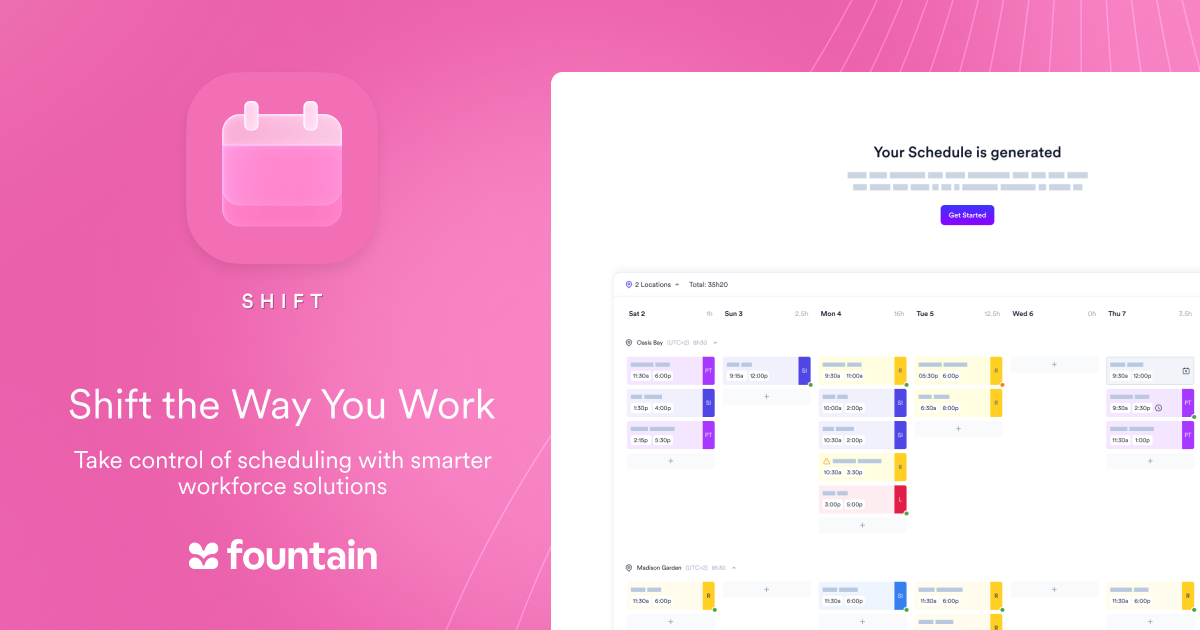
Smart, flexible scheduling built for frontline teams—because flexibility is essential, not optional.
Optimize your frontline workforce management with Fountain Shift—the all-in-one mobile scheduling solution designed to streamline operations and enhance employee satisfaction.
Automate shift creation, minimize errors, and empower your team with mobile access to schedules, time tracking, and seamless shift management. Experience the future of workforce scheduling today.
- Speed-to-hire and end-to-end automation. Fountain’s research finds a slow process is the top frustration for 57 percent of candidates, which makes delay a direct driver of lost hires. Strong platforms automate screening, self-scheduling, around-the-clock communication, and bulk processing.
- Mobile-first candidate experience. Appcast research shows roughly two-thirds of job-site traffic now comes from smartphones. A desktop-first apply flow misses how frontline candidates search, so mobile completion rates and SMS or messaging-app apply flows are the real proof.
- Integration depth with HRIS, WFM, and onboarding. Frontline hiring has to feed cleanly into existing workforce management. Native connectors to UKG, Workday, and ADP matter, along with onboarding handoff quality and whether integration ships pre-built or custom.
- Scalability under volume surge. Workology data shows applications per opening more than doubled from 116 to 244 between 2022 and 2025, which turns volume into a throughput problem. The credible vendors can show that bulk communication and workflow performance hold at peak.
- Compliance and labor-law support. The EU AI Act classifies recruitment and selection AI as high-risk under Annex III, and Gibson Dunn notes those obligations are now scheduled for December 2027 after the AI Digital Omnibus deferral. SOC 2 Type 2, bias auditing, data residency, and EEOC and OFCCP audit trails become go/no-go criteria for multi-region employers.
- Analytics and funnel visibility. Fountain’s data shows 43 percent of frontline hires leave within 90 days at roughly $7,000 each, so early attrition is a measurable cost of weak screening and onboarding. Real-time pipeline dashboards, source-of-hire attribution, and stage-by-stage drop-off tracking make that cost visible.
- Total cost of ownership. Per-hire and per-seat pricing behave differently as volume swings, so the model matters as much as the sticker price. A vendor that shows cost-per-hire outcomes from a customer at similar scale beats one quoting a headline average.
Scored against hiring volume, location count, mobile completion, recruiter capacity, and onboarding needs, these criteria turn a crowded field into a short list.
How the platforms compare on agents and frontline fit
One question sorts these platforms fastest. Which candidate steps does the software complete without a recruiter or store manager? Screening, scheduling, reminders, document collection, and manager handoff are where high-volume hiring usually stalls. The table sorts each vendor by the work its agents complete, next to market focus, frontline fit, and post-hire coverage.
| Platform | Primary market | Frontline fit | Named agents and agent story | Post-hire products | Best for |
| Fountain | High-volume frontline | Purpose-built | Cue orchestration layer; Anna live for phone screening and voice interviews; Emma and Sam are roadmap items, not live; people make the final call | ATS, Sourcing, CRM, Onboarding, Shift & Scheduling | Frontline hiring across many locations |
| iCIMS | Enterprise TA | Frontline AI suite, strengthened by the Apli acquisition | Frontline AI suite rather than a single named agent; suite-level automation configured per workflow | Broad enterprise suite plus partner network | Corporate and hourly on one enterprise system |
| SmartRecruiters | Enterprise recruiting | High-volume module inside an enterprise platform | AI sourcing and screening assistants that behave as an enterprise recruiting layer, not frontline-native orchestration | SmartOS spanning attraction to onboarding | Companies standardizing on SAP |
| Paradox | Conversational AI layer | Strong in QSR and retail | Olivia, a single conversational agent, easy to evaluate but one main layer rather than a multi-agent architecture | Conversational recruiting, now under Workday (per Orrick) | High-volume conversational apply |
| Phenom | Talent experience | Broad, not frontline-native | Markets 30+ agents; breadth is real, depth per agent varies by workflow | Shift scheduling and lifecycle modules that vary in depth | A professional and frontline mix |
| Eightfold | Talent intelligence | Not frontline-native | AI Recruiter, AI Interviewer, Candidate Concierge, tuned for skills-based hiring rather than hourly volume | Internal mobility | Enterprise skills-based hiring |
| HireVue | Video and assessment | High-volume structured evaluation | Assessment AI for structured evaluation, not conversational hiring | Focused on evaluation rather than post-hire workflow | Structured knowledge-worker screening |
| Harver | Assessment | Retail, QSR, contact center | Assessment AI for scoring and job fit, a quality-of-hire layer rather than full orchestration | Plugs into an existing ATS | Adding assessments to an existing ATS |
| Hireology | Multi-location ATS | Structured multi-location workflows | No dedicated hiring agents; workflow automation across locations | Onboarding and applicant management | Distributed teams that want structured workflow over advanced AI |
| Snagajob | Hourly sourcing | Job posting and candidate routing | No dedicated hiring agents; a sourcing and distribution layer | Limited post-hire; expects a downstream ATS | Sourcing hourly roles early in the funnel |
Based on the sources cited in this guide, only one platform in this set pairs a named, live hiring agent with a full frontline workflow beneath it, while most others automate a single step well or wrap configured workflow in AI language. That gap is worth pressing on in every demo.
Platform profiles
Fountain sits here alongside enterprise ATS platforms, conversational AI tools, talent intelligence systems, assessment vendors, a multi-location ATS, and hourly sourcing sites. Several are adjacent point tools rather than direct alternatives, so each is best weighed against the specific workflow a buyer needs to fix.
Fountain
Cue orchestrates the agents inside Fountain, the frontline hiring and workforce management platform built around Frontline Superintelligence. Anna is the live agent, running phone screening and voice interviews around the clock. Emma and Sam are roadmap items, not live today; confirm current availability with Fountain. Cue is the orchestration layer, not an agent.
Why Fountain wins for high-volume hiring
Fountain was built for filling 500 roles across 200 locations, where candidates move from application to offer in hours and the team still makes the final call. High-volume hiring fails in the handoffs, when the recruiter is offline and the onboarding team doesn’t see a post-shift application until the next day. Agentic systems act when the event happens, so screening, scheduling, and handoffs keep moving. Its integration center connects with UKG, SAP, ADP, and Workday rather than replacing the HCM.
Key features
- Cue, the orchestration layer. It lives inside every product and moves work forward, not an agent.
- The agents Cue orchestrates. Anna is live, screening and qualifying candidates through phone screening and voice interviews. Emma and Sam are roadmap items, not yet available. People make the final hiring decision.
- The platform the agents operate on. ATS, Sourcing, CRM, Onboarding, and Shift & Scheduling cover intake, reactivation, mobile onboarding, compliance, and scheduling.
Proof points
At UPS, Fountain reports time-to-offer as low as seven minutes across 1.98 million peak-season applicants, with 98 percent Day 1 I-9 completion, in its UPS results. At CLEAR, Fountain reports Anna cut time-to-hire from 17 days to 10.
Fountain’s 2025 Frontline Report says 74 percent of frontline workers prefer voice interviews over waiting.
Best for: High-volume frontline employers in QSR, retail, logistics, and outsourced services filling hundreds or thousands of roles across many locations who need speed, mobile-first apply, and a full worker lifecycle through onboarding.
Fit caveat: Fountain is built for frontline and hourly hiring. Companies hiring mostly corporate or knowledge-worker roles, or with low frontline volume, will get more from a general ATS or their HCM’s native recruiting module.
Book a Demo to see how Fountain handles high-volume hiring at your scale.
iCIMS
iCIMS is an enterprise applicant tracking system combining iCIMS Hire, a Frontline AI suite, iCIMS Engage for CRM, and employer branding in a broad partner network. Founded in 2000 and named a Gartner MQ Leader for talent acquisition suites, it serves large enterprises, and in 2025 it acquired Apli to add multilingual, hourly coverage.
Key features
- Frontline AI suite for high-volume, multilingual, hourly hiring, strengthened by the Apli acquisition
- Text recruiting and live chat from the TextRecruit acquisition
- Broad partner network across HCM and workforce systems, with reporting for talent-pool and hiring-metric analysis
Best for: Enterprises that want one ATS for both corporate and frontline hiring and can invest in a multi-month rollout.
Limitations for frontline hiring: Enterprise configuration runs heavier than a dedicated frontline tool, and mobile apply is worth testing with real hourly candidates before rollout.
SmartRecruiters
SmartRecruiters is enterprise recruiting adapted downmarket, known for high-volume recruiting, automation, and automated candidate engagement. HR Executive reports SAP acquired SmartRecruiters in 2025, and it continues as a standalone product interoperable with SAP SuccessFactors rather than folded into SAP’s separate SuccessFactors Recruiting module. Diginomica reports SAP named high-volume capability as part of the rationale.
Key features
- Unified SmartOS spanning attraction, selection, hiring, and onboarding
- Dedicated SmartCRM and a high-volume hiring module, with workflow configurability
- AI sourcing and screening assistants for candidate scoring, screening, and scheduling
Best for: Mid-sized to large organizations, especially those consolidating onto SAP, that want one platform from attraction through onboarding across hourly and professional hiring.
Limitations for frontline hiring: The assistants read as an enterprise recruiting layer rather than a frontline-native, mobile-first conversational apply.
Paradox
Paradox is a conversational AI recruiting platform whose agent, Olivia, manages candidate conversations across SMS, WhatsApp, career-site chat, and email. Founded in 2016, Orrick reports Workday acquired it for $1 billion in 2025. Aptitude Research describes it as a prominent platform in frontline and hourly hiring.
Key features
- Olivia conversational AI operating around the clock across SMS, WhatsApp, career-site chat, and email
- Candidate screening through conversational flows that replace long forms
- Interview self-scheduling, reportedly bookable in minutes, per QSR reporting
Best for: High-volume QSR and retail employers whose main bottleneck is candidate engagement speed, and teams on or moving to Workday.
Limitations for frontline hiring: It works as a conversational engagement layer rather than a sourcing or full-lifecycle platform.
Phenom
Phenom is a talent experience management platform covering candidate attraction through internal mobility, and it markets 30+ agents alongside career sites, CRM, and a chatbot. Depth per agent varies, so hourly screening, scheduling, and manager handoffs are worth confirming on the specific paths a team plans to automate. Phenom reads as a broad talent-experience system rather than a dedicated frontline hiring platform.
Key features
- Phenom’s stated 30+ agents across features, with depth that varies by workflow
- Candidate discovery, screening, sourcing, and internal-mobility workflows
- Interview scheduling and candidate engagement at volume
Best for: Enterprises with a professional and frontline mix that want one platform spanning hiring, internal mobility, and workforce planning.
Limitations for frontline hiring: Enterprise breadth adds setup and workflow complexity beyond a dedicated frontline platform.
Eightfold AI
Eightfold is an enterprise talent intelligence platform built around skills-based recommendations for building, buying, or borrowing talent, with AI Recruiter, AI Interviewer, and Candidate Concierge across the layer. It fits workforce intelligence and internal mobility more than hourly volume.
Key features
- AI Recruiter, AI Interviewer, and Candidate Concierge across the talent intelligence layer
- Skills-based matching across a broad talent-profile dataset
- Talent intelligence connecting HRIS, ATS, and external market data, with AI-governance documentation
Best for: Large enterprises pursuing skills-based hiring, internal mobility, and workforce planning across mostly professional roles.
Limitations for frontline hiring: Talent intelligence depth runs beyond what hourly teams need when speed and mobile completion are the bottleneck.
HireVue
HireVue is an enterprise video interviewing and AI assessment platform for structured evaluation, supporting on-demand and live video interviews, scheduling, structured interviewing, automated evaluations, and ATS integration. Per SHRM, it discontinued its facial-analysis feature in March 2020.
Key features
- On-demand and live video interviewing for high-volume teams
- Assessment AI across structured evaluation dimensions
- Self-service scheduling and candidate status updates
Best for: Large enterprises running structured, high-volume evaluation for professional and knowledge-worker roles across time zones.
Limitations for frontline hiring: It covers evaluation, so conversational apply, scheduling, and candidate follow-up need a separate layer.
Harver
Harver Assessments evaluates candidates through skills tests, situational judgment tests, and realistic job previews. Its Assessment AI scores candidates rather than orchestrating a full hiring workflow, so it works as a quality-of-hire layer on an existing ATS.
Key features
- Assessment AI scoring candidates on situational judgment and job fit
- Realistic job previews that improve quality-of-hire
- Plugs into an existing ATS
Best for: Retail, QSR, and contact-center teams adding assessment-driven quality-of-hire to an ATS they already run.
Limitations for frontline hiring: It doesn’t cover conversational-agent, voice-interview, onboarding, or scheduling workflows.
Hireology
Hireology is a multi-location applicant tracking option for SMB and mid-market buyers, oriented to structured hiring workflows across distributed teams rather than agent-first coverage. The practical test is whether it reduces manager follow-up across locations without adding recruiter cleanup.
Key features
- Structured hiring workflows for multi-location operations
- Distributed-team coordination
- Onboarding and applicant management, with no dedicated hiring agents
Best for: SMB and mid-market operators hiring across multiple locations who want structured workflows over advanced AI.
Limitations for frontline hiring: Its AI depth is modest against agent-first frontline requirements.
Snagajob
Snagajob is an hourly sourcing and job-distribution option for comparing job posting, candidate routing, and basic workflow needs against fuller ATS requirements. It fits when applicant flow is the first question and deeper ATS, CRM, onboarding, or orchestration needs are still forming.
Key features
- Job posting and distribution for hourly candidates
- Application screening and candidate routing
- Job matching for entry-level roles, with no dedicated hiring agents
Best for: Employers that mainly need to source and post hourly roles and don’t need deep ATS or AI capability.
Limitations for frontline hiring: A job-board workflow may fall short of full ATS requirements, so pair it with a downstream ATS.
How to choose the best ATS for your workforce
Workforce type is the first filter. Corporate roles alongside high-volume hourly across brands point to iCIMS or SmartRecruiters in one enterprise system, with longer implementations and a less mobile-first candidate experience as the tradeoff. A QSR or retail bottleneck in candidate engagement speed points to Paradox, especially on Workday. Assessment-driven quality-of-hire on top of an existing ATS points to Harver. Skills-based professional hiring and internal mobility point to Eightfold or Phenom.
Fountain fits when the priority is fast mobile apply, automated screening and scheduling, onboarding handoff, and integrations with UKG, SAP, ADP, or Workday. Whichever platform makes the shortlist, a customer reference in your own industry, showing time-to-hire, completion rate, no-show, and cost-per-hire, tells you more than any demo. A useful demo runs your real hiring volume, not a generic workflow, so you can watch a candidate move from apply to interview to onboarding without hidden manual work between systems.
Frequently Asked Questions
What is the difference between an ATS and a recruiting CRM?
An ATS handles the transaction of a hire. It tracks applications and moves candidates through stages to an offer. A recruiting CRM handles the relationship over time. It keeps candidate data current, automates follow-ups, and re-surfaces past applicants when a matching role opens. For high-volume frontline employers, the CRM’s biggest payoff is talent reactivation. Former workers and prior applicants become new hires without fresh sourcing spend.
Why do corporate ATS platforms struggle with high-volume frontline hiring?
They were designed for knowledge-worker hiring, where one recruiter runs roles through a resume-centric, multi-stage process. That process is too slow when hundreds of roles need filling across many locations, and candidates take the first offer that moves. Aptitude Research finds one in four companies plan to replace their ATS, citing the need for more personalization, consistency, and speed. Persistent scheduling delays or inconsistent manager follow-up are platform-fit problems, not process problems.
How long should a frontline job application take?
Five minutes or less on a mobile device, the practical threshold for candidates applying between shifts. Appcast research shows applications that run past 15 minutes are abandoned by the large majority of candidates, while sub-five-minute mobile flows complete at several times that rate. Fountain reports the same lever from the conversion side, with sub-five-minute applications converting at 3.5 times the rate of applications running 15 minutes or longer.
Should AI make hiring decisions in high-volume recruiting?
No. A human-in-the-loop model lets AI agents screen, schedule, and engage candidates while hiring managers or HR staff review recommendations and make the final call. SHRM’s AI framework calls for human oversight of AI-generated recommendations before final hiring decisions. The EU AI Act classifies recruitment and selection AI as high-risk, and Gibson Dunn notes obligations are scheduled for December 2027 after the AI Digital Omnibus deferral, so bias auditing, transparency disclosures, and human review are becoming standard purchase criteria.