
In 2006, Amazon opened the infrastructure it had built for its own stores and called it AWS. Customers bought it because the most demanding retailer on Earth already ran on it.
Agentic software will be bought the same way. The first question to ask anyone selling you agents: do you run your own company on them?
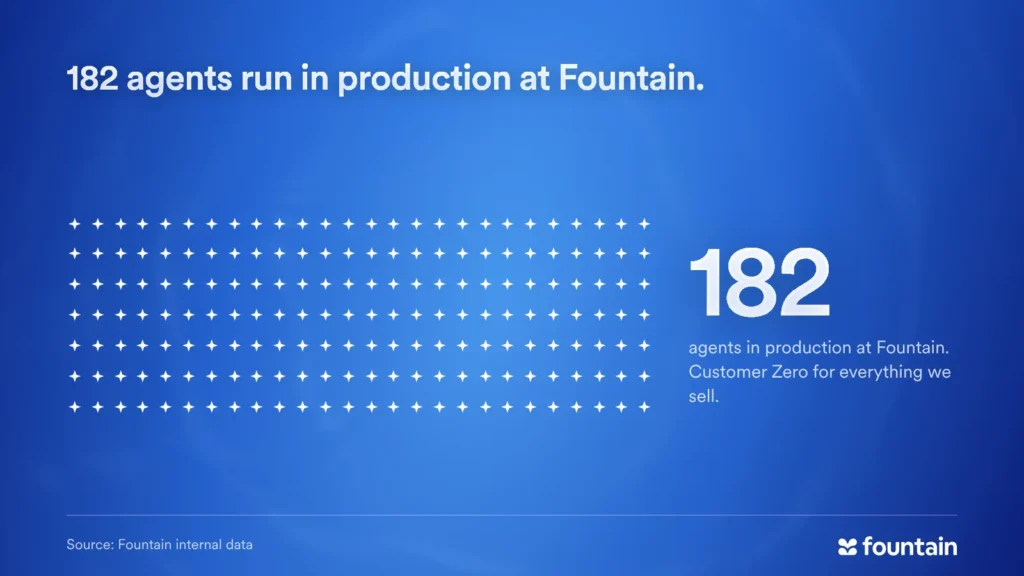
We do. One hundred eighty-two (182) agents run in production across Fountain. We are Customer Zero for everything we sell, and the hardest customer we have. Here is what that looks like in the two places it changed us most.
How we build
An idea at Fountain now starts as one sentence typed into what we call the software factory.
Agents read everything we already know about the problem, from customer calls to support tickets. Before anyone designs a screen, digital twins of our recruiters and hiring managers walk through the idea and say where they get lost. Five minutes later, the product manager is clicking through a working prototype drawn up on a copy of our real product. Agents then plan the change against our actual code and write it. One of them uses the new screens the way our users would and files what breaks.
Eleven gates sit between the sentence and the release. Agents do the work at every gate. A person signs every decision.
Work that took a squad of six people, a product manager, a designer and four engineers, six weeks now takes two people a day. That is about 1% of the effort, and much faster output.
Building got cheap. Judgment got expensive. So in the factory, every feature names the metric it should move before we build it, and we check that metric after it ships.
How customers start
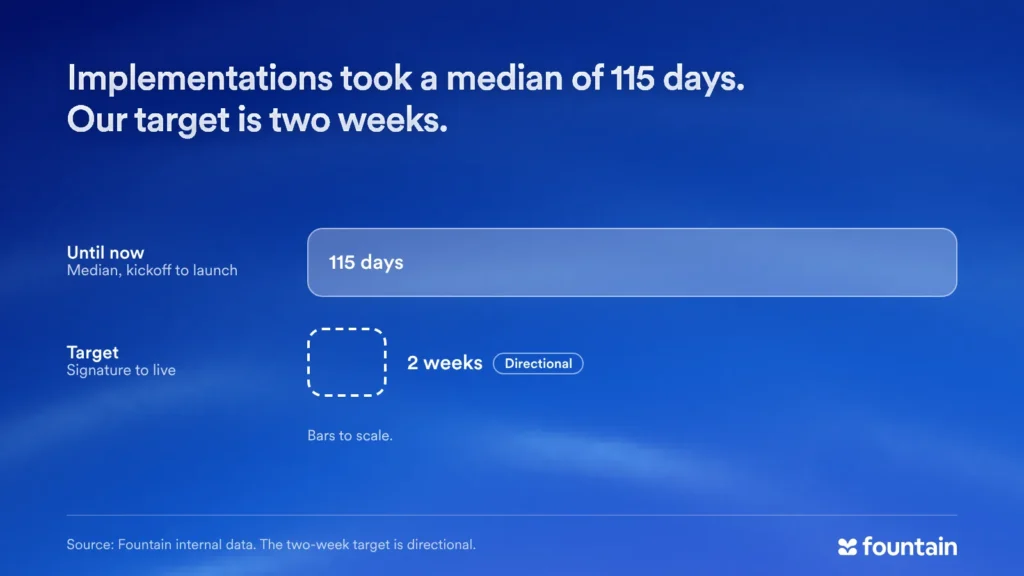
Implementation is where enterprise software loses months. Ours took a median of 115 days from kickoff to launch.
In September, we handed the finished specification of one of our customers to our implementation agent. That customer had taken 15 weeks to go live. The agent rebuilt the whole account, 403 stages and 351 openings, in two and a half hours.
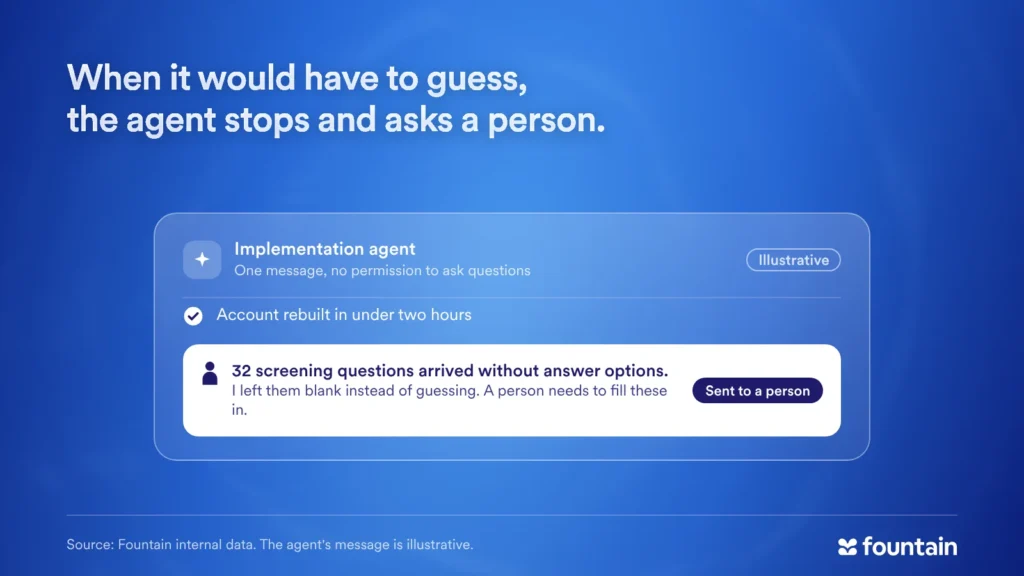
A week later, we ran it on another account with one message and no permission to ask questions. It finished in under two hours. When 32 screening questions arrived without their answer options, it left them blank and asked a person. That is the behavior we want. Judgment calls when needed, the task automated.
The lesson matched the factory’s. The slow part of an implementation is the decision-making. So we are rebuilding it around one checklist the customer and our team work through together, starting from the customer’s own data. Our target is two weeks from signature to live. That target is directional, and we are working toward it now.
Everywhere else
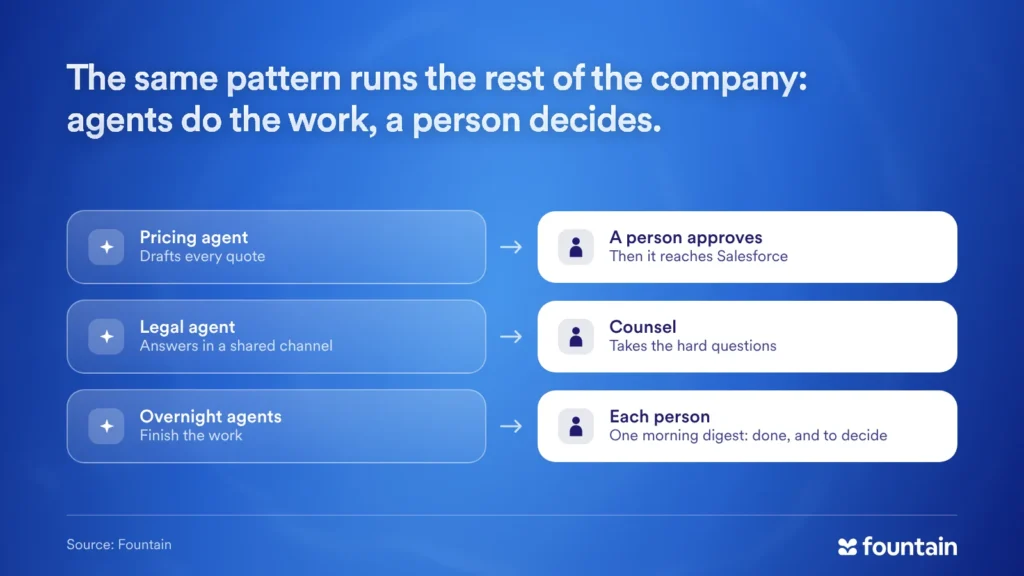
The same pattern runs the rest of the company. A pricing agent drafts every quote, and a person approves it before it reaches Salesforce. A legal agent answers questions in a shared channel and hands the hard ones to counsel. Each person starts the day with one digest: what agents finished overnight, and what needs their decision.
Why we do it
A hundred times the output means we build what used to sit on the roadmap for quarters, and every run makes the factory better. Every rough edge also cuts us before it reaches a customer. When an agent mishandles an edge case, it mishandles ours first, and we fix the problem.
An honest number: in early measurement, about three quarters of reviewed agent threads reach their goal. The other quarter is why every gate has a human signature, and why the implementation agent stops when it would have to guess.
That leads to the question every buyer should ask next: what exactly are these agents allowed to do?
Next in the series: Autonomy Is Earned.