Forty-three percent of new frontline hires walk out within the first 90 days, per the 2025 Fountain Frontline Report. Each of those exits costs roughly $7,000 to replace. Every unfilled shift compounds the loss. Frontline employers running dozens or hundreds of locations face fragmented systems that don’t talk to each other, and compliance gaps that surface too late.
HR Superintelligence is the answer that the category is converging on. It connects hiring, onboarding, scheduling, compliance, and workforce operations into a single system, then coordinates work within configured workflows toward business goals.
Fountain’s version of it, called Frontline Superintelligence, is purpose-built for the realities of high-volume, multi-location, hourly workforces. As Salim Jernite, Chief Product Officer at Fountain, put it, “Superintelligence, in our world, is intelligence that runs work, not software that reports on it.”
This article covers what HR Superintelligence means in practice, how it differs from HR automation and traditional HR tech, what the four building blocks look like, and how to start moving toward it.
What is HR Superintelligence?
HR Superintelligence is a production-grade execution layer for workforce operations. It understands an operational goal, builds a plan, and runs the work across hiring, onboarding, scheduling, and compliance. Governance is built in, and humans stay in the loop on the decisions that matter.
It is not a bigger model, and it’s definitely not a chatbot stapled onto an ATS. It is the loop between knowing and doing, closed inside permissions and audit trails.
The shorthand from Salim Jernite: enterprise adoption is intelligence plus trust. Intelligence on its own produces interesting demos. Trust on its own produces another reporting dashboard. Both together produce a system that can operate at scale without breaking.
For frontline hiring specifically, this is where the test gets hardest. When software fails in a knowledge-worker context, someone misses a deadline. When software fails on the frontline, a shift goes unstaffed, a candidate ghosts a competitor’s offer, or an I-9 misses the three-day window. Software failure becomes operational failure. The frontline is where you find out whether HR Superintelligence actually runs work or just narrates it from the sidelines.
From HR automation to HR Superintelligence
HR automation handles tasks. HR Superintelligence coordinates work toward goals within configured rules and approvals. Automation sends the text reminder. It fills in the form field. It moves a candidate from one stage to the next based on a rule someone wrote six months ago. Each step runs in isolation. When context changes (a new compliance regulation, a demand spike, a regional bottleneck), the whole thing breaks until a human intervenes.
The real shift is from assistance to execution. The market is moving from ‘tell me’ to ‘do it.'”
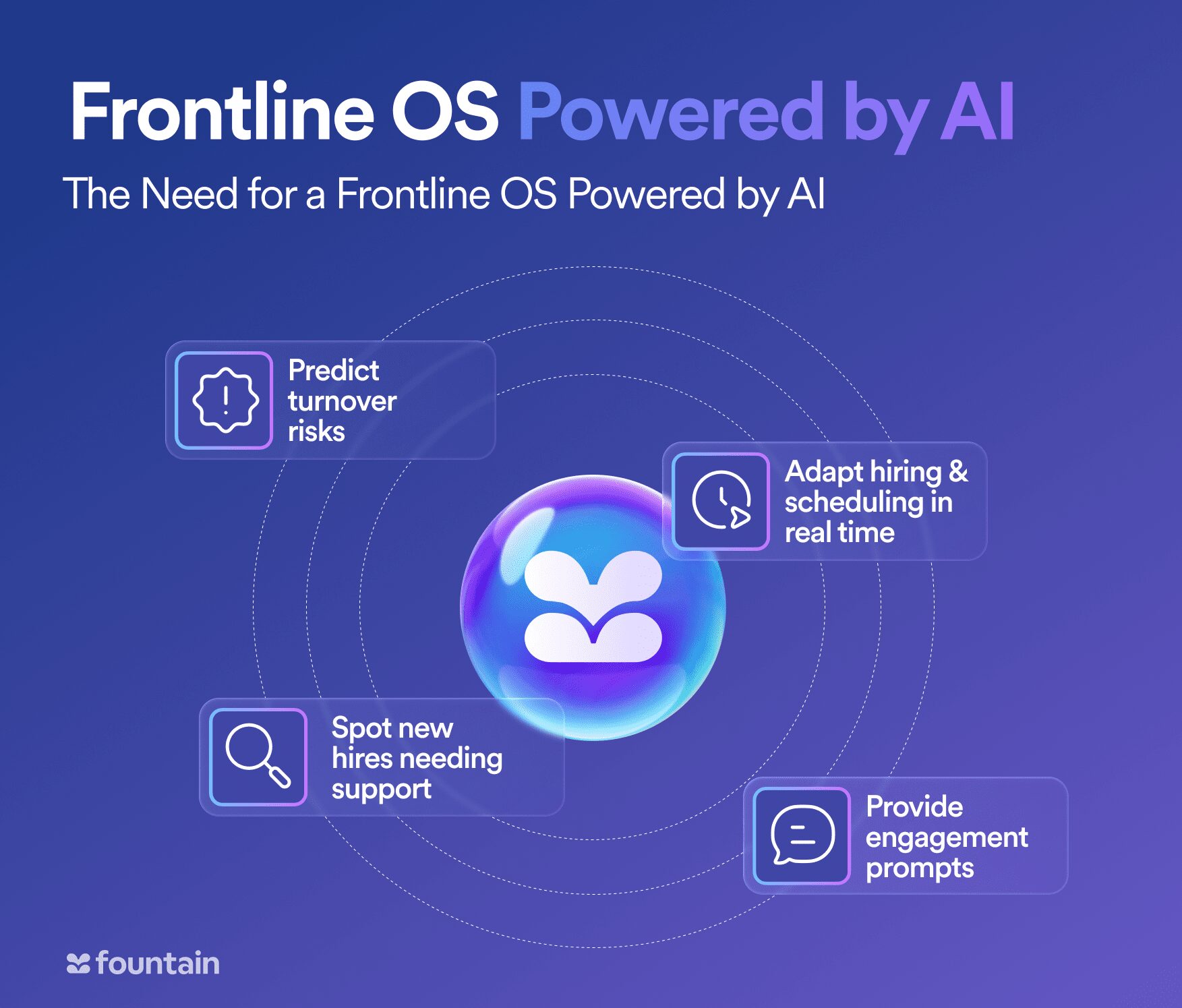
That line separates an automated HR stack from an HR Superintelligence system. Automation reduces clicks. A copilot surfaces recommendations. HR Superintelligence ingests data from across the full worker lifecycle, then coordinates workflow execution across systems to support business goals: staffed shifts, lower churn, faster hiring and fewer compliance gaps.
Specialized AI agents handle defined operational tasks inside approved workflows. An orchestration layer coordinates them. Humans approve high-stakes decisions and make final hiring decisions.
McKinsey defines the underlying capability: agentic AI systems “pursue multistep, adaptive goals with limited human oversight” and are “capable of planning, executing, and adjusting to a variety of situations that previously required human judgment and coordination.”
The four building blocks of HR Superintelligence
HR Superintelligence runs on four layers. Each one is load-bearing. Strip one out and what’s left is the disconnected tool stack the system was built to replace.
- Unified data: Applications, shifts, performance metrics, retention signals, and compliance status feed into a single connected layer. Fragmentation is the structural problem; consolidation is what makes the rest possible.
- The operating layer: Configurable workflows that span the worker lifecycle, from sourcing and candidate relationship management through applicant tracking, onboarding, and shift scheduling. Each module handles a distinct operational function. Together, they form the system the agents operate on.
- Specialized AI agents: Each agent is scoped to a specific function. One handles voice and SMS interviews. Another runs 24/7 candidate Q&A and application support. A third surfaces retention risk through post-hire check-ins. This is what agentic AI looks like in practice: systems that coordinate execution across workflows to resolve goals within defined boundaries.
- Built-in governance: Role-based permissions control who can do what. High-stakes actions preview before execution. Audit logs capture every AI-driven action. Budget controls cap spend, and humans override at any critical decision point.
The coordination across all four is what separates HR Superintelligence from isolated point products.
What HR Superintelligence looks like on the front line
Five concrete capabilities, each running continuously across locations. Each one draws on the unified data layer, workflows, and specialized agents described above.
The difference shows up in how problems get resolved inside configured workflows before managers have to intervene.
1. Demand-responsive hiring
Demand-responsive hiring closes the gap between seeing a spike and staffing for it. The system detects an upcoming spike from historical application curves, attrition trends, and shift forecasts.
Within defined workflows, it can ramp sourcing, reactivate dormant talent pools, and run AI pre-screening before a manager submits a requisition. Hiring teams still make the final hiring decision.
For example, Everli, the Italian grocery delivery service, saw a 600 percent applicant surge during peak demand and cut time-to-convert from 15 days to three days with the same team size.
2. Funnel diagnosis and repair
Funnel diagnosis is what stops slow leaks from becoming permanent ones. The system watches stage-to-stage conversion across every location, role, and time window. When a region’s application-to-screen rate dips, it flags the bottleneck, can trigger automated follow-up for stalled candidates inside approved workflows, and reports the outcome for review.
A good example of this is Stitch Fix, which moved the day-one show rate from 68 percent to 95 percent by pairing mobile-friendly workflows with automated screening.
3. Shift gap coverage
Shift gap coverage means the manager sees a solved problem, not an open one. 48 hours before a gap opens, the system identifies unfilled shifts, matches available qualified workers from the talent pool, sends coverage requests by text, and confirms shifts within configured workflows, permissions, and approvals.
For many frontline teams, shift coverage is still handled manually when gaps open. The operational gap is enormous.
4. Compliance at scale
Compliance is where the cost of getting it wrong shows up fastest. ICE audits doubled to 6,400+ in a single fiscal year, with fines up to $28,619 per worker for repeat offenses, per Fountain’s Employer’s Guide to I-9 Audits. HR Superintelligence tracks I-9 completion rates, background check status, E-Verify submissions, and orientation progress across every location continuously.
5. Post-hire retention signals
Post-hire retention signals catch the people who are about to walk before they actually do. The system runs scheduled check-ins at day 7, day 30, and day 90, captures sentiment through SMS or voice, flags responses that signal flight risk, and routes the case to a manager with a recommended action.
Onboarding quality is the strongest predictor of whether any of it works: per the 2025 Fountain Frontline Report, employees who describe onboarding as “messy” are 9x more likely to plan their exit, and 43 percent of frontline new hires leave within the first 90 days.
Catching disengagement at day 7 instead of day 91 is the difference between a coaching conversation and a replacement requisition.
HR Superintelligence vs. traditional HR tech
Here’s the easiest way to tell HR Superintelligence apart from everything else on the market. Most tools describe work, react to work, or recommend what to do about it. HR Superintelligence runs the work, inside governance, and reports back.
The table below stacks the four categories side by side so the gap shows clearly.
| What you might have | What it does | Where it stops |
|---|---|---|
| AI chatbot | Answers candidate questions | Doesn’t act on what it learns |
| Automation | Handles one step (sends a text, fills a form) | Breaks when context changes |
| Copilot | Surfaces recommendations in your workflow | You still execute manually |
| HR Superintelligence | Understands the objective, coordinates work across systems, reports back | Works within governance; you review and approve |
Most teams already run the top three. The work still piles up. The fourth row is the only one that changes that.
Why HR Superintelligence matters for frontline employers
Frontline employers move to HR Superintelligence for two reasons. The first is operational: lower vacancy rates, faster hires, fewer compliance fines and less turnover. The second is human: managers, HR leaders, and recruiters spend their time on different tasks. Both compound the longer the system runs.
Business impact
The business case shows up in metrics tied to real costs and real revenue. Each one below compounds across every location you operate.
- Faster response to demand spikes: Hiring ramps when the data signals a spike (historical application curves, attrition trends, shift forecasts), not three weeks after a manager finally submits the req. The system pre-warms the funnel so candidates are screened and ready before the operational pressure hits. Bojangles, the QSR chain with 750 locations across the Southeast, cut time-to-hire from 30 days to 5.8 days running this pattern.
- Lower vacancy rates: Every unfilled shift is lost productivity, a missed SLA, or overtime someone else has to pick up. The system keeps the talent pipeline warm continuously, so vacancies fill from a ready pool instead of a cold sourcing scramble each time.
- Lower turnover costs: Replacing a frontline worker runs about $7,000 per the 2025 Fountain Frontline Report, and 43 percent of new frontline hires walk in the first 90 days. The system protects against that cost by standardizing onboarding across locations, surfacing retention risk early through structured check-ins, and cutting the friction that pushes new hires back out the door before they ever get traction.
- Better candidate experience: Frontline candidates apply to multiple jobs at once and take the first credible offer that lands. HR Superintelligence keeps the conversation moving with 24/7 responses, fewer dropped threads, and faster scheduling, which closes the window where a competitor’s offer can pull them away.
- Compliance without the scramble: Most compliance work runs on spreadsheets and panic until an audit shows up. HR Superintelligence handles I-9 completion, E-Verify submissions, and predictive scheduling rules continuously across every location, with audit logs that hold up under enforcement review.
Each one connects back to the same structural shift: the system closes gaps before they become emergencies. Across 50 or 500 locations, that compounds into the difference between an operation that runs and one that constantly puts out fires.
Human impact
The other half of the case is what changes inside the org. HR Superintelligence doesn’t replace HR teams or managers. It changes what they spend their day on.
- Managers: Shift from task management to coaching and running the floor. The hours they used to spend chasing candidates and filling shifts go back into the operation they’re actually paid to run.
- HR leaders: Stop firefighting individual exceptions and start designing the systems that prevent them. Strategic work becomes possible when the operational work runs itself.
- Recruiters: Move from chasing applications one at a time to running a portfolio of hiring funnels. The job becomes managing throughput, not personally touching every record.
Liveops, the virtual contact center, runs a nine-person recruiting team that manages 400,000 applications a year and cut time-to-fill by 48 percent. That throughput isn’t a feature you buy. It’s what happens when the system handles the work, and the team handles the judgment.
The verticals where HR Superintelligence matters most: retail, QSR, logistics, warehousing, healthcare, staffing, manufacturing, and outsourced services. Anywhere with high-volume, multi-location, time-critical workforce operations.
How to start moving toward HR Superintelligence
Four steps, in sequence. Each builds on the last, and trying to skip ahead just means rebuilding the foundation later under deadline pressure.
- Data and workflow consolidation: Consolidate hiring, onboarding, and scheduling onto a single system that can see across them. Fragmentation is the structural problem. Consolidation is the structural fix.
- Baseline automation: Run candidate communications, screening, and onboarding tasks as workflows, not ad-hoc emails. This is where most teams find the first 80 percent of recruiter time savings.
- Agent deployment, one workflow at a time: Screening is the best starting point: highest volume, clearest measurement. Add candidate support next. Add post-hire retention signals last.
- Governance before scale: Role-based permissions, approval thresholds, audit logs, human override. The governance layer is what makes scale safe. This is also a live compliance issue, with California Civil Rights Council rules and other emerging frameworks raising expectations around human oversight, documentation, and auditability for AI used in employment decisions.
This is a phased rollout, not a re-platform. Many operators see early wins in time-to-hire and screening throughput soon after implementation, with broader lifecycle benefits building over time.
How Fountain runs HR Superintelligence in production
Most agentic systems are still demos. Production means handling 24/7 candidate flow, same-day hiring windows, multilingual pools, regulatory frameworks that differ by jurisdiction, and audit exposure that compounds with every location.
Fountain has spent years building what the rest of the field is now trying to assemble. The branded version is Frontline Superintelligence: HR Superintelligence built for hourly, multi-location, high-volume workforces. Here’s how it ships:
- Orchestration layer: Cue takes a plain-English goal (“hire 200 drivers in three weeks across the Southeast”), builds the plan, carries work forward inside permissions, asks for approval where needed, and summarizes what changed.
- Three named agents: Anna runs voice and SMS interviews 24/7. Emma handles candidate Q&A and application support. Sam runs post-hire feedback and retention signals, the part of the lifecycle most platforms still leave to spreadsheets.
- The platform underneath: Sourcing, CRM, ATS, Onboarding, and Shift & Scheduling. One operating system the agents act inside, not a stack of point tools.
- Governance built in: Role-based permissions, audit logs for every action, budget controls, and human override at every critical decision point. Constitutional AI safeguards and bias auditing across protected groups.
Every quarter without a coordinated system costs you in turnover, delay, and compliance exposure that compounds with every location you add. The longer the patchwork sets the rules, the harder it gets to retrofit. HR Superintelligence is already running hiring, onboarding, scheduling, and other workforce operations for frontline employers, with less chaos and more control.
Salim Jernite’s frame closes it: “If you can make it run there, under pressure, at volume, with compliance, across locations, on mobile, in real time, you are not building another assistant. You are building the infrastructure for how work gets done next.”
Book a Fountain demo to see Cue, Anna, Emma, and Sam in one interface.
Frequently asked questions about HR Superintelligence
Is HR Superintelligence the same as general AI superintelligence?
No. General AI superintelligence refers to a theoretical system that exceeds human intelligence across all domains. HR Superintelligence is a production-grade execution layer scoped to workforce operations: hiring, onboarding, scheduling, compliance, and retention. It is domain-specific, governed, and built to run within human-set boundaries.
Does HR Superintelligence replace HR teams or managers?
No. HR Superintelligence handles the coordination, screening, scheduling, and compliance work that currently consumes most of a team’s time. Humans make the final call on hiring decisions, set the goals, define the guardrails, and override when needed. Teams shift from task execution to strategy and exception management.
What’s the difference between HR automation and HR Superintelligence?
HR automation handles isolated tasks: sending a text, filling a form, moving a candidate between stages based on a static rule. HR Superintelligence ingests data across the full worker lifecycle, coordinates specialized agents across systems, and drives toward business goals like staffed shifts and lower churn. Automation reduces clicks, and a copilot surfaces recommendations. HR Superintelligence coordinates execution across systems within governance boundaries.
Which industries benefit most from HR Superintelligence?
Any industry with high-volume, multi-location, time-critical workforce operations. Retail, QSR, logistics, healthcare, manufacturing, staffing, and outsourced services all face volume, urgency, and compliance pressures that HR Superintelligence is built to address.