Frontline employers have more data than ever. They can see where candidates drop off, which locations underperform and which shifts go unfilled. The problem is that they don’t act on it fast enough. The insight exists, but execution doesn’t follow.
The root cause is fragmentation. Per Fountain’s Redefining Frontline Operations research, 70% of HR employees use three to six apps to complete a single task. Hiring lives in the ATS, scheduling lives in a spreadsheet, and compliance lives in another system. Managers become the integration layer, translating data into action by hand. That fragmentation costs U.S. employers more than $21 billion a year in management inefficiencies.
The outcomes are measurable and expensive. 82% of employers say they struggle to hire frontline workers, according to the 2025 Fountain Frontline Report. The same report shows that 43% of new hires leave within 90 days. Replacing one frontline worker costs $6,500 to $7,000. That’s about 40% of their annual pay. And when 42% of applicants withdraw if scheduling takes too long, every day of delay is a candidate lost to a competitor who moved faster.
These problems don’t respond to better dashboards or faster alerts. They respond to a different kind of system. One that closes the loop between insight and action automatically, within governed boundaries, across every location. That category now has a name: frontline superintelligence.
Defining frontline superintelligence?
Frontline superintelligence is an AI execution layer that connects hiring, onboarding, scheduling, compliance, and workforce operations into a single system. It senses what’s happening, plans the response, and acts. Continuously, across locations, within human-set boundaries.
It closes the gap between knowing what’s wrong and actually fixing it.
Applied to frontline operations, where execution failures are immediate and measurable, frontline superintelligence represents a shift from software that reports on work to a system that runs it.
How frontline superintelligence works in practice
Every interaction follows the same logic: intent, plan, approval, execution. The operator states an objective. The system builds a plan, gets approval, executes, and summarizes what changed. Every action is logged, auditable, and reversible. Humans review and approve high-stakes decisions, while the system handles everything in between.
Four scenarios make the pattern concrete:
1. Demand-responsive hiring
Demand-responsive hiring closes the gap between seeing a spike and staffing for it. The system detects a seasonal spike approaching based on historical patterns, ramps sourcing, activates dormant talent pools, and pre-screens candidates. All before a manager submits a request.
The signals come from data already in the system. Last year’s application curve. Last quarter’s attrition rate. The shift forecast three weeks out. When those patterns line up the way they did before a past hiring push, the system treats that as the trigger.
Execution runs in parallel from there. Sourcing channels that went quiet reactivate. Talent pools from previous seasons (workers who finished a prior stint in good standing) get re-engaged with a text asking if they’re available.
Fresh applicants move through knockout questions, assessments, and background checks automatically. By the time a manager logs in to submit a requisition, there’s already a qualified pipeline waiting.
The payoff shows up when demand actually spikes. Everli, the Italian grocery delivery service, saw a 600% applicant surge during COVID and cut time-to-convert from 15 days to 3. An 80% reduction, with the same recruiting team size.
2. Funnel diagnosis and repair
Funnel diagnosis and repair catches conversion problems in days, not at the next quarterly review. When drop-off spikes at the screening stage for one region, the system identifies the bottleneck, proposes workflow changes, triggers re-engagement to stalled candidates, and reports the fix.
Diagnosis starts with comparison. The system monitors stage-to-stage conversion across all locations, roles, and time windows, then flags any variance against the baseline. A 40% application-to-screening rate is fine if that’s the baseline. A sudden dip to 22% in one region or one role is the signal that triggers an investigation.
From there, the system looks at what changed. A new screening question that runs too long, a background check vendor with a delayed turnaround, or an automated message that stopped sending.
Whatever’s driving the drop gets surfaced with the candidate data attached. The fix comes with it:
- Rewrite the question
- Swap the vendor
- Restart the automation
- Reopen a stalled candidate batch with a re-engagement message
Stitch Fix ran this play on day-one show rates.Only 68% of applicants who cleared background checks actually showed up for their first shift. Running A/B tests on interview flows through Fountain’s analytics surfaced a counterintuitive finding: candidates with human contact at the offer stage showed up at dramatically higher rates than those on fully automated paths.
The team rebuilt the handoff, and the show rate jumped to 95%. This represented a 40% increase, from the same applicant pool.
3. Shift gap coverage
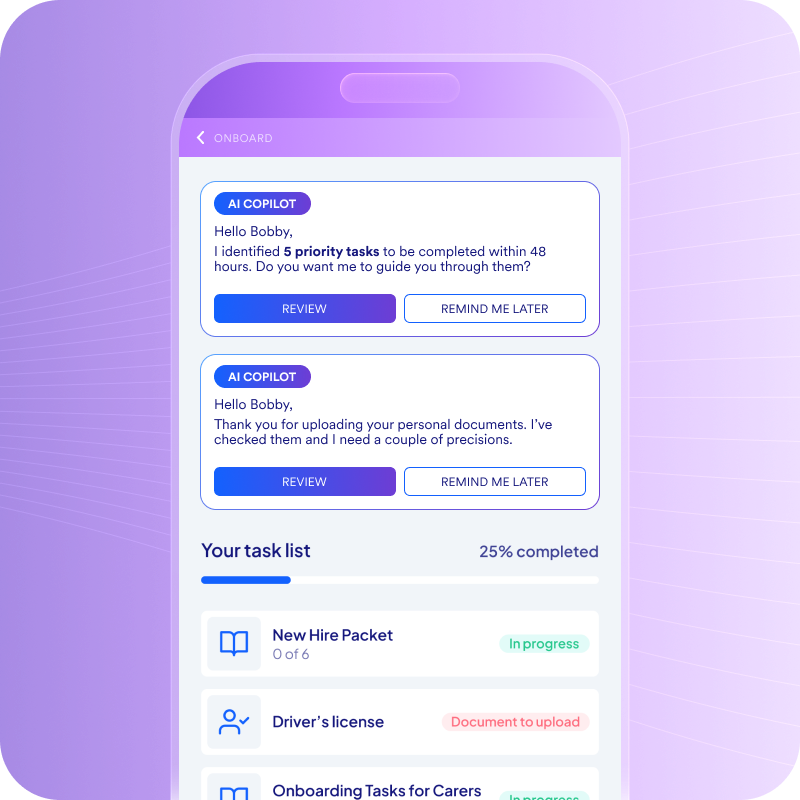
Shift gap coverage kills the last-minute scramble. Forty-eight hours before a gap, the system identifies unfilled shifts, matches available workers from the talent pool, sends assignments, and confirms coverage. The manager sees a solved problem, not an open one.
Detection runs continuously against the schedule. Scheduled hours versus staffed hours. Last-minute callouts. Workers who have just crossed an attrition threshold. Locations trending toward a gap based on historical patterns. Any of those signals kicks off matching before the gap becomes a scramble.
Matching weighs the variables a manager would weigh manually. Who’s qualified for this shift. Who’s within commuting distance. Who’s available without pushing into overtime. Who prefers more hours. Who’s in good standing from past shifts. The system narrows the pool, sends a coverage request by text, and moves to the next match if the first declines. Every step gets logged for the manager to review, not re-do.
Marsden Services, a facility services provider managing 50+ brands, ran into the coverage problem from the hiring side. Tighter sourcing and faster matching cut client vacancy rates from 18% to 6%. A 66% reduction in locations running short-staffed, with the same recruiting team absorbing more client demand.
4. Compliance at scale
Compliance at scale catches problems when they happen, not when the audit arrives. I-9 completion rates, background check status, and orientation progress get tracked across hundreds of locations continuously. Gaps are flagged, and follow-ups are triggered automatically.
The tracking pulls from every system that touches a worker’s compliance status:
- E-Verify submissions
- Background check vendor responses
- State-specific work authorization windows
- Orientation completions logged against start dates
Each field has a deadline, and each deadline has an owner. When a document is missing or a check is stalled, the exception surfaces in real time rather than in a quarterly audit prep cycle.
The follow-up runs on its own. Candidates get reminder texts for outstanding documents. Managers get flagged when a worker’s start date is at risk. HR gets escalated alerts when a deadline passes without resolution.
Every action sits in an audit log, so the paper trail exists whether the audit arrives tomorrow or two years from now.
The stakes are concrete. Per Fountain’s Employer’s Guide to I-9 Audits, ICE audits exceeded 6,400 in a single fiscal year. Paperwork violations run $288 to $2,861 per instance. Knowingly employing unauthorized workers can reach $28,619 per worker for repeat offenses.
The building blocks for frontline superintelligence
Four components make frontline superintelligence work. None of them works in isolation.
- A unified data layer: Applications, shifts, performance metrics, retention signals, and compliance status feed into a single connected layer. The intelligence layer reads and acts on all of it at once. The 70% of HR employees juggling three to six apps for a single task is exactly the problem consolidation solves.
- Automated workflows: Hiring, onboarding, scheduling, and candidate communication are each configured as workflows that the system can run. Each workflow runs largely on its own once configured, with humans stepping in at critical decision points.
- Specialized AI agents: Recruiting, candidate communication, onboarding compliance, and engagement each get a dedicated agent focused on that workflow, coordinated by an orchestration layer. This is how agentic AI works in practice, per Fountain’s Agentic AI for Frontline Workforces research: systems that plan, decide, and act to resolve goals, coordinated through a single interface with increasing autonomy.
- Built-in governance: Role-based permissions control who can do what. High-stakes actions are previewed before they are executed. Every action lands in an audit log. Budget controls cap spend, and humans override at any critical decision point.
Pull any one of them out, and the system stops being a system. The coordination across all four is what separates superintelligence from a pile of disconnected tools.
How frontline superintelligence differs from copilots, chatbots, and automation
Most frontline employers already have some AI tools. The question is where those tools’ capabilities hit their ceiling.
| What you might have | What it does | Where it stops |
|---|---|---|
| AI chatbot | Answers candidate questions | Doesn’t act on what it learns |
| Automation | Handles one step (sends a text, fills a form) | Breaks when context changes |
| Copilot | Surfaces recommendations in your workflow | You still execute manually |
| Frontline superintelligence | Understands the objective, plans, executes across systems, reports back | Acts within governance; you review and approve |
The distinction comes down to one shift in posture. “Here is what I recommend” versus “Here is what I did, here is what changed, and here is what to review.”
The benefits of frontline superintelligence for employers
Frontline superintelligence delivers seven operational outcomes that hit the P&L directly.
- Fewer unstaffed shifts: The system closes gaps before they become emergencies. Managers stop scrambling for coverage and start running operations.
- Faster response to demand spikes: Hiring ramps when the data says it should, not when someone submits a request three weeks late.
- Better candidate experience: Candidates who apply on Tuesday hear back on Tuesday, not next week. Every day of delay is a candidate that a competitor could have caught.
- More stable teams: Faster onboarding, better candidate matching, and proactive engagement reduce the turnover that costs $6,500 to $7,000 per lost frontline worker.
- Managers freed from admin: Managers reclaim 9+ hours a week that used to go to scheduling, coordination, and administrative tasks. They shift from task management to coaching and running the floor.
- Compliance without the scramble: I-9, E-Verify, background checks, and predictive scheduling laws handled continuously across every location. Not audited quarterly after the damage is done.
- Consistent execution across locations: Same hiring standards, same onboarding experience, same compliance discipline at location 1 and location 400. Multi-location variance stops being a management problem.
These benefits compound. When sourcing, screening, onboarding, and scheduling feed the same intelligence layer, every improvement in one area accelerates the others.
What to look for in a frontline superintelligence system
Most HR tech will claim some version of this. The criteria that separate real frontline superintelligence from dressed-up dashboards are specific and testable.
- Does it act, or just recommend? A system that shows a drop-off chart is analytics. A system that identifies the bottleneck, proposes a workflow fix, triggers re-engagement, and reports what changed is execution. If every recommendation still needs a human to click through each step, it’s a copilot.
- Is the data actually unified, or just integrated? Integrations are connectors between systems that still think independently. A unified data layer is one system that sees hiring, onboarding, scheduling, and compliance as one continuous flow. Test: ask whether a shift gap can trigger a re-sourcing action without a manual handoff.
- One orchestration layer, or a pile of AI features? Specialized agents are only useful if they coordinate. Point solutions (an AI recruiter here, an AI scheduler there) produce the same fragmentation problem that consolidation is supposed to solve. Look for a single interface that commands across agents.
- Built for the frontline, or adapted for it? Real frontline superintelligence systems have mobile-first application flows, text-first communication, and location-based logic baked into the data model. Enterprise HCMs with an “hourly worker mode” layered on top fail this test. The giveaway: ask how the product handles a candidate who applies from a phone between shifts.
- Auditable and reversible by default? Every action logged, every decision traceable, every step previewable before execution, every output reversible. If the system’s outputs can’t be explained or rolled back, it’s not production-ready for employment decisions.
- Does it get sharper over time? A system grounded in live operational data should learn your thresholds, patterns, and failure modes. Vendor-trained models that don’t adapt to your specific operation produce the same recommendations for everyone.
If a system passes five of six, it’s worth a deeper look. If it fails on “acts vs. recommends” or “unified vs. integrated,” the rest doesn’t matter.
How Fountain built frontline superintelligence
Fountain is the AI-native platform for the global frontline workforce, purpose-built for the operational realities this article describes: high-volume hiring, mobile-first candidates, multi-location operations, and compliance-heavy workflows.
Frontline superintelligence is built around five core products (ATS, Sourcing, CRM, Onboarding, and Shift & Scheduling), coordinated by Cue, the agentic orchestration layer that lets operators state an objective and watch the system act.
Cue runs in four modes:
- Setup (configure products in minutes)
- Operate (handle repetitive tasks and decisions)
- Support (troubleshoot problems before they reach your team)
- Optimize (track metrics and auto-tune workflows)
From that single conversational interface, Cue coordinates specialized agents. Anna,Fountain’s AI Recruiter, conducts voice interviews at scale, 24/7. Additionally, the Candidate AI Agent handles 24/7 candidate Q&A across web, SMS, and WhatsApp.
Additional agents are on the roadmap, including Sam for workforce engagement and Emma for I-9 and W-4 guidance. Agent Studio, the environment for building and managing custom agents, is also in development.
The architecture was co-developed with Anthropic, using Claude models with the enterprise safety infrastructure that employment AI requires.
Book a Fountain demo to see Cue run hiring, onboarding, and scheduling from a single interface.
Frequently asked questions about frontline superintelligence
Is superintelligence the same as AGI?
No. In the context of work, superintelligence means a system that understands operational context, handles workflow decisions within approved boundaries, and executes reliably across workflows. It’s a practical category for enterprise software, not a theoretical AI milestone.
Does frontline superintelligence replace recruiters and managers?
No. It resets the ratio. Instead of one recruiter managing 200 applicants manually, they manage thousands with agents handling operational work. Managers shift from admin to coaching and running the floor. Hiring teams still make the final call.
What industries benefit from frontline superintelligence?
Any industry with high-volume, distributed, time-critical workforce operations. Retail, QSR, logistics, warehousing, staffing, healthcare, and manufacturing are immediate applications. Especially in sectors with persistent hiring and retention pressure.
How is frontline superintelligence different from an AI chatbot?
A chatbot answers questions. Frontline superintelligence acts on them, configuring workflows, moving candidates, closing shift gaps, and generating compliance reports within governed boundaries.