According to the 2025 Fountain Frontline Report, 52% of frontline candidates say ghosting and lack of updates are a top frustration with hiring, and 57% cite slow hiring processes. These aren’t survey complaints from passive job seekers. They’re signals from the people employers need on the floor next week.
Every ghosted candidate is a vacant shift, a missed week of output, and $6,500 to $7,000 in replacement cost, per Fountain’s Redefining Frontline Operations research. For a retailer replacing 600 workers a year, that’s nearly $4M in preventable cost.
Ghosting concentrates at four predictable points: post-apply, pre-interview, post-offer, and pre-first shift. This article covers what it is, why it happens at each stage, and five fixes that stop it.
What is candidate ghosting?
Candidate ghosting is when an applicant or new hire stops responding at any stage of the hiring process without declining or communicating. They don’t say no, per se; they just disappear.
In frontline hiring, ghosting clusters at four stages:
- Post-apply: They submit an application and never respond to the first outreach. Often, that first outreach never came. The silence starts on the employer’s side, and candidates take that as a signal to move on.
- Pre-interview: They confirm an interview, then no-show. Manual hiring processes see an average 35% drop-off rate, per Agentic AI for Frontline Workforces research.
- Post-offer: They accept, then vanish before their first day. Offer-stage ghosting rises when pay, schedule, or location details don’t match what the candidate expected.
- Pre-first shift: They finish onboarding paperwork but don’t show up for their first shift.
These four stages show where silence turns into staffing risk. Ghosting is not the same as a decline. A decline gives you a signal you can act on, but ghosting leaves you planning shifts around someone who was never going to show.
Why candidate ghosting is worse in frontline hiring
Frontline candidates often apply to several jobs at once. They need income this week, not next month. Whoever moves fastest wins.
That speed gap creates a structural problem most corporate hiring processes weren’t designed for. The average frontline hiring timeline runs 27.5 days from application to offer, per Fountain’s Redefining Frontline Operations research. By the second week, many candidates have moved on.
Corporate roles tolerate a week of silence between stages, but frontline roles can’t. One missing hire means an understaffed Saturday, forced overtime, or a closed location. The candidate took another offer on day two while your team was still reviewing applications from day one.
This is a speed-and-communication problem, not a candidate-quality problem.
The root causes of ghosting in frontline funnels
Five root causes drive most candidate ghosting in high-volume hiring. Each maps to a specific stage where candidates disappear.

- Slow response times: The gap between application and first outreach is where most post-apply ghosting happens. Manual outreach can’t keep up when candidates are taking the first offer that arrives.
- Complex applications: Long forms on desktop-only flows kill mobile candidates. Every extra question is another reason to bail before submitting.
- Rigid scheduling: Asking candidates to pick from three weekday 10 am slots when they’re already working another job guarantees no-shows. Their availability is nights and weekends, not when your hiring managers happen to be free.
- Email-only communication: Frontline teams don’t sit at desks checking inboxes. Email goes to a folder they rarely open.
- Misaligned expectations: Pay, schedule, physical requirements, or location details that surface only at the offer stage create post-offer ghosting. When “competitive pay” turns out to be $2 under what the candidate expected, the offer dies. So does the relationship.
Each of these has a fix. The next five sections cover them in order: speed at the top of the funnel, better communication, candidate control over scheduling, upfront transparency, and automation that makes the first four work at volume.
Fix 1: Stop post-apply ghosting with speed and mobile-first design
The post-apply drop-off is the biggest bleed in most frontline funnels. That makes it the right place to start.
Start with the application itself. If it takes too long on a phone, you’re losing candidates before you even know they exist. Every question that doesn’t directly help the hiring decision should go. Instant confirmations the moment someone applies let the candidate know they’re in the system, not wondering whether the form went through.
Then, same-day or next-day interview options keep momentum alive. In frontline hiring, “we’ll be in touch next week” is a decline the candidate hasn’t sent yet.
Bojangles, a QSR chain with 750 locations across the Southeast, compressed their application and outreach process and cut time-to-hire from 30 days to 5.8 days. Their application flow rate hit 50%, well above the 15% target they originally set.
Fix 2: Communicate early, often, and on the right channels
SMS and WhatsApp should replace email as the default candidate communication channel. For most frontline employers, this is the single most impactful change available.
The communication cadence matters as much as the channel. Candidates need a confirmation after they apply, a timeline for the next step, reminders before the interview, status after the interview, clear offer terms, and pre-start logistics. Each message closes a gap where ghosting would otherwise happen.
Rejections deserve communication, too. A clear no beats silence, and candidates remember how you handled it. They also tell other candidates.
Fix 3: Give candidates control over scheduling
Self-serve scheduling and rescheduling stop pre-interview ghosting. Many no-shows aren’t candidates bailing. They’re candidates whose situations changed and who had no way to tell you without making a phone call during work hours.
Frontline candidates are already working somewhere, so 10 am Tuesday isn’t a realistic interview window. Offer evening and weekend slots that match when they’re actually free.
Automated reminders 24 hours and one hour before the interview, with a one-tap reschedule option via SMS, close the gap between confirmation and show-up.
Organizations that implement AI scheduling see 79% faster time-to-interview, per Fountain’s Agentic AI for Frontline Workforces research. The gap is both massive and fixable with interview scheduling software.
MAPS Logistics, a UK courier hiring 2,000 drivers a year, cut candidate no-shows by 70% after moving to automated scheduling with reminders. The fix was structural, not motivational.
Fix 4: Set clear expectations upfront
Post-offer ghosting usually traces back to a surprise:
- The shift pattern didn’t match what the candidate expected
- The pay turned out to be lower than the range implied
- The commute was further than the listing suggested
- The physical demands weren’t mentioned until orientation
The job posting should include pay range, schedule, physical requirements, and exact location. Not “competitive pay.” The range. Employers who withhold this information aren’t protecting anything. They’re creating a gap that fills with assumptions and disappointment.
Here’s what transparent looks like in practice.
Vague posting: “Retail Associate. Competitive pay. Flexible schedule. Must be dependable and a team player. Apply today!”
Transparent posting: “Retail Associate. $17.50/hr. Mon, Wed, Fri 2 pm – 10 pm plus rotating Saturdays. Chicago Loop, 5-min walk from the Blue Line Roosevelt stop. Must lift 30 lbs. Apply in 4 minutes from your phone.”
The second version answers every question a candidate has before they ask. Carry those same details into the confirmation message, the interview reminder, and the offer itself so the candidate hears a consistent story from apply to first shift.
If someone still walks away, they’re walking away on accurate information, not on a misunderstanding you could have prevented with a text on day one.
Fix 5: Scale communication with automation
Fixes one through four describe what needs to happen. Automation is how it happens at volume. One recruiter can’t text 500 applicants within two minutes of applying. But automated workflows can.
Automated nudges triggered at known drop-off stages keep candidates moving forward. Each additional follow-up increases the chances of individual conversions, which compounds across thousands of applicants into hundreds of additional hires per quarter.
Employers using full-funnel automation see measurable results. For example, Liveops, a virtual contact center with a 9-person recruiting team, hit a 100% fill rate with a 44,000-to-1 applicant-to-recruiter ratio and cut time-to-fill by 48%.
That kind of coverage is impossible without automation handling the repetitive outreach, so recruiters focus on conversations and final decisions.
How Fountain keeps candidates from ghosting
The pattern across high-volume employers who’ve reduced ghosting is consistent: they replaced disconnected point tools with a single workflow that covers apply through first shift.
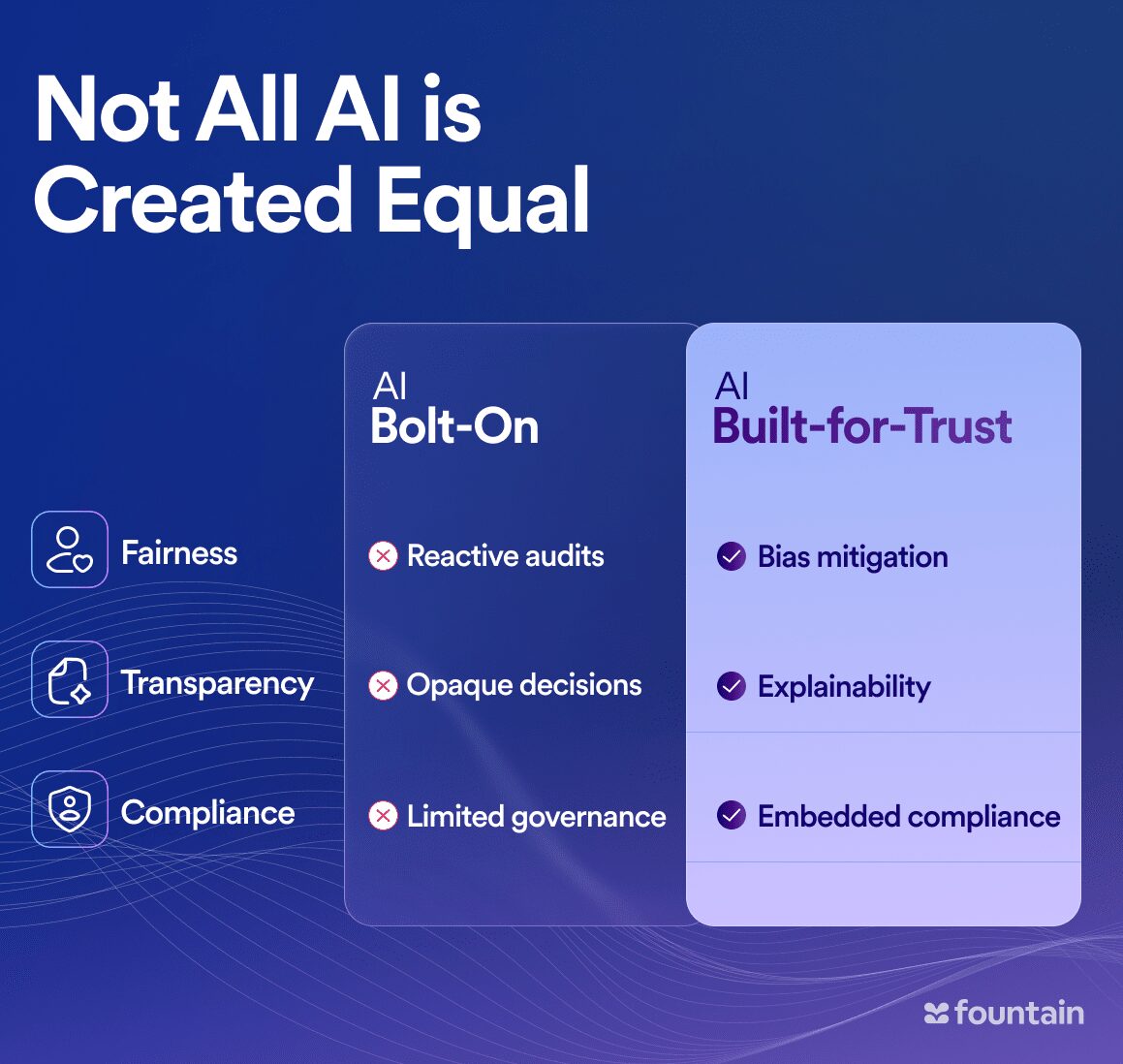
Speed, communication, scheduling, transparency, and automation need to work as one system, not five separate tools stitched together. Fountain is the AI-native Frontline Superintelligence platform for the global frontline workforce, and we built that single workflow into one solution designed for frontline hiring volume.
- Cue is the single entry point to every Fountain product. Recruiters type prompts like “Show me every candidate stalled between offer and first shift across my Chicago locations, and send the right next-step message,” and Cue runs it across the platform.
- Candidate AI Agent responds instantly post-application, over SMS, WhatsApp, and web chat, 24/7, answering questions about pay, location, and next steps before candidates lose interest.
- Anna, the AI Recruiter, conducts agentic AI voice interviews on demand, so candidates interview when they’re available instead of waiting for a scheduled slot.
- The ATS runs configurable workflows with self-serve scheduling by role, location, and brand.
- Onboarding automates document collection, I-9, and E-Verify before the first shift, closing the gap where pre-first-shift ghosting happens.
Candidates don’t just ghost because they’re unreliable. They ghost when silence makes them feel invisible. The employers filling shifts fastest aren’t working harder; they’re running systems that treat every hour of silence as a risk.
See how Fountain prevents candidate ghosting at your hiring volume and locations. Book a demo to see how it works for your team.
Frequently asked questions about candidate ghosting
How common is candidate ghosting in frontline hiring?
Very common. As seen in the 2025 Fountain Frontline Report, 52% of frontline candidates say ghosting and lack of updates are a top frustration with hiring, and 57% cite slow hiring processes.
Drop-off happens at apply, pre-interview, and post-offer stages, with manual processes averaging 35% drop-off per Fountain’s Agentic AI for Frontline Workforces research.
What should I do when a candidate ghosts me?
Send one follow-up via SMS within 24 hours. If they don’t respond, mark them as unresponsive and move on. The better question is what to fix upstream. Automated confirmations, faster outreach, and clear next steps prevent most ghosting before it happens.
Can automation reduce candidate ghosting?
Yes. Automated reminders, instant follow-ups, and self-serve scheduling address the three biggest ghosting drivers: slow response, poor communication, and rigid scheduling.
At what stage do most candidates ghost?
Candidates can disappear at any stage, but the post-apply drop is usually the largest because employer non-response is the first leak.
After that, post-offer ghosting rises when pay, schedule, or location details don’t match what the candidate expected at application. Measuring stage-by-stage drop-off rates tells you where to focus.