Most “best recruiting software” lists rank tools built for corporate roles. They’re written for dozens of applicants, weeks of review cycles, and single-location teams. That’s not frontline hiring. Frontline means thousands of applicants per role, hours (not weeks) to fill, and thousands of locations that all need to be staffed at once.
Replacing a single frontline worker already costs between $6,500 and $7,000, roughly 40% of annual pay, per Fountain’s Redefining Frontline Operations research. Picking a tool designed for corporate hiring makes every part of that worse.
The bar for “best” also shifted. Most frontline employers run many disconnected tools: ATS, chatbot, assessment engine, scheduler, onboarding, comms, and analytics. But the next generation of recruiting tools replaces that stack with agents that run the work across it.
That’s the deeper shift. Software is becoming the back end, and agents are becoming the front end. What separates these tools in 2026 isn’t just whose ATS has the better dashboard. It’s whose agents actually screen candidates, schedule interviews, and run onboarding.
This guide covers the 10 recruiting tools that actually matter for frontline hiring, including retail, QSR, logistics, hospitality, healthcare, and staffing. Each entry names the use case, the agents (or absence of them), and who the tool is actually for, updated for the 2026 landscape.
What are recruiting tools for frontline hiring?
Recruiting tools for frontline hiring are software systems that help employers source, screen, schedule, hire, and onboard frontline workers at volume. They differ from corporate recruiting tools in several fundamental ways:
- Mobile-first applications
- SMS and WhatsApp communication
- Location-level analytics
- Day one compliance (I-9, E-Verify)
- Automations built for thousands of applicants per role rather than dozens
Two buyer contexts dominate this market. The first is frontline-first employers replacing a legacy ATS that was never built for hourly hiring speed. The second is enterprise employers running both corporate and frontline workforces who need a dedicated frontline hiring layer alongside their existing HCM.
How we evaluated these tools
Corporate recruiting lists often grade tools on brand strength, ATS features, and sourcing integrations. Frontline hiring in 2026 demands a different bar, with agents as the first question, not the last.
We weighted each tool against criteria that separate systems built for high-volume shift work from systems adapted for it.
- Agent depth and Agentic AI: Named agents, what they actually do, and whether they act on outcomes or only report them. Chat-only assistants rank lower than multi-agent systems that screen candidates, run voice interviews, schedule, onboard, and orchestrate cross-product workflows. An agent that suggests the next step isn’t the same as one that executes it.
- Frontline traction: Documented customers across retail, QSR, logistics, hospitality, healthcare, and staffing. A mention on a capabilities page wasn’t enough.
- Funnel coverage: Sourcing, screening, scheduling, hiring, onboarding, and first-shift readiness. Tools that cover one slice of the lifecycle got weighted lower than systems covering all of it.
- Usability for non-HR managers: Whether a store or warehouse manager can review candidates, schedule interviews, and make hiring decisions from a phone, without training.
- Compliance and scalability: I-9, E-Verify, local labor rules, audit readiness, and proven performance at multi-thousand-location scale.
- Documented customer results: Named case studies with specific metrics, not anonymous “customers see improvement” claims.
A tool had to clear most of these to land on the list. Tools that cleared one or two but missed on agent depth or frontline traction got dropped from the list.
The 10 best recruiting tools for frontline hiring at a glance
This table is placed before the ranked list intentionally so you can orient quickly. The detailed entries below add context.
| Tool | Best for | Frontline-first vs. adapted | Named agents and depth | Funnel coverage |
|---|---|---|---|---|
| Fountain | Full-lifecycle frontline hiring | Frontline-first | Cue (orchestrator) + Anna, Emma, Sam: voice and SMS across interviews, support, satisfaction | Apply → hire → onboard → schedule |
| Paradox | Conversational layer on Workday | Frontline-focused | Olivia: conversational agent (chat-led) | Capture/apply → screen → schedule |
| iCIMS | Enterprise ATS with frontline and high-volume hiring support | Enterprise-grade with frontline layer | Frontline AI suite: screening and engagement | Apply → hire |
| SmartRecruiters | Mixed corporate + frontline in SAP shops | Standalone (SAP-integrated) | AI sourcing and screening assistants | Apply → hire |
| Harver | Volume assessments and job previews | Add-on | Assessment AI: scoring only, not an agent | Screen / assess only |
| Phenom | Enterprise talent experience | Mixed | 30+ agents across CRM, ATS, CX | Attract → apply → nurture |
| Eightfold | Skills matching and internal mobility | Mixed | AI Recruiter, AI Interviewer, Candidate Concierge | Matching & redeployment |
| Hireology | Franchise and decentralized hiring | Frontline-leaning | Limited agent capability | Apply → hire |
| Snagajob | Hourly sourcing marketplace | Hourly-focused | Minimal / none named | Source only |
| HireVue | Video interviews at scale | Add-on | Assessment AI: interview scoring, not orchestration | Screen → interview |
1. Fountain: Best overall recruiting tool for frontline hiring
Fountain is Frontline Superintelligence for the global frontline workforce. Cue is the orchestration layer, the single entry point to every agent on the platform. Under Cue, three named agents run the work: Anna handles voice interviews, Emma provides 24/7 candidate support, and Sam collects post-hire feedback.
They operate across one platform covering the full hiring lifecycle: ATS, Sourcing, CRM, Onboarding, and Shift & Scheduling.
Why Fountain wins for frontline hiring
Fountain is the clearest answer to the patchwork problem. It was built from day one to replace the five-to-seven-tool stack with a single operating system, purpose-built for the specific realities of frontline hiring.
Every design choice centers on agents running the work across the lifecycle. Recruiters run funnels across thousands of locations, so Cue turns natural-language goals like “Hire 10 drivers before Monday” into orchestrated tasks that fan out across the system.
Per the 2025 Fountain Frontline Report, 74% of candidates prefer AI voice interviews over waiting for a scheduled call, so Anna handles first-round screening 24/7. Candidates need answers at 2 a.m., so Emma responds instantly across SMS and voice at every stage of the funnel.
New hires drop out fast if the first week feels chaotic, so Sam checks in on the first shift and flags retention risks before they become quits. All four share data through one operating system, so what happens at one stage updates the profile flowing through every other stage.
Key features
Cue: the orchestration layer
- Cue (Fountain Copilot): The single entry point to every Fountain agent. Recruiters type a goal in plain English, and Cue breaks it into agent-executed tasks across the platform. A prompt like “Hire 10 drivers before Monday” fans out to Anna for interviews, Emma for candidate questions, and Sam for first-day follow-up, with Cue running the workflow end to end. A prompt like “Show me funnel drop-off by location for the last 30 days” returns the answer, no analyst needed.
The agents Cue orchestrates
- Anna (AI Recruiter): SMS and voice. Conducts real voice interviews and evaluates candidates 24/7. 74% of applicants choose Anna over waiting for a scheduled call.
- Emma (AI 24/7 Support): SMS and voice. Answers candidate questions at any hour across channels, handles application-stage support without a recruiter in the loop, and keeps the candidate profile updated as it moves through the funnel.
- Sam (AI Satisfaction): SMS and voice. Collects first-day feedback and workforce satisfaction signals, flagging retention risks early. Covers a post-hire layer most competitors don’t touch.
The platform the agents operate on
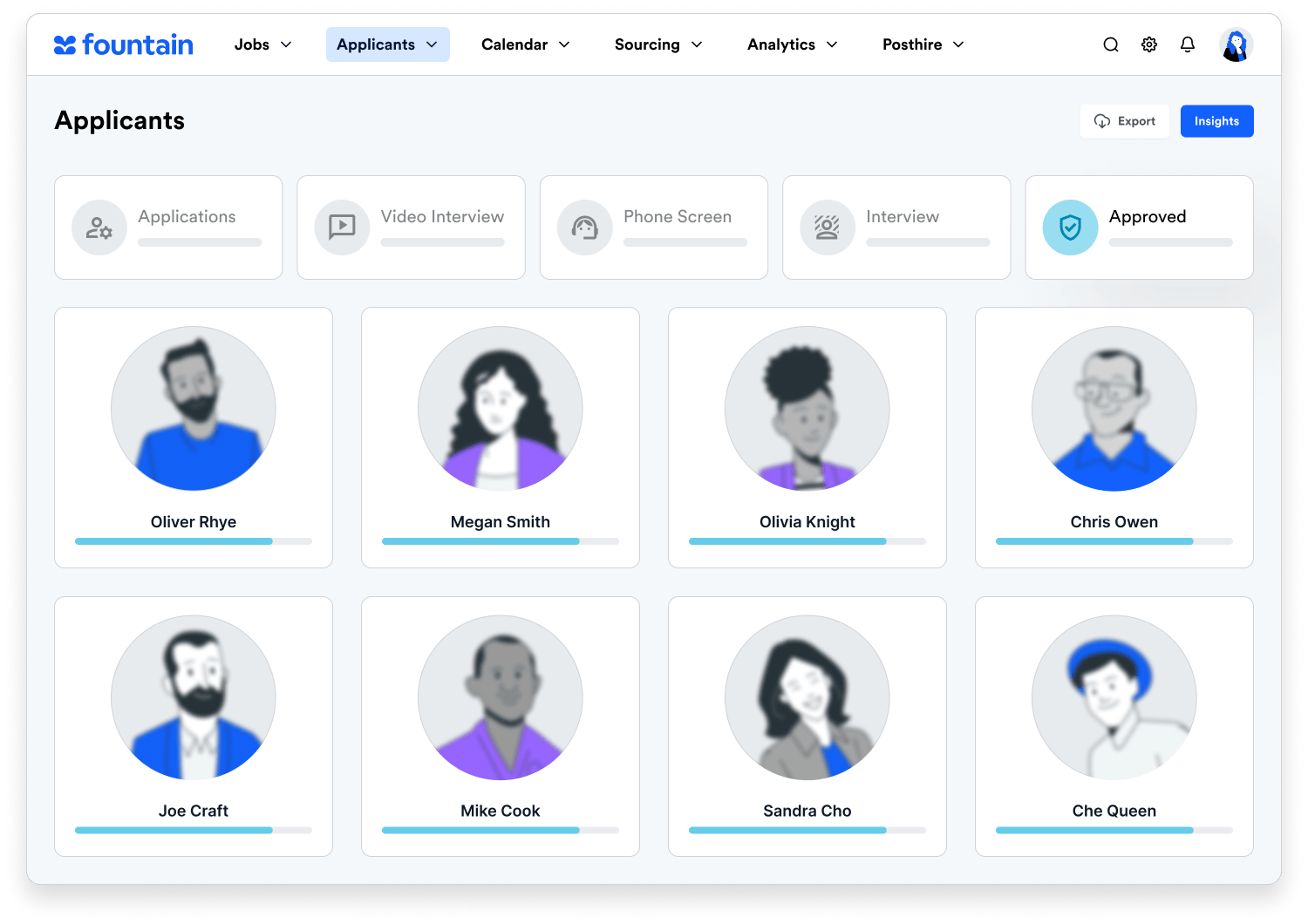
- ATS: Mobile-first application, configurable workflows by role and location, automated screening, bi-directional calendar sync for self-scheduled interviews, and multi-brand support.
- Onboarding: Mobile I-9 completion, E-Verify integration, remote authorized rep, compliance dashboard, and automated document verification.
- Shift & Scheduling: AI demand forecasting, real-time gap detection, mobile self-service for swaps and drops, and built-in labor compliance safeguards. Closes the loop between hire and first shift.
- CRM: Centralized talent profiles, AI-powered candidate matching, and automated re-engagement of past workers. Reactivating prior workers eliminates new sourcing spend for known-quantity hires.
- Sourcing: Multi-channel campaign management, AI-powered budget optimization, and predictive shortfall detection across job boards, SMS, and paid channels.
Fountain integrates with UKG, SAP, ADP, and Workday. It isn’t a replacement for your HCM. It’s the frontline hiring layer that plugs into it.
Best for: Retail, QSR, logistics, warehousing, healthcare, and staffing teams operating at a multi-location scale who need to stop managing a patchwork of point solutions.
2. Paradox
Paradox is a single-agent system. Olivia handles candidate chat, Q&A, and interview scheduling. Anything past that (sourcing, onboarding, shift scheduling, CRM, deeper compliance) needs other systems.
Workday acquired Paradox in October 2025, and the Conversational ATS became available through Workday in January 2026 for employers whose core hiring system is Workday.
Best for: Workday customers who want a chat layer without replacing their ATS.
3. iCIMS
iCIMS launched Frontline AI in March 2026, a dedicated agent suite aimed at high-volume screening and candidate engagement. It sits on top of a long-established enterprise applicant tracking system with CRM, career site, and onboarding modules.
The agents are newer than the platform, and their footprint is narrower: strong on screening and chat, thinner on the onboarding, scheduling, and shift-readiness agents frontline employers actually need to run end-to-end.
Best for: Enterprise employers with strong corporate TA operations and a secondary frontline workforce who want one system for both populations.
4. SmartRecruiters
SmartRecruiters runs AI-powered sourcing and screening assistants inside a broader talent acquisition suite, now part of SAP after the September 2025 acquisition.
The agent story is still early post-integration; public documentation on how the SmartRecruiters AI assistants behave inside the SAP stack remains limited.
Best for: Large enterprises standardized on SAP with a meaningful corporate TA function plus some frontline hiring.
5. Harver
Harver’s AI is about scoring, not orchestrating. The models rank candidates on situational judgment tests, realistic job previews, and assessments. No conversational agent, no voice interviewer, no onboarding or scheduling automation.
Best for: Retail, QSR, and contact center teams that want to plug assessments into an existing ATS to improve quality-of-hire without slowing the funnel.
6. Phenom
Phenom ships AI agents across CRM, ATS, chatbot, internal mobility, and candidate experience, plus a shift scheduling capability announced in November 2025. However, the agents are distributed across features rather than orchestrated behind one interface.
Best for: Enterprise employers blending professional and frontline hiring who care about brand consistency and talent lifecycle coverage.
7. Eightfold
Eightfold has three agents: AI Recruiter, AI Interviewer (launched October 2025), and Candidate Concierge Agent (launched August 2025). They run on a model trained on career profile data, and the agents match candidates on inferred skills and potential.
Best for: Enterprises with 10,000+ frontline workers and a mature internal mobility function who want to redeploy workers between roles, stores, or regions as demand shifts.
8. Hireology
Hireology is lighter on agents than the rest of this list. It’s a structural play: a location hierarchy for multi-location and franchise networks, with per-location hiring manager assignment, centralized visibility across all locations, and multi-location process controls.
Best for: Franchise networks and multi-unit operators who need standardization without centralizing execution.
9. Snagajob
Snagajob doesn’t have agents. It’s a job marketplace, and that’s the point. The platform is purpose-built for frontline and shift-based roles, recently acquired by JobGet. The combined entity covers frontline sectors such as food service, retail, hospitality, manufacturing, and customer service. It’s a sourcing channel, not a hiring system.
Best for: Employers who need a dedicated hourly sourcing channel alongside their ATS.
10. HireVue
HireVue’s AI is about grading, not agents. The models score asynchronous video interviews, game-based assessments, and structured interview responses. They don’t conduct the interview, schedule it, or move candidates through the funnel.
Best for: Employers scaling interviewer consistency for supervisory and management hires across many locations.
How to pick the right tool for your stack
The right recruiting tools depend on your scale and complexity.
- One to 10 locations, under 500 hires a year: Start with a frontline-first ATS plus a job marketplace for sourcing.
- 10 to 100 locations, thousands of hires a year: The stack breaks here. Consolidate onto a frontline hiring system. The five-to-seven-tool patchwork stops scaling at this tier.
- 100+ locations, enterprise scale: You need corporate visibility and franchisee flexibility. An enterprise ATS handles corporate hiring. A frontline hiring system handles the frontline workforce. The two integrate.
- Mixed corporate plus frontline: Don’t force a corporate ATS to run frontline hiring. Keep both, integrate them, and let each do what it’s built for.
The trap most frontline employers fall into is buying a corporate ATS, bolting on a chatbot, adding an assessment tool, plugging in a scheduling system, and wondering three years later why nothing talks to anything.
Seventy percent of HR employees use three to six apps to complete a single task. That fragmentation carries high costs for U.S. employers. Frontline-first systems exist because the patchwork approach doesn’t scale for high-volume hiring.
The right recruiting tool in 2026 isn’t the one with the most features. It’s the one where the agents actually run the work. Fountain is the clearest version of that for frontline hiring: Cue orchestrating, Anna, Emma, and Sam running screening, support, and day one retention, all in one system.
Book a demo to see Fountain’s agents in action.
Frequently asked questions about recruiting tools for frontline hiring
What is the best recruiting software for frontline hiring?
Fountain is a frontline-first Frontline Superintelligence layer built for high-volume hiring, covering the full lifecycle from sourcing through onboarding and shift scheduling. The best choice for any specific employer depends on scale, existing HCM stack, and whether hiring is centralized or distributed across locations.
How much do frontline recruiting tools cost?
Pricing varies widely. Some tools offer plans starting around $249/month, while larger or all-in-one packages may require a custom quote. Enterprise systems like iCIMS, Phenom, and Fountain use custom pricing based on hiring volume, locations, and modules. Expect custom quotes for any employer hiring more than a few hundred workers per year.
What’s the difference between an ATS and a frontline recruiting platform?
An ATS tracks applicants through hiring stages. A frontline recruiting system adds the automation, compliance tools, mobile-first candidate experience, and operational tools (shift scheduling, onboarding, workforce comms) required to hire and retain shift-based workers across many locations at speed.