QSR turnover runs 110% annually for limited-service hourly roles as of Q3 2025. Understaffing drags sales, service, and margin. Overstaffing burns through the labor budget. For QSR franchise operators, the hiring tool shapes day-to-day operations, not just HR workflows.
Franchise networks add a second layer of complexity: corporate wants consistency, rollup visibility, and compliance controls; franchisees want local flexibility and tools that don’t require an HR team to operate. The wrong tool creates friction between those needs, and adoption weakens over time.
The definition of “best” also shifted. The person buying a recruiting tool for QSR in 2026 isn’t staffing an HR department. They’re trying to keep a 50-person store running at 110% turnover with no HR seat on site. A tool that expects a recruiter to log in and move candidates through stages doesn’t fit that reality. The tools that fit are the ones where AI agents run the work while general managers (GMs) run stores.
That’s the new bar. It isn’t about whose ATS has the slickest interface. It’s which tool can interview a crew applicant at 2 am when the GM is off shift, answer a candidate’s 11 pm question from a parking lot, and flag a new hire as a retention risk before their first week ends. Every tool on this list claims some version of this. But few deliver it.
This guide covers 9 high-volume recruiting tools built for QSR and franchise realities. Each entry names the use case, the agents, the franchise fit, and who it’s actually for in 2026.
What are high-volume recruiting tools?
High-volume recruiting tools are software that help employers hire frontline workers at scale: sourcing, screening, scheduling, offer, and onboarding automation built for thousands of applicants per role.
The best-performing QSR hiring teams process candidates at 16% hire rates versus 4% for the slowest, and the gap comes down to tooling and speed.
QSR is different from other high-volume use cases:
- Multi-unit franchise structures mean brand-versus-franchisee permissions matter
- In-store sourcing (QR codes, table tents) is common
- Mobile-first application flows are central to frontline hiring
- Role layers (crew, shift lead, assistant manager) each require different screening logic
- Compliance requirements vary across states, brands, and municipal labor laws
A generic ATS with a “high-volume mode” doesn’t solve any of this. QSR volume isn’t corporate volume with more applicants.
What QSR franchise operators need from high-volume tools
The IFA’s 2025 Franchisor Survey found that 70% of franchisors report unfilled job vacancies across their networks and 48% cite availability of qualified candidates as the most significant hiring challenge. Fixing that requires specific capabilities.
- Agentic AI: Named agents that actually run the work across the funnel (screen, answer questions, onboard, re-engage) and orchestrate across brand-franchisee boundaries. Chatbots bolted onto legacy systems don’t clear this bar.
- Multi-location and franchise support: Brand-versus-franchisee permissions, shared templates, location-level reporting, and corporate visibility without controlling every hire.
- Speed: Hours-not-days time-to-hire for crew and shift leads. Per the 2025 Fountain Frontline Report, 57% of frontline candidates cite slow processes as a top frustration. In QSR, faster processes usually win.
- Mobile-first candidate experience: QR codes in-store, text apply, five-minute applications. Longer applications increase drop-off before candidates finish.
- Automation across the funnel: Apply, screen, schedule, offer, and onboarding tasks executed without manager intervention at every step.
- Integration with the QSR stack: POS systems, scheduling tools, payroll, and background check providers.
- Roll-up dashboards: Brand, region, franchisee, store, and daypart visibility so corporate can see patterns without auditing each location.
When tools miss several of these capabilities, franchisees end up filling gaps with workarounds, spreadsheets, or another vendor.
Comparison table: High-volume recruiting tools for QSR at a glance
This table is placed before the ranked list intentionally so you can orient quickly. The detailed entries below add context.
| Tool | Best for | QSR focus | Named agents and depth | Funnel coverage | Franchise support |
|---|---|---|---|---|---|
| Fountain | Multi-unit QSR networks | Frontline-first | Cue (orchestrator) + Anna, Emma, Sam: voice and SMS across interviews, support, satisfaction | Apply → hire → onboard → schedule | Brand + franchisee controls |
| Workstream | Independent operators and small chains | QSR-native | VoiceAI phone screening at higher tiers | Apply → hire + payroll | Multi-location |
| Harri | Hospitality ops + hiring | Hospitality-native | Carri: conversational agent (chat-led) | Apply → schedule + payroll | Yes |
| TalentReef | Franchise QSR with compliance complexity | Frontline-native | Limited agent capability | Apply → onboard | Strong franchise |
| Paradox | Conversational layer on Workday | Adapted (post-Workday) | Olivia: conversational agent (chat-led) | Apply → schedule | Via Workday |
| iCIMS | Enterprise QSR brands on iCIMS | Enterprise-grade with frontline layer | Frontline AI suite: screening and engagement | Apply → hire | Yes |
| SmartRecruiters | Enterprise QSR brands on SAP | Standalone (SAP-integrated) | AI sourcing and screening assistants | Apply → hire | Yes |
| Hireology | Franchise networks with centralized templates | Franchise-leaning | Limited agent capability | Apply → hire | Strong franchise |
| Sprockets | AI-driven crew selection | Frontline-leaning | Assessment AI: scoring only, not an agent | Screen only | Multi-location |
1. Fountain: best overall for multi-unit QSR networks
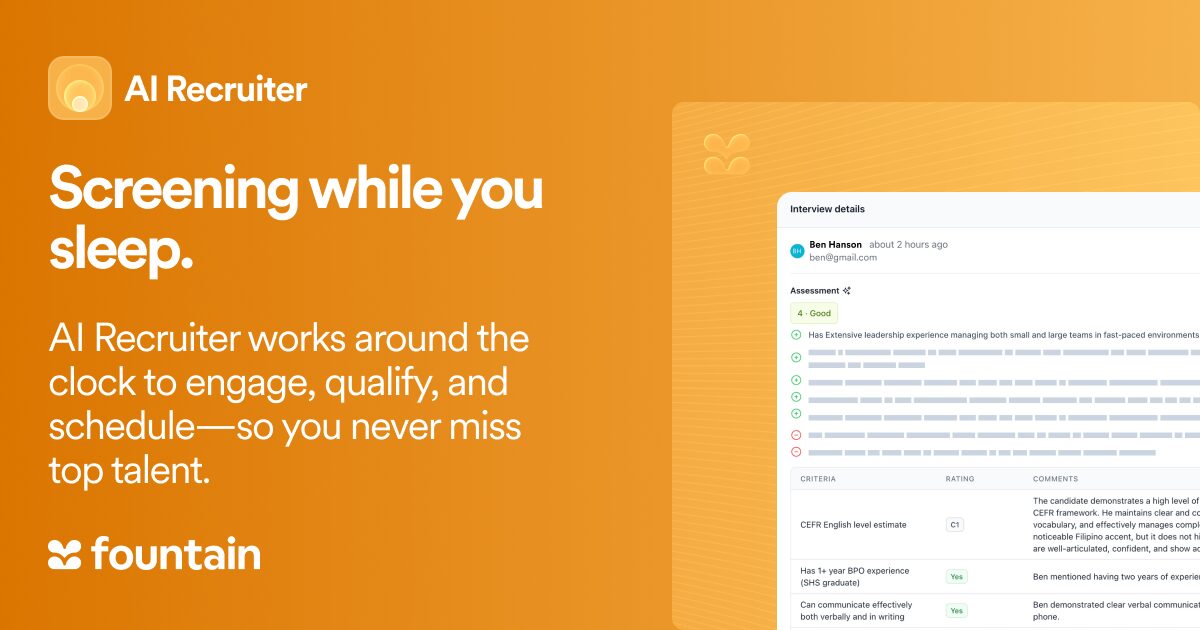
Fountain is Frontline Superintelligence for the global frontline workforce. Cue is the orchestration layer, the single entry point to every agent on the platform. Under Cue, three named agents run the work: Anna handles voice interviews, Emma provides 24/7 candidate support, and Sam collects post-hire feedback.
They operate across one platform covering the full hiring lifecycle (ATS, Sourcing, CRM, Onboarding, Shift & Scheduling), with franchisees running hiring from the mobile manager interface and corporate keeping visibility and standards across the network.
Why Fountain wins for QSR franchise hiring
Fountain is the only tool on this list built around the QSR franchise structure from day one, not adapted to it. Corporate keeps hiring templates, compliance rules, and brand standards in one place. Franchisees run hiring from their phones without logging into an HR system. Agents handle every step in between.
Every agent in Fountain maps to a specific QSR hiring pain. GMs don’t have time to run five apps, so Cue turns natural-language goals like “Hire 10 crew members at stores 47, 52, and 103 before Friday” into orchestrated tasks that fan out across the system.
According to the 2025 Fountain Frontline Report, 74% of frontline candidates prefer AI voice interviews over waiting for a scheduled call, so Anna handles first-round screening 24/7 without blocking the manager.
Candidates apply at 11 pm from a parking lot and want answers then, so Emma responds instantly across SMS and voice at every stage of the funnel. New hires drop out fast if the first week feels chaotic, so Sam checks in on the first shift and flags retention risks before they become quits.
Because all four run on one system, a candidate’s 2 am question updates the same record Sam picks up on day one.
Key features
Cue: the orchestration layer
- Cue (Fountain Copilot): The single entry point to every Fountain agent. Corporate TA and franchise GMs type a goal in plain English, and Cue breaks it into agent-executed tasks across the platform. A prompt like “Hire 10 crew members at stores 47, 52, and 103 before Friday” fans out to Anna for interviews, Emma for candidate questions, and Sam for first-day follow-up, with Cue running the workflow end to end. A prompt like “Show me applicant drop-off by location for the last 30 days” returns the answer, no analyst needed.
The agents Cue orchestrates
- Anna (AI Recruiter): SMS and voice. Conducts real voice interviews and evaluates crew candidates 24/7.
- Emma (AI 24/7 Support): SMS and voice. Answers candidate questions at any hour across channels, handles application-stage support without a GM in the loop, and keeps the candidate profile updated as it moves through the funnel.
- Sam (AI Satisfaction): SMS and voice. Collects first-day feedback and workforce satisfaction signals, flagging retention risks early. Covers a post-hire layer most QSR hiring tools don’t touch.
The platform the agents operate on
- ATS: Mobile-first application, configurable workflows by role and location, brand-versus-franchisee permissions, QR codes and text-to-apply, automated screening, bi-directional calendar sync, and multi-brand support.
- Onboarding: Mobile I-9 completion, E-Verify integration, remote authorized rep, compliance dashboard, and automated document verification. One system for I-9, W-4, and state-specific compliance.
- Shift & Scheduling: AI demand forecasting, real-time gap detection, mobile self-service for swaps and drops, and built-in labor compliance safeguards. Closes the loop between hire and first shift.
- CRM: Centralized talent profiles, AI-powered candidate matching, and automated re-engagement of past workers. Reactivating prior workers eliminates new sourcing spend for known-quantity hires.
- Sourcing: Multi-channel campaign management, AI-powered budget optimization, and predictive shortfall detection across job boards, SMS, and paid channels.
Fountain integrates with UKG, SAP, ADP, and Workday. It isn’t a replacement for your HCM. It’s the frontline hiring layer that plugs into it.
Proof points
- Bojangles cut time-to-hire from 30 days to 5.8 across 750 locations, saved 230 recruiter hours per year, and reduced job board spend by 86%.
- Turas Group’s Chick-fil-A locations went from a two-week response time to a 3-day time-to-hire, with a 1,600:1 applicant-to-recruiter ratio.
Best for: QSR brands with 50+ locations who need corporate consistency and franchisee flexibility in one system.
2. Workstream
Workstream is a QSR-native hiring platform built around SMS-first candidate communication, fast apply flows, and, at higher tiers, payroll and HR tooling.
It targets restaurant and retail operators, with text-to-apply, QR codes, and VoiceAI phone screening as the agent-like layer. The agent layer is scoped to one use case and gated behind higher tiers.
Best for: Single-unit and small-chain QSR operators (one to 20 locations) who want purpose-built tooling without enterprise implementation.
3. Harri
Harri leads with Carri, a conversational AI agent for candidate chat and scheduling, inside a broader workforce operations suite covering onboarding, scheduling, time and attendance, and payroll.
Carri’s scope is candidate conversations. Orchestration across the full hiring lifecycle sits outside what Carri handles.
Best for: Restaurant groups who want workforce ops and hiring under one vendor.
4. TalentReef
TalentReef is a frontline ATS, now part of Mitratech, with compliance handled inside the applicant workflow rather than via separate vendors: I-9 verification, E-Verify submission, WOTC screening, and multi-state labor compliance rules.
For a multi-state QSR franchise, that consolidates compliance into the ATS instead of a separate tool.
The agent layer is where TalentReef is thinner than the rest of this list. There’s no named AI recruiter, no voice interview agent, and no candidate-facing chat orchestration. The tool is designed around recruiters and compliance officers, not autonomous agents running hiring across locations.
Best for: Multi-state franchise QSR operators where compliance risk is a board-level concern.
5. Paradox
Paradox is built around a single agent, Olivia, that handles candidate chat, Q&A, and interview scheduling. Workday acquired Paradox in October 2025, and the Conversational ATS became available through Workday in January 2026.
Paradox’s limit is scope: Olivia runs chat and scheduling; anything past that (onboarding, shift scheduling, CRM, deeper compliance) needs other systems.
Best for: Enterprise QSR brands standardized on Workday who want a chat layer without replacing their ATS.
6. iCIMS
iCIMS launched Frontline AI in March 2026, a dedicated agent suite aimed at high-volume screening and candidate engagement, sitting on top of a long-established enterprise applicant tracking system with CRM, career site, and onboarding modules.
For QSR brands already running corporate TA on iCIMS, Frontline AI is the native path to handle crew hiring inside the same system. The agents are newer than the platform, and their footprint is narrower: strong on screening and chat, thinner on the onboarding, scheduling, and shift-readiness agents QSR operators need to run crew hiring end-to-end.
Best for: Enterprise QSR brands with strong corporate TA operations already on iCIMS who want one system for both corporate and frontline.
7. SmartRecruiters
SmartRecruiters runs AI-powered sourcing and screening assistants inside a broader talent acquisition suite, now part of SAP after the September 2025 acquisition.
For QSR enterprises consolidating HR systems on SAP, SmartRecruiters is the native path. The agent story is still early post-integration; public documentation on how the SmartRecruiters AI assistants behave inside the SAP stack remains limited.
Best for: Large enterprise QSR brands standardized on SAP with a meaningful corporate TA function plus some frontline hiring.
8. Hireology
Hireology is a hiring platform with multi-location hierarchy and franchise-focused positioning, though its strongest documented use cases are in automotive and healthcare franchises rather than QSR.
The platform includes customizable job templates, role-based permissions, and multi-location reporting.
Best for: Franchise QSR networks prioritizing process standardization over automation depth.
9. Sprockets
Sprockets is a crew-selection overlay that uses AI scoring against a store’s top performers to estimate retention fit. Applicants answer three questions; the platform scores them 1 to 10 based on personality alignment with high-performing employees at that specific location.
The premise is that retention is a selection problem, not a sourcing problem: if you hire people who look like the ones who already stay, more of them stay.
It’s a narrow tool aimed at a narrow failure mode. Sprockets isn’t an ATS, and it isn’t an agentic system. The AI scores, but it doesn’t orchestrate.
For QSR operators whose bigger problem is speed, volume, or onboarding, Sprockets doesn’t move the needle. But for operators who can hire plenty of people but can’t keep them past the first month, a selection overlay like this is the kind of thing that actually fits the shape of the problem.
Best for: QSR operators whose main problem is retention of the people they hire, not sourcing volume.
How to pick the right stack for your QSR operation
The right tool depends on your network’s size, structure, and primary gap.
- Single-unit or small-chain franchisee (1 to 5 locations): You need a tool that runs from a phone, deploys in days, and doesn’t require an HR team. Fountain’s mobile manager interface lets a single GM run hiring end-to-end, with Anna handling screening and Emma answering candidate questions, so the funnel isn’t waiting on anyone.
- Multi-unit franchisee (5 to 50 locations): Template consistency becomes the thing that breaks first. You need a platform where corporate sets brand-level standards once and every location runs them, with Cue orchestrating agents so no GM has to learn multiple tools. Running a separate ATS, chatbot, scheduler, and onboarding tool stops scaling around 15 locations.
- Franchisor or corporate standardizing across 50 to 500 locations: This is where most QSR networks struggle. Corporate picks a platform, franchisees adopt it, and after three years, some locations go off-system because it was too rigid. Fountain’s brand-template-plus-franchisee-flexibility model is built for exactly this scenario, and Bojangles runs 750 locations on it.
- Enterprise QSR (500+ locations, public company, HCM-based): You’re running an HCM (Workday, SAP, ADP, UKG) for corporate roles. The frontline crew layer carries the hiring load, and integration architecture is the whole game. Fountain plugs in as the frontline layer without replacing the HCM.
- Mixed corporate plus frontline: Don’t force a corporate ATS to run frontline crew hiring. Keep both, integrate them, and let each do what it’s built for.
The franchise trap that many QSR brands fall into is letting each franchisee pick their own tool. Years later, corporate ends up with many ATSs across the network, limited visibility, and no way to set brand hiring standards. That fragmentation has a number attached to it.
Replacing an hourly QSR employee costs $2,706 in hard costs alone. At 110% turnover in a 50-person store, that’s $148,830 per store per year, before lost sales from being understaffed. Multiply that across a network running different tools at every location, and every dollar of it gets harder to recover.
QSR operators don’t win this back by adding another tool. They win it back by picking one that handles the hiring that a GM shouldn’t have to. Fountain is the cleanest version of that: Cue orchestrating, Anna interviewing, Emma supporting, and Sam holding onto new hires through the first week, all on one operating system.
Book a demo to see Fountain’s agents in action.
Frequently asked questions about high-volume QSR recruiting tools
What is the best ATS for restaurants?
The best ATS depends on the size and structure of the operation. Single-unit operators benefit from QSR-native tools built around SMS and mobile applications.
Multi-unit franchise networks need a platform that handles brand-versus-franchisee permissions, rollup analytics, and compliance across states. Full-stack platforms purpose-built for frontline hiring, like Fountain, generally outperform generic ATSs adapted for restaurant use.
Should each franchisee pick their own recruiting tool?
No. Fragmented tooling across a franchise network eliminates corporate visibility, prevents brand-level hiring standards, and makes compliance tracking harder at scale. The most effective model is corporate standardization with franchisee-friendly execution: corporate selects the platform and sets templates, while franchisees operate within those guardrails using mobile-first interfaces.
How long does it take to hire a QSR crew member with the right tools?
Median time-to-hire for QSR team members is six days across the industry, but top performers close in three.
Bojangles cut time-to-hire from 30 days to 5.8 days by automating screening, scheduling, and candidate messaging. Every additional day in the process is a day your competitor fills the role first.