AI in HR for the frontline workforce goes beyond talent analytics dashboards or chatbots that draft job descriptions. For employers hiring at scale across multiple locations, AI in HR means filling shifts faster, reducing candidate drop-off, and keeping every location staffed without burning out a small recruiting team.
Much of the coverage of AI in HR assumes a corporate context: salaried roles, slower hiring cycles, and recruiters managing a limited set of open positions. Frontline hiring operates in a different reality, and the AI systems that matter to frontline employers look fundamentally different.
This piece covers where AI in HR is making a measurable difference for high-volume frontline hiring teams, what risks to manage, and how to get started without over-engineering the rollout.
What AI in HR actually means for frontline teams
AI in HR, scoped to frontline operations, refers to systems that handle sourcing, screening, scheduling, communications, onboarding, and workforce planning with minimal recruiter input. The critical distinction for buyers evaluating these systems is the difference between AI that acts on defined tasks and AI that reports.
AI that reports gives you dashboards, scores, and recommendations. However, you still have to act on every recommendation yourself.
On the other hand, AI that acts screens candidates, sends reminders, schedules interviews, and triggers onboarding workflows based on rules and workflow design, while people still make the final hiring decision.
For example, Fountain’s AI Recruiter, Anna, completes multi-step screening workflows autonomously. Anna conducts voice interviews, scores candidates, and routes qualified applicants to your team for human review. That is fundamentally different from a chatbot that answers FAQs.
The spectrum runs from rules-based automation (if an application is complete, send a confirmation text) to predictive AI (score candidates by likelihood of accepting an offer) to agentic AI that runs entire workflows toward a goal.
The Forrester TEI describes these systems as able to “flexibly plan to resolve goals by taking action in their environment, with increasing levels of autonomy.” For a frontline employer managing many open roles across many locations, that autonomy in task execution can be the difference between a recruiter spending hours on administrative tasks and spending that time on the conversations that actually matter.
When evaluating vendors, ask a direct question: “Show me which workflow steps execute without human prompting.” If the answer is none, you’re looking at an assistant, not an agent.
Why AI in HR looks different for frontline employers
Corporate HR technology was designed for a world where a recruiter manages a handful of requisitions, candidates submit polished resumes, and the hiring cycle stretches across weeks. Frontline hiring operates under a completely different set of constraints: perpetual open requisitions, seasonal volume spikes, multi-location coordination, and candidates who take the first offer that comes through.
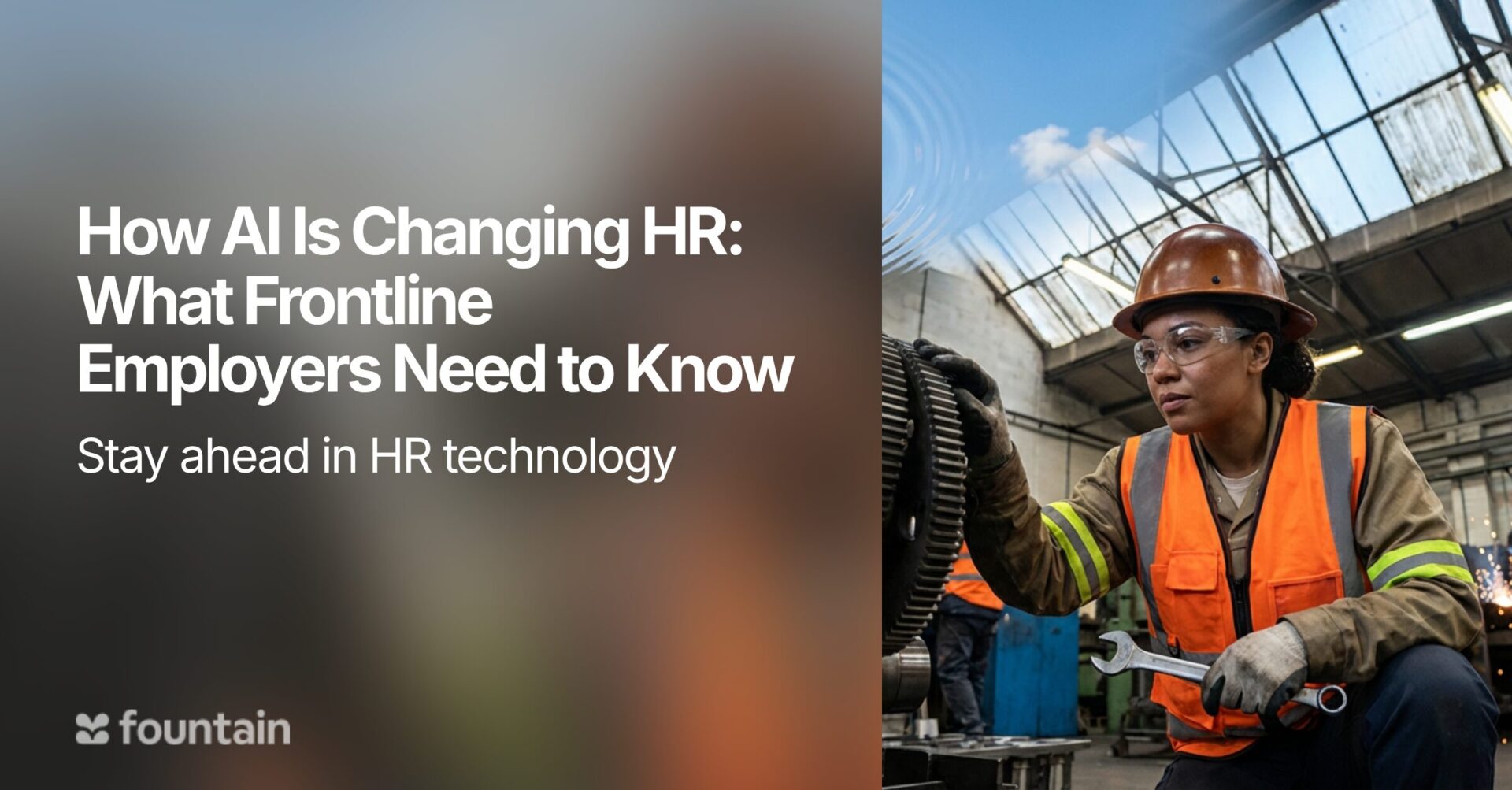
As such, HR technology for the frontline must accelerate shift planning, support flexible scheduling, and improve recruiting and onboarding tailored to high-volume, hourly roles.
The numbers reinforce the gap. According to Fountain’s Redefining Frontline Operations white paper, the average time from application to offer sits at 27.5 days. When you’re competing for candidates who need to start earning this week, that timeline is a dealbreaker. Every day your process takes, candidates are accepting offers from competitors who moved faster.
For frontline employers, AI in HR means systems that operate at the speed candidates expect: screening in minutes, scheduling interviews without phone tag, and getting new hires to day one before they ghost.
Where AI is reshaping frontline HR today
AI in HR applications spans the full hiring lifecycle. For frontline employers, the clearest use cases fall into six categories.
- Sourcing: AI-driven job distribution reallocates ad spend to the highest-converting channels automatically, so recruiters stop guessing where to post. Fountain’s Agentic Sourcing, for example, tracks cost-per-applicant and cost-per-hire by channel and shifts budget in real time rather than waiting for a monthly report.
- Screening: Candidates get qualified in minutes based on shift availability, certifications, and location rather than resume keywords. Fountain customers like Centerfield saw an 80% decrease in manual recruiter actions and 88% fewer resumes to screen after automating their screening pipeline.
- Scheduling: Interview coordination and shift assignment run automatically across time zones and locations, balancing worker availability, labor regulations, and cost without a recruiter managing calendars by hand.
- Candidate communications: Automated SMS, WhatsApp, and email nudges keep candidates warm from application through onboarding. Per the 2025 Fountain Frontline Report, 52% of frontline workers cite ghosting or lack of updates as a top frustration. Timely, automated outreach closes that gap before candidates move on.
- Onboarding: Document collection, I-9 verification, and training triggers fire automatically on hire, replacing static checklists with personalized, role-specific workflows that get new hires to onboarding readiness faster.
- Workforce planning: Hiring velocity matches demand signals like seasonal ramps, location openings, and attrition patterns. Instead of reacting to staffing gaps after they happen, AI forecasts them before they hit.
These six categories cover the core of where AI is delivering measurable results in frontline HR today. The next question is what those results actually look like in practice.
Benefits frontline HR leaders can expect
AI in HR improves the metrics that matter most to frontline operations: time-to-hire, unfilled shifts, cost per hire, and recruiter capacity. The gains show up across four areas.
1. Faster hiring, lower cost
The most immediate impact is speed. When screening, scheduling, and candidate communications run automatically, the days between application and onboarding compress significantly.
For example, Bojangles, the QSR chain operating 750 locations, cut time-to-hire by 80%, from 30 days to 5.8 days, while reducing job board spending by 86%. Automated messaging saved 230 recruiting hours in a single year.
2. Recruiter capacity without headcount
AI handles the repetitive volume, so small teams can cover more ground. Instead of adding recruiters to keep up with seasonal spikes or new location openings, the same team manages higher throughput because screening, scheduling, and follow-ups no longer require manual effort at every step.
3. Better candidate experience
Candidates get a mobile-first experience with instant responses instead of days of silence. In frontline hiring, the employers who communicate fastest are usually the ones who land the hire. Automated outreach keeps candidates engaged throughout the hiring cycle, closing the gap before they move on to a faster competitor.
4. Stronger retention
Per the 2025 Fountain Frontline Report, 43% of new hires leave within their first 90 days, and employees who describe onboarding as “messy” are 9x more likely to plan their exit. Structured, automated onboarding directly addresses this by getting new hires through paperwork, training, and onboarding logistics before confusion and disengagement set in.
Compliance and risk: what frontline employers need to know
AI in HR is subject to the same anti-discrimination laws as human decision-making. Regulators are catching up fast, and enforcement is no longer theoretical.
- EEOC enforcement: The agency has designated AI in hiring as an explicit priority through FY 2028, focusing on cases where automated tools contribute to discriminatory outcomes.
- State and local regulations: Multiple U.S. jurisdictions have enacted AI-specific hiring laws. NYC requires annual bias audits, California holds automated tools to the same legal standards as human decision-makers, and Colorado mandates impact assessments with penalties up to $20,000 per violation.
- EU AI Act: The EU framework classifies HR systems as high-risk, with full obligations taking effect in August 2026.
- Shared liability: Employers share legal exposure with the AI vendors they deploy. Vendor contract review and compliance architecture are procurement requirements, not afterthoughts.
Every automated screening step needs an audit trail, adverse impact testing, and explainability built in from the start. Retrofitting compliance after a regulator asks for it is how fines happen.
How to implement AI in HR: a step-by-step approach
Deploying AI in HR without a plan is how organizations burn budget and erode trust. The employers seeing the strongest results follow a narrow-to-wide approach: prove value in one place, then expand.
1. Pick one role, one bottleneck
Start with the role that has the most open requisitions and the stage where candidates drop off most: screening backlog, scheduling delays, or offer-to-start ghosting. Capture baseline time-to-hire, drop-off rate, and recruiter hours before changing anything.
That gives your pilot a clear benchmark and makes results easy to measure.
2. Run a 30 to 60-day pilot
Choose one repetitive, high-volume task and automate it. Screening is usually the best starting point because the volume is highest and the manual effort is easiest to quantify. Run for 30 to 60 days and compare the same metrics.
If screening automation cuts your backlog from 5 days to same-day, you have a clear signal to expand.
3. Connect the stages
Once screening automation is producing measurable results, add sourcing reallocation. Once scheduling is solid, layer in onboarding automation. Each stage builds on the data and workflows from the previous one.
The goal is a connected workflow where each AI action triggers the next: application triggers screening, screening triggers scheduling, interview triggers onboarding and onboarding triggers shift assignment.
That orchestrated system, not a collection of disconnected tools, is what separates incremental improvement from a fundamentally different way of operating.
Start narrow, prove results, then scale. The employers who rush full deployments without building that foundation are the ones who end up a year later, wondering why AI hasn’t moved the needle.
What AI-native frontline HR looks like in practice
A growing class of frontline hiring systems is built around multi-agent orchestration: always-on AI systems that screen, schedule, and engage candidates across the worker lifecycle without requiring a recruiter to manually initiate every step.
Unlike single chatbots bolted onto a legacy ATS, these systems coordinate specific functions and move work forward automatically while keeping people in control of hiring decisions.
Fountain is built as Frontline Superintelligence for the frontline workforce, purpose-built for the hiring reality described throughout this article: high volume, multi-location, mobile-first, and compliance-intensive.
Cue, Fountain’s AI copilot, sits at the center of that system. It’s the single entry point to every Fountain agent, so a recruiter can launch a screening workflow, pull hiring metrics, reassign an interview, or trigger onboarding with a natural-language prompt instead of clicking through screens.
That’s what makes the rest of the stack usable day to day: one place to direct the work, no tab-switching, no training a team on a dozen different interfaces.
Behind Cue is Fountain’s full product stack. The core applications cover the hiring lifecycle end-to-end:
- Sourcing to reallocate ad spend
- CRM to reactivate past candidates
- ATS to run hiring
- Onboarding to get new hires to day one
- Shift & Scheduling to put them on the floor
Specialist agents run on top of that stack. For example, Anna, Fountain’s AI Recruiter, conducts voice interviews around the clock in ten languages, scores candidates, and routes qualified applicants to your team for the final hiring decision.
Cue is how a recruiter operates all of it from one prompt, turning five products and a fleet of agents into a single orchestrated system covering the full worker lifecycle.
Book a Fountain demo to see how frontline employers are filling shifts faster with less recruiter effort.
Frequently asked questions about AI in HR for frontline employers
How is AI used in HR for frontline employers?
AI in HR automates high-volume, repetitive tasks across the hiring lifecycle. This cuts across:
- Screening candidates based on shift availability and certifications
- Scheduling interviews without recruiter involvement
- Sending automated SMS and WhatsApp nudges to reduce ghosting
- Collecting onboarding documents digitally
- Matching hiring velocity to seasonal demand signals
The key difference from corporate AI in HR is speed and scale, not analytics sophistication.
What are the biggest benefits of AI in frontline hiring?
The biggest benefits include faster time-to-hire, fewer unfilled shifts, lower cost per hire, and higher application completion rates.
Is AI in HR compliant with employment and data privacy laws?
AI in HR is subject to the same anti-discrimination laws as human decision-making. Jurisdictions including NYC, California, Colorado, and Illinois have enacted AI-specific hiring regulations.
Compliance depends on auditable screening criteria, documented audit trails, human oversight at decision points, and regular testing for adverse impacts.
Does AI replace frontline recruiters?
No. AI handles the repetitive, high-volume tasks that consume recruiter time: screening applications, scheduling interviews, sending reminders, and collecting onboarding documents.
Recruiters still make the final hiring decisions, manage candidate relationships, and handle exceptions. The employers getting the strongest results use AI to multiply what a small recruiting team can do, not to eliminate it.