A QSR location can’t open without staff. In a restaurant chain, hiring isn’t a backend function. It’s the gate that decides whether a store serves dinner tonight, whether the lunch rush gets covered, and whether shifts get filled across hundreds of locations every week.
The problem is structural. Applications come in over the phone, paper, text or sometimes a job board. General managers chase candidates between rushes, but candidates ghost because the process took three days.
Across 100 locations, the variance is wild: some stores are fully staffed, others are bleeding shifts every Friday. The same chain runs at very different speeds depending on which manager is handling hiring at which store.
That’s the structure agentic AI is changing. A new architecture, what Fountain calls Frontline Superintelligence, coordinates QSR hiring as a single system instead of a stack of disconnected tools. Applications move from submission to first shift in hours, managers stop chasing applicants, and cross-location consistency becomes the default, not the exception.
What is frontline superintelligence for QSR?
Frontline superintelligence is a multi-agent execution layer that runs hiring, onboarding, scheduling, and retention as coordinated work, not separate steps in disconnected tools. In QSR specifically, that means application data, screening, candidate communication, document collection, and compliance flow through one architecture instead of a chain of human handoffs.
“Superintelligence, in our world, is intelligence that runs work, not software that reports on it,” says Salim Jernite, Chief Product Officer at Fountain.
This is a structural difference from the chatbot generation of “AI hiring tools” that shipped a conversation interface and called it agentic AI. A chatbot can tell a candidate their application status.
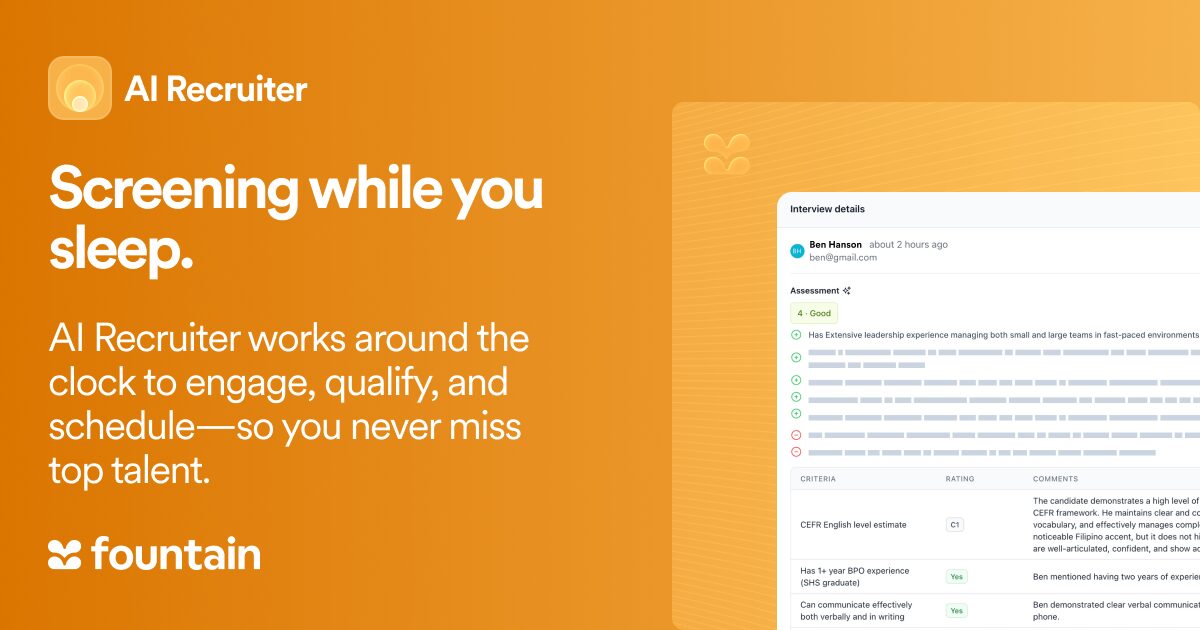
A multi-agent system screens that candidate, schedules the interview, completes onboarding documents, assigns a first shift, and flags retention risk. That’s the difference between recruiting automation that surfaces work and recruiting infrastructure that does it.
Why QSR is built for agentic AI hiring
QSR is one of the cleanest fits for agentic AI hiring because it has every condition the architecture needs to outperform manual processes:
- Structured data: application fields, screening criteria, role requirements, and retention outcomes are already standardized across roles.
- High-volume repetitive decisions: every shift, every turnover, every store, every week.
- Time-sensitive outcomes: unlike knowledge work, a missed staffing decision means a closed dining room or an unstaffed peak hour. The cost is immediate and measurable.
- Multi-location pattern: the same workflow scaled across 50 to 5,000 locations, where consistency across stores compounds the leverage.
When all four are true, the bottleneck stops being a tooling problem and starts being a coordination problem. Multi-agent systems are built to solve coordination problems.
Benefits of frontline superintelligence for QSR
The leverage shows up in five places, and the gains compound because each one feeds the next. Faster apply-to-shift increases applicant flow. Continuous applicant flow makes 24/7 candidate communication useful. Pre-Day-1 onboarding reduces no-shows. Cross-location visibility turns operational variance into something an area coach can actually fix.
1. Apply-to-first-shift in hours, not weeks
In QSR, speed isn’t a vanity metric. It’s the difference between staffing tonight’s dinner shift and losing an applicant to the competitor who responded first. Agentic AI compresses the path from submission to first shift into a single business day.
The mechanics: a candidate completes a mobile app in under three minutes. A screening agent scores them against the role’s actual performance criteria. If they pass, calendar sync pulls available interview slots from the GM’s schedule and books one without back-and-forth. After the interview, offer and onboarding paperwork fire automatically. The candidate is on the schedule before they would have heard back from the average QSR chain.
2. Continuous applicant flow that doesn’t reset every quarter
Most QSR operators rebuild their applicant pipeline from scratch every time they need to hire. That’s expensive in job-board spend and slow in time-to-fill. Continuous applicant flow keeps past applicants in a candidate database, qualifications and history intact, ready to re-engage when a new shift opens.
The operational shift is meaningful. When a store needs to hire, the first move isn’t posting a job and waiting for fresh applicants. It’s pulling qualified past applicants who already know the role, the brand, and sometimes the location. Faster fill, lower cost, and a higher hit rate because these candidates have already raised their hands once.
3. 24/7 candidate communication without GMs touching it
Hourly candidates don’t apply during business hours. They apply at midnight after a shift ends, between classes, or on a smoke break. Most QSR hiring loses candidates in the gap between when they apply and when a manager responds. A support agent running across SMS, chat, and WhatsApp closes that gap to zero.
The agent answers application questions in real time, sends interview reminders, confirms shift details, and handles common reschedules without pulling a GM off the floor. Managers see the conversations afterward. Candidates get the immediate response they need to stay engaged. Managers stop chasing. The funnel runs on its own.
4. Onboarding that completes before the first shift
In a typical QSR, onboarding bleeds into the first week of work. I-9 verification gets pushed to “we’ll do it Monday.” Tax forms sit unsigned. Background checks run late. The cost shows up later as compliance exposure or, worse, a no-show on the first shift because the candidate never finished their paperwork.
Agentic onboarding compresses that into hours. The moment an offer is accepted, document collection fires automatically. I-9 verification runs through E-Verify. Tax forms get pre-filled and signed via mobile. Background checks initiate without manual triggering. By the first shift, the worker is documented, verified, scheduled, and ready to start the shift, not standing in the back office filling out paperwork.
5. Cross-location visibility for area coaches and regional ops
Multi-location QSR ops have a visibility problem that compounds with scale. Some stores are fully staffed and operating smoothly. Others bleed shifts every Friday, and no one in regional ops knows why. Manual reporting can’t keep up with the variance.
A unified system gives every store, every funnel stage, and every drop-off point a single view. Area coaches see which locations are slow at screening, which are losing candidates between offer and the first shift, and which managers haven’t responded to applicants in 48 hours.
The intervention shifts from reactive (“this store is short tonight, scramble”) to predictive (“three stores are trending toward shortfall next week, here’s where to focus”).
According to the 2025 Fountain Frontline Report, AI-driven screening and scheduling cut hiring time by about 40% on average. In QSR specifically, those gains compound because the same architecture runs across every location simultaneously.
Frontline superintelligence for QSR in action: the Bojangles case study
When a multi-agent execution layer runs across hundreds of QSR locations, the operator stops getting reports and starts getting outcomes. Time-to-hire compresses. No-shows drop. Application flow climbs.
Recruiter and manager time gets reclaimed. The same architecture works across rural and metro stores, across high-turnover and low-turnover seasons, across formats.
Bojangles is one of the clearest examples. The chain runs 750 fast-food locations across the Southeastern US, hiring frontline staff at scale in both rural and metro markets. Before switching to an agentic execution layer, Bojangles had a 30-day time-to-fill for hourly roles.
Hiring ran through fragmented tools with no integrations, applications were too long for hourly candidates, and rural applicants frequently couldn’t apply in person at all. Managers were doing the chasing.
After the switch, the picture changed:
- Time-to-hire dropped 80%, from 30 days to 5.8 days
- Job-board spending dropped 86%
- 230 recruiting hours saved in a single year through automated messaging
- Application flow rate hit 50% against a target of 15%
- Around 30% hire conversion via Text-to-Apply, opening rural applicant reach the old process couldn’t access
Same brand, same franchise standards, faster hiring, less manager time spent on admin, more consistent staffing across stores. That’s the architecture running at multi-location QSR scale.
Where frontline superintelligence fits across QSR operations
The shape of the deployment depends on the size of the operation. Two patterns dominate.
For franchise groups and regional chains
Smaller franchise groups and owner-operator brands with a handful to a few hundred locations need the system to be lightweight enough for a GM mid-rush. This includes lean corporate teams and store managers running hiring without dedicated HR support. The order of operations is usually:
- ATS first to move candidates from apply to hire with minimal manager touch
- Sourcing next, once the flow is steady
- Onboarding to compress day-one readiness
- Scheduling once the foundation is stable
The benefit pattern: faster apply-to-first-shift, fewer no-shows, less GM time on admin, and more consistent staffing across locations. The system has to be mobile-first and fast, or managers won’t use it.
For enterprise QSR brands and multi-brand operators
Large enterprise brands and multi-brand franchise groups with hundreds to thousands of locations need standardization, compliance, and visibility, not just speed. Hiring is distributed across regions but has to roll up to centralized control. Agency spend is usually high and compliance exposure is real, especially with I-9 and state-by-state labor rules.
The deployment runs deeper:
- ATS for standardized workflows
- Sourcing for a predictable flow that reduces agency reliance
- Onboarding for consistent compliance across regions
- AI screening agents for high-volume throughput
- A CRM for shared candidate pipelines across brands
The benefits include hiring consistency, compliance audit trails, lower agency spend, regional pipeline visibility, and AI screening throughput without requiring linear scaling of the recruiting team.
How Fountain runs frontline superintelligence for QSR
Fountain is the AI-native platform for the global frontline workforce, used by QSR brands to run hiring, onboarding, and workforce operations at scale. Inside the platform, Cue is the orchestration layer above the agents. Anna handles voice screening at scale. Emma handles 24/7 candidate support across SMS, chat, and WhatsApp. Sam handles post-hire engagement to surface retention risk. Each one is purpose-built.
Cue translates plain-English goals (“hire 50 line cooks across the region this month”) into coordinated work, then logs every step.
Underneath the agents sits the platform: ATS, Sourcing, CRM, Onboarding, and Shift & Scheduling. Workflows are configurable per brand, so a multi-brand operator can enforce standards while letting franchisees customize where it makes operational sense.
Enterprise-grade AI infrastructure with constitutional AI safeguards powers the model infrastructure behind every agent decision, with audit logs, approval flows, and human override built in.
“If you can make it run there, under pressure, at volume, with compliance, across locations, on mobile, in real time,” Jernite says, “you are not building another assistant. You are building the infrastructure for how work gets done next.”
For QSR operators, that means hiring stops being the bottleneck. Stores open on time. Managers run the floor instead of the funnel.
Book a Fountain demo to see what high-volume hiring looks like when domain superintelligence runs the work.
Frequently asked questions about AI for QSR hiring
How does AI reduce time-to-hire in restaurants?
Each step that used to wait on a human now runs automatically. Screening scores candidates against the role’s actual performance criteria. Bi-directional calendar sync books interviews without back-and-forth. Voice screening agents handle first-round interviews 24/7. Onboarding documents complete before Day 1. Stack those compressions, and a multi-week hiring cycle becomes a multi-day one.
Can AI hiring tools work across multiple QSR locations?
Yes, and that’s where they have the strongest leverage. The same workflow runs across every location simultaneously, which means consistency across stores becomes the default. Area coaches and regional ops get one view of every funnel stage. Configurable workflows let multi-brand operators enforce standards while letting franchisees customize within them.
How is agentic AI different from chatbots for restaurant hiring?
A chatbot stops at the conversation. It can answer a candidate’s question, then hands the next step to a human. A multi-agent system runs the next step: screening, scheduling, document collection, first-shift assignment, and retention check-ins. The same workflow, but executed instead of just facilitated.