Hourly hiring runs on a different clock than corporate recruiting. Frontline candidates apply between shifts, often from a phone, and take the first concrete offer that shows up. The average application-to-offer cycle in the U.S. is 27.5 days for frontline roles. By the time most employers reach offer stage, the candidates who started the application a month ago are already working somewhere else.
The pressure shows up in candidate sentiment. According to the 2025 Fountain Frontline Report, 57% of frontline candidates name slow hiring as their top frustration, and 52% cite ghosting and lack of updates. Hiring costs have doubled since 2020, driven by administrative load and manual work that hasn’t kept pace with how candidates actually apply. The result is a hiring funnel that costs more, runs slower, and bleeds the candidates the operation was built to attract.
This guide covers what time to hire is, why it slips, what causes the slowdown, seven plays to compress it, and how to measure progress without letting speed mask quality.
What is average time to hire for hourly roles?
Average time-to-hire is the number of days from when a candidate enters your pipeline (applies or is sourced) to when they accept an offer. The formula is offer acceptance date minus application date, averaged across all hires in a given period.
Time-to-hire is not the same as time-to-fill. Time-to-fill starts at requisition approval and includes internal lead time before the candidate ever shows up. Time-to-hire measures pipeline speed and candidate experience. Time-to-fill measures org-level planning and headcount lead time. Both matter, but time-to-hire is the metric your candidates feel directly.
The headline benchmark for U.S. hourly roles sits at 27.5 days application-to-offer, per Fountain’s Redefining Frontline Operations research. However, numbers vary by sector. Top-performing QSR (quick-service restaurant) teams compress to under two weeks. The point isn’t the headline average; it’s how much faster your operation can move once the funnel is built for the way frontline candidates actually apply.
Why slow hiring costs more than a recruiter’s time
At scale, every day a shift goes uncovered compounds across overtime, customer experience, and lost revenue. The cost shows up in four places that the recruiting team doesn’t always see.
- Application abandonment: 60% of applicants abandon applications that feel too long or aren’t optimized for mobile. Most of those candidates never come back.
- Scheduling drop-off: 42% of candidates withdraw if scheduling takes too long. The slowest stage of the funnel is also the most fixable.
- Funnel leakage: Manual hiring processes drop roughly 35% of candidates between stages. Each stage transition that requires a recruiter to act is a moment when a candidate decides to quit.
- Replacement cost: Per the Fountain Frontline Report, replacing a frontline worker runs about $7,000, or roughly 40% of annual pay. At 50 monthly hires, that turns into a multimillion-dollar annual line item moving with your hiring speed.
At hundreds of locations, those costs compound. The 60% who abandon and the 42% who withdraw aren’t tracked in time-to-hire averages, but they cap how fast hiring can actually run.
What causes slow time to hire in hourly roles
Frontline hiring breaks in places corporate hiring doesn’t, because the candidate, the device, and the timeline are all different. Six causes account for most of the lag.
- Long applications that aren’t mobile-first: Candidates apply on phones during shift breaks, not at desks. Forms built for desktop bleed candidates at the first scroll.
- Screening volume overload: Applications rose more than 45% in the past year, with LinkedIn now averaging 11,000 per minute. Manual screening buries recruiters in volume before they can respond.
- Back-and-forth scheduling friction: Every email exchange is a chance to lose the candidate. AI scheduling can deliver up to 79% faster time-to-interview.
- Slow or no communication between stages: 52% of candidates cite ghosting and lack of updates as a top frustration.
- Compliance steps held to the end: I-9, background checks, and W-4 stacked at offer time delay Day 1 starts.
- Hiring tools designed for salaried roles, retrofitted for hourly: Enterprise ATSes often create friction in frontline workflows built around shifts, locations, and fast applications.
Each cause has a fix, and most don’t require more recruiters. They require a workflow built for the way frontline candidates actually apply.
How to measure and track time to hire
Most teams report a single time-to-hire number to leadership and stop there. The headline average obscures more than it reveals. Teams that actually compress hiring time treat measurement as a recurring practice with three layers underneath the headline: where the time accumulates, who’s hitting the bar, and whether the speed translated to hires who showed up and stayed.

A practical setup runs on a weekly cadence. Pull stage-level data from your ATS, segment by location and role, and compare against the prior period.
Three views matter:
- Funnel timing breakdown: Days from application to screen, screen to interview, interview to offer, offer to acceptance. The two longest stages are where automation pays off first. If interview-to-offer runs four days while screen-to-interview runs eight, the scheduling layer is the bottleneck.
- Location-level distribution: Median time-to-hire per location, with a callout for locations in the bottom quartile. Same role, same brand, three-fold variance is common. The bottom-quartile location’s funnel almost always has a fixable process gap, not a market problem.
- Speed-quality cross-check: Day 1 show rate and 90-day retention paired against time-to-hire for the same cohort. Hires that move fast but don’t show up are not hires. Stitch Fix tightened its funnel to lift Day 1 show rate from 68% to 95% across warehouse hiring, an example of the cross-check working as intended.
Stand the dashboard up before any process change goes live. Run weekly for the first quarter, then monthly at the org level once the numbers stabilize, with weekly reads staying on bottom-quartile locations.
How to reduce time to hire for hourly roles
Seven tactics, each with a data anchor and a first move you can run this week. Each tactic removes a manual step. Most anchor the workflow to the candidate’s phone and trigger compliance in parallel rather than at the end.
1. Applications under five minutes convert more candidates
Every minute of friction filters out qualified candidates who applied during a 10-minute break. A mobile-first form with essentials only defers heavy screening to post-application stages. Fountain customers running mobile-first applications move candidates from apply to conditional offer in under 10 minutes.
The fastest first step is auditing the current application and cutting every field that doesn’t determine qualification.
2. Automated screening against knockout criteria cuts days off the funnel
Screening should run in the time it takes a candidate to finish lunch, not the time it takes a recruiter to clear an inbox. Availability, location, and certifications should be the knockouts. AI-driven screening can cut screening time significantly and run voice interviews around the clock.
For example, CLEAR cut time-to-fill by 41%, going from 17 days to 10, after AI took over first-round screening. The highest-leverage starting point is three to five knockout questions for the highest-volume role, with AI handling the first-round call.
3. Scheduling friction is the most fixable bottleneck
Scheduling is often the biggest bottleneck in frontline hiring funnels and one of the easiest stages to fix. The right setup eliminates the back-and-forth without adding headcount:
- Bi-directional calendar sync: Recruiter availability flows to candidates in real time, and the slot they pick lands on the recruiter’s calendar instantly.
- Candidate self-scheduling: Candidates choose a slot in one tap from their phone, no email exchange required.
- Automatic confirmations and reminders: SMS and WhatsApp confirmations go out at booking, day-before, and morning-of.
AI scheduling can deliver up to 79% faster time-to-interview. Calendar sync is the fastest fix. Once it’s on, candidates pick their slot in one tap.
4. SMS and WhatsApp at every stage prevent silent drop-off
Silence loses candidates faster than rejection. Automated SMS or WhatsApp at every stage transition covers confirmations, reminders, updates, and follow-ups. Bojangles, a QSR chain with 750 locations across the Southeast, cut time-to-hire by 80% (from 30 days to 5.8 days) and reduced job board spend by 86% through automated messaging and other workflow improvements.
The five most common drop-off points (application submitted, screening passed, interview scheduled, offer extended, Day 1 confirmed) are where messages should live first, one short line each.
5. Always-on talent pipelines turn past workers into same-week hires
The fastest hire is the one you already know. A CRM that keeps profiles current and reactivates prior workers eliminates new sourcing spend for known-quantity candidates. Reactivation means hiring from a pool of workers whose performance has already been measured, instead of starting from zero each season.
Last year’s top performers who left in good standing are the first list to reactivate, before opening new sourcing.
6. Parallel compliance closes the gap between offer and Day 1
I-9, background checks, and W-4 should trigger at offer acceptance, not after. Stacked at the end, they push Day 1 out. Triggering them in parallel closes the gap:
- Onboarding workflows that fire at offer acceptance: Compliance tasks start the moment the candidate signs, not after orientation is scheduled.
- Mobile I-9 completion: Section 1 finishes on the candidate’s phone before Day 1.
- Remote authorized representative: Section 2 doesn’t require an in-person visit, which removes a common scheduling delay.
- E-Verify integration: Verification runs alongside background checks, not after them.
Automated onboarding handles I-9 completion before Day 1 for high-volume employers. The quickest win is moving I-9 and background check triggers from “after offer” to “at offer acceptance” in the workflow.
7. Stage-by-stage measurement by location reveals where time actually leaks
Company-wide averages hide where time actually leaks. Stage-by-stage conversion, Day 1 show rate, and first-90-day retention should be tracked by location, not just at the org level. Turnover variance across locations within the same company can run threefold.
The bottom-quartile location for time-to-hire is the right place to begin, auditing each funnel stage against the company median.
How Fountain runs hourly hiring at scale
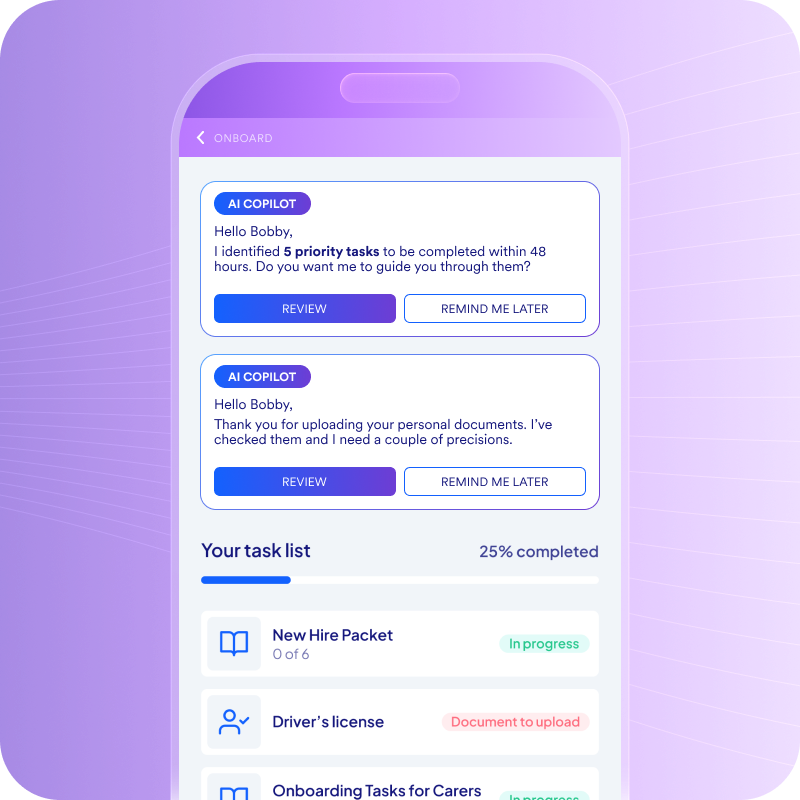
Fountain’s Frontline Superintelligence is purpose-built for high-volume frontline hiring, not a corporate ATS adapted downmarket. The system covers the full hiring funnel in one workflow, orchestrated by Cue, the single entry point to every agent on the platform. A recruiter prompts Cue in plain language (“Hire 25 cashiers across Atlanta by Friday, all background-checked and scheduled for orientation”), and Cue breaks the goal into orchestrated tasks across products and agents.
Three named agents run under Cue:
- Anna handles voice interviews 24/7 and applies consistent screening criteria, with human reviewers making final advancement decisions.
- Emma answers candidate questions on SMS, WhatsApp, and web at any hour, keeping hiring moving without recruiter touch.
- Sam takes the pulse of new hires through Day 1 and beyond, surfacing retention risks early enough to act on them.
The agents operate on Fountain’s core products: ATS, Sourcing, CRM, Onboarding, and Shift & Scheduling. The result shows up in customer outcomes. Fetch, a package delivery platform, cut time-to-hire from 15 days to 6.5 hours with Anna handling first-round screening. Liveops, a virtual contact center, runs a 44,000:1 applicant-to-recruiter ratio while maintaining a 100% fill rate.
The pattern is the same in each case. The funnel runs as one continuous workflow instead of five disconnected systems passing work between them. Speed comes from removing handoffs, not from running the same broken process faster. The gap between the 27.5-day headline average and the operators hitting single-digit days is the gap between fragmented tooling and a system built for how frontline candidates actually apply.
If your operation is ready to compress hourly hiring from weeks to days, book a Fountain demo and see the full funnel run from a single prompt to Day 1.
Frequently asked questions about average time to hire
What’s a good average time to hire for hourly roles?
The U.S. average for frontline roles sits at 27.5 days application-to-offer, according to Fountain’s Redefining Frontline Operations research. Top-performing teams running mobile-first applications and AI-driven screening compress that to six to eight days, with the fastest operators hitting single-digit days.
The right target depends on role complexity (a CDL driver needs more verification time than a cashier), but six to eight days is a reasonable bar for most high-volume hourly roles.
What’s the difference between time to hire and time to fill?
Time-to-hire starts when a candidate applies. Time-to-fill starts at requisition approval, so it captures internal lead time before the candidate enters the picture. Time-to-hire measures pipeline speed and candidate experience. Time-to-fill measures org-level planning and headcount lead time.
How is time to hire calculated?
Sum the days from application to offer acceptance for every hire in a given period, then divide by the number of hires. Track it alongside Day 1 show rate and first-90-day retention. Fast hires that don’t show up are not fast hires, and the cross-check prevents speed gains from masking quality drops.
Can AI really cut time to hire in half?
Yes. Per Fountain’s Agentic AI for Frontline Workforces research, manual hiring averages 14+ days for hourly roles. With AI in the screening and scheduling layers, that compresses to six to eight days, with screening time falling 40% and time-to-interview falling up to 79%. The fastest operators compress further when AI handles first-round screening end-to-end.