43% of frontline new hires are gone within 90 days, and replacing each one costs about $7,000, according to the 2025 Fountain Frontline Report. Among voluntary leavers, 45% said no manager talked with them about their future in the three months before they quit. The exit interview is the autopsy. The stay interview is the conversation you hold while the employee is still on the schedule and you can still change something.
Managers own the conversation and the follow-through: technology can flag missed shifts, schedule changes, and incomplete onboarding as quit signals, but the manager decides what happens next.
What is a stay interview?
A stay interview is a short, structured conversation with a current employee about what keeps them, what wears on them, and what might push them out, held while they’re still on the team.
Richard Finnegan codified the practice in the SHRM-published The Power of Stay Interviews for Engagement and Retention as “a structured discussion a leader conducts with an individual employee to learn specific actions the leader can take to strengthen the employee’s engagement and retention with the organization.”
Most take 20 minutes or less, fitting around frontline operations without losing the time they need. Record reasons employees stay alongside sources of friction, and note whether the employee is likely to leave.
A stay interview diagnoses; it doesn’t replace competitive pay, safe staffing, or predictable schedules. On hourly, deskless, multi-location teams, the signals rarely stay individual: they cluster by location, shift, manager, and tenure, worth writing down rather than remembering.
How stay interviews differ from exit interviews, reviews, and surveys
An exit interview tells you why someone left after nothing can be done about it, yielding canned responses since nobody wants to burn a bridge on the way out. A stay interview gets the same information while you can still act.
A performance review is your evaluation of the employee; a stay interview is the employee’s evaluation of the job, and mentioning performance in one discourages honesty in the other. Stay interviews “should not be add-ons to performance-appraisal meetings, but should instead be separate meetings that are entirely focused on what leaders can do for their employees.”
Engagement and pulse surveys are anonymous and aggregate: they can tell you frontline workers are frustrated with scheduling, not which worker is about to quit or what would change their mind.
A stay interview is individual and named, producing a plan for that employee, going a step past a regular one-on-one by formally recording answers for analysis.
Create a standalone stay-interview check-in in Onboarding and keep it separate from performance reviews. Before, retention feedback is mixed with evaluation and left in informal notes. After, managers hold a dedicated conversation and record consistent answers for follow-up.
Who to interview, and when
The direct manager should run stay interviews, at key early-tenure milestones and at least annually after. Kathleen Quinn Votaw, CEO of TalenTrust, is blunt: “Never delegate stay interviews to the human resource department.”
That relationship gap is exactly what most departing employees point to, and HR running the conversation on a manager’s behalf builds none of it. Where trust is thin, a skip-level or HR conversation is the fallback, but going around the supervisor teaches the team the fast lane runs over their manager.
Half of frontline hourly workers last four months, so interview new hires first, then high-turnover locations and hard-to-fill roles. Prioritizing can feel like a watch list, so plan to interview everyone eventually and skip only employees with active performance issues.
Use 30/60/120-day check-ins for new hires, inside the window where most early quits happen, and meet tenured employees once a year. An extra conversation is worth it after a manager change, rising absenteeism and late arrivals, a seasonal peak that rushes onboarding, or a schedule disruption, since unstable schedules predict turnover in retail and food service.
Skip it in the six months around a performance review, and mid-rush, wedged between orders.
What to ask
Finnegan’s five questions are the spine, plus the probes managers use, adapted below to shift work, where real answers tend to be about hours, staffing, and whoever runs the floor.
- “What do you look forward to when you come in for a shift?” Finnegan’s opener, reframed for people who don’t commute to a desk.
- “Is the job what you were told it would be when you were hired?” Surfaces any gap between the posting and the floor.
- “How are your hours and schedule working for you right now?” Five of seven strategies rated most effective for retaining frontline hourly workers involve scheduling.
- “What makes a shift easier, and what makes one harder?” Can uncover short staffing and equipment problems, or coworker conflict, without asking about each directly.
- “Do you have the training, the tools, and the backup from me that you need?” Surfaces gaps in job training and whether the manager provides enough support.
- “When was the last time you thought about leaving, and what prompted it?” Finnegan’s fourth question. The “when” gives urgency, the “what” gives cause.
- “Why do you stay?” When the answer is “I have to pay the bills,” trained managers reply, “Me too, but why do you really stay?”
- “If I could change one thing about your week, what would it be?” Finnegan’s fifth question in shift terms, and the one that usually turns into a concrete commitment.
Add these eight questions to a standard Onboarding check-in template. They’re a starting point: the real answer lives one level below the first response, in “Tell me more about how that happened” or “How important is that to you right now, one to 10?”
Effective probing develops more information and “also shows you care.”
How to run one that gets honest answers
Getting honest answers starts with psychological safety: the shared belief that employees can speak with candor without fear of punishment or humiliation, and a manager who listens without defensiveness. Nobody tells a supervisor the truth if the next schedule might punish them for it, or if nothing will change either way.
Hold the conversation in a private, informal spot away from the rush, 30 minutes, phones down.
The manager’s job is to listen roughly 80% of the time and probe the rest. Defensiveness is fatal: word spreads “that the manager cannot take feedback,” and remaining interviews turn short and fruitless. Save commitments until feasibility is checked.
Stay interviews aren’t anonymous, so how feedback gets used matters as much as the questions. Say up front what notes you’ll take, whether themes go to leadership without names, and that disclosures like harassment or discrimination allegations can’t be kept confidential. Retention runs four times higher among workers who get clear, predictable communication, starting with this conversation.
Across locations, standardize the core questions and manager training, leaving the flow to the manager: sending questions ahead of time “limits leaders to responding to scripted, bullet-pointed answers.”
What to do after: from signal to action
Notes with no action don’t strengthen trust; asking, listening, and acting does, in four steps. Confirm what you heard before the conversation ends, in a summary the employee can correct. Write the stay plan together with the employee, then change one thing.
Tell them what changed and by when, including an honest “no, and here’s why” when you can’t, and follow up promptly with clear actions.
Stay plan, one page:
Employee and date:
What I heard, in their words:
One thing we’re changing:
Owner and deadline:
Follow-up date:
Keep it to one page and one commitment: a stay plan with five action items is a plan nobody owns. Set the follow-up date at the next scheduled check-in, not “sometime”: a 30-day commitment gets checked at 60, and anything promised after a tenured employee’s annual conversation gets checked again within the quarter, not next year.
Recurring themes separate an individual issue from a broader one. One employee who hates closing shifts is a scheduling conversation. The same complaint repeated across a shift, location, or a supervisor’s whole team is systemic, and no frontline manager can fix it alone.
Pay bands, headcount, scheduling rules, and a supervisor’s behavior belong on the escalation list, and the manager carrying them up needs cover to raise them without fear.
Compare 90-day retention against a pilot baseline by location and manager before crediting stay interviews with any movement.
Common stay interview mistakes
Stay interviews fail when managers undermine safety, judge instead of listen, skip the follow-through, overpromise, or treat the interview itself as the fix.
- Running it as a performance review or an interrogation. The direction flips from manager serving employee to manager judging employee, and candor stops.
- Asking for candor before building safety. If employees have watched a supervisor mock a complaint, the answers will be short and false.
- Promising before checking feasibility. A frontline manager usually can’t change pay or headcount alone, and a broken promise lands harder on an employee with few other reasons to stay.
- Collecting feedback with no owner or deadline. Stay plans require implementation, and every employee needs an answer; district managers with no channel back to HR or ops are the multi-location version of this failure.
- Treating the interview as the fix. When answers keep pointing at pay, staffing, scheduling, or a manager, the interview has already done its job. Change the policy or escalate to someone with authority.
When managers don’t address what employees say they need, “employees are likely to find a different employer to fulfill them.” A stay interview program with no budget or authority behind it is a slow way to relearn what exit interviews already said.
How Fountain turns stay-interview signals into action
Across 200 stores or 40 depots, a district manager can’t manually track every new hire’s tenure, callouts, and overdue check-ins across separate systems. Cue, Fountain’s orchestration layer, combines those records and routes the tasks to the responsible managers, within the permissions and approval triggers they set.
A frontline ops lead can type “Flag anyone hired in the last 90 days across sites 4 to 9 who is showing quit signals, and line up a check-in this week,” and Cue breaks that goal into tasks across Fountain’s products.
The agents Cue coordinates cover this lifecycle:
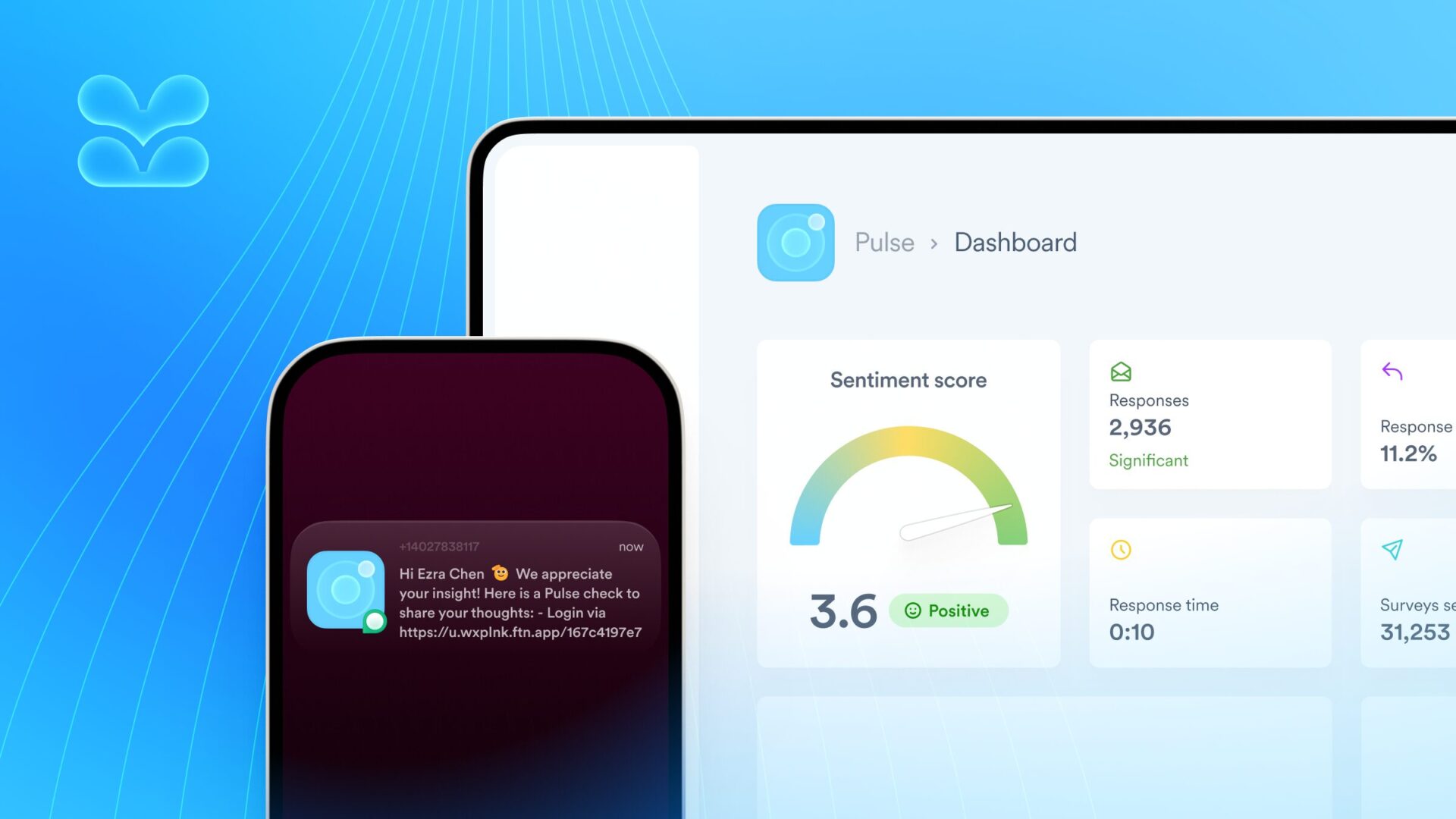
- Sam runs the post-hire pulse inside the 90-day window, making the stay-interview conversation continuous between sit-downs.
- Emma handles candidate questions and day-one paperwork, keeping managers out of that queue.
- Anna runs voice screening upstream; the final advancement decision always stays with a human reviewer.
Underneath, Fountain ATS and Fountain Onboarding cover the early-tenure window; Shift & Scheduling addresses the predictability complaint employees raise most; and Fountain CRM re-engages former employees instead of sourcing strangers.
After moving its multi-brand hiring onto Fountain, Marsden Services saw a 16% increase in Day 1 retention and cut one client’s site vacancy rate from 18% to 6%. That’s a comparison point, not proof Fountain alone caused the change.
Frontline attrition announces itself weeks ahead: a missed shift, a flat answer to “why do you stay,” a schedule that changed twice in a week. Book a demo to see how Cue routes those signals to the managers who can act on them.
Frequently asked questions about stay interviews
What is the main purpose of a stay interview?
To learn what a specific employee needs to stay, while there’s still time to provide it. Finnegan’s definition centers on “specific actions the leader can take,” and the output is an individual stay plan rather than a score.
How is a stay interview different from an exit interview?
Timing and usefulness. A stay interview happens while the employee is on the team, so you can act on what you hear. An exit interview happens after the decision is made, when it’s rare to change someone’s mind.
Do stay interviews actually reduce turnover?
Stay interviews diagnose retention problems; their effect on turnover depends on whether managers act on the findings. Pilot against a baseline before crediting them with any movement.