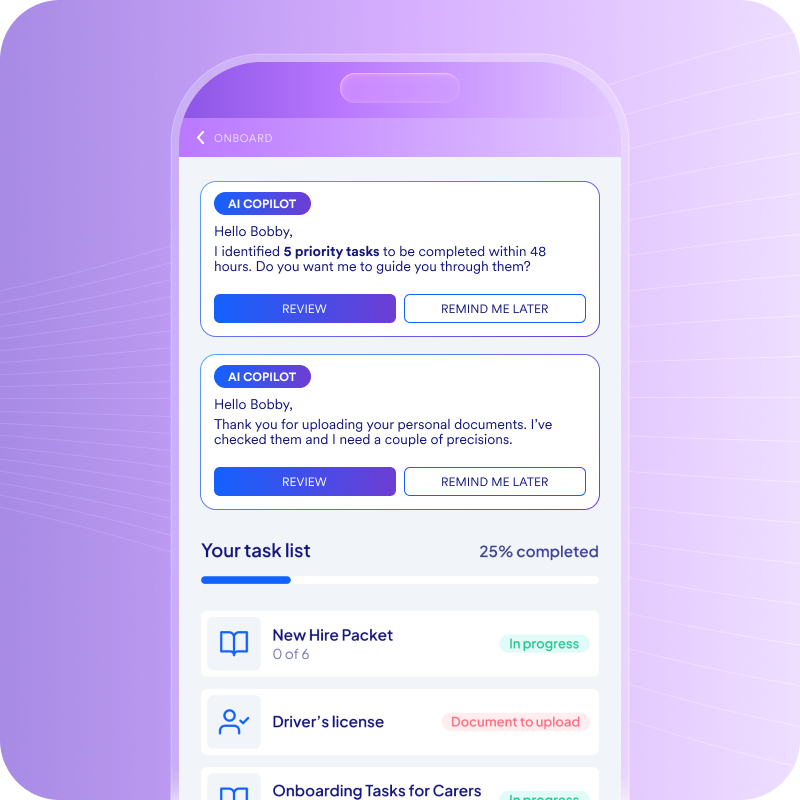
New hires keep moving toward Day 1 when the days between a signed offer and a first shift stop being silent. A pre-Day-1 onboarding workflow does four things in that window. It collects paperwork on the new hire’s phone, starts the background check at offer, confirms first-shift details with timed reminders, and flags anyone who isn’t ready before the shift begins.
For frontline employers, that makes onboarding the first retention move, and it happens before the new hire ever clocks in.
Why the offer-to-Day-1 gap costs frontline employers so much
Many frontline hiring processes go quiet once an offer is signed. The recruiter moves to the next requisition and the store manager returns to the floor. When the new hire doesn’t show, the employer loses its recruiting spend and ends up with an uncovered shift. The crew already working absorbs the hours, and the manager returns to recruiting. At a quick-service restaurant (QSR), that can mean running the lunch rush one person short.
Early turnover adds to the cost. In QSR, an HourWork survey of employees at more than 8,000 restaurants found that only 54 percent reached 90 days of work before quitting in 2022. With losses that heavy inside three months, the weeks before Day 1 are the earliest point a team can act.
The third cost is funnel leakage, where a new hire accepts an offer but never shows up for their shift. In a 2019 Indeed survey reported by HR Dive, 22 percent of job seekers who admitted to ghosting had accepted a job offer but didn’t show up for their first day.
Your Day-1 show rate tells leadership how much recruiting spend leaks out of the funnel after acceptance. The sections below cover where those no-shows come from and how to fix each cause.
Where pre-Day-1 no-shows actually come from
Most no-shows trace back to the process, not the candidate. The employer has done the expensive work of recruiting, then gives the new hire nothing to do, nothing to read, and no one to ask. A new hire who feels forgotten will reasonably take the next call from a competing employer. Day-1 no-shows usually come from four process failures, and each one has a timing or channel fix.
- Silence after the offer: A new hire who hears nothing after the offer may start treating it as optional, especially if they still have other applications open.
- Paperwork that only opens on a desktop: In Pew Research Center’s 2026 survey, 16 percent of U.S. adults owned a smartphone but had no home broadband, a pattern Pew finds especially common in lower-income households. For those new hires, a W-4 that needs a laptop can sit unfinished.
- Unclear first-shift logistics: A new hire may not know the start time, entrance, parking, dress code, or who to ask for. Each missing detail gives a nervous new hire an easy reason to stay home.
- Slow verification steps: Some background checks start days after the offer. County court searches can require manual record pulls, and driver checks can stall while waiting on the candidate’s consent. Every delay stretches the gap a competing employer can fill.
Every item on that list maps to a specific workflow stage, which is where the fixes live.
The pre-Day-1 onboarding workflow, stage by stage
The workflow has six stages, from signed offer to a Day-1 readiness check. The workflows that hold up automate every repetitive or time-based step and leave the human moments to managers. Your store and site managers don’t sit at desks, so they have to handle those moments on their phones.
| Stage | What happens | Owner |
| 1. Offer signed | System enrolls the new hire in onboarding and sends a welcome text with the Day 1 date, time, and location | System |
| 2. Mobile document collection | Tax and employment eligibility forms, direct deposit, ID upload, and role certifications completed on the new hire’s phone | System sends and tracks; new hire completes |
| 3. Background check trigger | Background check and any role-specific screening, such as driver checks, order at offer signing and run alongside paperwork | System |
| 4. Schedule confirmation and first-shift details | Manager confirms the shift and names the person who will greet the new hire, then logistics go out | Manager (on phone), then system |
| 5. Automated reminders | Nudges on unfinished tasks, plus the 48-hour and night-before messages over SMS or WhatsApp | System |
| 6. Day-1 readiness check | System flags anyone missing documents, checks, or document review steps by location before the shift | System flags, manager acts |
Because each stage starts on an event, each one also leaves a timestamped record. A manager or HR lead can open any new hire’s file and see exactly where they stalled, without asking around.
The background check needs its own trigger. It should fire automatically the moment the offer is signed and run in parallel with document collection. Running it after paperwork is finished adds days to an already too-long window.
Building the communication cadence for SMS and WhatsApp
Pre-Day-1 messages belong on the channels frontline hires actually read. An hourly-sourcing panelist quoted by SHRM said, “Not all hourly candidates even have email addresses, much less check them with regularity.” SMS and WhatsApp should carry the core cadence, and email should hold a backup copy of documents.
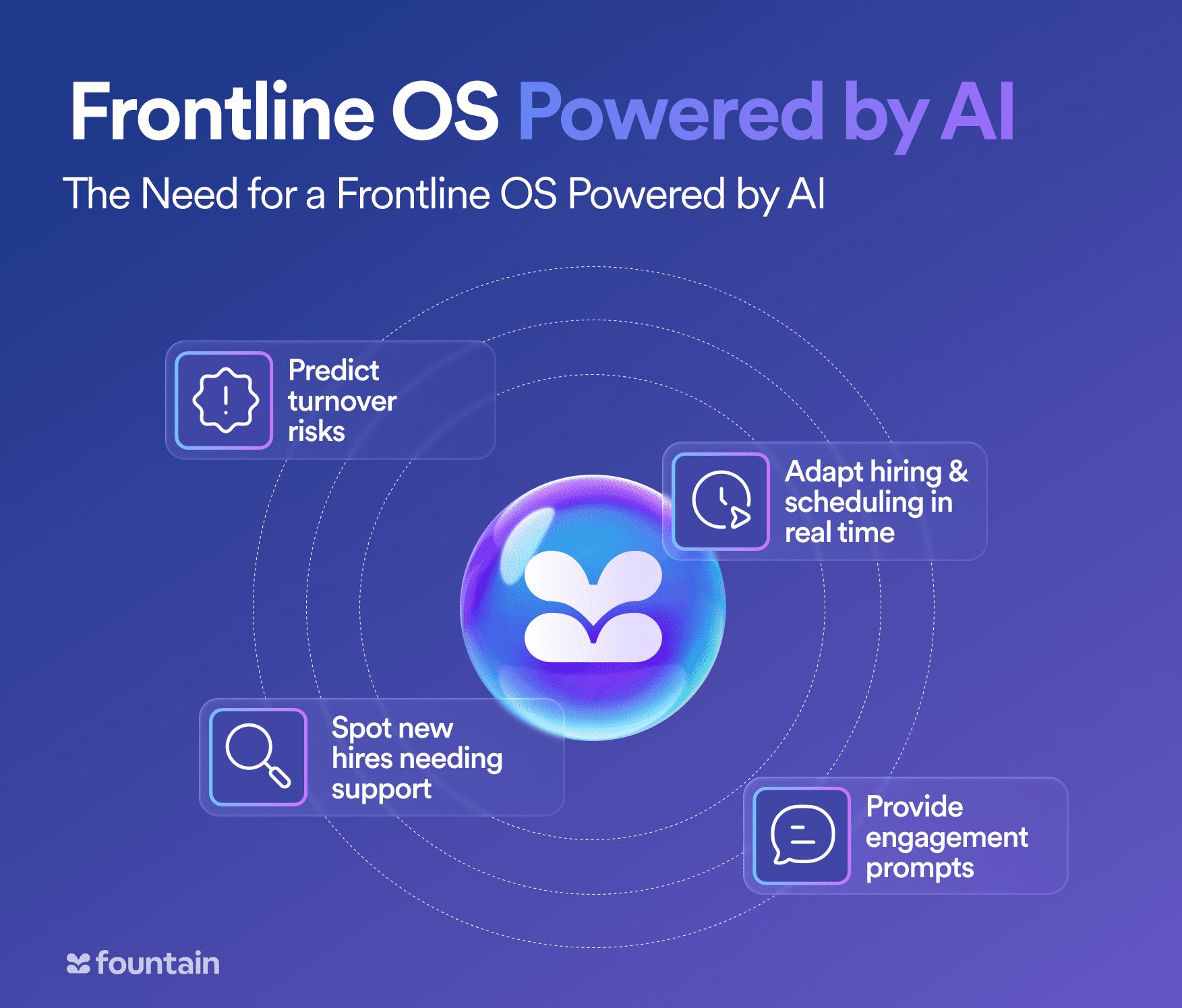
A smarter, connected way to hire, engage, and retain frontline teams
Centralize scheduling, hiring, onboarding, engagement, and analytics in one AI-powered platform built for the frontline workforce. Fountain OS gives leaders the real-time insights and tools they need to predict turnover, boost retention, and streamline high-volume operations.
Automate repetitive tasks, identify at-risk employees early, and make data-driven workforce decisions with a unified solution designed to help frontline teams thrive.
- Within minutes of offer acceptance, send a confirmation with the Day 1 date, time, and location, plus a mobile link to the paperwork. It also lists any documents to bring on Day 1, so the first-shift document review holds no surprises.
- About 48 hours before the first shift, a readiness check shows what’s still open and asks the new hire to reply to confirm. This is the last comfortable window to fix a missing document or a schedule conflict.
- The night before, a short message says who will meet them, which entrance to use, and what to wear.
Each reminder should carry a detail the new hire didn’t have yet. Compare two night-before messages:
- Before: “Reminder: your shift starts tomorrow. Are you still coming?”
- After: “Hi Jordan, Maria will meet you at the side door on Elm St. at 7:45 tomorrow. Wear black non-slip shoes. Reply here if anything comes up.”
The first gives the new hire nothing to act on. The second answers the questions that keep nervous new hires at home.
Every message should invite a reply. Your workflow should route replies like “can’t make it” or “where do I park?” to the manager’s phone within the hour. A two-way thread also gives the manager an easy way to make early contact. During a holiday hiring wave across, say, 40 stores, this cadence would keep each store manager from texting dozens of new hires personally.
Keeping verification steps off the Day-1 critical path
Verification becomes a Day-1 bottleneck when every step waits for the new hire to walk in. The workflow fix is to start each step as early as your process allows and give it an owner, building on your existing onboarding checklist.
- Collect forms on the phone at offer: Send the new hire’s portion of each form with the offer confirmation, so it’s done before anyone needs to review it.
- Schedule the document review; don’t leave it to memory: Put the in-person document review on the calendar with an owner, and set reminders from the start date so it doesn’t depend on a manager remembering it.
- Name a backup reviewer: If the store manager is often on the floor, assign a second person who can handle the review so it doesn’t stall.
- Give each driver type its own branch: Driver roles often carry extra checks, so a separate workflow branch for each driver type keeps every new hire’s checklist short and holds dispatch until that branch’s checks clear.
Employment eligibility verification, E-Verify, and DOT driver checks are regulated processes with their own timing. USCIS’s I-9 Central publishes official guidance for employment verification; confirm the sequence for each role with counsel before building it into the workflow.
How to measure the pre-Day-1 workflow
Four metrics show whether the workflow reduces no-shows or just shifts the problem.
- Day-1 show rate: One workable definition is new hires who arrive for their first shift divided by accepted offers. Track it separately from interview no-shows, since the causes differ.
- Onboarding completion rate before start: The share of new hires who complete all assigned tasks before their first shift, including forms, direct deposit, and certifications.
- Time-to-onboard: Days from offer accepted to Day-1 ready. The endpoint needs a clear definition, because the day a hire becomes ready and the day of the first shift aren’t always the same.
- Readiness by location: Split the completion metric by store, restaurant, or site. A gap at one location may point to a specific manager or a location-specific step.
Track show rate and readiness separately. Changes to your messages should show up in show rate, while changes to paperwork or verification sequencing should show up in readiness. Independent benchmarks for frontline Day-1 show rate are thin, so record your own baseline at one location before changing the workflow, then compare afterward.
How Fountain runs the pre-Day-1 workflow
Most pre-Day-1 failures happen at a handoff that depends on someone remembering it. A store manager might plan to confirm a new hire’s shift once the background check clears, then get pulled onto the floor during a rush. The check clears, nobody confirms the shift, and the new hire never gets a logistics message.
Cue, Fountain’s Frontline Superintelligence, closes that gap by running the workflow across Fountain’s products on events, not memory. Three capabilities map to the failures above:
- Handoffs fire on events: An Automation Center rule can notify the hiring manager when a new hire signs the offer and completes the background check. First-shift details then go out over SMS or WhatsApp, so silence after the offer never sets in.
- Paperwork on the phone: Onboarding enrolls new hires when they accept the offer and lets them complete their onboarding paperwork on their phones. Managers can see who’s ready for Day 1 and who has stalled before the shift.
- Stalled work moves on request: Ask Cue to “Get every new hire starting Monday ready for their first shift,” and it proposes a plan, asks for approval where you’ve set it, and carries it out.
The results show up in onboarding speed and attendance. GoFor, a last-mile delivery company, cut time-to-onboard from 30 days to 5.
MAPS Logistics, a UK courier that hires 2,000 drivers a year, shows the same reminder mechanism working earlier in the funnel. It cut candidate no-shows by 70 percent after replacing manual interview scheduling with calendar integration and SMS reminders.
Automation handles the handoffs, but the human moments stay with your team. A manager still greets the new hire and makes the personal call when someone goes quiet, and the person your process designates still reviews documents in person. Which onboarding events and records are captured depends on your deployment, so confirm them during setup.
Onboarding is the first retention intervention
The offer-to-Day-1 window decides more frontline retention outcomes than most hiring teams account for. A workflow that runs on phones closes the timing and channel gaps that produce no-shows, and it moves verification steps ahead of the first shift so new hires arrive ready to work.
Fountain’s Frontline Superintelligence runs this workflow from mobile paperwork and automated reminders to Day-1 readiness, connecting hiring and onboarding so new hires are ready before they clock in.
Ready to get new hires Day-1 ready? Book a demo to see Onboarding in action.
Frequently asked questions
What should happen when a new hire’s start date moves?
Update the start date in the workflow first, so reminders and readiness flags recalculate from the new date. Then resend the first-shift details with the new date and greeter, and check whether any scheduled document review or check needs to move with it.
Do rehires need to go through the full pre-Day-1 workflow?
Usually a shorter version. Check which documents on file are still current and skip what doesn’t need repeating. Keep first-shift logistics and reminders, because a returning worker can no-show too. Counsel can confirm which forms a rehire needs to complete again.
How many pre-Day-1 messages is too many?
Three core messages cover most cases: the offer confirmation, the 48-hour readiness check, and the night-before details. Task nudges go only to people with open items and stop once the task is done. If a message adds no new detail, cut it.
What should happen when a new hire stops responding before Day 1?
Escalate in steps. After two unanswered reminders, have the manager place one personal call. If there’s still no reply, notify the recruiter so a backup candidate from the pipeline can be lined up for the shift. Log the outcome to learn where silence starts.