
What agentic software should cost.
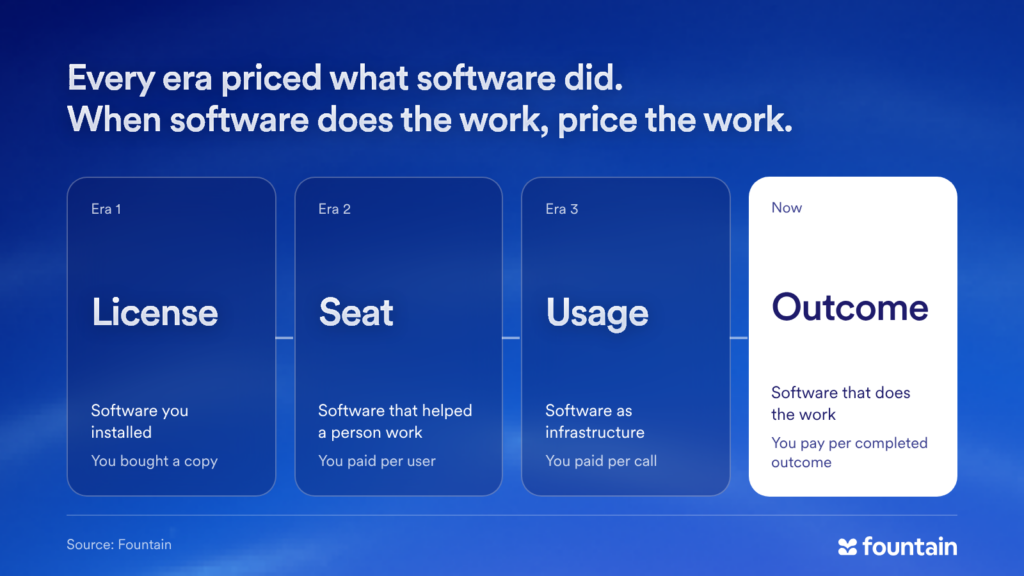
Software pricing has always described what software did. When software was a tool you installed, you bought a license. When it helped a person work, you paid per seat. When it became infrastructure, you paid for usage. Each model matched the unit of value of its era, and each is wrong for what comes next. When software does the work, the unit of pricing is the work.
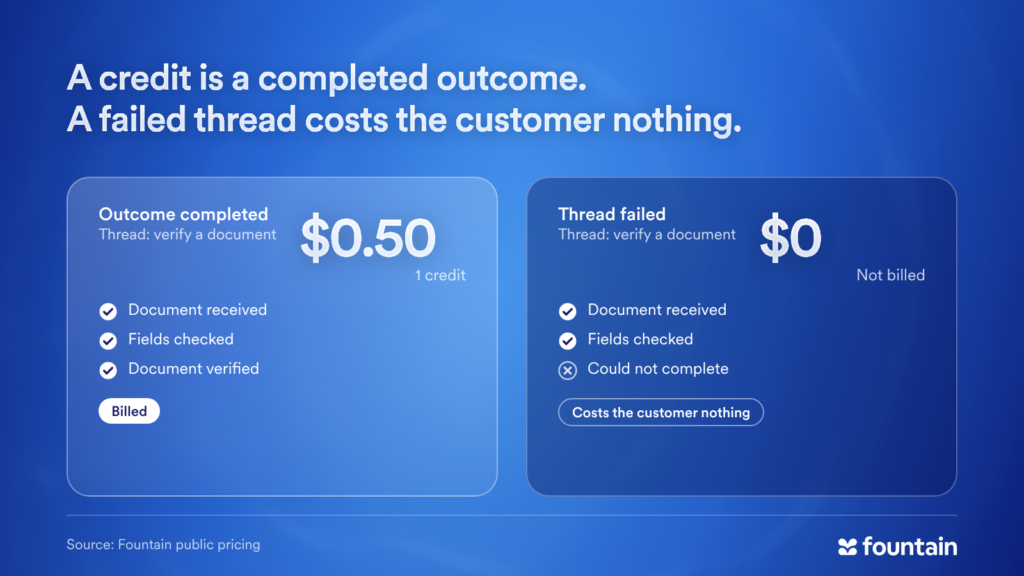
At Fountain, a credit is charged when an outcome completes. A credit costs fifty cents, and a thread that fails costs the customer nothing. We bill for results, and I believe the entire industry’s pricing is heading here. Sierra proved the model in customer service, where paying per autonomous resolution built one of the fastest-growing enterprise software companies of this cycle. We apply it to frontline operations, where an outcome is a verified document, a completed onboarding, a covered shift, a resolved case.
What outcome pricing does to the vendor is the point. When failed threads are free, the vendor eats the cost of every failure, which turns evaluation from a research interest into a survival discipline. The roughly-three-quarters success rate I published earlier in this series is the number our revenue is built on. Every point it climbs is margin we earn by engineering instead of invoicing. I cannot think of a stronger alignment between a vendor and a customer, and alignment is what pricing is for.
Outcome pricing also carries a consequence I rarely see addressed, and it matters more as autonomy grows. Once the system proposes the agents that generate the outcomes, the system is generating its own bill. A company whose operation staffs itself with software must never discover that it also spent for itself without limit.
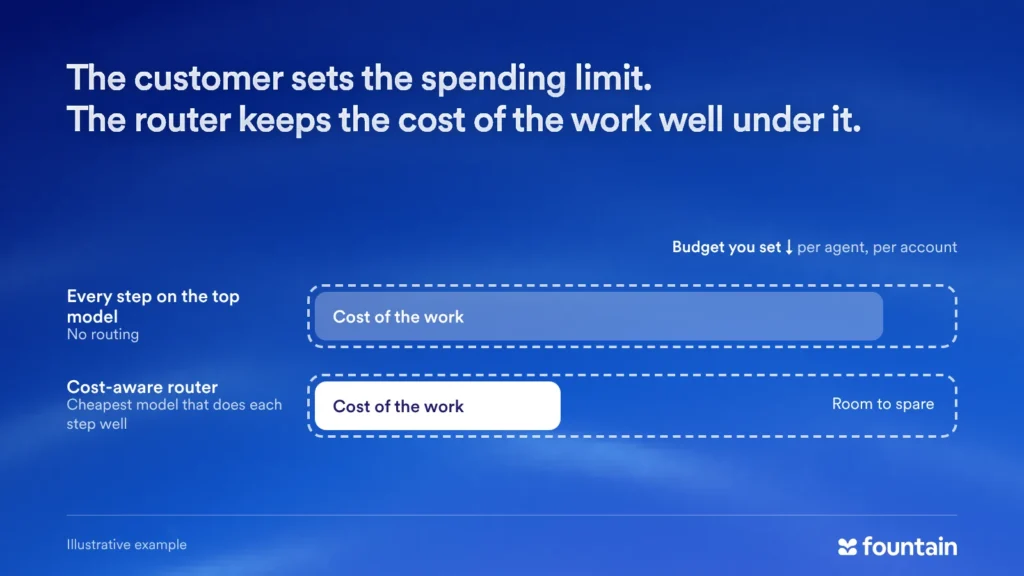
So spend control moves up a level, from approving individual actions to setting the envelope the system operates inside. Customers set budgets per agent and per account, and the budget is a genuine control surface for autonomy itself. How much initiative and volume the system may exercise is a dial the customer holds, tied directly to what they have decided to spend. Large or unusual runs are proposed with their estimated cost before a credit moves. Spend anomalies pause the agent, ahead of the customer’s trust. And a failed thread never bills, at any scale.
The system carries the mirror obligation: to make every credit go as far as the task allows. A cost-aware router matches each step of each task to the least expensive model capable of doing it well, reserving frontier intelligence for the judgment that needs it. The customer sets the ceiling. The router pushes the floor down. Between the two, an autonomous operation stays something a CFO can sign, at any level of autonomy.
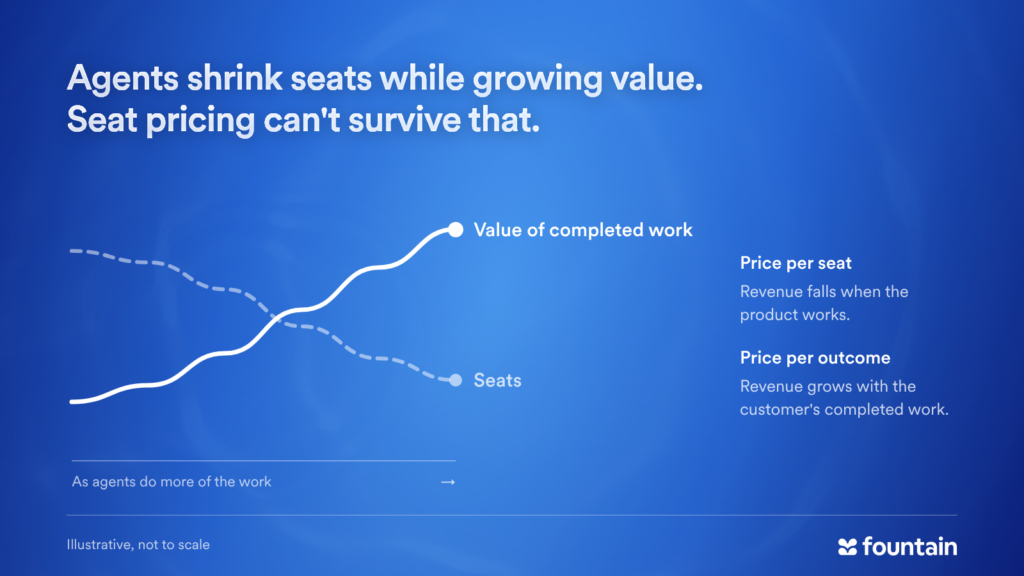
One prediction, stated plainly. Seat pricing cannot survive agents, because agents shrink seats while growing value, and a vendor whose revenue falls when its product works will stop improving that product. The vendors that thrive will be the ones whose revenue is composed of their customers’ completed work. That is a harder business to build. It is also the only honest one available.
Everything in this series has described a way of operating: the vision, the workforce, the conductor, the proof, the trust, the economics. All of it has been running under one roof for months. On November 1, it gets a name.
Next in the series: November 17.
Save your seat.