The marketing in this category is loud and the finished work is thin. Vendors pitch assistants with the same three verbs (assist, accelerate, augment), the demos look alike, and it’s hard to tell what one completes and what the next only drafts.
Meanwhile, 88% of HR leaders report that their organizations haven’t realized significant business value from AI tools, so treat faster drafts as a reason to run a real-requisition pilot against baseline metrics, not proof of ROI.
By the definition used here, every output waits for a person to review it and take the next step. These tools can cut recruiter effort, but each review queue still adds time to the hire.
What is an AI copilot for hiring?
An AI copilot for hiring is an assistant that sits inside the hiring workflow and drafts, summarizes, suggests, and prepares work for a recruiter or hiring manager to review and act on. It responds when asked. It doesn’t move a candidate, book an interview, or extend an offer on its own.
Hiring AI falls into three capability tiers. A chatbot answers questions. A reactive copilot produces work for a human to approve.
An AI agent plans and completes a multi-step workflow toward a goal within defined permissions. Vendor pitches blur that boundary, and the difference determines what lands in a recruiter’s queue. This category produces work. It doesn’t finish it.
What an AI copilot actually does for hiring teams
AI copilots draft job descriptions, summarize candidates, generate questions, draft outreach, and transcribe calls, and every output still needs a person to act on it.
Five common tasks show where they help today:
- Job description drafting: Writing and rewriting a posting is the most common use, with 66% of organizations that use AI in recruiting applying it here. That makes drafting a baseline capability, not a differentiator, so test whether the output writes back into the ATS, not into a doc someone re-pastes.
- Candidate and resume summarization: Applications become briefs a recruiter can scan, and 44% of those same teams use AI to screen resumes. Test summary quality and how many a recruiter can review in a day, since the read is the bottleneck, not the draft.
- Interview question generation: The tool builds a question set from the role requirements, generated once they’re approved and before interviews are booked. It saves prep time without deciding who gets interviewed.
- Outreach and follow-up drafting: First-touch messages, reminders, and rejection notes come out ready for a recruiter to send, taking repetitive writing out of the queue while a person still hits send.
- Call transcription: Interviews and intake calls get recorded, with summaries and action items surfaced, so the recruiter who ran the call has a record to review instead of relying on memory.
Interview scheduling deserves an honest split. Drafting the invite is assistive work, and these tools do it well, but running the reschedule loop when a candidate no-shows, chasing the manager’s calendar, and re-confirming the slot is workflow completion, not assistance.
What an AI copilot doesn’t do
A copilot gives recruiters drafts and summaries. Recruiters still source, screen, schedule, decide, and move each candidate stage by stage.
Keep a human on anything a company would have to defend later. Screening decisions, exceptions, accommodation requests, and offers all carry legal and reputational weight, and these tools assume a person owns those calls. That assumption is their operating limit: every output waits in a queue for someone’s attention.
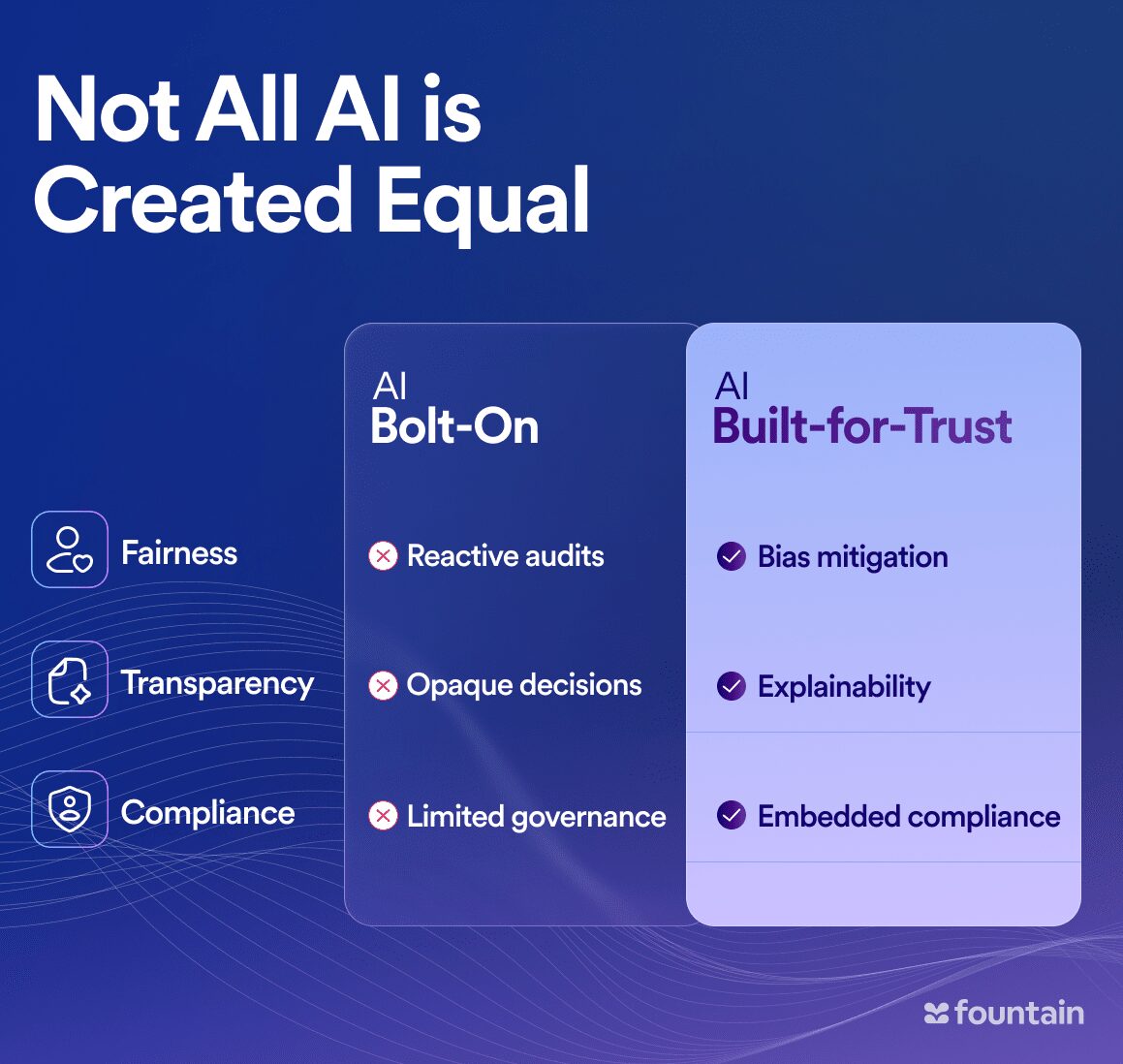
Faster decisions. Fairer outcomes. AI hiring built for compliance, speed, and scale.
Leading employers use trust-first AI to:
✅ Reduce bias and improve hiring equity
✅ Automate compliance with built-in safeguards
✅ Increase candidate engagement and completion rates
Curious how ethical AI can improve your frontline hiring?
For each step in your funnel, ask the vendor one question: does the product complete this step, or draft it for your team to complete? The answer sorts the market faster than any feature list.
Bias, disclosure, and the rules that apply when AI assists a hiring decision
Assistive tools are not exempt from AI hiring regulation just because a human approves the output.
- New York City’s Local Law 144 covers any computational tool used to “substantially assist or replace discretionary decision making,” and requires an annual independent bias audit plus 10 business days’ notice to candidates.
- California’s employment AI regulations, effective October 1, 2025, cover systems that make employment decisions or help people make them.
- Illinois’s HB 3773 amendment took effect January 1, 2026, classifying discriminatory AI use in employment as a civil rights violation and addressing candidate notice, though no implementing rules exist yet.
At the federal level, federal guidance explains how disability-discrimination rules apply when employers use hiring technologies. Bias can enter at the summarization and ranking step, before any human weighs in, because the summary a recruiter reads shapes the decision they make.
In one University of Washington study, people working with a severely biased AI followed its picks, while those without AI showed little bias, so a final human click is not a sufficient safeguard. Pilots should test overrides, audit logs, and reviewer behavior, not just accuracy.
Vendor due diligence should cover how candidate data is stored, retained, and deleted, plus consent, access controls, and breach response, and a vendor evaluation checklist helps assess those before they buy.
Put retention and consent terms in the contract, not the sales deck. This is general information, not legal advice, and these rules change quickly, so confirm your obligations with counsel.
How to evaluate and pilot an AI copilot
Evaluate a copilot on where its output lands and whether it drafts or finishes work, then pilot it on one role against a baseline you capture first.
- Where the output lands: A tool that writes back into your ATS saves time, while one that produces text for someone to copy and paste adds a step. Ask to see the write-back, not a description of it.
- Drafts versus finishes: Test against one real requisition with real applicant volume, which exposes what a demo script hides.
- Review checkpoints: Define a required review point for anything touching a hiring decision, rather than leaving review optional.
- Auditability: Look for action logs and an explanation the team can show a reviewer, because some jurisdictions impose audit, notice, or anti-discrimination requirements on AI use in hiring.
- Frontline fit: Ask whether the product supports mobile, high-volume frontline hiring rather than assuming it does; frontline workflows assume neither desktop recruiters nor low volume.
- Behavior at volume: With 400 applicants, a tool can generate summaries faster than recruiters can read them, so measure how many reviews the team can complete per day.
Run it with one team, on the step that causes the most delay. Capture the baseline first (time-to-hire, application completion, interview no-shows, Day 1 readiness), rerun after 30 to 60 days, and expand only if the numbers moved.
Where assistance stops in high-volume frontline hiring
Assistive drafting scales with recruiter hours. A tool that halves the time to write outreach still leaves every message waiting for a recruiter to send, every summary waiting to be read, and every interview waiting to be booked.
At frontline volume, faster drafts don’t shorten the queue: the reschedule loops and follow-up lag stay exactly as long as they were, and those are elapsed-time problems. A candidate no-shows Tuesday, the recruiter catches it Wednesday, emails the manager for new availability, and hears back a day or two later.
The replacement slot still has to land in a week the candidate can work, so one missed interview can cost the better part of a week with no one at fault.
The average application-to-offer window for U.S. hourly roles is 27.5 days, and 57% of candidates say slow hiring is their top frustration. Candidates take the first concrete offer they get, so the employer whose process keeps moving between steps holds their attention, regardless of whose job description read better.
On a 400-applicant queue, faster drafting reduces recruiter effort but doesn’t remove the review queue, so measure your team’s real daily review capacity before counting on a faster clear.
A suggestion doesn’t remove the elapsed time between steps. Some systems produce work for a person to action; others complete the workflow inside defined permissions, moving a candidate from application through screening into a booked interview, with human approval at the decision points.
The first makes each recruiter hour more productive. The second removes the wait between recruiter hours.
How Fountain runs frontline hiring end to end
Fountain runs frontline hiring end to end through Cue, its single entry point for turning a plain-English goal into sequenced workflows across the funnel. Bolt separate assistants onto sourcing, screening, and scheduling and each hands its output back to a person; those handoffs are where the calendar days go.
Cue passes each completed step to the next, so work doesn’t wait for a recruiter to move it. A prompt like “We have 400 applicants stalled for warehouse roles: screen them, prep those who qualify for manager review, and schedule after approval” sets up the screening, scheduling, and routing, with a manager reviewing before anyone advances.
Cue coordinates three live agents:
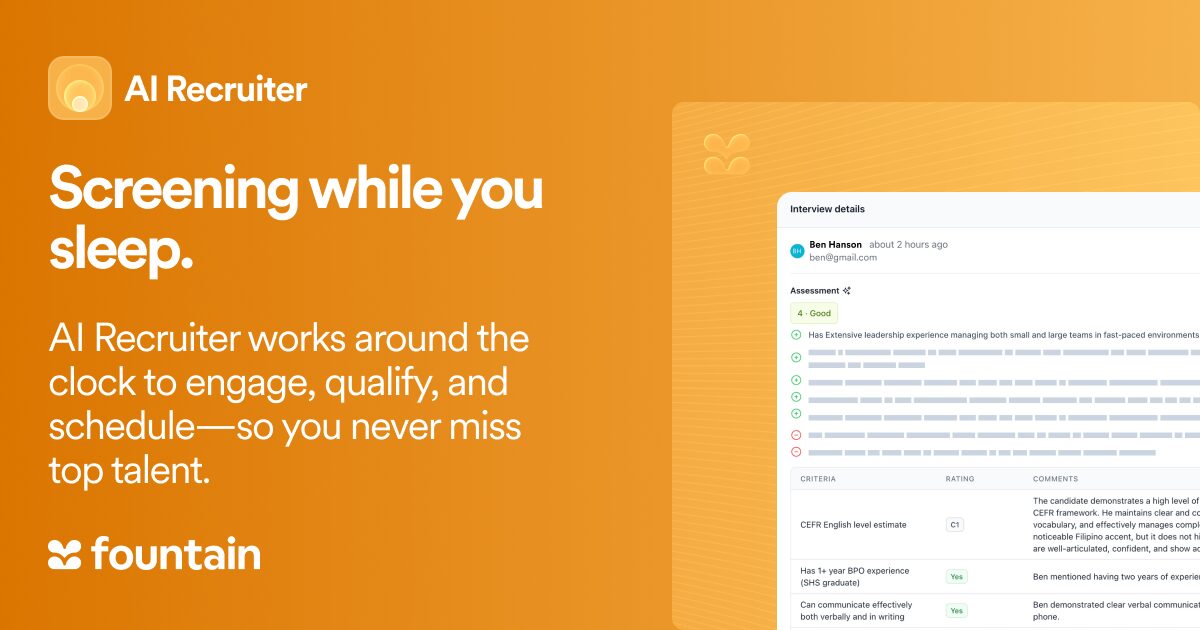
- Anna, the AI Recruiter, screens candidates by voice and text, scores their answers, and routes qualified people to hiring teams.
- Emma, AI 24/7 Support, answers the candidate and paperwork questions that otherwise stall a start date.
- Sam, AI Satisfaction, checks in after Day 1 and flags retention risk early.
Managers approve every offer and exception, and the agents route those decisions to them rather than around them.
Those agents run on one connected platform, so the passes stay inside a single system: Sourcing and CRM feed the ATS, which feeds screening, scheduling, document collection, Onboarding, and Shift & Scheduling.
That final pass, onboarding into a scheduled first shift, is where most tools hand off to a person. In Fountain’s published Fetch case study, the last-mile delivery company cut average time-to-hire from about 15 days to 6.5 hours with Fountain AI, a 95% decrease, though you should require comparable results in your own role-level pilot before projecting that outcome.
An assistant hands a recruiter better drafts and a faster read, and for teams whose constraint is recruiter effort, that is worth piloting. Teams constrained by elapsed time need systems that complete the workflow, which is what Fountain’s Frontline Superintelligence is built for: a candidate moves from application to first shift without changing hands between disconnected tools.
If you’re building an evaluation shortlist, download Gartner’s Magic Quadrant report before your next vendor call; Fountain was named a Niche Player in the 2026 Gartner® Magic Quadrant™ for Talent Acquisition Suites.
Afterward, see it on one of your own requisitions. Book a demo to watch Cue route a signed offer into onboarding, Anna screen a candidate by voice, and a manager approve the result.
Frequently asked questions about AI hiring assistants
What’s the difference between an AI assistant and an AI agent in hiring?
An assistant drafts, summarizes, and suggests when asked, and a person approves and sends every output. An agent plans and completes a multi-step workflow toward a goal within defined permissions, with human sign-off at the decision points. For example, an agent can move a candidate from application to a scheduled interview.
Do AI hiring laws apply if a human approves every output?
In several jurisdictions, yes. New York City’s Local Law 144 covers tools that substantially assist discretionary decisions, and California’s regulations cover systems that help people make employment decisions. Audit, notice, and anti-discrimination obligations can apply to assistive tools even when a recruiter makes the final call. This is general information, not legal advice, so confirm your obligations with counsel.
Will AI replace recruiters?
In this model, AI handles drafting and manual triage while recruiters decide on offers and exceptions. The time saved moves to screening, assessments, and the judgment calls a tool shouldn’t own.