Retail hiring software for multi-location operators has to move candidates from application to offer in hours, work on a phone, and stay consistent across every store. In the 2025 Fountain Frontline Report, 57% of frontline candidates name a slow hiring process as their top frustration and 52% point to ghosting, so the wrong tool loses applicants to whoever moves faster.
The 10 tools below all serve frontline and high-volume retail hiring, but they differ in mobile application flow, automation depth, manager usability, and HCM fit. Some were purpose-built for hourly hiring; others are corporate applicant tracking systems adapted downmarket, or enterprise suites absorbing AI through acquisition.
The real question has shifted from which platform has the better feature list to which agents actually run the work, and how much a human still has to touch.
TL;DR: platforms at a glance
- Fountain: Frontline hiring and workforce platform for high-volume, mobile-first hiring across hundreds of locations, with Cue orchestrating its agents.
- Workstream: Text-first hourly hiring platform with documented scale across thousands of locations.
- Paradox (Workday): Conversational recruiting via the assistant Olivia, now part of Workday after its 2025 acquisition.
- iCIMS: Enterprise ATS with a Frontline AI suite from its 2025 Apli acquisition.
- SmartRecruiters (SAP): Enterprise recruiting adapted downmarket, inside SAP SuccessFactors after SAP’s 2025 acquisition.
- Workable: Mid-market ATS built around integrations and structured workflows.
- ADP Workforce Now: HR and payroll suite with a basic recruiting module, best if you already run ADP.
- Ceipal ATS: Automation-heavy talent acquisition tool; validate mobile usability in demos.
- ApplicantStack: Affordable SMB ATS with knockout screening and texting.
- RecruitBPM: Automation-focused ATS for volume hiring without documented frontline specialization.
The profiles and table below weigh each platform on six dimensions and judge the agent layer separately. Notes reflect publicly available information and vary by plan.
How to evaluate frontline hiring software
Six dimensions separate tools that work at frontline volume from those that buckle under it. Lead with the agents, since that is what runs the hiring work in 2026, then judge the platform underneath.
Ask any high-volume hiring platform these questions in a demo:
- Agent depth and agentic AI screening: Which named agents run which tasks, and where a human stays in the loop. Adoption is rising, but the model that holds up uses agents to screen and qualify while managers make the final call.
- Mobile-first application: It should complete on a phone in 5 minutes or less. Roughly 60% of applicants abandon applications that feel too long or are not built for mobile, per Fountain’s Redefining Frontline Operations.
- Bulk operations across locations: High-volume hiring means managing thousands of applicants at once. The platform should pull every store into one pipeline and route candidates without manual handoffs.
- SMS and multi-channel communication: Silence drives drop-off, so automated SMS, WhatsApp, and email at every stage keep candidates engaged.
- Integration with payroll, scheduling, and HRIS: Manual administrative tasks eat 6 or more hours a week for roughly 60% of recruiters and hiring managers, per AMS and Talent Board research. The platform should connect cleanly to the HCM you already run.
- Manager usability without training: Manager-owned hiring is the frontline norm. If a store manager cannot review candidates from a phone between tasks, adoption fails.
Clear all six and you fill roles before the candidate takes another offer. Clear only a few and you leak applicants at the gaps.
Here is how the 10 platforms line up on the dimensions that matter most for multi-location retail.
| Platform | Built for | Mobile-first | Named agents and depth | Native scheduling | Best fit |
| Fountain | High-volume frontline | Yes | Cue orchestration + Anna (voice screening) | Shift & Scheduling | Multi-location retail, QSR, logistics |
| Workstream | Hourly QSR/retail/hospitality | Yes (text-first) | No named agent; automated screening | Yes | QSR franchises |
| Paradox | Frontline + corporate | Yes (chat/SMS) | Olivia (conversational, deep) | Yes | Enterprise on Workday |
| iCIMS | Enterprise TA | Mobile-first apps | Frontline AI suite (via Apli) | Limited | Large enterprise, mixed hiring |
| SmartRecruiters | Enterprise recruiting adapted downmarket | Mobile-friendly | AI sourcing and screening assistants | Limited | Corporate hiring on SAP |
| Workable | Mid-to-large companies | Mobile app | AI matching (no named agent) | Self-scheduling | Structured mid-market hiring |
| ADP Workforce Now | Mid-sized HR/payroll | Limited | ADP Assist (basic) | Via suite | Existing ADP customers |
| Ceipal ATS | Staffing/agency | Limited (validate during demo) | AI automation (no named agent) | Via integrations | Staffing agencies |
| ApplicantStack | Small-to-mid business | Text-to-apply | Knockout rules (no agent) | Limited | SMB volume hiring |
| RecruitBPM | Volume hiring | Yes | Built-in automation (no agent) | Yes | Agencies, general volume |
What are the top retail hiring software platforms?
Profiles lead with the agent story, then the platform. Fountain runs longest because it is purpose-built for frontline scale.
1. Fountain
Cue sits at the front of Fountain’s agentic architecture as the single orchestration layer for setting up, operating, and improving frontline workflows. Underneath it, named agents do the work: Anna screens at scale, Emma handles candidate and new-hire questions and paperwork, and Sam tracks post-hire sentiment. Fountain is the frontline hiring and workforce platform those agents run on.
Fountain was purpose-built for frontline hiring, and customers hire over 1.2 million workers a year through it across 78 countries. Retail hiring breaks when applications take too long, managers do not adopt the system, or handoffs stall between hiring, onboarding, and scheduling. Fountain is built around those failure points: a mobile-first apply path with no account required, a manager workflow that runs between tasks, and configurable automation across role, location, and brand.
The idea behind it, Frontline Superintelligence, is intelligence that runs frontline work, not software that only reports on it.
Cue is the orchestration layer:
- Cue is the single entry point to Fountain’s agents across setup, operations, support, and improvement.
- It configures products, handles repetitive tasks, and tunes workflows from a plain prompt like “hire 15 seasonal associates across these 8 stores before Friday.”
- It sits above the agents, not beside them.
The agents Cue orchestrates:
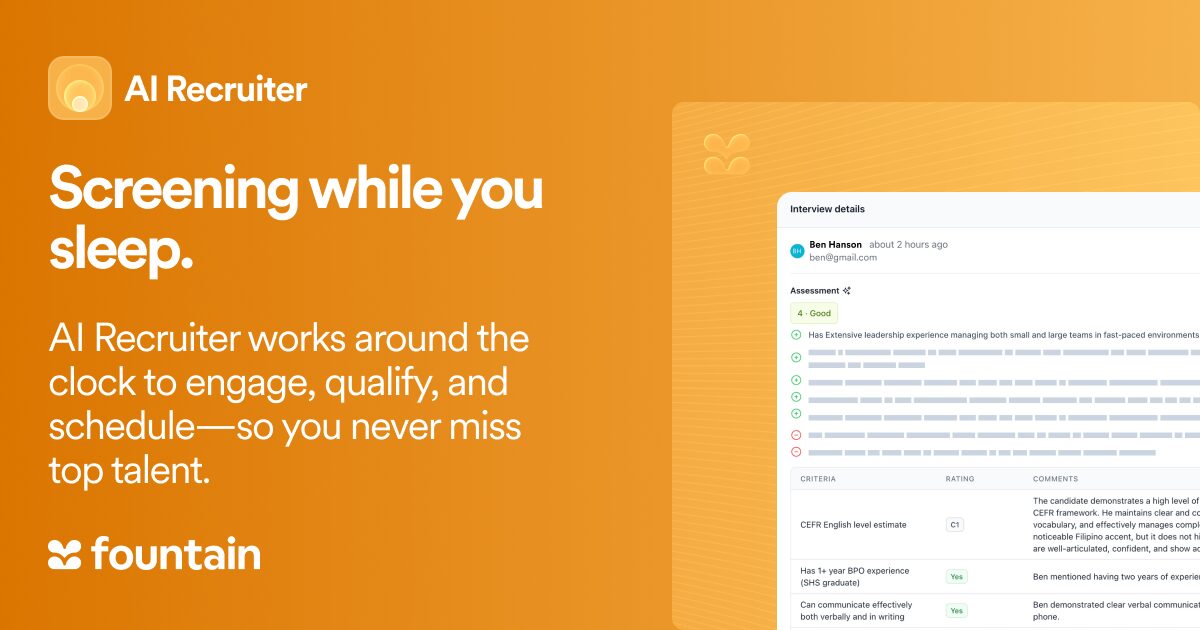
- Anna, the AI Recruiter, runs voice and SMS screening at scale, scores candidates, and pushes qualified applicants to managers for the final call.
- Emma, AI 24/7 Support, answers candidate and new-hire questions across web, SMS, and WhatsApp and clears paperwork like I-9 and W-4 before day one.
- Sam, AI Satisfaction, checks in after hire to surface engagement and retention signals while there is time to act.
The platform the agents operate on:
- ATS: Applicant tracking with configurable workflows, automated screening, calendar sync, mobile offers, compliance, and a mobile manager interface.
- Sourcing: Agentic sourcing with multi-channel budget management, campaign automation, and spend visibility.
- CRM: Candidate database with matching and re-engagement of past applicants for seasonal rehiring.
- Onboarding: Mobile onboarding with I-9, E-Verify, document storage, and compliance workflows.
- Shift & Scheduling: Workforce scheduling with demand forecasting, gap detection, mobile self-service, and labor-compliance safeguards.
Proof points:
- Bojangles cut time-to-hire from 30 to 5.8 days (80%) and job board spend 86%.
- Stitch Fix lifted its day-one show rate 40% among applicants who pass background checks.
- Liveops cut time-to-fill 48%.
- Outcome data is largely Fountain-published, so ask for direct customer references when building a business case.
Best for:
Multi-location retail, QSR, and logistics operators hiring at high volume who need mobile-first apply, agentic screening that keeps managers in control, and a platform that plugs into an existing HCM. It is less suited to teams hiring mostly for corporate roles.
2. Workstream
Workstream is a text-first, mobile-first platform for hourly hiring in restaurants, retail, and hospitality, with no named agent but automated text screening and reminders that cut manual follow-up. As of September 2022 it reported scale across 4,000-plus customers and 24,000 locations.
Operators outside restaurant-heavy hiring should validate vertical depth. Best for QSR franchises wanting a text-first workflow managers adopt easily.
3. Paradox (Workday)
Paradox built one of the first conversational recruiting platforms around its assistant Olivia, and was acquired by Workday in 2025. Olivia screens, schedules, answers questions, and runs two-way SMS and chat, the deepest single-agent option here. Post-acquisition planning is Workday-first, so buyers on other ATS platforms should pressure-test integration.
Best for enterprise frontline employers already on Workday Recruiting.
4. iCIMS
iCIMS is an enterprise ATS that added a dedicated Frontline AI suite through its 2025 acquisition of Apli, bringing conversational engagement, screening, and assessments to a platform built for complex enterprise hiring. It offers real breadth across multiple hiring models, but the interface has a learning curve and can be costly for smaller teams.
Best for large enterprises spanning corporate and frontline hiring.
5. SmartRecruiters (SAP)
SmartRecruiters is enterprise recruiting adapted downmarket and, after SAP’s 2025 acquisition, is being folded into SAP SuccessFactors. Its agents are AI sourcing and screening assistants rather than a single named agent, and it scores well on collaboration and usability. Frontline QSR, retail, and logistics proof is thinner than for purpose-built platforms.
Best for enterprises consolidating onto SAP that hire mainly for corporate roles.
6. Workable
Workable is an ATS for medium and large companies, with broad integrations, a mobile review app, AI matching, and self-scheduling rather than a named agent. Its sourcing, LinkedIn integration, and multilingual support suit structured international hiring, but it can feel restrictive for lean high-volume teams. Validate HRIS depth and tier costs before buying.
Best for structured, lower-velocity hiring that values integrations over frontline speed.
7. ADP Workforce Now
ADP Workforce Now is a cloud HR platform for mid-sized businesses, with recruiting tied to onboarding, HR, and payroll and a Job Description Generator from the ADP Assist agent. Its strength is the suite and clean payroll integration for existing ADP customers; recruiting depth is shallower than frontline-specialized platforms.
Best for mid-sized businesses already on ADP that want one suite, not a frontline-grade ATS.
8. Ceipal ATS
Ceipal ATS is an automation-heavy platform with mass email to up to 999 profiles at once, posting to 25-plus job boards, and broad integrations, all driven by automation rather than a named agent. Buyers hiring mobile-heavy frontline populations should validate full ATS functionality on mobile and test reliability under load.
Best for staffing agencies that prioritize mass outreach and integrations.
9. ApplicantStack
ApplicantStack is a cloud ATS owned by SwipeClock, on the ADP Marketplace, with knockout questions, one-click posting, and text-to-apply with two-way texting. It is a lighter-weight option for SMB teams that want screening rules without enterprise overhead; validate custom reporting depth and duplicate-application handling.
Best for small to mid-size businesses wanting affordable knockout screening, especially those already on ADP.
10. RecruitBPM
RecruitBPM targets speed-to-hire at volume through built-in automation, flexible workflows, access controls, and remote and video interviews, but no named agent. It suits teams wanting configurable automation without a frontline-specific platform; compare usability against stronger-rated options, since frontline retail and logistics proof is limited.
Best for agencies and general high-volume teams that want automation and workflow flexibility.
How Fountain runs retail hiring
Frontline hiring software is a different category from corporate recruiting tools, and the platforms that recognize it win the multi-location operators who live with mobile-first applicants and managers who hire between tasks. Fountain is built for that reality.
Cue is the orchestration layer, the single entry point to every agent, so a TA lead can type “hire 15 seasonal associates across these 8 stores before Friday” and Cue breaks it into sourcing, screening, scheduling, and onboarding steps, asking for approval where it needs it. Underneath, Anna screens, Emma answers questions and clears paperwork, and Sam tracks retention signals, with the case studies above showing what that adds up to.
Evaluate any platform against the six dimensions above, judge the agent layer separately from the platform underneath, and pressure-test integration before you commit. Book a demo to see how Cue orchestrates Anna, Emma, and Shift & Scheduling across your locations.
Frequently asked questions about retail hiring software
What is high-volume hiring?
High-volume hiring is filling roles at scale, from dozens to thousands of positions in a short window, typically in frontline industries like retail, QSR (quick-service restaurants), logistics, and hospitality where demand swings with seasonal cycles or growth. It demands the structure, speed, and coordination to manage thousands of applicants at once, unlike curated corporate recruiting with small candidate pools.
What’s the difference between a purpose-built frontline ATS and a corporate ATS adapted downmarket?
A corporate ATS was built to manage one professional role at a time through a multi-week, linear process. A purpose-built frontline platform is designed for bulk operations across many locations, mobile-first applications, automated screening, and manager-owned hiring. Legacy corporate systems force a rigid path that does not fit the high-churn reality of frontline hiring, which is why they buckle during seasonal spikes.
How do AI screening tools stay compliant with hiring regulations?
The EEOC enforcement plan for FY2024 to 2028 targets screening tools that disproportionately affect protected groups, including AI-facilitated ones, and NYC Local Law 144 requires annual bias audits and candidate notification. Compliant platforms keep a human in the final decision, audit screening for fairness, and stay transparent about where AI is used. This is general information, not legal advice, so confirm your obligations with counsel.