For frontline employers, the future of recruitment is hiring software that finishes work across the hiring process, not software that reports on it. A May 2025 Gartner survey found that 82% of HR leaders plan to implement some form of agentic AI.
Yet in Aptitude Research’s early-2026 frontline analysis, only 25% of talent acquisition leaders call their current technology very effective at high-volume hiring. The AI being sold into recruiting far outruns the hiring work it finishes.
A stalled screening or scheduling queue can leave a frontline shift uncovered within days, so employers need software that moves candidates through the administrative stages without waiting on a recruiter at every step. It runs screening, scheduling, outreach, and document collection under employer-defined rules, while managers review the consequential decisions: offers, accommodations, appeals, and exceptions.
What does the future of recruitment mean for frontline hiring?
For frontline hiring, the shift is in what the software does: it moves from recording and reporting hiring work to running it. Three different technologies get bundled under that promise, and telling them apart is the first job of anyone evaluating vendors this year.
- Trigger-based automation fires one predefined action per event: a confirmation text when an application arrives, or a review routing when a knockout question fails.
- Scoring and recommendation systems rank candidates against role requirements and tell a recruiter who to call next.
- Agentic systems go further: they pursue a hiring outcome across multiple steps, screening applicants and booking interviews inside the employer’s permissions and approval rules, and move candidates between stages while routing consequential decisions to a person, which is what separates an agentic applicant tracking system (ATS) from a traditional system of record.
As HRCI Chief Business Officer Andre Allen distinguishes the three, “Predictive AI shows us what might happen, generative AI creates something new, but agentic AI takes the next step: acting on our behalf.”
What is not changing: the manager still owns the offer, the exception, and the judgment call, and a candidate still has to show up on Day 1 and be worth keeping three months later. Agentic systems take the queue work between application and offer; accountability for the hire stays with the manager.
What’s changing in how frontline roles get filled
Across every stage of the frontline funnel, software now executes the administrative work, which is most of how AI is already changing hourly hiring. Screening and qualification begin the moment an application arrives: knockout questions and availability matching finish in minutes with a score attached, instead of sitting in a recruiter’s queue overnight.
Candidates who meet the documented criteria pick an interview slot from a synced calendar before the impulse to apply fades, and the phone tag that used to burn days disappears.
Outreach runs continuously: stalled applicants get nudged, and past workers hear from you before peak season instead of you paying to source strangers. Compliance steps become workflow stages rather than follow-up tasks, so a missing document surfaces before Day 1, not after.
For frontline roles, skills-based hiring means fast, accurate verification of the credentials and availability that decide whether someone can do the job. In trucking, employers verify commercial driver’s license (CDL) class and current medical certification, then check the federally mandated employment history.
In healthcare it means licensure confirmed at the primary source; in retail and quick-service restaurants (QSR) it mostly comes down to availability that matches the shifts you need covered.
Download the Free Guide: Agentic AI for Frontline Hiring & Retention
Explore how top HR teams are using agentic AI to speed up hiring, improve onboarding, and reduce frontline turnover—at scale. This guide breaks down real-world use cases, ROI benchmarks, and a 90-day roadmap for getting started.
On July 1, 2025, the Federal Motor Carrier Safety Administration (FMCSA) Clearinghouse listed 190,402 CDL and permit holders in prohibited status. Run that check as an automated stage on application arrival, and the result and its timestamp land in the candidate record, where an auditor can find them.
Why frontline hiring is where these shifts land first
Frontline hiring is the proving ground because software failure becomes operational failure in the same week. Volume is high, decision windows run in hours, and the hiring rules vary by city and state across every location in your footprint.
Most candidates apply from their phones, and the employer who makes a concrete offer first usually wins them. With fewer applicants per opening, every candidate lost to a slow stage costs more as openings grow. Turnover then keeps refilling the same roles: a location that refills the same job twice in a year pays the recruiting, onboarding, and ramp cost twice, before any of it shows up as an uncovered shift.
What candidates will expect from the hiring process
Frontline candidates expect a fast, mobile-first process that is transparent about pay and shift and clear about when AI is evaluating them. Put the pay range, shift details, and an AI-use notice on the first mobile screen, and a candidate can decide before investing time instead of discovering the terms late.
Candidate experience used to be a branding project; now a slow or confusing application limits how many candidates reach the next stage, and a slow reply hands them to whoever answers first.
Shift transparency is becoming a legal obligation too: predictive scheduling laws in cities and states including Chicago, New York City, Seattle, San Francisco, Philadelphia, and Oregon generally require posting schedules at least 14 days in advance. The process also has to survive a phone-width read: frontline candidates apply between shifts and abandon anything that demands a desktop or drags past a few minutes.
The assumption that these candidates resist AI does not hold up. The Frontline Report 2025, which Fountain produced with Lighthouse Research & Advisory from a survey of nearly 2,000 frontline workers, found that 74% said they would rather deal with AI during hiring than with traditional methods. What they reject is being evaluated by AI without being told.
Disclosing AI use at the first step, before a candidate invests time, is what separates acceptance from a walk-off.
What stays human, and where oversight sits
Humans keep offers, exceptions, accommodations, appeals, and any decision your team would have to defend in an audit. Document which administrative stages run automatically and which decisions require manager approval, and each review and override is recorded as it happens rather than reconstructed after an audit request.
Defined permissions and audit logs are what make agentic hiring work, not model size or demo quality, and teams have to redesign workflows before they deploy. A Gartner forecast on agentic AI project cancellations predicts that more than 40% will be scrapped by the end of 2027, over escalating costs, unclear value, or inadequate risk controls. Effective deployments are built on those controls even when a demo never shows them.
State and local regulators are also setting specific expectations around automated hiring decisions. Under New York City’s Local Law 144, in force since 2023, employers that use an automated employment decision tool are generally required to obtain a bias audit no more than a year old and to give candidates at least 10 business days’ notice.
California’s Civil Rights Council regulations, effective October 1, 2025, clarify that using an automated-decision system that produces an unlawful disparate impact can violate state employment law. When those verification and human-review steps live inside the workflow, the record is captured as the work happens, not reconstructed after the audit letter arrives.
Treat this as general orientation, not legal advice; confirm your obligations with counsel.
How to tell whether your hiring operation is ready
Start where your team still translates insight into action by hand. Map those stages for one role and one location: when the dashboard shows drop-off at the scheduling step and a coordinator spends Tuesday clearing it, that is the handoff to automate.
Check five conditions before you deploy:
- Clean operational data: Keep location lists, role requirements, availability rules, and pay bands current enough that the system can act on them without a person interpreting them first.
- Clear permissions and approval thresholds: Document which administrative actions run autonomously, which decisions need a manager’s sign-off, and where the workflow escalates.
- Integration with your systems of record: Make sure hires, hours, and compliance records flow into your human capital management (HCM) system without creating a second system of record.
- Willingness to redesign the workflow: Fix the broken process before you add software to it, or the system will just automate the breakage.
- Measurement that would show a change: Track time-to-hire, drop-off by stage and device, Day 1 show rate, first-90-day retention, and cost per hire at the location level.
An operation that clears all five is ready to let software execute. One that does not will spend its pilot cleaning data.
How Fountain runs the future of frontline hiring
Fountain is Frontline Superintelligence: connected software that runs workflows across sourcing, screening, onboarding, and scheduling instead of reporting on them. Cue, the orchestration layer inside every Fountain product, takes a plain-English goal and builds the workflows that carry it out, then keeps them running.
A multi-unit restaurant operator can type, “We’re opening 12 locations across Texas before summer: build the hiring plan, sourcing, screening, and I-9 steps for each store,” and Cue configures each one.
Cue coordinates the agents that handle the recurring work, so the screen, the interview slot, and the new-hire paperwork stop being separate queues that each wait on a person to restart them.
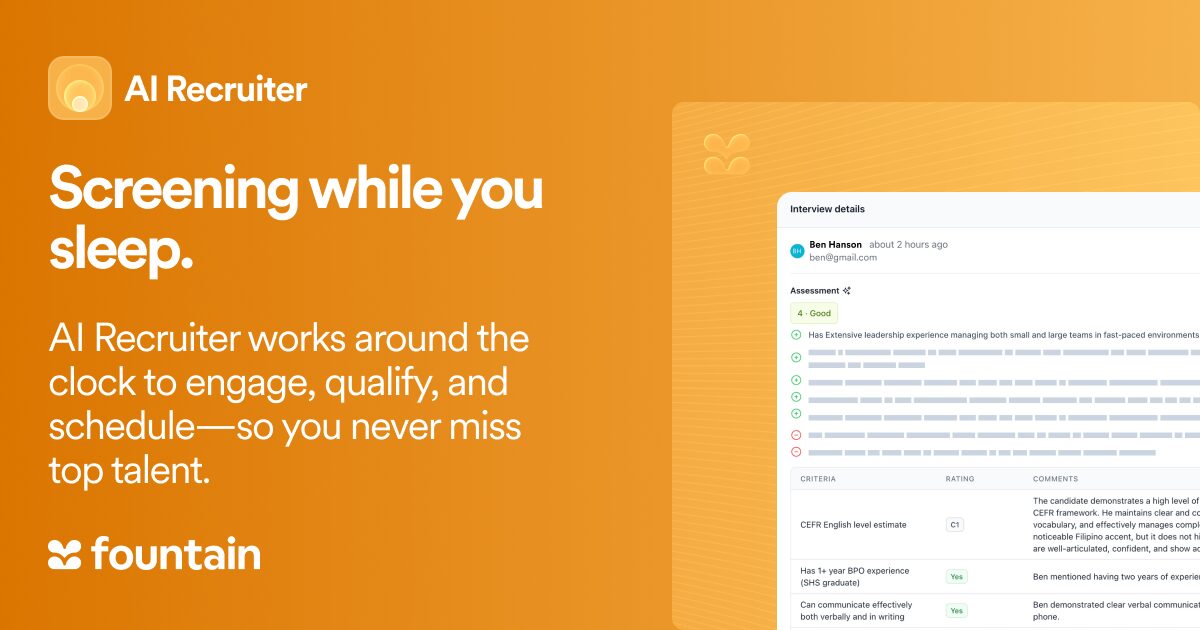
- Anna, the AI Recruiter, runs phone and text screens around the clock and surfaces scores for the hiring team’s final call.
- Emma, AI 24/7 Support, answers the candidate and paperwork questions that otherwise stall a start date.
- Sam, AI Satisfaction, checks in after Day 1 and flags retention risk early. Managers review the consequential decisions and approve every offer and exception.
Those agents act on one connected platform, because payroll, tax, and audit obligations still live in the HCM.
Fountain connects its ATS, Sourcing, CRM, Onboarding, and Shift & Scheduling to UKG, SAP, ADP, and Workday through the Integration Center, so new-hire records, hours, and verification documents land in the existing system of record as the work happens. That keeps one record instead of a second store of decisions to reconcile when a bias audit asks who signed off on which output.
With Fountain, Alto reported hiring 450 drivers in 6 months by 3 recruiters at a $300 cost per hire, with a 2- to 7-day time-to-offer, compared with the $4,700 average cost per hire cited by SHRM.
An uncovered shift can’t wait in a follow-up queue, which is why the frontline is where recruiting software that runs the work pulls ahead of software that only reports it.
Fountain was named a Niche Player in the 2026 Gartner® Magic Quadrant™ for Talent Acquisition Suites. See it against one of your own high-volume roles: Book a demo to watch Cue configure a location’s hiring workflow, Anna screen a candidate by voice, and a manager approve the offer.
Frequently asked questions about the future of recruitment
Will AI replace recruiters and hiring managers?
No. Agentic systems remove the screening-queue work and surface results for the hiring team, handle candidate self-scheduling, and collect documents before Day 1, but a person still owns the offer and any exception or accommodation. Rules in New York City, Illinois, and California point the same way: toward notice, bias audits, and documented human review around automated decisions.
What laws regulate AI in hiring in the US right now?
New York City’s Local Law 144 has required bias audits and candidate notice since 2023. Illinois HB 3773 took effect January 1, 2026, and California’s Civil Rights Council regulations took effect October 1, 2025. Multi-state frontline employers face a patchwork that rewards centralized documentation.
How is frontline recruiting different from corporate recruiting?
Frontline recruiting runs on volume and speed, and the gating checks are verification rather than resume review. Employers process thousands of mobile applications for roles where licensure, certifications, and shift availability decide who qualifies, and an unfilled role shows up as an uncovered shift rather than a delayed project.