

The anchor that priced an industry just moved.
For twenty years, every SaaS deck contained the same slide. The product changed, the logo changed, the slide did not: 10x ROI. Ten times faster onboarding, ten times cheaper reporting, ten dollars back for every dollar spent. And the industry priced itself with a matching rule of thumb: charge about a tenth of the value you create. Sell a 10x return, take a tenth of it, everyone wins. 10x was the anchor, the objective, and the business model, all in one number.
The number was honest. It was also a ceiling, and the ceiling was structural. Workflow software accelerates humans. It routes the ticket, reminds the approver, assembles the report, renders the dashboard. The human still performs the work, so the value created is bounded by how much faster a human can go. Make every click instant and you still cannot get past the person. A tool that helps someone work can be worth a multiple of their output. It cannot be worth a multiple of their team.
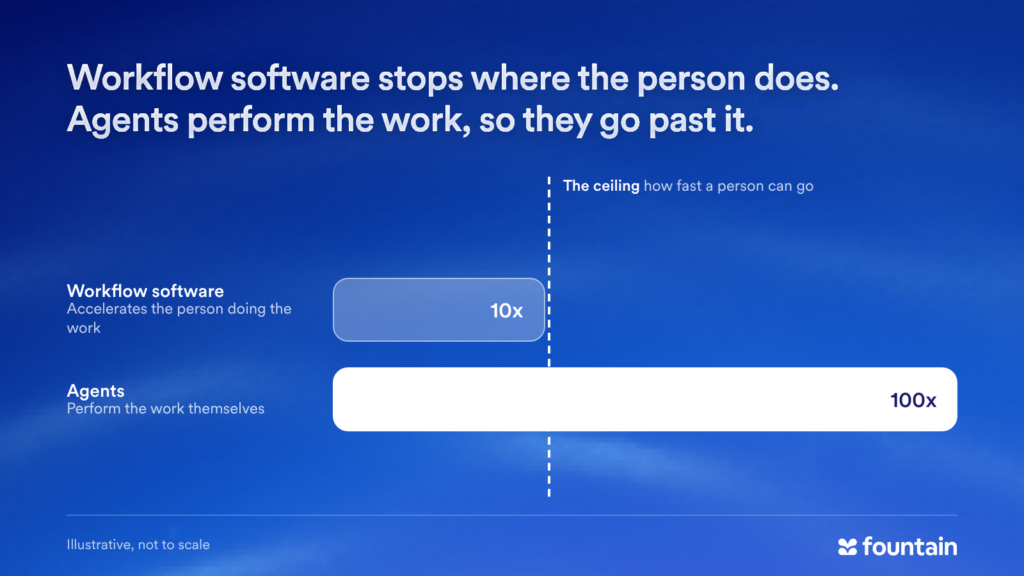
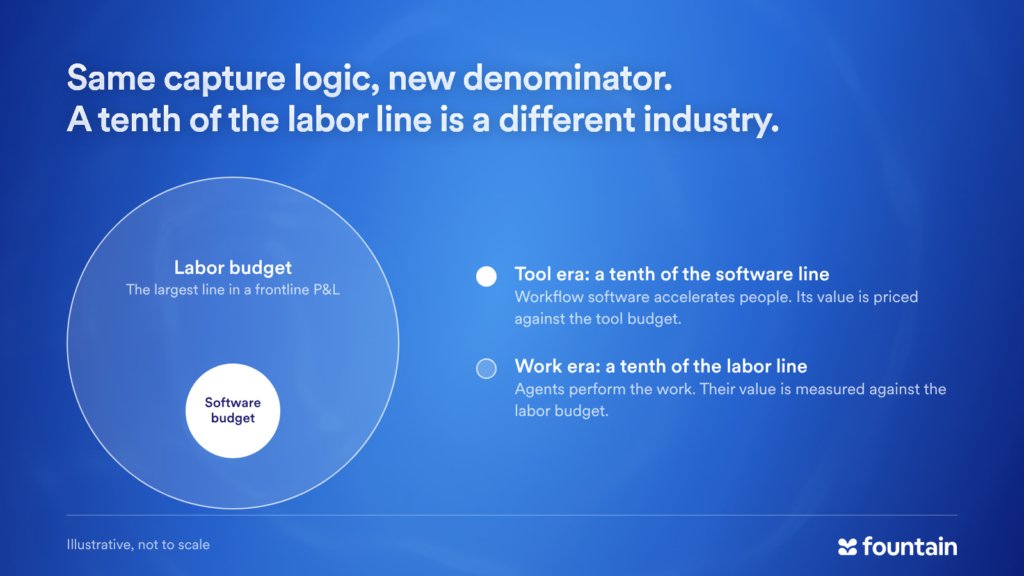
Agents break the ceiling because they change what is being sold. An agent does not accelerate the work; it performs it. And the moment software performs work, its value stops being measured against a software budget and starts being measured against a labor budget. Labor is the largest line in nearly every frontline P&L, an order of magnitude above the tool spend that SaaS competed for. Same capture logic, new denominator. A tenth of a labor line is a different industry than a tenth of a tool line. That is the entire shift in one sentence: 100x is the new 10x.
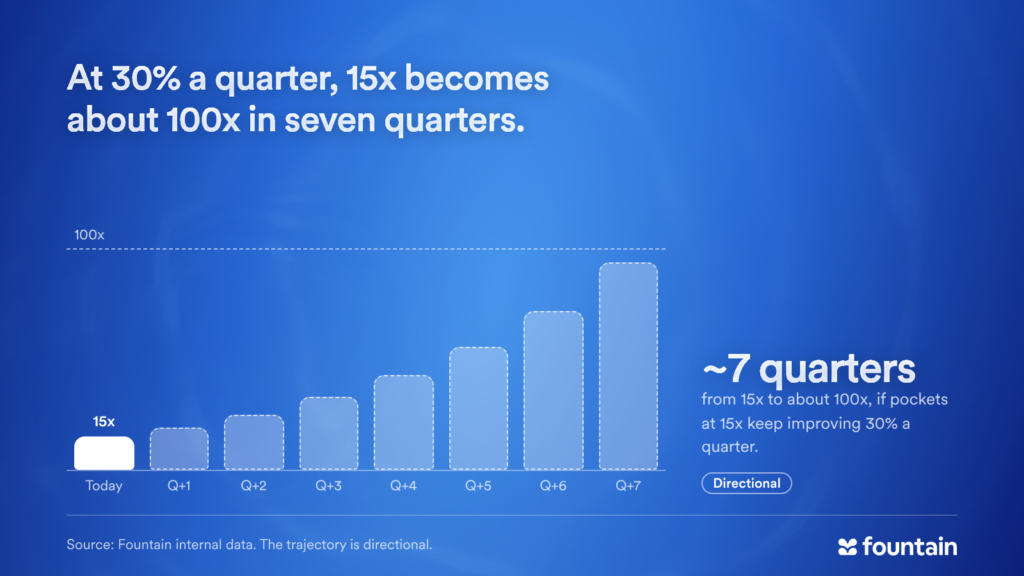
The anchor has already moved in the field, and the evidence overshoots it. At UPS, time to hire went from several weeks to a 7-minute job offer: three orders of magnitude, two full anchors past the old slide. Liveops runs 44,000 applicants per recruiter, a ratio no workflow tool has ever produced, because no workflow tool performs the screening. Klarna’s assistant did the work of 700 agents in its first month. And inside Fountain, the same engineering team runs at ten times last year’s output, with pockets at fifteen improving roughly 30 percent per quarter, which puts 100x about seven quarters out on trajectory. When results overshoot the anchor by this much, the anchor is wrong, and markets reprice around results.
The repricing is literal. A tenth of a 10x workflow gain justified a seat license: a fraction of the salary of the person being accelerated. A tenth of 100x performed work cannot be a seat, because the seats are no longer where the value sits. It has to be a share of the work itself, which is why outcome pricing follows the new anchor as surely as seats followed the old one. A credit per completed outcome is the tenth-of-value rule applied to labor instead of tools.
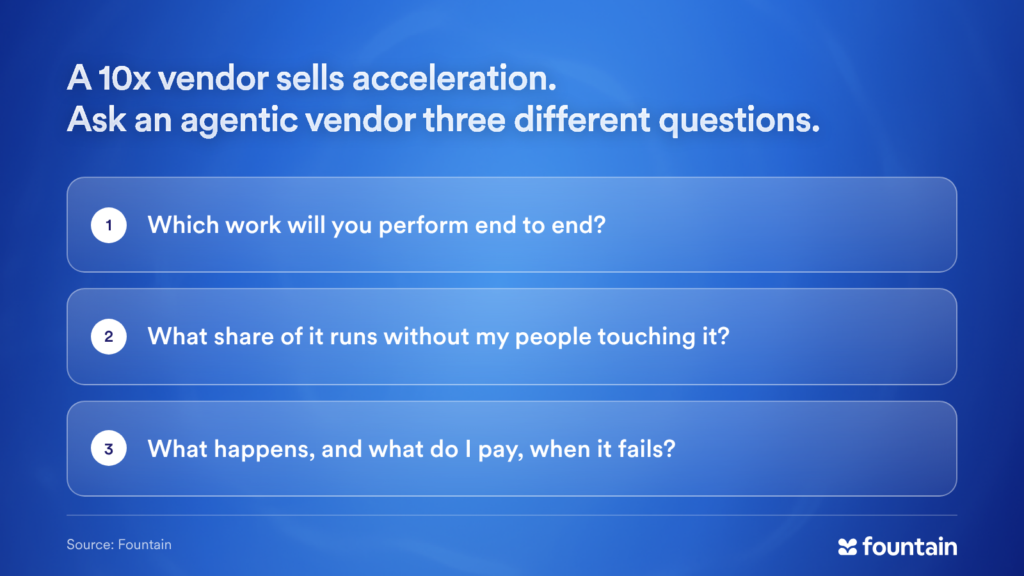
For buyers, the anchor question changes. A vendor promising 10x is selling acceleration: the previous era, honestly priced for what it is. The questions to ask an agentic vendor are different in kind. Which work will you perform end to end? What share of it runs without my people touching it? What happens, and what do I pay, when it fails?
For operators and builders, the anchor becomes the planning bar. A 10x objective in an agentic world is sandbagging. Inside Fountain, every function is held to the trajectory, with honest labels: measured where we have measured it, directional where it is an objective. The bar is what an operation produces when the people in it each run a fleet, and that bar starts at three digits.
10x built the software industry. It anchored the pitches, the pricing, and the ambition of two decades, and it was the truth of the tool era. The work era has a new anchor. 100x is what agents make normal, and normal is where objectives start.