The contractors vs. employees debate comes down to who directs the work and who carries the payroll costs, and employment counsel makes the classification call for each role. Once counsel sets the worker model, HR and operations focus on keeping hiring moving: clean handoffs, fast screening, onboarding that clears before day one, and early retention.
This guide covers the cost picture behind that decision and the operational workflow that follows it.
What’s the difference between a contractor and an employee?
A contractor is typically self-employed, works on a project basis, and controls their own methods and schedule. An employee typically works under the employer’s direction on an ongoing basis, usually with employer-provided tools and a set process. In payroll terms, that’s the W-2 vs. 1099 split.
| Factor | Employee (W-2) | Independent Contractor (1099) |
|---|---|---|
| Day-to-day direction | Employer sets schedule and process | Worker sets methods and schedule |
| Pay structure | Hourly wage or salary, regular pay periods | Per project, per deliverable, or negotiated rate |
| Benefits | Typically eligible for employer benefits such as health insurance, PTO, and retirement | Typically no employer-provided benefits |
| Equipment | Employer-provided | Worker provides their own |
| Duration | Ongoing | Defined project or time period |
The table shows typical arrangements and doesn’t determine a worker’s status.
Worker classification is regulated at the federal and state level, under rules such as the Fair Labor Standards Act. Employment counsel decides how they apply to each role.
What each worker type really costs
An employee’s fully loaded cost runs well above the base wage. Beyond pay, the employer covers payroll costs, workers’ compensation, paid leave, and any health or retirement benefits. In the Bureau of Labor Statistics Employer Costs for Employee Compensation release for June 2026, private-industry retail trade employers paid an average of $6.36 per hour worked in benefits against $20.71 in wages, about 31% on top of wages.
A contractor’s hourly rate often looks higher on paper because it has to. The contractor covers their own insurance, equipment, and business costs, and gets no paid leave, so those costs are priced into the rate.
The table below shows the illustrative hourly payroll cost of one $20-per-hour frontline role. The benefits row applies the BLS retail-trade ratio above.
| Cost line (per hour) | W-2 employee at $20 | 1099 contractor |
|---|---|---|
| Base pay | $20.00 | Negotiated contract rate |
| Benefits and employer-paid costs, including workers’ compensation and paid leave | About $6.15 (about 31% of wages, BLS retail-trade average, June 2026) | Priced into the contract rate |
| Illustrative loaded cost | About $26.15 | Contract rate only |
The comparison covers payroll costs only and leaves out turnover.
Turnover is where the math changes for high-volume roles. A role that’s filled all year carries a replacement cost every time someone leaves, because sourcing, screening, onboarding, and training start over for the next hire. For roles that refill continuously, retention and rehiring speed shape total cost more than the payroll line does.
Contractors vs. employees trade off differently for the business and for the worker:
| Side | Pros | Cons |
|---|---|---|
| Employer, W-2 employee | Directs schedules, training, and process; keeps continuity in ongoing roles | Covers payroll costs, workers’ compensation, and benefits |
| Employer, 1099 contractor | Avoids employer payroll costs and employee benefits for a properly classified contractor; fits defined projects | Gives up control over methods and schedule; needs a fresh counsel review if the work becomes ongoing |
| Worker, W-2 employee | Benefits eligibility; steady schedule and pay periods | Works under the employer’s direction on schedule and methods |
| Worker, 1099 contractor | Controls methods and schedule; can serve other clients and subcontract | Covers their own business costs; no employer benefits or paid leave |
For high-volume frontline roles, the employer-side savings of a contractor arrangement usually shrink once the work is ongoing and directed.
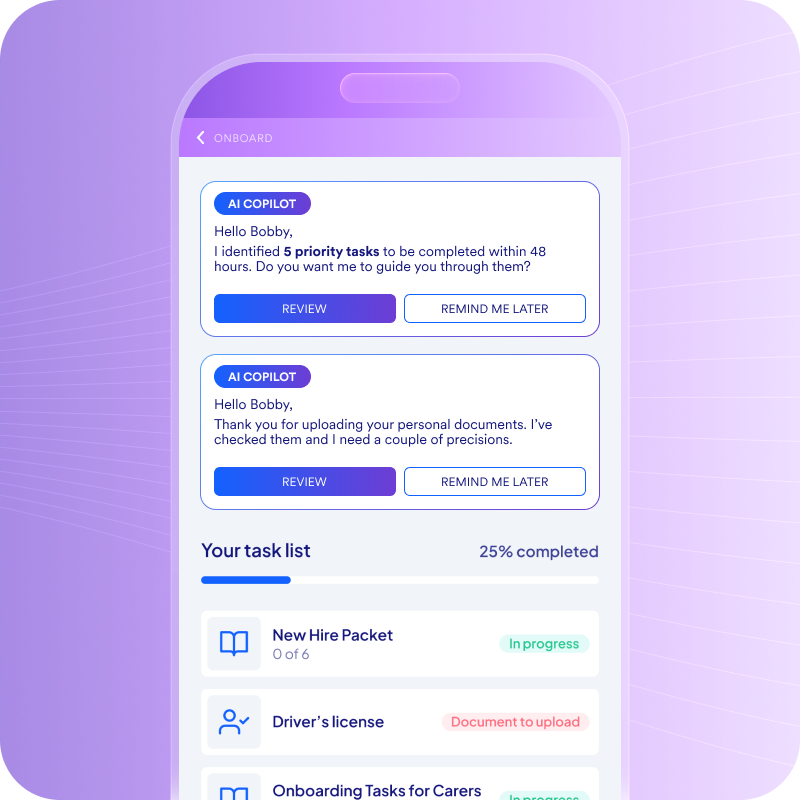
Faster ramp-up. Lower early attrition. AI onboarding built for speed, scale, and retention.
Top employers are already using Fountain’s Frontline OS to:
✅ Reduce turnover in the first 60 days
✅ Eliminate manual paperwork and task delays
✅ Accelerate new hire productivity with smarter workflows
Curious what smarter onboarding could unlock for your team?
Once counsel sets the worker model, the risk turns operational
Once counsel approves a worker model for a role, the next risk is a slow, inconsistent hiring path. A decision that lives in an email thread doesn’t reach the store manager who posts the job next month.
The fix is a documented handoff from the decision to every location that hires for the role:
| Handoff | What moves forward | Record it produces | Owner |
|---|---|---|---|
| Decision to role template | Counsel’s worker model, pay structure, and expected duration | A role template with the decision and its date attached | HR |
| Role template to hiring path | The matching flow: offer and onboarding for W-2 roles; a signed agreement for contractor engagements | A configured hiring workflow per role | Recruiting operations |
| Hiring path to locations | The same posting, screening, and onboarding steps at every site | Location-level hiring activity tied to one template | Location managers |
| Role change back to counsel | New duties, scheduling, equipment, or duration | A dated change request | Hiring manager |
Here’s what that changes in practice. Before, a manager needing delivery coverage posts a role locally with whatever paperwork is on hand. After, the delivery role template carries counsel’s decision, so the posting, offer, and onboarding steps follow it at every location. Include these role records in a recurring template review to keep them current.
Keeping high-volume W-2 hiring moving
For W-2 frontline roles that refill all year, three stages decide whether hiring keeps pace: screening, onboarding, and the first weeks on the job.
Screening that keeps up with turnover
A mobile-first application only works if the next step moves quickly. Screening that waits for a recruiter’s calendar adds friction. Run interviews around the clock, use the same structured questions for every applicant in the role, and move qualified candidates straight to scheduling.
Onboarding paperwork that clears before day one
Stalled forms can leave a hire unready to work. Collect documents on mobile, route approvals to a named owner, and track who’s still missing what before the start date. Keep audit-ready onboarding records from day one so nothing needs rebuilding later.
Early retention after the start date
The cost of restarting sourcing, screening, onboarding, and training lands when a new hire leaves in the first weeks. Check in with every new hire at set points, from readiness before day one through their first months, and route issues like scheduling problems or unclear expectations to the manager who can fix them.
Running contractor engagements on their own track
Contractor engagements need a separate path so they don’t drift into the employee flow. Give them their own intake, a signed agreement, and a defined scope with an end date. When the scope changes or the engagement keeps getting extended, send it back to counsel through the same change request the W-2 roles use. Route gig and app-based roles to counsel before they enter either track.
Where Fountain fits in high-volume frontline staffing
W-2 roles that refill all year need screening, paperwork, and retention to run at volume. Cue, Fountain’s Frontline Superintelligence, turns a goal like “hire 50 warehouse associates” into screening, scheduling, and onboarding work run by its agents:
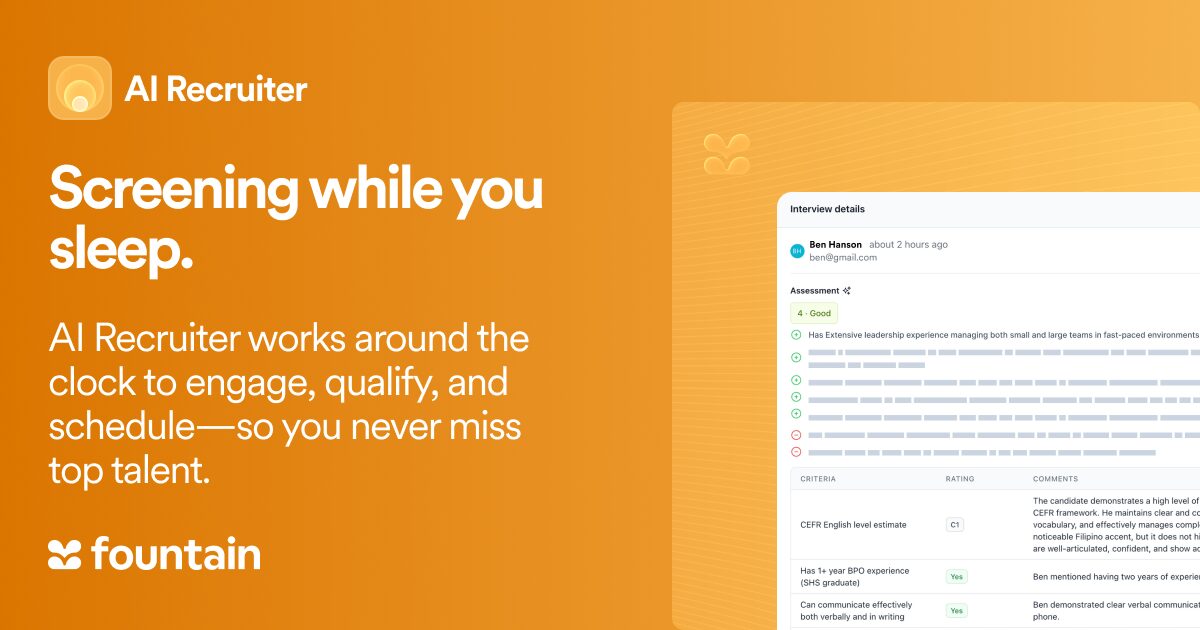
- Screening that keeps pace with turnover: Anna, the AI Recruiter, runs voice interviews 24/7 and moves qualified applicants to scheduling.
- Fewer stalled new-hire forms: Emma, the AI 24/7 Support Agent, answers new-hire questions at any hour, follows up on outstanding forms before the start date, and hands off to a person when needed.
- Earlier warning on attrition: Sam, AI Retention, checks in with everyone seven times, from readiness before day one through exit, and finds issues before they become problems.
Worker-model decisions stay with your team and counsel.
Using Fountain, Bojangles reduced time-to-hire by 80%, from 30 days to 5.8 days across 750 locations, and saved 230 recruiting hours.

Keep every frontline role moving after the worker-model decision
Counsel decides whether a role is W-2 or 1099. What happens next is operational: a documented handoff, fast screening, onboarding that clears before day one, and early retention for roles that refill all year.
Fountain’s Frontline Superintelligence runs that work at volume, with Anna on screening, Emma on new-hire questions and forms, and Sam on early retention.
Book a demo to see Cue run screening and onboarding for one of your high-volume roles.
Frequently asked questions about contractors vs. employees
How does onboarding differ for a W-2 employee and a 1099 contractor?
W-2 hires usually move through an offer, new-hire paperwork, benefits enrollment, training, and shift scheduling. Contractor engagements typically run on a signed agreement and a defined project scope, with no benefits enrollment or employer training program attached.
How can hiring teams keep worker models consistent across many locations?
Set the worker model at the job level, not the location level. Build one role template per position with counsel’s decision attached, and let every location inherit that hiring path, so a store manager can’t switch a role from W-2 to 1099 on their own.
How do teams keep role templates current?
Give every role template a named owner, usually HR, and review it on a fixed schedule. When a location reports a change in duties, scheduling, equipment, or duration, the owner updates the template once so every site hires from the same version.
What do candidates want to know about W-2 vs. 1099 offers?
Frontline candidates usually ask about pay frequency, benefits eligibility, who supplies equipment, and whether the schedule is set or flexible. Answering those points in the job posting and first message reduces drop-off from applicants who expected a different arrangement.