
Count an hourly hire only after the person works a first shift. By that measure, most hourly funnels lose more candidates than their owners realize: people skip interviews they scheduled themselves, accept offers and never appear, and read a week of silence as a rejection.
In 2025, 41% of organizations facing recruiting difficulty reported a rise in candidate ghosting, with health care and social assistance among the hardest hit. For any operation staffing hourly roles at volume, track interview show rate and response time at every location.
The workflow runs from sourcing channels to Day 1 logistics. Judge every stage against one question: does it produce someone who shows up?
What hiring hourly workers actually involves
Hiring hourly frontline workers is the work of recruiting, screening, scheduling, and onboarding wage-based employees in quick-service restaurants, retail stores, warehouses, delivery fleets, hospitals, and outsourced service operations. In 2025, about 81.5 million U.S. workers were paid hourly rates, and the industries above run on them.
At that scale, even local funnel leakage is an operations problem, not just a recruiting metric.
The first completed shift is the finish line. An hourly candidate who accepts an offer may still be deciding, because they are often applying to several jobs at once. Everything below assumes the candidate keeps weighing other offers right up until they work that shift.
Where hourly candidates come from
Hourly sourcing sorts into five channels. Compare them by reach, commute fit, schedule fit, and first-shift conversion, not raw volume:
- Aggregators and general job boards deliver the widest reach and the weakest signal. Use them for volume, and build the screening to handle everyone they send.
- Hourly and shift-specific platforms trade pool size for fit. Candidates there already expect wage work and set shifts, so schedule mismatches surface before anyone enters the funnel.
- Local and community channels punch above their weight for geo-dense roles. Community groups, school partnerships, and transit-adjacent ads reach people for whom a long commute, a common reason hourly workers quit, is less of a dealbreaker than it is on a general board.
- Referrals and rehire pools carry the highest intent and are the least systematized. A standing referral program prioritizes candidates who already know the job, the manager, and the commute, which heads off week-one surprises.
- Your own careers page is the only always-on channel you own. It routes candidates straight into your process instead of renting reach from a third-party board.
Channel choice sets the ceiling on show-up rate before anyone applies, because a local referral behaves nothing like a candidate who mass-applied from an aggregator at 3 p.m. Compare each source by its last-30-day application-to-first-shift conversion, and move spend toward the channels that produce worked shifts.
Writing a job post that pre-qualifies
An hourly job post should pre-qualify candidates by stating the pay range, the specific shift pattern, and the street-level location up front. Most advice stops at pay. All three let a candidate self-screen, and that filtering is what protects show rate: among organizations that list pay ranges, 70% reported more applicants and 66% reported higher applicant quality. Shift specificity does the same work in the other direction.
A posting that says “flexible schedule” attracts the person who needs Tuesday mornings and the person who needs Saturday nights, and one of them disappears when the real schedule lands. Naming the shift lets a candidate catch the conflict at minute one instead of week two.
Rewrite one live posting so the difference is visible:
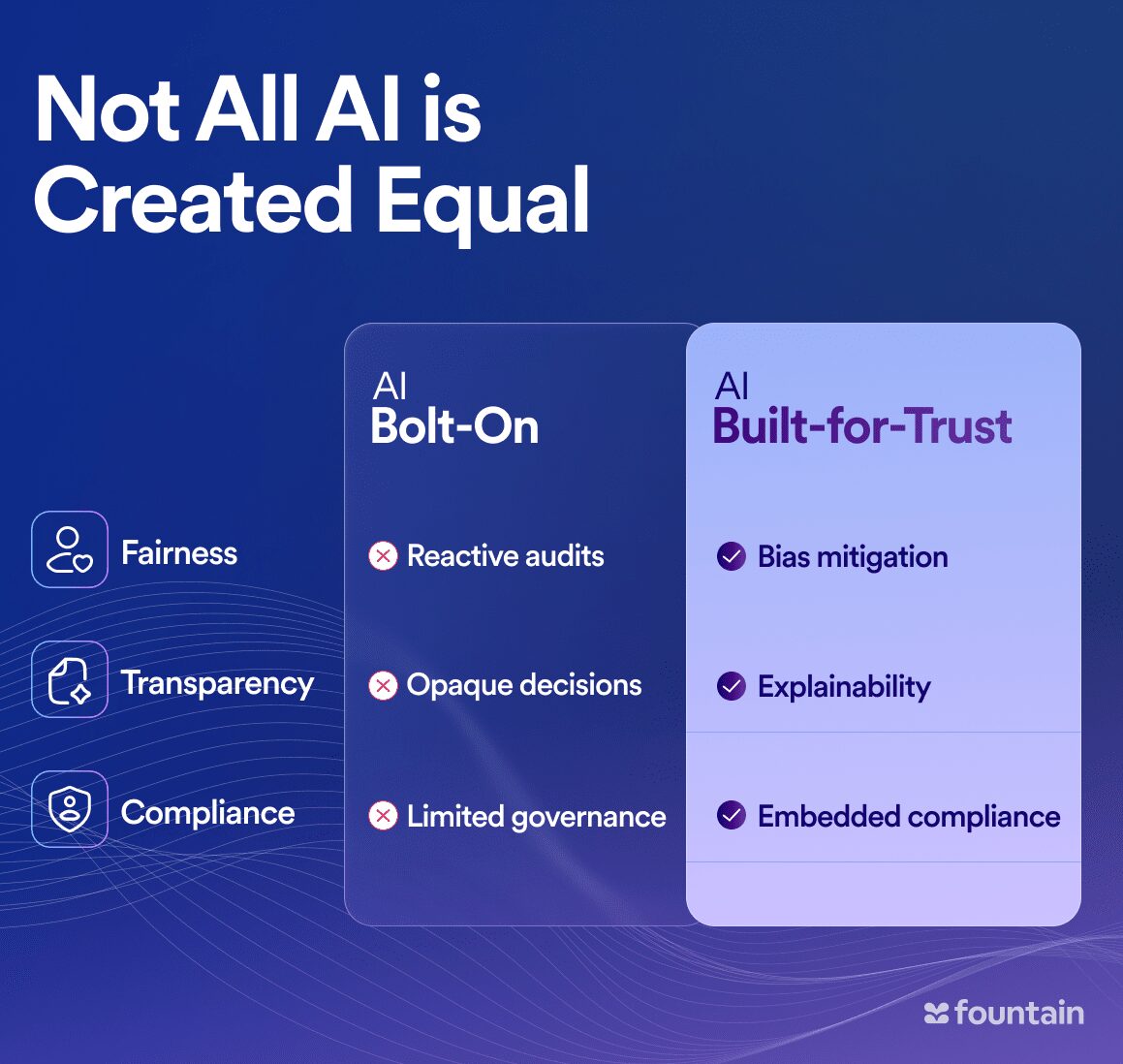
Faster decisions. Fairer outcomes. AI hiring built for compliance, speed, and scale.
Leading employers use trust-first AI to:
✅ Reduce bias and improve hiring equity
✅ Automate compliance with built-in safeguards
✅ Increase candidate engagement and completion rates
Curious how ethical AI can improve your frontline hiring?
Before: “Team Member Wanted. We’re a growing company that values hard work and a positive attitude. We offer competitive pay, a fun team environment, and opportunities for advancement. Candidates should be flexible, reliable, and passionate about customer service. Duties may vary based on business needs. Submit a resume and cover letter to be considered.”
After: “Line Cook, $17 to $19 per hour. Friday through Sunday, 11 a.m. to 7 p.m., at 1420 Market Street, near the 12th Street station. Apply from your phone in under five minutes. No resume needed.”
The rewrite is shorter because it swaps adjectives for facts a candidate can self-screen against.
Screening and scheduling without losing the candidate
Most hourly funnels leak at the application and the calendar, so start there. Design the application for a phone, because long, desktop-era forms lose candidates who are applying on a break rather than at a desk. Completion holds up when the form takes about five minutes and drops sharply once it asks 50 or more questions, so cut one hourly application down to a five-minute mobile form with no resume and no account creation.
Screen on the three things that actually predict a worked shift: whether the posted shift fits the candidate’s week, whether they have reliable transportation, and whether they can start on Day 1.
Schedule fit in particular shows up later in the turnover record. Turnover in the Harvard Shift Project panel of hourly retail and food-service workers ran 39% for people with less than 72 hours of schedule notice versus 24% with two weeks’ notice.
Skip the personality and culture-fit questions that predict little at volume, and spend the candidate’s five minutes confirming logistics.
Then fold scheduling into screening. Every hour between a completed application and a booked interview gives a competing employer more time to move, and phone tag burns the window while the candidate is still interested. Self-scheduling with multiple time slots lets a qualified candidate book the interview at 11 p.m. from the couch, the moment they applied, instead of waiting for a callback that may never connect.
Keeping candidates warm between apply and interview
Hourly candidates apply to several employers the same afternoon and commit to whoever stays in contact, so silence is a common reason they slip away. Slow hiring frustrates 57% of frontline candidates, per Fountain’s 2025 Frontline Report, and if you go quiet, another employer contacts and hires them first.
Acknowledge the application on arrival, remind the candidate 24 hours and two hours before the interview, and send an update whenever the process pauses. Agentic screening can qualify a new application within minutes, self-scheduling books the interview, and automated follow-up re-engages anyone who stalls, so a candidate usually hears from you before a week of silence reads as rejection.
The reminders and screening run automatically; recruiters still approve every disqualification and offer.
Fountain’s published MAPS Logistics case study, a UK courier hiring about 2,000 drivers a year, reports a 70% decrease in candidate no-shows alongside automated scheduling with calendar integration plus automated text and email reminders.
Test the same scheduling and reminders against your own no-show baseline before assuming the problem is candidate quality.
Closing the offer-to-first-shift gap
The offer-to-first-shift stretch is the least-managed part of the funnel, where a hire is technically won and still doesn’t arrive. In one survey, about 1 in 5 job seekers accepted an offer and never showed up on Day 1.
Assign a recruiter or manager to every accepted offer until the worker completes a first shift, and start pre-onboarding the moment the offer is accepted, so paperwork gets done on a phone that evening and the manager reaches out before Day 1. Send arrival instructions that name the entrance, the on-site contact, and what to wear, and use the early paperwork to surface a new hire’s questions while they are still weighing other offers.
Stitch Fix, a warehouse hiring operation that defines its headline metric as applicant conversion, saw the share of applicants who pass background checks and show up on Day 1 rise from 68% to 95%.
Measured that way, conversion runs through background checks and Day 1 attendance, which tells you exactly where to remove paperwork and communication friction.
Measuring where people disappear
Show rate belongs on the leadership dashboard next to time-to-hire and cost-per-hire, as one of the hourly-hiring metrics that predict retention rather than a number a single recruiter tracks. Baseline two figures by location: the share of scheduled candidates who attend the interview, and the share of accepted offers that become a worked first shift.
Stage-by-stage conversion shows where the leak sits. Interview-stage drop-off deserves its own location-level measurement, and drop-off by device exposes mobile friction once you compare phone and desktop abandonment.
Run the measurement past Day 1, too, so first-shift no-shows and week-two quits stay separate, visible outcomes rather than one blurred number. Frontline new-hire attrition reaches 43% within the first 90 days, so track show rate through the first month, not just to the offer.
How Fountain runs hourly hiring end to end
Every stage above has to run daily across every location, and manual follow-up breaks first when volume spikes. Cue is the orchestration layer that runs it instead. A regional operator can type a plain-language objective, something like “show me where candidates dropped off between offer and first shift last month, by location, and flag anyone stalled on paperwork,” and get the diagnosis plus the follow-up actions, with a recruiter approving anything sensitive.
Underneath Cue, three live agents carry the repetitive work.
First, there’s Anna, who handles screening and voice interviews around the clock, so a candidate who applies at 11 p.m. can interview then. Then, Emma, who answers candidate questions at any hour and walks new hires through I-9 and W-4 paperwork, the exact stall point in the offer-to-first-shift gap.
Finally, Sam, who monitors post-hire engagement signals past Day 1, where first-shift no-shows and week-two quits hide.
The agents run on products that map to the funnel: the ATS for a five-minute mobile application, Onboarding for paperwork closed the evening of the offer, and scheduling and sourcing tools that hold the stages between. Fountain is purpose-built for frontline hourly roles, not a corporate applicant tracking system retrofitted for them, which is why the workflow runs past offer acceptance instead of stopping there.
The hire you counted is the one who worked the shift. Book a demo to see Cue, Anna, and pre-Day-1 onboarding run against your own show rate, location by location.
Frequently asked questions
How do you hire hourly workers quickly?
A fast hourly process posts pay and shift details up front, keeps the application under five minutes on mobile, screens on logistics rather than culture fit, lets candidates self-schedule their interview, and contacts applicants the same day they apply.
What causes hourly worker no-shows and ghosting?
Candidates usually apply to several jobs at once, so slow processes and silence between stages let a competing employer move first. Pay or schedule mismatches discovered late in the process push candidates toward that other offer, which is why stating both up front and staying in contact matter so much.
What should an hourly job posting include?
Pay range, the specific shift pattern, the exact street-level location, and a mobile apply path that needs no resume, all stated plainly enough that a mismatched candidate self-selects out before booking an interview.