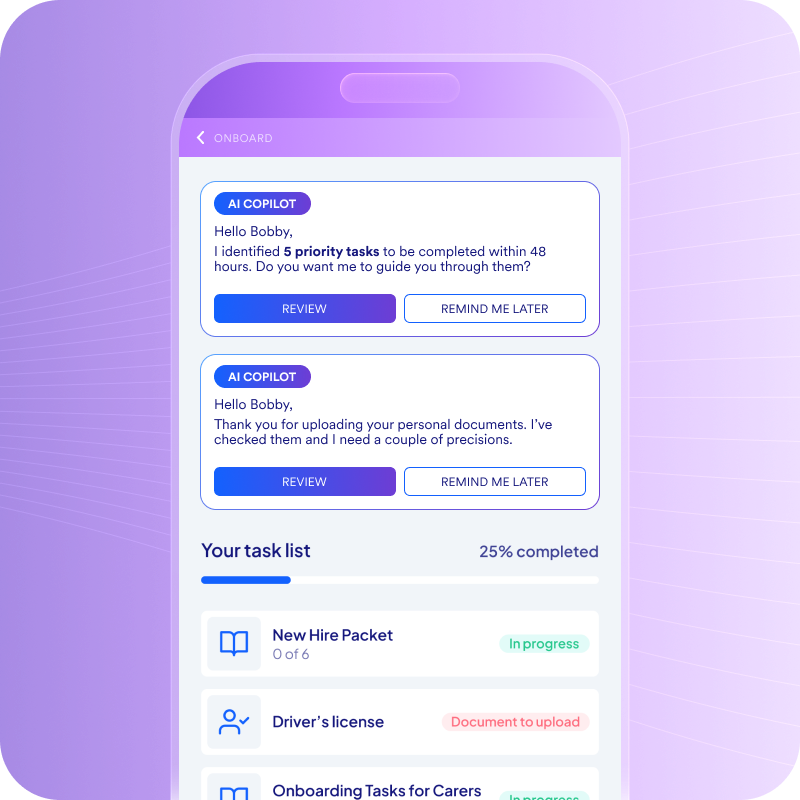

A structured employee onboarding checklist is one of the most controllable levers for frontline retention, and most high-volume teams don’t have one that works. The numbers in the 2025 Fountain Frontline Report say it plainly: 43% of new hires leave within their first 90 days. Workers who call onboarding “messy” are 9x more likely to plan their exit, and each replacement runs about $7,000, or roughly 40% of annual pay.
An employee onboarding checklist won’t fix a broken culture. But for operations leaders hiring hundreds or thousands of frontline workers across multiple locations, a checklist is where retention either starts or falls apart.
This article covers the full checklist by phase, from offer acceptance through the first 90 days, plus a playbook for teams that need onboarding to work at scale without relying on manager memory.
What is an employee onboarding checklist?
An employee onboarding checklist is a structured list of every step a new hire moves through between offer accepted and fully productive. It covers compliance, role clarity, cultural integration, and team connection across five phases: pre-hire, day one, first week, 30-60-90 days, and ongoing operationalization.
When the checklist works, the quality of a new hire’s first 90 days never depends on which manager happens to be working. For high-volume teams, the checklist serves a second function: it makes onboarding auditable.
Every location runs the same sequence, every manager follows the same steps, and every gap is visible before it becomes a retention problem.
Why onboarding breaks in high-volume environments
Most teams focus heavily on the hiring process itself, then lose consistency once the offer goes out. The real risk window is offer-to-first-shift, and in frontline hiring, that window is where preventable losses stack up. Four failure modes show up again and again at scale.
- Drop-off: Candidates abandon hiring flows when communication stops. Per the Redefining Frontline Operations report, 60% abandon applications that feel too long, and 42% withdraw if scheduling takes too long. That same impatience carries through the offer-to-start window.
- Consistency: Onboarding quality varies wildly by manager and location. SHRM research documents that frontline onboarding typically stays at Level 1: passive paperwork and rules. Everything else depends on which manager happens to be working that day.
- Compliance: I-9 Section 1 must be completed by Day 1 and Section 2 within three business days. Per the Employer’s Guide to I-9 Audits, paperwork violations run $288 to $2,861 per error, and ICE audits nearly doubled to 6,400+ in a single fiscal year. Errors compound fast at volume.
- Retention: Per the Frontline Report, 43% of new hires leave within 90 days. Fountain’s agentic AI for Frontline Workforces research puts industry-wide frontline turnover at 45% on average, with retail at 60% and logistics at 38%.
These four are connected. Drop-off feeds attrition and inconsistent onboarding multiplies compliance risk. Fix them at the system level or watch them compound across every location.
The four pillars of effective onboarding
Effective onboarding moves through four levels, each building on the last:
- Compliance: Tax forms are completed, employment eligibility is verified, and policies are acknowledged. This is the legal minimum.
- Clarification: Role expectations, performance metrics, reporting structure, and escalation paths are explained. New hires know who to ask when something goes wrong.
- Culture: Mission, values, norms, and unwritten rules are made visible. New hires understand how things actually get done here.
- Connection: Relationships with the manager, peers, and the broader team are established. This social infrastructure keeps people engaged past the first paycheck.
Most frontline onboarding programs never get past Compliance. The checklist below is designed to move through all four levels across the first 90 days.
Pre-hire onboarding checklist: offer to day before start
The offer-to-start window is often where the most preventable attrition happens. No-shows and drop-off before the first shift make pre-boarding one of the highest-leverage parts of the process.

The fix is a pre-boarding sequence the new hire can complete from their phone before they ever walk through the door.
Paperwork to collect or send for digital signature
The first priority is the documents every new hire needs signed or submitted before Day 1.
- Complete the I-9 form for employment eligibility verification, with Section 1 completable before Day 1 but not before offer acceptance.
- Complete the W-4 for tax withholding.
- Send any required state tax withholding forms.
- Collect direct deposit authorization.
- Send insurance and benefits enrollment materials.
- Send non-disclosure agreements where applicable.
- Collect background check authorization.
- Collect emergency contact information.
This packet should be ready before the first shift so day one does not get consumed by preventable admin work.
Access and logistics
Everything the new hire needs to walk in and start working should be ready before the first day.
- Add the new hire to company email, Slack, or messaging platforms.
- Prepare the ID badge, access fob, or store keys.
- Confirm parking or transit instructions.
- Send equipment such as uniforms, devices, or tools.
When these logistics are handled early, the first day can focus on role clarity and team connection instead of avoidable setup delays.
Welcome communication template
Send the first welcome message the moment the offer is accepted. Include start time and location, a tentative first-day schedule, what to bring, dress code, manager and team intro, a link to the handbook, and any pre-work or training modules.
Two examples below: one for offer-acceptance, one for the day-before reminder.
Template 1: Offer acceptance (send within one hour of accept)
Subject: Welcome to [Company], [Name]!
Hi [Name],
Welcome to the team. We’re glad you said yes.
Here’s what to expect:
- Start date: [Day, date]
- Start time: [Time]
- Location: [Address, including which entrance to use]
- Your manager: [Name], reachable at [phone or email]
- What to bring: Two forms of ID for I-9 verification (see [link] for accepted documents) and your direct deposit info
- Dress code: [e.g., black non-slip shoes; uniform top will be provided]
Before Day 1, please complete:
- I-9 Section 1: [link] (about 5 minutes)
- W-4: [link]
- Direct deposit setup: [link]
- A short welcome video from our CEO: [link]
Reply to this message if anything is unclear, or text [number] to reach our team. We’ll send a reminder 48 hours before your start date.
Welcome aboard,
[HR or Hiring Manager Name]
Template 2: Day-before reminder (send 24 to 48 hours before Day 1)
Subject: See you tomorrow, [Name]!
Hi [Name],
Quick reminder that your first day at [Company] starts tomorrow at [time].
- Where to go: [Address and entrance]
- Who to ask for: [Manager Name]
- What to bring: Two forms of ID, comfortable shoes
- First-day schedule: Tour, equipment setup, safety briefing, lunch with the team, paperwork wrap-up
If anything changes (running late, transportation issue, last-minute question), text [number] and someone will respond.
Excited to have you on board.
[Manager Name]
A national retail chain documented in Fountain’s Redefining Frontline Operations report cut new-hire no-shows by 35% after automating its pre-boarding sequence. The mechanism: tasks fired the moment an offer was accepted, not when a manager remembered.
Day one onboarding checklist
Day one is identity-forming, and most workers walk in without the support to handle it. Per Fountain’s Redefining Frontline Operations report, 81% of new hires feel overwhelmed with information on the first day, and only 12% believe their organization delivers a strong onboarding experience.
Almost 40% start questioning their job choice during onboarding, with Gen Z making up half of that group. The first day sets the trajectory.
- Welcome the new hire and provide a site or store tour.
- Set up equipment and verify access.
- Deliver a safety briefing, especially for warehouse, manufacturing, and logistics roles.
- Introduce the manager, peers, and any cross-functional contacts.
- Walk through role expectations and how performance is measured.
- Review the code of conduct and HR policies.
- Complete any paperwork not finished during pre-boarding, including I-9 Section 2 within three business days.
- Schedule coffee or lunch with the manager or team.
When every item on this list is covered, new hires leave day one with clarity on their role and confidence they made the right decision. That foundation keeps them past week one.
First week onboarding checklist
Week one is where the new hire goes from oriented to operational. The trajectory of a new hire’s success is set within the first two weeks, and the patterns set in week one tend to hold.
- Schedule shadowing shifts or paired work with an experienced peer.
- Complete the initial training modules.
- Hold a manager check-in at the end of day three.
- Assign the first piece of independent work.
- Invite the new hire to team rituals or social events.
- Create open-question time with the manager or HR.
- Run a day 7 pulse check with one question: “Is this what you signed up for?”
That first-week structure helps teams catch friction before it turns into early attrition. The day 7 pulse is the single highest-leverage item on the list. It surfaces problems while there is still time to fix them.
First 30, 60, and 90 days
Onboarding doesn’t end at week one. The 30-60-90 day window is where retention is often won or lost.
- Day 30: Performance check-in and training progress review. Surface early skill gaps. Per the Frontline Report, workers without scheduling tools are almost 5x more likely to struggle with basic requests like time off. If the schedule feels chaotic by Day 30, retention is already at risk.
- Day 60: Goal-setting for the next quarter, structured feedback in both directions, and a growth path discussion. Connection at this stage isn’t optional.
- Day 90: Formal review. Recalibrate role expectations and recognize early wins. Per the Redefining Frontline Operations report, employees with disorganized onboarding are 2x as likely to leave within their first year. The Day 90 review is the last clean intervention point before that exit risk converts.
How to operationalize onboarding at scale
A checklist on paper doesn’t survive high volume. When your high-volume hiring strategy calls for 500 people across 200 locations in a six-week window, you need the checklist plus a system that runs it without relying on manager memory.
The gap between having a checklist and consistently executing it is where most frontline employers fail. Five principles separate the teams that close that gap from the teams that don’t.
- Templates by role: Every role gets a documented onboarding template, not a manager’s mental model. A warehouse associate and a delivery driver have different compliance requirements, different training sequences, and different Day 1 experiences. The template captures all of it.
- Automated triggers: Tasks fire when the offer is accepted, when the background check clears, and when the first shift is 48 hours away. They do not depend on someone remembering to send them.
- Manager accountability: A dashboard should show who is behind on which step, by location and by individual. The accountability gap in frontline onboarding is structural. Managers are running a store, a warehouse, or a kitchen, and they don’t have time to track onboarding manually. The dashboard does it for them.
- Reminder loops: New hires should get nudges for incomplete steps. Managers should get nudges when check-ins are due. Nobody should fall through because someone was short-staffed and forgot.
- Pulse feedback: Pulse feedback should be built into the workflow at Day 7, 30, 60, and 90, not bolted on as an afterthought survey three months in. Pulse checks at the right intervals catch retention risk before it becomes a resignation.
Together, these principles turn onboarding from a manager-dependent process into an operating system the business can actually run.
How Fountain runs onboarding at scale
In high-volume hiring, onboarding is your retention engine. The checklist makes it repeatable. The system makes it scalable. Fountain runs that system through one orchestration layer, three named agents, and a product layer underneath.
Cue is the orchestration layer and the single entry point to every agent on the platform. A talent acquisition leader types something like “Onboard 200 new hires across 50 locations by Friday and flag anyone missing I-9 Section 2,” and Cue breaks the goal into tasks, routes them to the right agent, and reports back when something is stuck.
That’s what agentic AI looks like in frontline hiring: software that runs the work, not software that reports on it. Three named agents run the work under Cue:
- Emma: 24/7 candidate and new-hire support across SMS and voice. New hires asking about I-9 forms, W-4 forms, parking, or badge status get answers the moment they ask, with no manager in the loop.
- Sam: Post-hire pulse. Day 7, 30, 60, and 90 satisfaction surveys send automatically, and Sam routes retention-risk signals to the manager dashboard before someone resigns.
- Anna: AI Recruiter conducting voice and SMS interviews 24/7 upstream of onboarding. Pre-qualified candidates enter Day 1, which removes a class of Day 1 surprises before they happen.
Underneath the agents, Onboarding is the product layer they operate on. Workflows auto-trigger by location, role, and worker type. I-9 packets fire on offer acceptance. E-Verify submission and document tracking run automatically. A real-time dashboard shows day-one readiness by location.
The cost of getting this wrong shows up in the math: about $7,000 per lost worker, compounded across every location, every quarter, every peak season. The cost of getting it right is a structured process that runs the same way whether you’re onboarding 10 people or 10,000.
Book a Fountain demo to operationalize this checklist running across every location.
Frequently asked questions about employee onboarding
What forms do new employees need to fill out on Day 1?
I-9 Section 1 must be completed no later than the first day of employment. W-4 for federal tax withholding and state tax forms should be completed before or on Day 1. Direct deposit authorization, benefits enrollment, and emergency contacts round out the standard packet.
How do you measure onboarding success?
The key metrics are new-hire retention rates at 30, 60, and 90 days, alongside time-to-productivity, pulse survey scores at each milestone, and manager feedback on new-hire readiness.
Automated pulse checks at Day 7, 30, 60, and 90 are the cleanest way to catch retention risk before it converts into a resignation.
What’s the best onboarding plan for high-turnover roles?
The highest-impact approach is front-loading the experience. All compliance paperwork should be completed before Day 1, new hires paired with experienced peers during week one, and structured pulse checks run at Day 7 and Day 30. Employees with disorganized onboarding are more likely to leave within their first year, so front-loading the process pays off in retention math.