
43% of frontline new hires leave within 90 days, according to the 2025 Fountain Frontline Report, Fountain’s survey of nearly 2,000 frontline workers. When onboarding begins only on Day 1, the offer-to-start period goes unmanaged. The gap between offer acceptance and first shift, when a new hire has said yes but hasn’t yet clocked in, shapes 90-day retention before any perk or program on the job takes effect.
Employers control communication, paperwork, and scheduling during this gap, but often assign no owner to those tasks. Recruiting budgets get scrutinized. Ninety-day turnover gets reported. The days in between, when the candidate is technically hired but practically invisible, usually belong to no one.
Automation carries the paperwork and the reminders. Managers make the calls.
What is the link between onboarding and retention?
Onboarding covers the period from offer acceptance until a new hire can perform the role and wants to stay. It clarifies the job and builds confidence with coworkers. Research on newcomer adjustment links role clarity, confidence, and social acceptance to commitment, performance, intent to remain, and turnover.
Frontline work usually needs hires ready to perform core tasks quickly, and orientation, the day of forms and videos, only opens the process. For employers, retention means keeping a hire past the point where replacing them costs real money: replacing a frontline worker runs about $7,000 once recruiting and training are counted alongside lost productivity, and the figure varies by sector.
Onboarding begins while new hires are still deciding whether to stay. Pay raises, development programs, and engagement surveys all act on workers who have already settled in. Onboarding is already running during the weeks when quit decisions form, earlier than any of those.
Workers who called their onboarding “messy” were 9x more likely to say they were planning an exit, in the same Frontline Report survey. A process that feels disorganized in week one reads as a preview of the whole job.
A consistent first week lets employers catch problems early, monitoring stalled paperwork, unanswered questions, and unconfirmed shifts before they become reasons to leave.
Why speed decides retention in the first weeks
Speed decides retention because the window to build confidence is short, and new hires start evaluating immediately. In a 2023 BambooHR survey of 1,565 US employees, 70% of new hires said they decide whether a job is the right fit within the first month, and 29% know within the first week, leaving employers about 44 days to influence whether someone stays.
On the frontline, that window is even tighter: hourly candidates often apply to several employers at once and take the first concrete start date.
A confirmed first shift gives candidates clarity while other options are still open. A warehouse associate or delivery driver may be comparing which employer can put them on a schedule this week, so each idle day between offer and first shift leaves more time for plans to change or another option to firm up.
Delays as small as an unanswered email or a stalled background check eat into the same window.
Faster ramp-up. Lower early attrition. AI onboarding built for speed, scale, and retention.
Top employers are already using Fountain to:
✅ Reduce turnover in the first 60 days
✅ Eliminate manual paperwork and task delays
✅ Accelerate new hire productivity with smarter workflows
Curious what smarter onboarding could unlock for your team?
The offer-to-first-shift danger zone
The offer-to-first-shift period turns risky when no one owns the new hire handoff, paperwork stalls, and the first shift stays unconfirmed. Your new hire accepts, then hears nothing for two days. The paperwork sits in a portal built for desktops, and the new hire only has a phone.
Nobody confirms a schedule, so the new hire can’t arrange childcare or a second job around it. On the scheduled first day, the shift stands empty and your hiring manager restarts the requisition.
The cause is a gap in ownership. Recruiting has moved on to the next requisition. The hiring manager doesn’t start managing until Day 1. In between, the new hire belongs to whoever happens to notice, which most weeks is nobody.
Assign one person to own communication, paperwork, and scheduling from acceptance through Day 1, and route the forms, reminders, and first-shift confirmation through a single workflow so nothing falls between roles.
Among organizations reporting recruitment difficulties, 41% reported an increase in candidate ghosting, the third-biggest recruiting challenge behind a low number of applicants and competition from other employers. The same top three challenges showed up in 2022 and 2024, so communication drop-off is a persistent funnel risk, though this is not a Day 1 no-show rate, which no public figure reliably captures.
Preboarding, the structured work between acceptance and the first shift, closes the chain one link at a time. Give it a single owner, one coordinator who runs the handoff from acceptance through Day 1, and work a simple cadence:
- Within hours of acceptance: send a mobile welcome, the phone-ready paperwork, and a first-shift confirmation, so the new hire knows the job is real and can start the forms before leaving the chair where they accepted.
- Days 1 to 2: confirm the forms are moving on the device the hire actually carries, and give them one named person they can text, since an unanswered question is often what starts the drift toward drop-off.
- Days 3 through the first shift: chase any stalled paperwork, re-confirm a shift the hire can plan childcare or a second job around, and keep the reminder cadence running while other offers are still live.
- Day 1 on-site: hand the new hire to the manager with paperwork done and the schedule set, so no one arrives to a shift that no one owns.
Schedule predictability keeps paying off after the first shift. The Harvard Kennedy School Shift Project reports that frontline workers with at least two weeks’ notice of their schedules had a 24% turnover rate, against 39% for those with under 72 hours’ notice. So confirm the first shift during the offer sequence, as early as you can.
To put things in perspective, MAPS Logistics (a UK courier hiring 2,000 drivers a year) reported a 70% decrease in candidate no-shows after automated text and email reminders and calendar integration replaced manual scheduling. The fix is rarely complicated; it just needs an owner and a workflow that runs every time.
What fast onboarding looks like in practice
As soon as the offer is accepted, phone-ready paperwork and the first-shift confirmation should go out in parallel, not one after the other. The device to design for is a phone, since frontline workers rarely finish a desktop portal, and the whole sequence should wrap before Day 1 rather than start on it.
Day 1 readiness means the paperwork and the schedule are both settled before the new hire arrives, and the manager knows who is coming. Compliance runs inside that same parallel flow. Federal rules require Section 2 of Form I-9 within three business days of the employee’s first day of work for pay, and E-Verify cases, where applicable, run on a parallel three-business-day clock.
Rules vary by state, so treat this as general orientation, not legal advice, and confirm the specifics with counsel.
The step-by-step mechanics live elsewhere: the employee onboarding checklist covers the full task sequence, and the guide to AI onboarding covers how automation runs it.
How to tell your onboarding is protecting retention
Measure the Day 1 show rate first, then 30-, 60-, and 90-day retention. New hires who accepted but never worked a shift are pre-start attrition, and folding them into general turnover hides the offer-to-first-shift problem entirely. A readiness dashboard that breaks completion down by individual and location makes this visible at a glance.
Next, plot 30-, 60-, and 90-day retention for each hiring cohort on one curve. Tracking “graduating classes” of hires who started in the same period shows whether a cohort erodes steadily or falls off a cliff at a specific week. Then record why new hires quit while the details are still current, since exit conversations often surface unmet promises or working conditions that honest job previews and better preboarding can fix for the next cohort.
Company-wide averages hide where your danger zone is widest. Sites running the same playbook still produce different 90-day curves as managers and local scheduling vary, so measuring at the location level, with Day 1 readiness tracked per site, turns “our turnover is high” into “these four sites lose hires between offer and Day 1.”
Process-level metrics like completion rates and time-in-stage sit underneath these retention numbers; track them alongside.
How Fountain closes the gap between offer and first shift
The 90-day retention window opens the moment a candidate accepts, not on Day 1, so the paperwork and schedule should be done before anyone walks in. Fountain automates that rule-based work while the judgment calls stay with people.
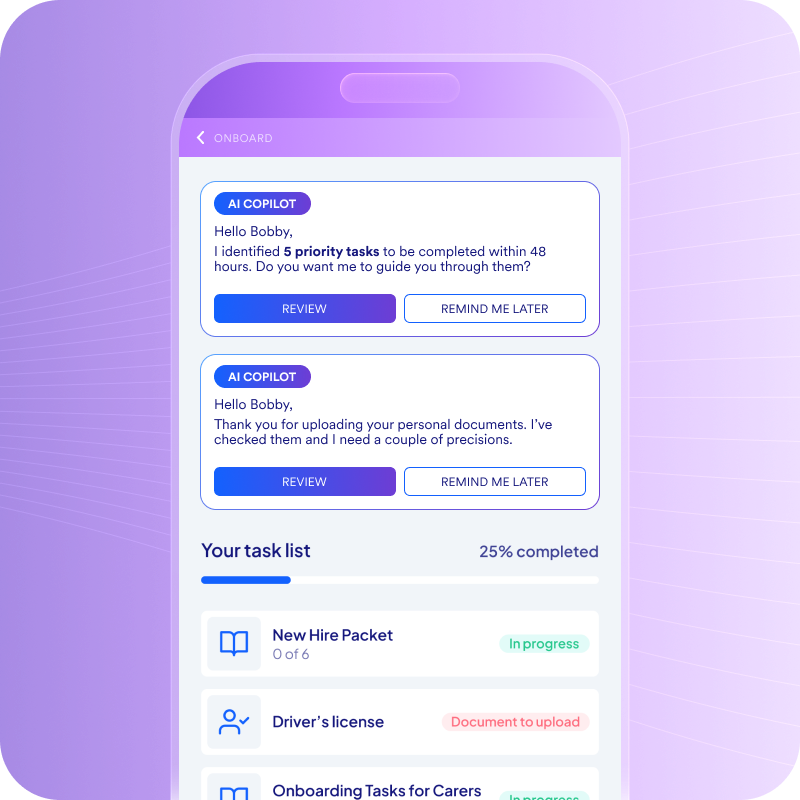
Cue, the orchestration layer, takes a plain-language goal (“get this weekend’s 12 new hires paperwork-complete by Friday”) and coordinates the agents: Emma moves I-9, W-4, and candidate questions onto the phone from offer day, Sam runs post-hire check-ins through the 90-day window, and Anna shortens time-to-offer upstream.
Fountain Onboarding carries the mechanics, with Day 1 readiness dashboards that flag stalled hires by location. Marsden Services cut time-to-hire from 18 days to about seven and raised day-one retention 16% in its Fountain case study.
If your operation is ready to close that gap, book a demo to see Emma on the phone and Cue running the offer-to-first-shift workflow end to end.
Frequently asked questions about onboarding and retention
What is the connection between onboarding and retention?
Onboarding is one of the first retention levers an employer has, because it builds role clarity and confidence during the weeks when new hires are still deciding whether to stay.
Why do new hires quit in the first 90 days?
Expectation gaps drive a lot of early exits, when the actual work looks different from what a hire was promised. Workers who called their onboarding messy were far likelier to say they were planning an exit, and silence between offer and first shift can end the relationship before it begins.
How is frontline onboarding different from corporate onboarding?
Frontline onboarding usually has to get workers ready to perform core tasks quickly and let them complete every step on a phone, while some corporate roles ramp over a longer period. The acceptance-to-Day 1 gap exists in both, but speed matters more on the frontline, where another employer may be able to put the candidate on a schedule sooner.