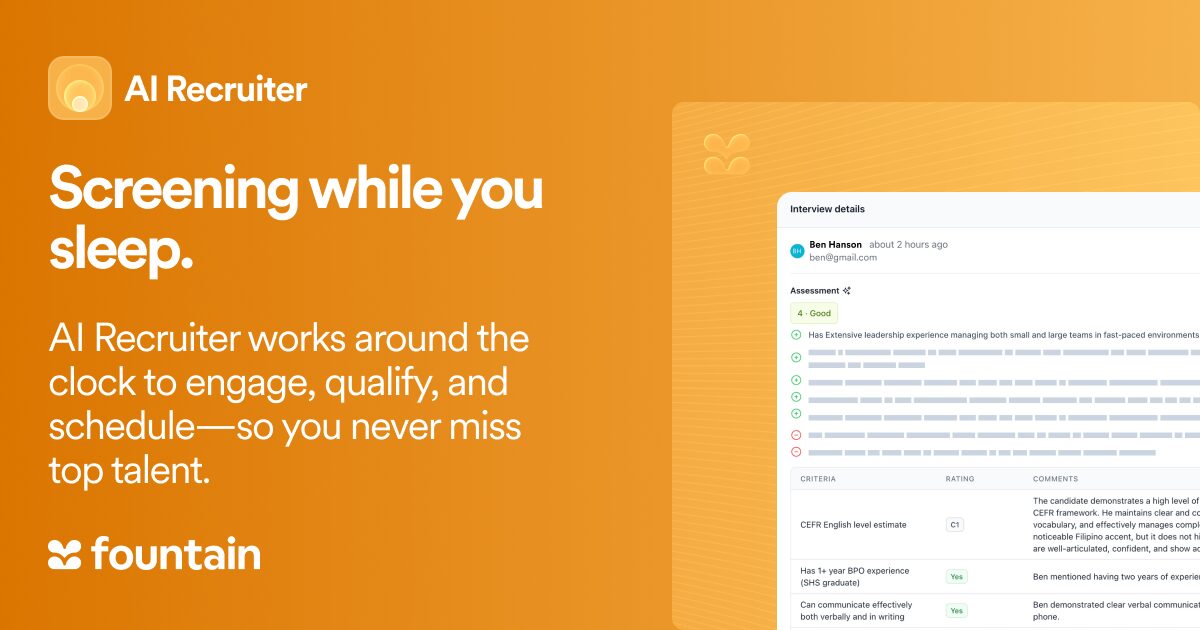
AI recruiting tools integrate with an ATS through API connections that let both systems read and write to a single candidate record. Many hiring teams run AI tools for sourcing or screening alongside an applicant tracking system, but the two systems may not share data cleanly. Recruiters end up copying match scores from one tab into another, re-entering candidate notes by hand, and toggling between dashboards while applicants wait for a response.
According to the 2025 Fountain Frontline Report, 57% of candidates cite a slow hiring process as a top frustration and 52% cite ghosting or lack of updates. Manual re-entry is what creates the lag candidates walk away from.
This article covers the practical path from disconnected AI tools to a working ATS integration: the architectural choice between native and bolt-on AI, readiness criteria, technical mechanics, compliance requirements, and how to measure results.
What does it mean to integrate AI recruiting tools with your ATS?
Integration means your AI tools for sourcing, screening, scheduling, and candidate Q&A read from and write to the ATS as the single system of record. AI-generated scores, skill tags, and notes flow directly into the candidate profile, while recruiters and hiring teams keep control over final advancement and hiring decisions.
A stage change in the ATS can trigger the next workflow task without a manual handoff, while recruiters keep control over high-stakes decisions.
This matters now because the volume and speed demands of frontline hiring have outpaced what manual screening can keep up with. Candidates expect responses on the same timeline as a delivery order, and the hiring teams that can’t match that timeline lose applicants before the first interview lands.
Native AI vs. bolt-on integration
The architectural choice determines how much integration work you do every quarter. Bolt-on integration connects a third-party AI tool to your ATS through API connections, field mapping, and ongoing maintenance. In that model, the AI typically only sees the data explicitly passed through the integration rather than the system’s full data model.
Native integration means the AI lives inside the ATS and operates on the same data model, with access to the candidate records, workflow state, and interaction history already in the system.
If you’re evaluating a tool, the question to ask is whether the AI reads the full candidate record or only what gets passed through the API. That distinction predicts whether your team will be doing field-mapping cleanup every quarter.
Fountain built its agentic capabilities directly into the system rather than bolting them on. The orchestration layer reads the same candidate records, workflow state, and interaction history the ATS already holds, which means agentic screening and scheduling write back into the system of record without field-mapping work.
At Fetch, a package delivery platform, Fountain’s AI capabilities cut time-to-hire by 95% and compressed source-to-hire to 8 minutes.
Are you ready? A pre-integration readiness check
AI tools amplify whatever’s already in your ATS. Clean data produces more useful outputs. Poor data produces unreliable outputs with enough confidence around them to make mistakes harder to spot. 3 signals tell you the foundation is solid enough to build on.
- Recruiter volume per quarter has outgrown your team’s capacity. Recruiters spending more time on manual screening than candidate conversations, with time-to-screen climbing month over month, is the clearest sign that AI integration will deliver measurable capacity gains.
- Your candidate records are clean and consolidated. Active records show no significant duplicate profiles, complete contact information, and current employment status. Run duplicate, completeness, and stale-record reports before any integration work begins.
- You can pull baseline KPIs today. You already have current numbers for time-to-screen, application completion rate, and candidate drop-off rate. Without those baselines, there’s no way to measure whether an AI tool is delivering value after it ships.
If all 3 signals are present, the foundation supports AI integration. If any are missing, the gap often shows up as noisy AI outputs rather than a clean failure message. The following blockers need resolution before moving forward.
- Duplicate candidate records fragment the talent pool. Multiple profiles for the same candidate produce conflicting AI scores and split that candidate’s interaction history across records. Merge these before any AI scoring runs.
- Unstandardized job titles confuse AI matching. “Cashier,” “Crew Member,” and “Store Associate” representing the same role pollute training data and create inconsistent screening rules across locations. Standardize naming conventions across locations and business units first.
- Missing baseline KPIs mean you can’t measure outcomes. If you can’t report current performance without a week of manual spreadsheet work, you’re paying to automate a process you can’t measure.
Treat the cleanup as a 1-month project before signing anything. The work pays off twice: cleaner data makes the first AI deployment land cleanly, and the baseline numbers give you something to measure against after go-live.
How the integration actually works
Two mechanisms move data between AI tools and an ATS. Polling checks for updates at fixed intervals, which can introduce delay and Webhooks send data when something changes, which supports faster sync.
For frontline hiring, where speed matters, that difference can affect whether you’re responding to an active applicant or one who has already moved on. Teams often pair webhooks with polling for reliability rather than relying on a single mechanism alone.
For teams connecting a bolt-on AI tool to an existing ATS, the integration path follows six steps that vary in detail by vendor but not in sequence.
- Map AI actions to ATS stages before writing code. Identify which AI actions (screen, score, schedule, message) correspond to which ATS stages, and decide where human review gates sit. This design step determines everything downstream.
- Issue a dedicated API key with least-privilege scopes. Authentication runs on a single key with role-based permissions scoped to the candidate data the AI tool actually needs, and no more.
- Configure webhooks for the events that move the workflow. Critical events include candidate.created, application.created, stage.changed, interview.scheduled, and offer.accepted. Each one fires data into the AI tool the moment something changes in the ATS.
- Create custom ATS fields to hold AI outputs. Each field needs a unique ID, display name, field type, and value format. Without dedicated fields, the AI scores have nowhere to land in the candidate record.
- Pilot in a sandbox with one role type and one location. A bounded sandbox verifies that scores, notes, and stage transitions write back correctly before any production traffic touches the integration.
- Monitor daily for the first 30 days after go-live. Webhook delivery rates, field sync accuracy, and AI agent performance need eyes on them every day until the integration runs predictably.
After each AI action, 4 data points write back to the ATS: the match score, a reasoning note explaining the score, inferred skill tags, and an audit log ID linking to the full decision record. Integration depth matters as volume rises.
One Fortune 50 Fountain customer processes 1.97 million applicants per quarter through a fully integrated workflow. Median process time runs at 8.3 minutes, mid-workflow data checks respond in 1 to 2 seconds, and 822,000 automated rehire checks run without recruiter intervention. Hires transfer to the HRIS automatically. The mechanics above produce those numbers when the AI and ATS share one data model.
Compliance, bias, and human oversight
Compliance in AI recruiting belongs in the system from the start. The regulatory environment touching AI hiring tools is active and expanding.
- Equal Employment Opportunity Commission (EEOC) and Title VII: The four-fifths rule applies to algorithmic decision-making. If a protected group’s selection rate falls below 80% of the highest-performing group, adverse impact is indicated. Employers are liable for vendor-developed tools. Private litigation exposure remains intact regardless of federal enforcement shifts.
- EU AI Act: Employment AI is classified as high-risk under Annex III, with full compliance obligations enforceable by August 2, 2027. Penalties for high-risk system violations reach €15 million or 3% of global turnover.
- NYC Local Law 144: Requires annual independent bias audits with published results for automated employment decision tools. Tools that do not substantially assist or replace discretionary decision making may fall outside scope, which may encourage employers to incorporate human review into hiring workflows. SHRM’s overview explains the scope distinction.
- Immigration and Customs Enforcement (ICE) and the I-9: Per Fountain’s Employer’s Guide to I-9 Audits, ICE audits crossed 6,400 in a single fiscal year, nearly doubling prior volumes. Paperwork violations alone run $288 to $2,861 per violation, and repeat offenses for knowingly employing unauthorized workers reach $28,619 per worker.
- General Data Protection Regulation (GDPR), California Consumer Privacy Act (CCPA), California Privacy Rights Act (CPRA), and SOC 2: Privacy notices are part of the compliance picture, and candidate consent flows may also shape how employers structure those processes.
CPRA’s automated decision-making regulations may create new compliance obligations for employers depending on how the rules apply to employment uses of automated decision technology. SOC 2 certification is an important third-party security validation to look for when evaluating AI hiring vendors.
Build human approval triggers before any high-stakes disposition, including reject or advance to offer. Audit logs should generate by default for every AI action, with bias auditing across protected groups at each funnel stage. The compliance layer is where the cost of getting integration wrong shows up first.
How to measure whether the integration worked
The KPIs that matter for frontline AI integration are specific to the funnel stages where AI acts.
- Time-to-screen captures AI impact in the early funnel. Track the median elapsed time from application to interview scheduling. This is the metric that most directly reveals whether the integration is doing what it’s supposed to.
- The interview-to-offer ratio shows whether the AI is advancing the right candidates. If the ratio worsens after AI deployment, the tool is pushing unsuitable candidates through to recruiters and the screening criteria need recalibration.
- Hiring outcome parity reveals whether the four-fifths threshold holds. Pass-through rates at each funnel stage, broken out by protected group, are the lead indicator for adverse impact under EEOC guidance.
- Recruiter capacity freed translates AI impact into team-level outcomes. Count screens per recruiter per week and the hours shifted from administrative tasks to candidate conversations. This is where AI ROI shows up as people doing higher-value work.
A 30-day pilot with one high-volume role type at one location, compared against a manual baseline at a comparable location, produces the clearest signal. Historical data before go-live provides the baseline. Check demographic parity during the pilot through ongoing bias auditing and regular review of selection outcomes.
If adverse impact appears, pause and recalibrate before the pattern compounds across a broader pool of applicants. At day 30, compare results against the control group across all 4 metrics.
Post-hire retention data can add to the measurement picture. Without post-hire outcome data feeding back into the system, AI screening improves interview completion rates rather than workforce stability. Measurement is what turns an integration from a cost line into a defensible investment.
How Fountain runs the integration problem out of existence
The market is shifting from AI that assists recruiters to agentic AI that handles multi-step workflow tasks, and that shift raises the architectural stakes. When AI and the ATS share one data model, the integration burden drops. Cue operates as the orchestration layer, the single entry point to every agent on the platform. A director of talent acquisition types “Re-engage seasonal applicants from last year, good standing only” and Cue carries that work through the system, while keeping human review in place for candidate advancement and hiring decisions.
Under Cue, 3 named agents run the work:
- Anna conducts voice interviews and screening; at CLEAR, Anna cut time-to-fill from 17 days to 10 days.
- Emma guides workers through I-9 and W-4 paperwork to clear day-one blockers.
- Sam takes the pulse of the workforce at post-hire milestones to surface retention risk early.
Cue coordinates the agents across the same ATS, CRM, Onboarding, Shift & Scheduling, and Sourcing products. Bojangles cut time-to-hire from 30 days to 5.8 days, an 80% reduction, running on a system where AI and hiring workflows share the same foundation across 750 locations.
Ready to run hiring from one system instead of three? Book a demo to see Cue orchestrate Anna’s voice interviews, Emma’s I-9 flow, and Shift & Scheduling on your own data.
Frequently asked questions about integrating AI recruiting tools with your ATS
How long does it take to integrate AI tools with an ATS?
Bolt-on integrations can take several weeks for a single ATS connection, depending on the systems involved and the integration approach. Native AI systems require no separate integration project because the AI and ATS share one data model from the start.
Do I need to replace my ATS to use AI recruiting tools?
Bolt-on AI tools connect to your existing ATS via API, with the tradeoff of ongoing maintenance, limited data access, and slower sync times. Native AI systems built into a unified platform deliver a tighter integration, but adopting one typically requires moving to a new platform.
What does human-in-the-loop look like in practice?
AI handles screening, scheduling, and candidate communications inside the workflow. Human recruiters review and approve high-stakes actions, including advancing candidates past a defined threshold, extending offers, and making final hire decisions. Fountain’s published materials reference exportable audit trails, explainability logs, and human override protocols at consequential decision points, with human oversight over final hiring decisions.