Peak season staffing compresses months of hiring into a few weeks, and this year the hiring window may be shorter for employers starting later. The Wall Street Journal reported in October that holiday hiring is happening later than usual this year. When hiring starts late, every step between application and first shift has less time to happen, and a candidate who waits a day for a screen or a callback often takes another offer.
When people run every screen, calendar invite, and follow-up by hand, employers have two choices: add recruiters or accept slower hiring, and both cost money. AI agents give a third option. They run the repetitive steps around the clock, so decisions can happen fast, and recruiters and hiring managers can keep the hiring decisions.
Why peak season staffing breaks the recruiter model
Peak season hits retail stores, warehouses, delivery fleets, and hospitality hardest, from cashiers and stockers to pickers, packers, and drivers, adding a seasonal hiring wave on top of hiring that never really stops. Four pressures make it hard for a recruiting team working by hand to keep up:
- Turnover keeps the baseline high. Retail turnover runs around 60 percent a year, so peak hiring starts from a replacement backlog rather than a fully staffed base.
- Quits are rising. In the Bureau of Labor Statistics’ August 2026 JOLTS data, the retail trade quits rate reached 3.0 percent, up from 2.4 percent a year earlier.
- Store managers absorb the work. Without automated scheduling, managers often run their own interview scheduling and phone screens, and sometimes spend days chasing candidates during their busiest weeks of the year.
- Plans are leaner. Challenger, Gray & Christmas’s 2026 holiday hiring outlook projects about 450,000 seasonal retail hires in the fourth quarter, October through December, down 2.5 percent from last year, with retailers leaning on existing staff and on-demand pools rather than large seasonal hiring waves.
Each of these pressures lands on the same few recruiters and store managers. Adding more hands to the same manual steps rarely keeps pace, so the practical fix is to move those steps to agents, stage by stage, across the peak timeline.
What AI agents handle across the peak season timeline
AI agents in hiring are software that works toward a goal your team sets and completes multistep recruiting work, such as screening, scheduling, candidate questions, and paperwork follow-up, with little human input at each step. They act on the rules your team defines, without waiting for a recruiter to click a button.
For a TA leader, the useful question is when agents take over at each stage of peak: before the rush, during the ramp, in the stretch to day one, and during peak itself.
Before the rush: Planning and setup
An agent can configure each store’s or distribution center’s hiring flow from a plain-language request. Your team states the objective, and the agent proposes the configuration. The flow runs only after someone with authority approves it.
Re-engaging people who already worked a season for you can cut new sourcing spend for those roles. Check your candidate database for eligible past seasonal workers before you open new sourcing. Macy’s reported that 33 percent of recent hires during the 2024 holidays were former colleagues returning for the season.
The ramp: Screening, scheduling, and questions at volume
An AI interviewer can screen applicants 24/7 over voice and chat. It scores each one on a consistent rubric and returns a ranked shortlist, which recruiters review before anyone moves forward. An applicant who finishes a shift at 11 p.m. gets interviewed that night instead of waiting for Monday.
A support agent answers candidate questions about pay, schedule, and next steps from your own knowledge base, and it guides applications in chat. Interview scheduling runs on synced calendars, so candidates book their own slots and managers get notified without phone tag.
The final stretch to day one: Paperwork and readiness
Agents can cover the gap between offer and first shift, when new hires often drop off. In HR.com’s State of Seasonal, Hourly and Volume Hiring 2025-26 report, 46 percent of the 560 HR professionals surveyed called new-hire no-shows a considerable or major problem.
Agents send SMS and email nudges for incomplete onboarding steps, helping new hires fix stuck forms and regain lost portal access. When an agent can’t resolve a problem, they hand it off to a person. Managers can see who is ready for day one and who has stalled.
Smarter, faster, and more compliant from day one
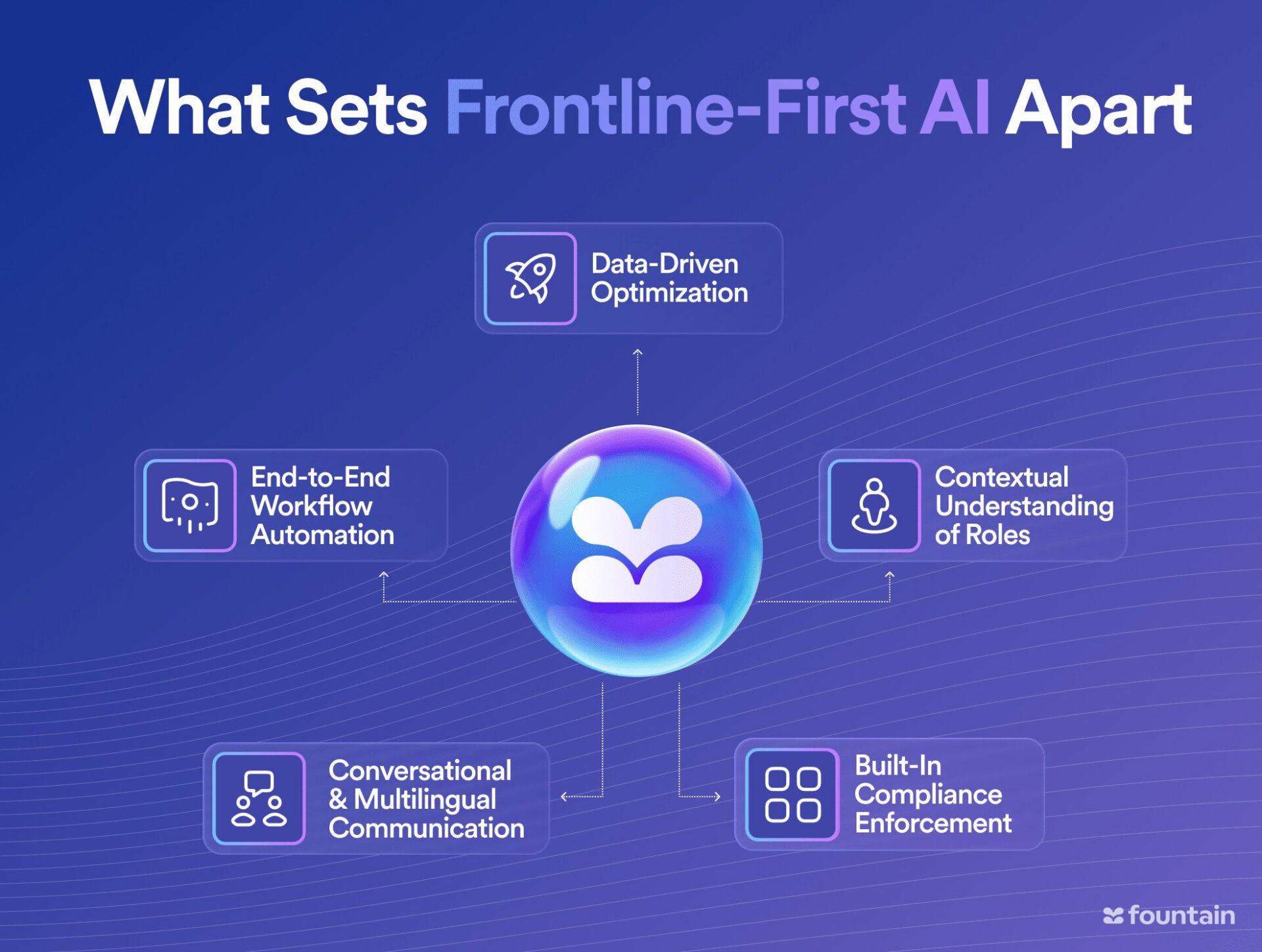
See how frontline-first AI helps you reduce time-to-hire, engage more candidates, and stay compliant at scale.
From instant chat-based screening to automated scheduling and built-in compliance, Fountain’s AI gives your team the tools to hire faster and smarter while maintaining accuracy and a great candidate experience.
Schedule a personalized demo and explore what’s possible.
During peak: Watching what’s slipping
During peak, agents flag which locations trail their hiring targets and where no-shows cluster. Coverage gaps surface before shifts go uncovered, so managers can act while open shifts are still fillable. When an agent proposes a fix, it runs only after a manager approves the plan.
Across those four stages, the repetitive volume moves off recruiters’ desks, and the recruiting team keeps the work that needs judgment.
What your recruiters do instead
With the repetitive volume handled, recruiters can put their time into the work that needs a person:
- Making hiring calls. Recruiters review AI-ranked shortlists and decide who moves forward.
- Coaching store and site managers. Managers whose locations lose applicants get help fixing the cause, whether that’s slow interview booking or a confusing job post.
- Handling escalated exceptions. Agents route the unusual cases to people: a scheduling conflict, a disputed result, a candidate who needs a conversation.
- Moving hours to lagging locations. Recruiters shift their own time toward the stores and sites falling behind their targets.
In a 40-store ramp, a recruiter might spend most of her day on shortlists and escalations rather than reading every application.
Candidates want that review point too. HR Dive reported that 38 percent of U.S. candidates want to know a human reviews AI decisions before a hiring decision is made.
How to manage peak season staffing
To manage peak season staffing, forecast the headcount your demand requires, decide how you’ll cover it, set the metrics you’ll use to judge the ramp, and build your hiring flows before roles open. AI agents then run the repetitive steps in that sequence, including screening, interview scheduling, candidate questions, and onboarding follow-up, while recruiters keep the hiring decisions and review progress by location every week until peak ends. The timing below is a suggested workforce planning sequence, not an industry benchmark, and teams with later hiring windows can compress it.
10 to 12 weeks out: Forecast headcount
Convert projected demand into shifts, then into hires, with buffers for drop-off.
Say a distribution center expects 12,000 extra orders a week, and one worker handles about 50 orders per shift across five shifts a week. That’s 240 extra shifts, or 48 workers on the floor. If past seasons show about 20 percent of accepted hires never start and 15 percent leave mid-season, plan for 48 ÷ (0.80 × 0.85), or about 71 hires. Use your own history for the buffers; these figures are illustrative.
About 10 weeks out: Choose your coverage mix
Most peak plans combine several sources of labor, and each fits a different gap. Returning seasonal workers need the least ramp-up because they already know the job. Direct seasonal hires take more effort but build a list you keep for next year. A staffing agency, temporary workers, or flex and gig workers can fill short gaps fast, while overtime or cross-training existing staff covers spikes that last days, not weeks.
About 10 weeks out: Set your ramp metrics
Decide how you’ll judge the ramp before the first posting goes live, so the numbers guide decisions instead of explaining them afterward. Track time-to-fill, applicant-to-hire ratio, day-one show-up rate, cost per hire, and hires per recruiter, each by location. Set a target range for each one, and a site that drifts outside it becomes the first place your recruiters look.
About eight to 10 weeks out: Configure hiring flows
Set up candidate screening, interview scheduling, and onboarding steps for each store and facility, so every location runs the same process from the first week of the ramp. Keep seasonal screens short and focused on availability, shift windows, and start date. Decide which calls stay with recruiters and hiring managers, such as final offers and exceptions, before agents start running the volume.
Six to eight weeks out: Re-engage past workers
Reach out to past seasonal workers in good standing before roles open publicly, while they’re still deciding where to work this season. They already know the job, the location, and the team, so they need less training and tend to ramp faster. Confirm availability and preferred shifts early, then hold their spots before new sourcing begins.
During the ramp: Review weekly
Once hiring opens, compare each location against its targets every week rather than waiting for the brand-wide average. A store that trails on applicant volume needs different help than one losing hires between offer and day one. Shift recruiter time toward the sites that trail, and bring in the store manager when a fix needs local action.
After peak: Keep a warm list
When peak ends, tag strong seasonal workers as rehire-eligible in your candidate database, and note the roles, locations, and shifts they worked. Ask about next-season availability before they leave, while the experience is fresh. Next year’s hiring then starts from a warm list instead of a cold one, which shortens every step from outreach to day one.
Here’s how that sequence could play out in an illustrative scenario. A retail Director of TA needs 800 seasonal associates across 40 stores, six weeks before the holidays. With location targets set and hiring flows configured, agents re-engage last year’s seasonal workers and screen new applicants overnight, while paperwork reminders keep new hires on track for day one. Her four recruiters spend their days on the stores where applicant flow is lagging. The next section shows how Fountain runs that ramp.
How Cue runs a peak season ramp
In the 40-store ramp, four recruiters can’t screen, schedule, and chase paperwork for 800 hires on their own. Cue, Fountain’s Frontline Superintelligence, runs Fountain’s agents across its five products: Source, CRM, ATS, Onboarding, and Shift & Scheduling. Here’s how it covers each stage of that ramp.
Setting up store flows and rehiring past workers
Cue’s Setup mode configures each store’s or distribution center’s hiring flow from a single prompt. Your team states the objective, Cue proposes the configuration, and it runs once someone with authority approves. CRM surfaces rehire-eligible workers from a prompt such as “Rehire our top seasonal workers from last year in good standing and start their onboarding.” “Just by a few prompts, we’re able to identify hundreds of folks,” said Ryan Oleniczak, Supply Acquisition Specialist at LoadUp.
Screening applicants around the clock
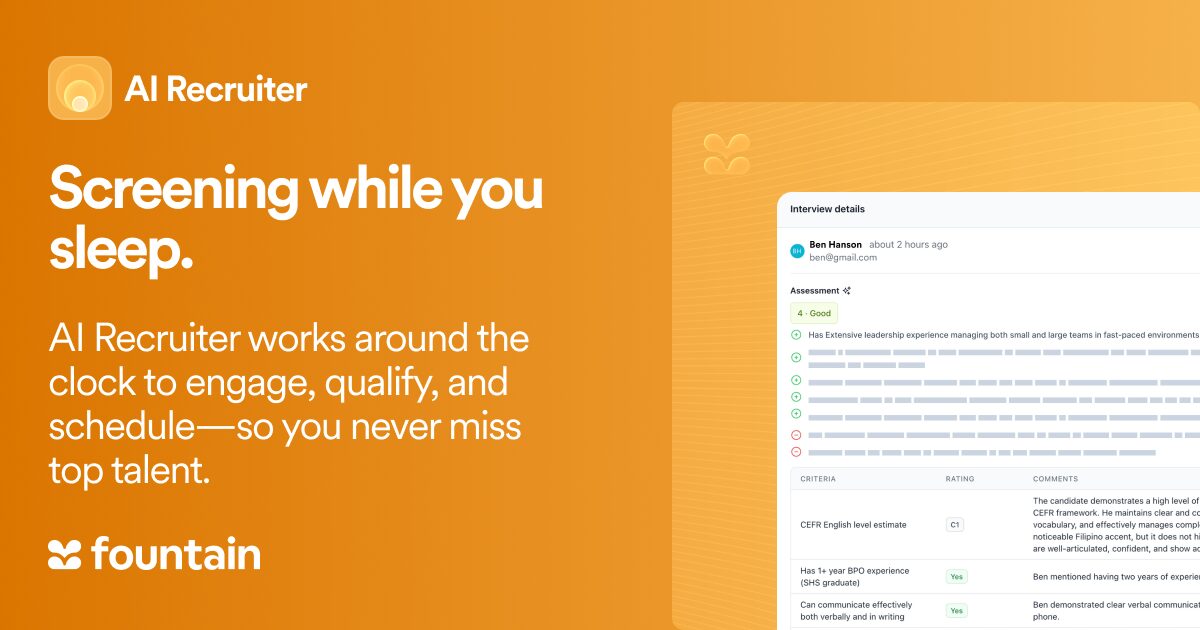
Anna, the AI Recruiter, interviews applicants 24/7 over voice or SMS, evaluates them against configured criteria, ranks them, and schedules qualified applicants. Recruiters review the ranked shortlist and decide who moves forward.
Clearing paperwork and checking in before day one
Emma, the AI 24/7 support agent, answers candidate and new-hire questions and clears onboarding paperwork blockers before the start date. Onboarding sends SMS and email nudges and shows managers who is ready and who has stalled. Sam, AI Retention, checks in with new hires from before day one to exit, so issues surface while there’s still time to fix them.
Cue works within human approval checkpoints, configurable approval triggers, and overrides, and its audit trails can capture configured approval and override events, depending on the deployment. Fountain customers have already run peak-scale ramps this way.
Peak hiring results from Fountain customers
Employers in logistics, retail, and fulfillment have used Fountain to absorb high applicant volume, hire faster, and get more new hires to show up on day one:
- Fetch: a three-person team handles more than 10,000 monthly applicants, and Fountain’s Agentic AI takes a candidate from source to hire in as little as eight minutes.
- UPS: with Fountain’s ATS, UPS hired 125,000 workers in six weeks.
- Shoe Station Group: time-to-hire fell from 14 days to 6 days across 430+ stores.
- Stitch Fix: the share of applicants who pass background checks and show up on day one rose from 68 percent to 95 percent.
- MAPS Logistics: candidate no-shows fell 70 percent with calendar integration and SMS reminders.
These results cover the full peak timeline: volume at the top of the funnel, speed through screening and scheduling, and attendance on day one. These are documented outcomes for those customers, not guaranteed results, and other teams may see different numbers.
Peak season without adding recruiters
Peak no longer forces a choice between hiring more recruiters and hiring more slowly. Agents can carry the overnight screens, interview bookings, and paperwork chasing, while recruiters keep the decisions, the exceptions, and the coaching. Teams that configure their hiring flows and update rehire-eligible records before October spend more of the season deciding.
Fountain calls this approach Frontline Superintelligence. Cue runs AI agents that screen applicants overnight, answer candidate questions at any hour, and clear onboarding paperwork before day one, with human approval checkpoints governing what moves forward.
Book a demo to see how Cue would run one location’s peak ramp and to inspect each approval step along the way.
Frequently asked questions
How do you keep seasonal hires from ghosting before day one?
Keep the gap between offer and first shift short. Nudge incomplete onboarding steps by SMS, check in on readiness and logistics before the first shift, and route stalled hires to a person. A hire who goes quiet is a signal you can act on early.
Is a staffing agency better or cheaper than hiring seasonal workers directly?
It depends on your volume and how often you hire. A staffing agency adds speed when you lack recruiters, but its markup usually applies to every hour worked. Direct seasonal hiring takes more setup and builds a rehire list you keep. Many employers combine both.
How do you keep seasonal workers from quitting mid-season?
Keep schedules predictable, confirm shift details before each week, and check in during the first weeks, when early problems surface. Pair new hires with an experienced worker, and route any concern to the manager quickly. Track show-up rate and quality by location to catch slipping sites.
How many recruiters does a peak ramp still need with AI agents?
No fixed ratio applies. Size your team around hiring decisions, escalated exceptions and lagging locations rather than per-application processing. Agents typically absorb the repetitive screening and scheduling, so your recruiters spend their hours on shortlists and the sites that need a person.
What should happen to seasonal workers after peak ends?
Tag strong performers as rehire-eligible in your candidate database and ask about next-season availability before they leave. Re-engage them before roles open publicly. Your best seasonal workers already know the job, so a warm list gives you a head start on next peak.