Job seeker interest in seasonal work hit a multi-year high in the 2025 holiday season, the most recent complete one, while employer postings recovered only modestly, and unevenly. Searches for holiday jobs ran 27% above 2024 levels as of September 30, 2025, per Indeed Hiring Lab.
More candidates are competing for fewer seasonal openings, so 2026 planning should assume larger applicant pools and slower headcount approvals. This piece covers the data behind that squeeze, the calendar it rewrites, and the playbook for competing in it.
Throughout, automation recommends and routes candidates while managers approve the decisions.
What is seasonal hiring?
Seasonal hiring is the practice of hiring temporary workers to cover a predictable, recurring demand peak, such as the holiday rush or summer tourism, with a defined end date. The IRS definition used for Affordable Care Act (ACA) purposes draws the line at positions where customary annual employment is 6 months or less, so confirm a role’s intended duration before classifying it and configuring benefits eligibility.
The recurring calendar pattern is what separates seasonal roles from other temporary work.
Two neighboring terms get conflated with it. High-volume hiring fills a larger-than-average number of roles quickly at any time of year, whether or not seasonal demand drives the openings. Temp staffing runs through an agency intermediary: the staffing firm is the employer of record and assigns workers to your operation, so sourcing and screening sit with the agency rather than your funnel.
Seasonal hiring trends shaping 2026
Together, these three trends set what a 2026 funnel should expect, so size screening capacity by role and location instead of applying one staffing assumption everywhere:
1. Interest up, postings barely recovered
Candidate interest surged while seasonal postings recovered only modestly across the 2025 season. Indeed recorded seasonal postings up just 2.7% year over year on September 30, 2025, still below both 2023 and pre-pandemic 2019 levels, before improving to 11% year over year by mid-November off that low base.
Indeed Hiring Lab called 2024 the weakest seasonal hiring year in its recent data, and even after the late gain, postings sat 13% below 2021 and 2022 levels. Base 2026 requisitions on the capacity operations actually needs, calculated from last season’s conversion rates, rather than reading posting growth as a return to earlier hiring levels.
2. Driving and stocking surge while the retail floor sits flat
Seasonal demand shifted toward driving, delivery, loading, and stocking roles while retail-floor demand stayed flat. By mid-November 2025, seasonal driving and delivery postings were up 153% year over year, loading and stocking up 49%, retail floor up 1%, and sales down 10%, per Indeed Hiring Lab.
Overall postings moved the opposite direction in the same window, with driving down 4.3% and retail down 12.1%, so the growth concentrated entirely in explicitly short-term logistics roles.
Retail still made up 63% of seasonal jobs on September 30, 2025, per Indeed’s October analysis, but the growth is happening behind the store, in warehouses and on routes. Preserve retail-floor coverage, shift recruiter capacity toward driving and stocking, and open logistics requisitions first, since routes and warehouses carry longer training windows.
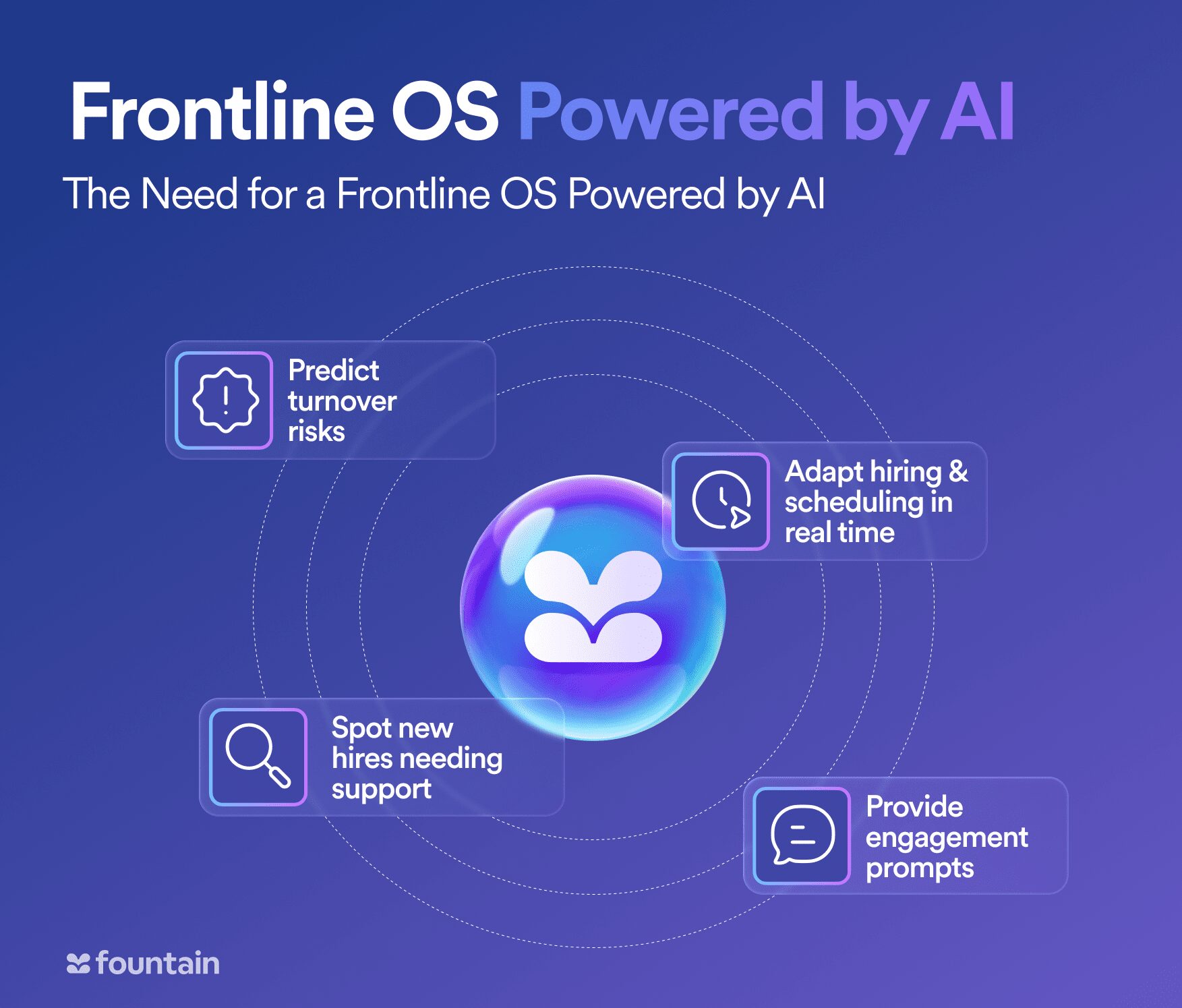
A smarter, connected way to hire, engage, and retain frontline teams
Centralize scheduling, hiring, onboarding, engagement, and analytics in one AI-powered platform built for the frontline workforce. Fountain OS gives leaders the real-time insights and tools they need to predict turnover, boost retention, and streamline high-volume operations.
Automate repetitive tasks, identify at-risk employees early, and make data-driven workforce decisions with a unified solution designed to help frontline teams thrive.
3. Employers are choosing short-term flexibility over headcount
The posting mix shows employers choosing short-term commitments over permanent expansion. The seasonal share of driving postings nearly tripled, from about 1% in November 2024 to 2.6% in November 2025, per Indeed Hiring Lab, as employers labeled more driving roles explicitly short-term rather than permanent.
Indeed economist Cory Stahle wrote that employers “don’t want to be understaffed during their busiest time of year, especially for logistics-heavy roles,” while “prioritizing short-term flexibility over long-term workforce expansion.”
The macro numbers back that caution: Challenger, Gray & Christmas counted 372,520 announced Q4 2025 seasonal hiring plans, the lowest since it began tracking in 2012, with full-year 2025 announced planned hires down 34% from 2024.
The result is a low-hire, low-fire market with little urgency. Only 2.1% of seasonal postings were flagged as urgently hiring on September 30, 2025, down from about 10% in late 2021, per Indeed Hiring Lab’s October analysis. That leaves room for consistent screening, but it makes early requisition approval matter more than emergency recruiting.
And not everyone is cautious: Spirit Halloween announced plans to hire more than 52,000 seasonal associates for 2026, its largest seasonal hiring push yet. Employers sharing local markets with a recruiter at that scale should map the overlap and launch sourcing before that demand hits, with peak-only logistics campaigns budgeted separately from permanent hiring plans.
The seasonal hiring calendar: When to start
Candidates start looking before employers start posting, so a late job post misses the interest peak. US holiday postings historically ramp in September and peak in November, but search interest was already surging by late September 2025, running 27% ahead of the prior year against posting growth of less than 3%.
A requisition that opens in early November lands weeks after the most motivated candidates started looking, and logistics roles need even more lead time than the retail floor because of those longer training windows.
The same pattern holds outside the holidays. Summer seasonal postings have peaked between late April and mid-May in recent years, per Indeed Hiring Lab, and the peak has been drifting earlier, which puts summer sourcing in early spring. Back-to-school retail hiring runs mid-July through August, which puts planning in early summer.
The working calendar: holiday sourcing begins late summer to early fall, summer hiring in spring, and back-to-school planning in early summer. Fountain’s Seasonal Hiring Guide covers the evergreen tactics for each window. In a market where interest outruns postings, the timing advantage goes to whoever opens the funnel first.
How to compete for seasonal talent in 2026
In a crowded applicant market, fast applications and fast offers beat a bigger job-board budget. Candidates notice silence most: 57% cite slow hiring processes as a top frustration and 52% cite ghosting or a lack of updates, per the 2025 Fountain Frontline Report, so automated status updates and a response-time standard are the baseline for a seasonal funnel.
- Reactivate before you recruit: Past applicants, former seasonal workers, and employee referrals are already sourced and effectively free to reach. Returning workers also ramp faster, and they are a growing share of the market: boomerang employees made up 35% of new hires in March 2025, up from 31% a year earlier, per ADP payroll data. Start with the rehire pool before paying to build a cold one.
- Make the application mobile-first and minutes long: Long or desktop-bound forms lose applicants before anyone screens them. Time your current application, strip nonessential fields until it takes 5 minutes or less on a phone, and track completions rather than starts.
- Compress time-to-offer: Surge volume outruns manual scheduling within days, and the first solid offer usually wins. Automated screening and candidate self-scheduling keep pace, letting qualified candidates book an interview the moment they clear knockout questions, while managers approve every offer.
- Publish pay and full shift details, including the end date: Transparent postings attract more applicants to seasonal openings while letting mismatched candidates self-select out before they reach a screen. Require pay, shift, location, and end date in every seasonal posting template.
- Keep paperwork and compliance in the same flow: Section 2 of Form I-9 must be completed within 3 business days of the first day of work, a deadline that gets missed when onboarding lives in a separate system, so handle I-9s and W-4s through mobile document completion with an audit trail. Teams hiring students should also build federal youth-work hour limits into screening and apply stricter state limits where they exist.
Before changing anything, audit last season’s funnel to find whether screening or the offer step caused the longest wait, then give the actual bottleneck the first intervention. Speed can’t come at the cost of consistency: a fast screen still puts every candidate through the same questions against the same criteria.
Retention, conversion, and the end-of-season review
Seasonal ROI is decided after the offer. Early attrition eats the season: 43% of frontline workers are gone within their first 90 days, per Fountain’s 2025 frontline retention research, and a holiday assignment often runs only 6 to 13 weeks, so that window closes before peak. Schedule retention check-ins in the first days and weeks, not at the end of the assignment.
The retention levers themselves are unglamorous: stable schedules, a fast pay cadence, and recognition that reaches workers over SMS or in the building rather than corporate email. Schedules carry the strongest evidence.
A randomized experiment at Gap stores found stable scheduling raised productivity 5.1% and sales 3.3%, which in practice means posting schedules further ahead and holding shift times steady through the peak.
Conversion has no credible public benchmark: no published figure isolates seasonal-to-permanent conversion rates for frontline employers, so the useful number is your own, tracked season over season.
Flag high performers around the midpoint of the assignment and extend conversion offers before the last shift, because teams that wait until season’s end find the best workers already gone.
Before the seasonal team disbands, capture five numbers:
- Time-to-fill by role and location
- Interview and day-one show rates
- Early attrition
- Seasonal-to-permanent conversion
- The size of the rehire pool
Each one feeds a specific decision next year, from when to open requisitions to how many cold applicants you actually need.
How Fountain runs seasonal hiring at scale
A seasonal surge is the workload Fountain’s Frontline Superintelligence is built for: screening, scheduling, paperwork, and follow-up that must keep pace with applicant volume, a workload a lean recruiting team can’t sustain manually.
Cue is the single entry point. A talent acquisition lead can prompt “Hire 300 seasonal associates across 40 stores before Black Friday,” and Cue assembles the plan and routes the work across Fountain’s agents and products, while managers approve offers and exceptions at every step.
That one prompt fans out across the whole season:
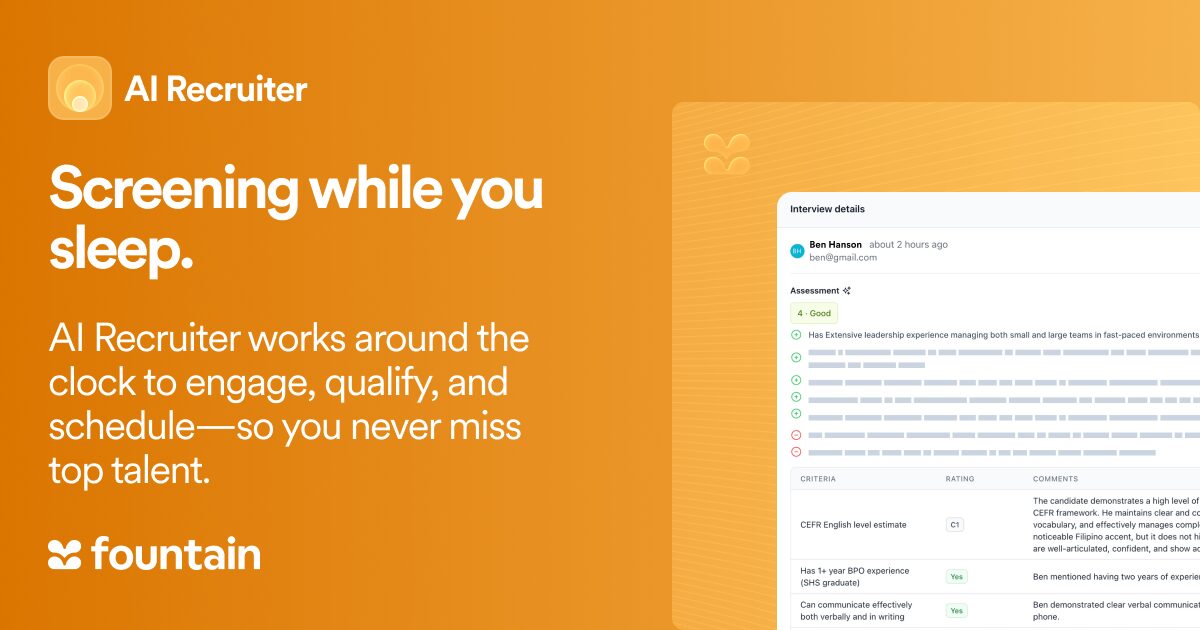
- Anna screens the surge, running voice interviews 24/7 and sending scored, qualified candidates to hiring managers, which keeps offers inside the same-week window a crowded market demands.
- Emma guides new hires through I-9 and W-4 paperwork on their phones, while Onboarding tracks completion with an audit trail against the 3-business-day deadline.
- Sam runs post-hire check-ins during the first weeks, where seasonal attrition concentrates, and Shift & Scheduling publishes the stable schedules that keep workers through peak.
- CRM and Sourcing reopen last season’s rehire pool before you spend on job boards, and the ATS runs the mobile applications, knockout screening, and self-scheduling underneath, with embedded reporting capturing the five end-of-season metrics.
The proof is a warehouse ramp: according to Fountain’s Stitch Fix case study, applicant conversion rate, or the percentage of applicants who pass background checks and show up on day one, increased from 68% to 95%, and median time-to-hire fell from about 3 weeks to 9.16 days.
The 2026 season rewards the same move everywhere in this data: candidates are already looking, postings are cautious, and the teams that win open first, with a warm rehire pool and same-week offers.
See it against your own seasonal plan: book a demo and walk through Cue’s seasonal workflows, Anna’s screening pace, and the rehire-pool play before the requisitions around you open.
Frequently asked questions about seasonal hiring
When should companies start hiring seasonal workers?
Start before the usual posting peak, because candidates begin searching earlier than employers post. Holiday sourcing should begin in late summer to early fall, summer hiring in spring, and back-to-school hiring in early summer. In 2025, holiday search interest was surging by late September while most postings didn’t peak until November, so open the funnel before demand crests.
Which industries hire the most seasonal workers?
Retail carries the largest share, at 63% of seasonal jobs as of September 30, 2025, per Indeed Hiring Lab, while logistics is growing fastest, with seasonal driving postings up 153% year over year by mid-November 2025. Sales, loading and stocking, and food preparation split most of the rest, so preserve retail recruiting capacity while adding lead time for route and warehouse training.
Can seasonal jobs become permanent?
Yes, and conversion works best when it starts mid-season rather than after the last shift, since top performers often leave before the season officially ends. No public benchmark exists for seasonal-to-permanent conversion rates, so track your own rate season over season as the internal baseline.