Frontline recruiters spend their days on scheduling, chasing documents and re-entering candidate data, so more hiring volume typically means adding more recruiters. Agentic AI in HR is software that completes entire workflows, such as screening, interview scheduling, and onboarding paperwork, from start to finish within guardrails the HR team defines.
Rules-based automation runs a fixed script. AI assistants answer questions and wait for the next instruction. Agentic systems act, check the result, and adjust.
That difference changes the job of frontline HR and talent acquisition. Teams that once spent their days operating software now direct it. They set the goal and step in where judgment is needed. This piece covers what agentic AI in HR means, why the operator model stalls under high-volume hiring, and what the shift looks like for a logistics hiring team.
What agentic AI in HR means, and how it differs from automation and assistants
Agentic AI starts tasks, links workflow steps, and acts across systems in real time: a shift from copilots that required every output to be reviewed and every action confirmed, as IDC’s June 2026 analysis describes. Human oversight remains, and people make final candidate decisions.
In frontline hiring, the approaches split cleanly.
- Rules-based automation follows a script. A candidate fails a knockout question, and the system disqualifies them under team-defined rules, with recruiters reviewing results before a final advancement decision. It behaves the same way every time and can’t adjust when conditions change.
- AI assistants recommend. They draft a job post, summarize an interview, or answer a policy question. A person still has to act on the output.
- Agentic systems act, check the result, and adjust. Given an objective, they plan the steps, carry them out across connected systems, and change course when a step underperforms, within the rules and approval boundaries your team sets.
For frontline teams, the difference is who connects the steps: dashboards report, workflows instruct, and agentic AI does the connecting itself.
Interest is running well ahead of deployment. Only 17 percent of organizations have deployed AI agents, while more than 60 percent expect to within two years, according to Gartner’s 2026 CIO and Technology Executive Survey, cited in its 2026 Hype Cycle for Agentic AI.
Why the operator model hits a ceiling in frontline HR
Most frontline HR and TA teams today work as operators, so handling more hiring volume means adding more recruiters. Your recruiters click through modules, move candidates between stages, chase missing documents, rebook interviews after no-shows, and pull reports into spreadsheets for the weekly ops call. More than half of recruiters spend at least 50 percent of their time on non-strategic work like scheduling, coordination, and manual data entry, according to Aptitude Research’s 2026 recruiter study.
Scheduling alone accounted for 38 percent of recruiter time in a survey of more than 500 TA leaders, covered by HR Dive.
Three problems keep recruiters tied to that work:
- Disconnected systems. Recruiters re-enter candidate data from one tool to the next, so every handoff adds manual work and room for error.
- Manual admin that slows hiring. Each stage move, reminder, and document chase waits on a person, and candidates wait with it.
- No reliable view of where hiring stalls. Teams can’t easily see which locations convert applicants and which lose them, so problems surface only after shifts go uncovered.
Each of these problems waits on a person to fix it by hand, and that manual work grows with every new requisition and location.
How the conductor model changes the work
Agentic AI lets HR teams direct repeatable work instead of performing every step, much as a conductor sets the direction, keeps every player in time, and steps in when something sounds off. The model has three parts: agents run the repeatable work, HR sets intent and guardrails, and humans own the judgment calls.
Download the Free Guide: Agentic AI for Frontline Hiring & Retention
Explore how top HR teams are using agentic AI to speed up hiring, improve onboarding, and reduce frontline turnover—at scale. This guide breaks down real-world use cases, ROI benchmarks, and a 90-day roadmap for getting started.
Agents run the repeatable work
Screening, interview scheduling, candidate follow-ups, document review, and stage transitions are high-volume and rule-bound, and delays cost candidates, so they suit agents best. Each task can run as soon as its trigger fires, whether that’s a new application at 11 p.m. or a missing document two days before a start date, without a recruiter pushing it forward.
HR sets intent and guardrails
You describe the outcome in plain language, such as “launch hiring for a new market,” and the system works out the steps instead of a recruiter configuring each one by hand. The guardrails matter as much as the goal.
Before the first agent runs, define what good looks like: the range of outcomes you’ll accept for time-to-hire, no-show rate, and drop-off, and the actions that need a person’s approval. Then watch for results that fall outside that range.
Humans own the judgment calls
People keep the judgment calls, such as who gets the offer and how to handle an edge case with a hiring manager. In McKinsey’s analysis, the recruiter’s new job involves “designing, supervising, and improving that system, and owning the moments where judgment, relationship, and persuasion decide the outcome.”
Before: a recruiter books and runs every screening call, types notes into the ATS, and decides who advances at the end of the week. After: an AI interviewer screens applicants as they apply and writes structured results to the ATS, and the recruiter reviews a ranked list each morning and decides who moves forward.
All of this holds only if the system carries out work across the whole hiring flow. The next section shows what that looks like in a frontline team.
How HR roles and skills change with agentic AI
Agentic AI shifts HR work from booking calls and chasing paperwork to directing workflows and handling exceptions. The Josh Bersin Company, in a talent acquisition playbook written with AMS, describes the shift as moving “from recruitment processor to orchestrator,” with recruiters becoming “strategic advisors who oversee AI agents and focus on judgment and business alignment.”
People still control candidate decisions and review workflow changes. Recruiters decide who moves forward, and agents work within the boundaries the team sets.
For frontline HR and TA teams, the change shows up in five skills:
- Setting goals and guardrails. Instead of configuring each posting and stage by hand, recruiters define the hiring goal, the outcome ranges they’ll accept, and the actions that need a person’s approval.
- Reading performance signals. Instead of reviewing every application, recruiters read ranked shortlists and location-level funnel data, and they spot when results drift outside the expected range.
- Handling exceptions. Instead of chasing every missing document, recruiters take the cases agents escalate: an unusual availability request, a disputed outcome, a candidate who needs a conversation.
- Coaching managers. With drop-off visible by site, HR leaders spend more time with the store or station managers whose locations lose applicants, and less time compiling the reports that reveal it.
- Making the final calls. Offers, edge cases, and policy decisions stay with people, and that responsibility becomes a larger share of the recruiter’s day.
Here’s what directing the work looks like for a frontline hiring team in a peak-season ramp.
Inside a frontline hiring team’s peak-season ramp
Six weeks before peak, a Director of TA at a last-mile delivery company has to staff three new stations with 120 drivers. Without agents, that target would mean temporary recruiters, a shared spreadsheet, and a lot of phone tag. With them, her week looks different.
She starts by setting the goal and the guardrails: 40 drivers per station by the launch date, a time-to-hire target, and a short list of actions that need her approval, such as any change to posted pay or start dates. From there, agents carry the repeatable work. Applicants are screened the night they apply, qualified drivers book their own interview slots from each station manager’s calendar, and new hires get reminders for every unfinished background check and onboarding form.
Her attention goes to the signals. By the second week, two stations are on pace, but the third is losing drivers between offer and background check. She looks at that station’s funnel, then calls its manager. Applicants are waiting days for a drug-screen appointment because the nearest clinic is booked. The agents escalate a handful of exceptions to her team: a driver who can only start on weekends, another disputing a screening result.
The final call is hers. She can approve a second clinic, push the third station’s Day 1 back a week, or raise its posted pay. She chooses the clinic, and the station catches up before launch. Every decision that shaped the outcome sat with a person, and none of her week went to booking calls.
How Cue runs the conductor model
That ramp only works when one request can move work across sourcing, screening, onboarding, and scheduling. Frontline hiring typically runs across separate tools for each stage, and recruiters carry every handoff by hand, re-entering candidate data from one tool into the next.
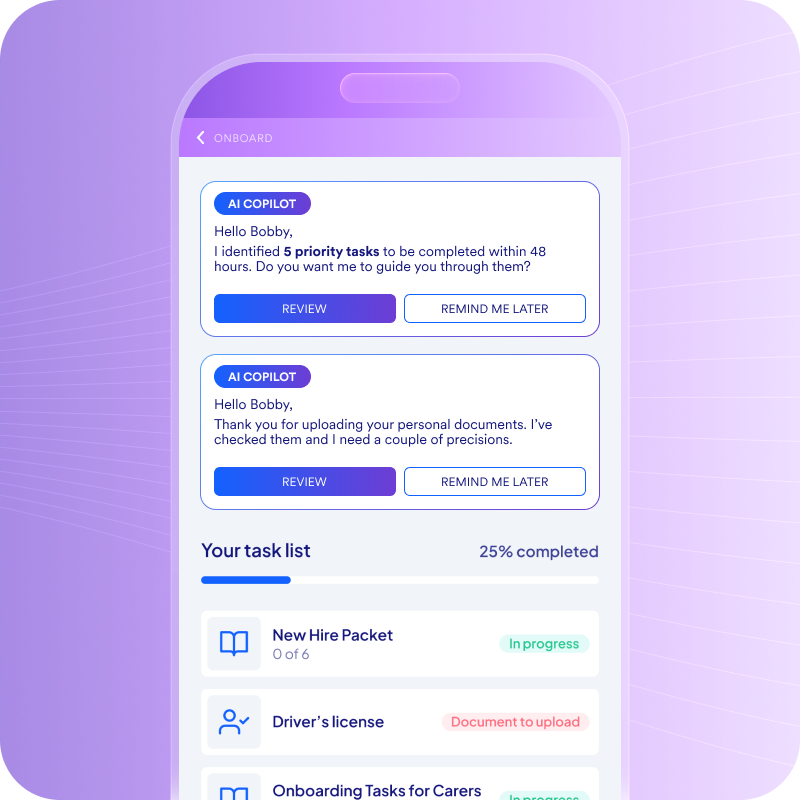
Cue, Fountain’s Frontline Superintelligence, runs that work across Fountain’s five products, including Fountain ATS. HR states the goal in one place, and Cue can set up supported hiring flows from a single prompt, run day-to-day work like stage moves and bulk actions across openings and locations, explain what’s happening when someone asks, and propose fixes when performance slips. Every action runs within each user’s permissions and the approval rules your team sets.
Cue runs three agents, each of which owns a stage:
- Anna, the AI Recruiter, conducts structured voice or SMS interviews, evaluates applicants against configured screening criteria, returns a ranked shortlist, and schedules qualified applicants, so your team can review candidates without booking every screening call.
- Emma, the AI 24/7 support agent, answers candidate and new-hire questions at any hour, walks people through applying, and clears onboarding paperwork before Day 1, handing off to a person when something needs one.
- Sam, AI Retention, checks in with every new hire across seven touchpoints: readiness, logistics, role clarity, belonging, manager relationship, commitment, and exit. He surfaces issues while they’re still fixable, so your team can step in before they become turnover.
In the ramp above, the Director would give Cue the three-station goal. Setup would build each station’s hiring flow, Anna would screen drivers around the clock, and Emma would clear paperwork before Day 1. Cue would then flag the station where conversion lags and bring her the options to approve.
Customers running Fountain see the change in time-to-hire and recruiter capacity. At Fetch, a last-mile package delivery platform, time-to-hire fell 95 percent with Fountain’s Agentic AI, from 15 days to 6.5 hours, and three recruiters handle 10,000 applicants a month.
Teams set the human approval checkpoints and override rules that Cue and its agents work within. Cue’s configured actions and approval events can be captured in audit trails, so teams can trace what the agents did; coverage depends on the deployment. Recruiters make the final hiring decision, with Anna’s ranked shortlist feeding it.
Less operating, more conducting
For years, frontline HR teams have worked as software operators, so more hiring volume meant more recruiters. Agentic AI breaks that link. Agents carry out the repeatable steps, and people own direction and the calls that need judgment.
Fountain calls this approach Frontline Superintelligence. Cue runs Anna on screening, Emma on candidate questions and paperwork, and Sam on new-hire check-ins, all within the approval rules your team sets.
Book a demo to test one high-volume flow, such as screening, and compare the result against your current time-to-hire baseline.
Frequently asked questions
Will agentic AI replace HR teams?
Agentic AI takes on repeatable work and leaves judgment and relationships with people. McKinsey describes a model in which people bring “judgment, empathy, and creativity,” adding unique value. We expect teams to need less interview booking and more people setting hiring goals and handling exceptions.
What should HR do first when an agent makes a mistake?
Pause or step into the affected flow, then review the logged action through audit trails. Correct the outcome, and adjust the guardrail or decision boundary so the agent stays within the acceptable range of outcomes. Escalation protocols typically send edge cases to a person.
How do you measure whether an agent is working?
Record a baseline before launch for time-to-hire, no-show rate and candidate drop-off, then compare results against it. Also watch for deviations from the acceptable range you defined before launch; those typically signal that an agent needs a closer look.
Do frontline managers need training to work with AI agents?
Yes, with training focused on their role. HR teams coach managers, and station managers and ops leaders help define what success looks like. Managers typically need to know which decisions stay with them and how exceptions reach them, so they can act on what the agent flags.