AI agents can already run many repeatable frontline hiring tasks: first-round screening, candidate questions, application help, interview scheduling, reminders, onboarding paperwork follow-up, and the reporting and setup work behind them. People keep the judgment calls: final hiring decisions, sensitive exceptions, and hiring strategy.
In the National Restaurant Association’s 2025 State of the Restaurant Industry report, 77% of restaurant operators said recruiting and retaining employees remained a leading challenge. This article covers the ten tasks agents can run, three that stay with people, and a test to help you choose which tasks to hand off first.
What are frontline hiring tasks?
Frontline hiring tasks are the recurring steps employers run to fill hourly, customer-facing, and operational roles such as cashiers, line cooks, warehouse associates, delivery drivers, and caregivers. They run from job posting and sourcing through screening, interview scheduling, reminders, background checks, offers, and onboarding paperwork. Each step must happen for every applicant, often over the phone and outside business hours.
These tasks differ from corporate recruiting work in volume and speed. A multi-unit operator may run the same steps hundreds or thousands of times a year across dozens of locations, usually for the same few roles. Candidates frequently apply to several employers at once and take the first offer that fits their schedule, so a task that slips by a day can cost the hire. That mix of high volume, repeatable steps, and short decision windows is what makes frontline hiring tasks a strong fit for AI agents.
Recruiting work you can hand off to AI agents
A task makes this list when it repeats hundreds of times a month, follows rules a team can write down, and costs candidates when it slips by a day. The ten tasks fall into three groups: candidate-facing work (tasks 1-3), scheduling and follow-up (tasks 4-6), and the operational work behind hiring (tasks 7-10).
1. First-round screening interviews at any hour
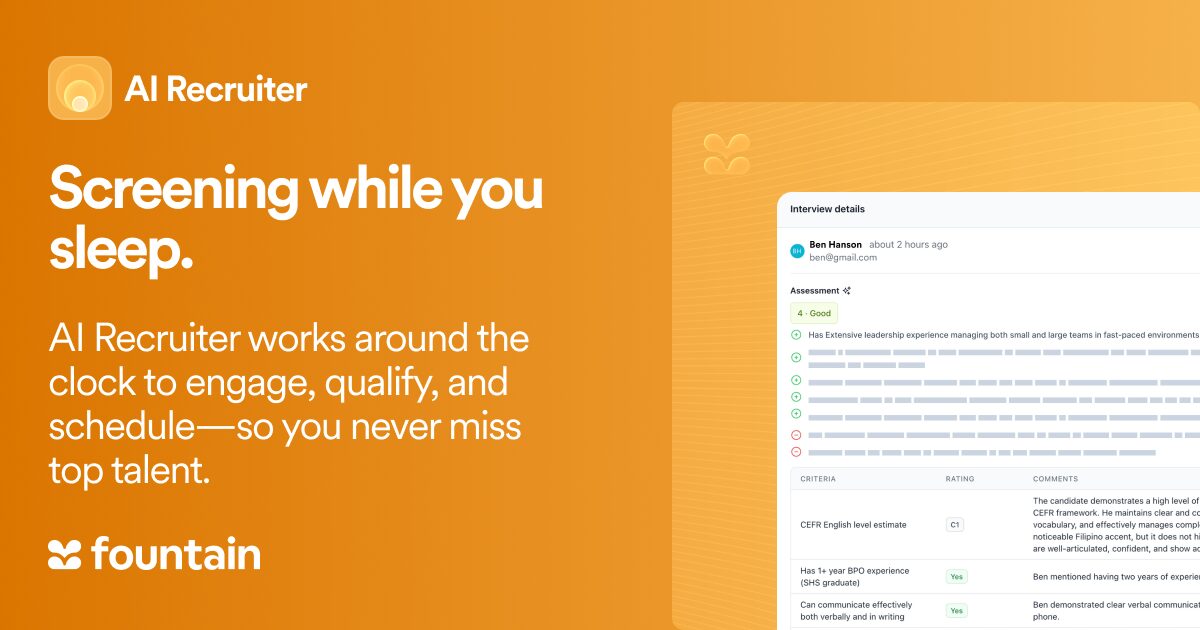
A first-round screen that waits for a recruiter’s calendar can lose candidates to whoever calls first. An AI interviewer screens each applicant by voice or chat as soon as they apply. It asks every applicant the same questions, so no one gets a different screen because of who happened to call. It scores each answer against a rubric your team sets, then writes the score, a summary, and the stage into the applicant record for a recruiter to review.
2. Candidate questions about pay, shifts, and process
An unanswered question about pay or shifts gives a candidate a reason to stop applying. A support agent answers candidate and new-hire questions about the role, pay, schedule, and process at any hour, over web chat, SMS, or WhatsApp.
The agent answers only from the employer’s approved content, from a defined knowledge base. It logs conversations and hands off to a person when a question falls outside that content, which keeps pay questions off a store manager’s phone mid-shift.
3. Application help on a phone
A candidate applying from a phone between shifts often won’t finish a form built for a desktop. An agent can guide the application as a chat on the web, SMS, or WhatsApp, asking one question at a time.
If the candidate has a question about pay, shifts, or the process, the agent answers it in the same thread from the employer’s approved content. When a question falls outside that content, the agent hands the conversation to a person.
4. Interview scheduling and rescheduling
Phone tag eats the days between a qualified applicant and an interview, and store managers often chase candidates themselves. Candidates pick an open slot from the hiring manager’s synced calendar, with no recruiter back-and-forth. The manager is notified automatically once a slot is booked. When plans change, candidates reschedule on their own without a call.
5. Interview reminders and missed-slot follow-ups
An empty interview slot wastes time a manager pulled off the floor. Automated text and email reminders go out at set times before each interview, so candidates remember the slot and can cancel or change it early. A follow-up goes to anyone who misses a slot and offers a new time. Your managers then fill more of the slots they set aside.
Smarter, faster, and more compliant from day one
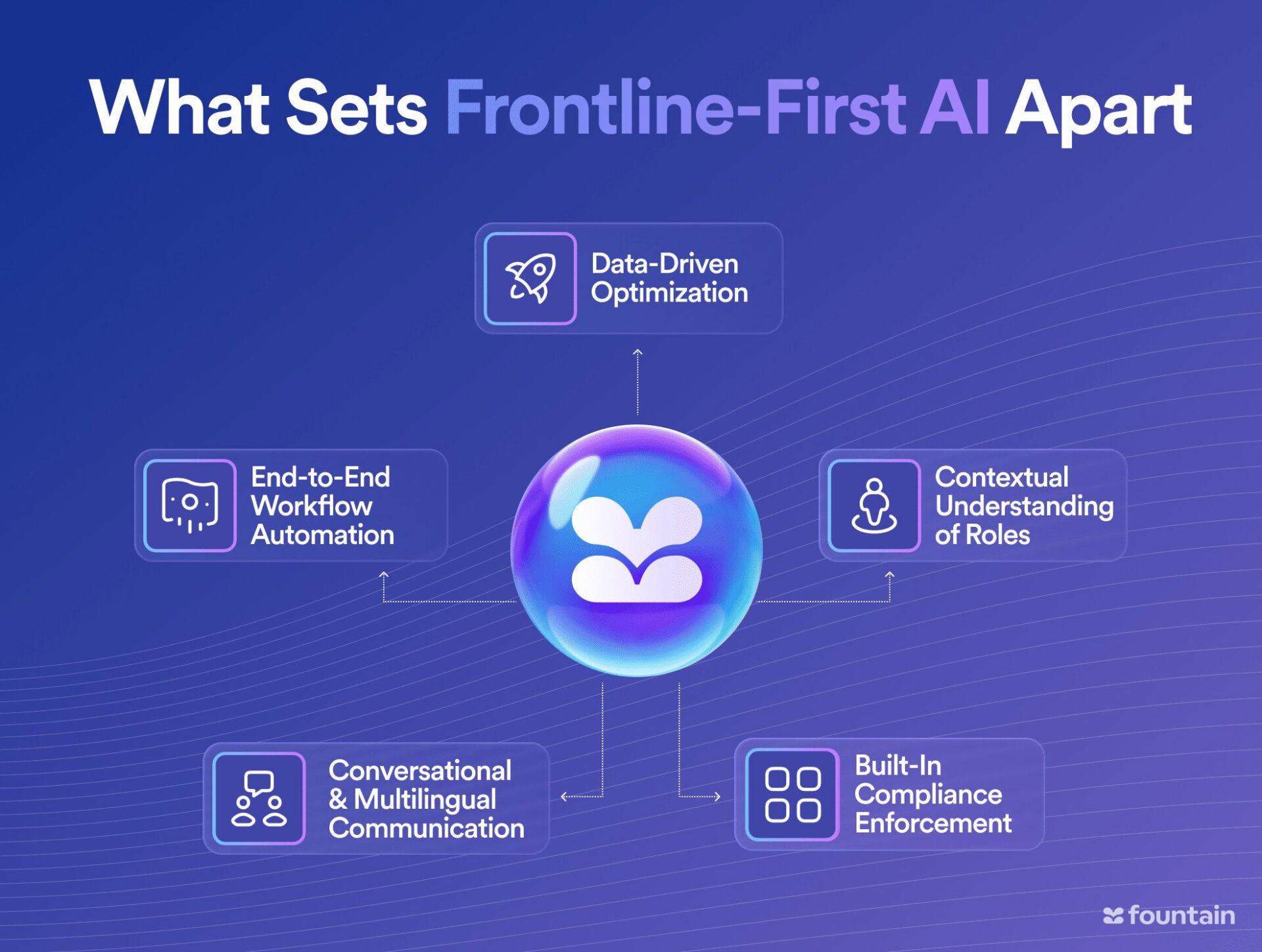
See how frontline-first AI helps you reduce time-to-hire, engage more candidates, and stay compliant at scale.
From instant chat-based screening to automated scheduling and built-in compliance, Fountain’s AI gives your team the tools to hire faster and smarter while maintaining accuracy and a great candidate experience.
Schedule a personalized demo and explore what’s possible.
6. Onboarding paperwork follow-up before day one
A new hire stuck on a form or locked out of the portal often misses the first shift. Agents nudge new hires by SMS and email about incomplete steps, so a missing signature or upload gets attention before it becomes a gap.
Agents flag incomplete or incorrect onboarding steps, guide the new hire where configured, and route exceptions to a person. Managers see who is ready for day one and who has stalled, broken out by location.
7. Turning a hiring goal into the work behind it
A district manager who needs 25 cashiers by Friday shouldn’t have to open postings one by one. An AI system takes that goal in plain language and proposes bulk actions across openings and locations. It runs them only after a person approves, sends edge cases to human review, and lets the team override any proposed action.
8. Finding where candidates drop off
Multi-unit operators often learn that a location is losing applicants only after shifts go uncovered. Instead of building a report by hand, an operator asks a plain-language question such as “show me which locations are losing candidates before screening” and gets a breakdown by site and stage. The worst breakpoint then goes to an owner.
9. Setting up hiring for a new location
A new unit needs postings, workflows, and screening rules in place before the first applicant arrives. An agent can build all three from a description of the market and the roles it needs, so nobody configures each location by hand. The team reviews the setup before launch and approves or changes it. Complex multi-brand setups may still need implementation support.
10. Tuning workflows against conversion
Workflows pick up steps that stop converting, and few talent acquisition teams have time to audit conversion stage by stage. An agent can diagnose where applicants stall in a role’s workflow and propose changes to the steps that cause it. A manager approves each change before it goes live. Judge each one by whether more applicants move forward.
Each of these tasks follows rules a team can write down and costs candidates when it stalls. The next three tasks fail both tests.
3 frontline hiring tasks AI agents shouldn’t run
Agents run the volume, and people own the decisions that affect someone’s livelihood or a brand’s reputation. U.S. adults draw a similar line. In a Pew Research Center survey of 11,004 U.S. adults fielded in December 2022, 71% opposed employers using AI to make a final hiring decision and 7% favored it. The three tasks below stay with recruiters and hiring managers: final hiring decisions, sensitive exceptions, and hiring strategy.
1. Final hiring decisions
An AI interviewer scores, summarizes, and ranks candidates. A recruiter or hiring manager reviews the ranked shortlist, overrides it where shift, crew, or site fit warrants, and makes the call. Agents move candidates between stages only under rules the team defines.
2. Sensitive conversations and true exceptions
A candidate with unusual circumstances, a disputed outcome, or an escalated manager concern needs a person’s judgment. Agents flag and log these cases, then route them to a named owner to resolve. That owner decides what happens next, so the agent never closes the case on its own. Unresolved interactions sit in a queue someone checks daily.
3. Hiring strategy and manager relationships
People should decide which locations to expand, what a strong shift hire looks like for the brand, and how to coach a struggling general manager. Agents supply the data, such as which locations lose candidates and which steps move applicants forward. Your leaders set the direction and use that data to coach the site manager on where applicants stall. The judgment stays with your people, and the agents free up the time to apply it.
Sorting the first 10 tasks from these three gets easier with a consistent test.
How to pick which frontline hiring tasks to hand off first
Start with the tasks your team repeats most and loses the most candidates to. Four questions sort almost any recruiting task.
- How often does it happen? Tasks that run hundreds of times a week, like screening and reminders, return the most recruiter hours.
- What does a one-day delay cost? If a slow reply sends a candidate to the restaurant down the street, the task belongs with an always-on agent.
- Does it follow clear rules? Knockout questions, reminder timing, and form checks can be written down, so an agent can run them consistently.
- Does it involve a judgment call about a person? If yes, an agent prepares the summary and a person decides.
A task that scores high on the first three and “no” on the fourth is a strong first handoff. For many quick-service restaurant (QSR) teams, that points to 24/7 screening and scheduling, the two tasks that sit between an application and a filled shift.
Before: a candidate applies for a cashier role at 11 p.m., waits until a recruiter calls back the next afternoon, and has already booked an interview elsewhere. After: an AI interviewer screens them at 11:05 p.m., the score and summary land in the applicant record, and they book a 9 a.m. slot from the manager’s calendar, while the hiring manager still makes the final call.
Where Fountain’s agents fit in frontline hiring
Frontline hiring tasks stall when screening, messaging, scheduling, and reporting sit in separate tools and wait on the same few recruiters. Cue, Fountain’s Frontline Superintelligence, runs that work across Fountain ATS and three agents, inside the approval rules, budgets, and overrides your team sets:
- Faster first-round screening: Anna, the AI Recruiter, interviews applicants by voice the minute they apply, scores answers against your rubric, and writes the results to the applicant record.
- Questions answered at any hour: Emma, the AI 24/7 support agent, answers candidate and new-hire questions over web, SMS, and WhatsApp and clears onboarding paperwork before the start date.
- Fewer surprise exits: Sam, AI Retention, checks in with every new hire from before day one to exit, so issues surface before they become turnover.
At Fetch, Fountain’s Agentic AI cut time-to-hire 95%, from 15 days to 6.5 hours, and more than doubled the hire rate.
Let agents run the volume; keep people on the judgment calls
Hand your agents the tasks that slip when your recruiters are busy, and keep your people on the calls that need judgment. Screening at midnight, reminders before every interview, and a funnel breakdown by location are all rules-driven work. Choosing who joins your team and how to coach a general manager through staffing problems are not.
Fountain’s Frontline Superintelligence puts that split into practice. Cue directs Anna on screening, Emma on candidate questions and paperwork, and Fountain ATS on scheduling and reminders, all inside the approval rules your team sets.
Book a demo to see how the screening and scheduling workflow would run for one of your roles.
Frequently asked questions
What happens when an AI agent can’t answer a candidate’s question?
The agent should answer only from your approved content. When a question falls outside it, the agent hands off to a person. It also logs the conversation, so a named owner can follow up with the candidate.
Should candidates be able to choose a human interviewer instead?
Yes. Offer a scheduled call with a recruiter as an option next to the AI interview. Use the same questions and rubric on both paths so scores compare, and nobody gets judged by different standards.
What does an AI interviewer need before it can start screening for a role?
It needs the screening questions and knockout criteria, a scoring rubric, approved answers on pay and shifts, team rules for stage moves, and a named person to review the shortlist. Without those, it has nothing consistent to follow.
How do you know an automated hiring task is working?
Record a baseline for time-to-hire, drop-off rate, no-show rate, and recruiter hours before launch, then compare each number afterward. Also check whether more applicants move forward, since faster work that loses candidates is not working.