When agents run much of a client program’s hiring, an HR engineer owns the workflows that keep it on track. The HR engineer designs, configures, tests, and monitors the workflows and AI agents that run HR operations, turning HR goals into systems that run reliably at scale. The role belongs inside HR, because the person who defines good hiring work should also define how agents do it.
The term causes confusion in search. Search for “HR engineer” and most results are HRIS or HR systems engineer postings focused on administering an HCM and building integrations. The HR engineer described here works mostly through configuration, prompts, and settings rather than code. It’s an HR role with a builder’s mindset, and it is the next step for HRIS analysts, HR operations staff, and recruiting operations teams.
What do HR engineers do?
HR engineers own how HR work gets done once agents and automation do most of it. They design, test, and monitor how those agents work together across hiring and onboarding.
Day-to-day, the role covers five jobs:
- Designing workflows. HR engineers turn a hiring goal, such as “Hire 40 forklift operators in Dallas by March,” into a sourcing plan, screening criteria, interview logic, onboarding steps, and the triggers that move a candidate from one stage to the next.
- Setting guardrails and permissions. They define what each agent can and cannot do. An agent can screen, schedule, and send reminders, while advancing or rejecting a candidate stays a human call.
- Testing before launch. A new screening question or onboarding step runs at one location or with one cohort first, so a broken rule costs a few applicants instead of a full program.
- Monitoring and improving results. HR engineers set an acceptable range for time-to-hire, interview no-shows, and candidate drop-off before launch, then adjust workflows when results fall outside it.
- Keeping integrations working. Hires have to land correctly in the HCM, payroll, and background check tools, without ripping out and replacing systems the business already depends on.
Each of these jobs exists because agents can’t define good work for themselves. The next section explains why the need is growing now.
Why the agentic era creates the need for HR engineers
Adopting AI doesn’t fix broken processes on its own. Sapient Insights Group’s 2026-2027 HR Systems Survey found that 36 percent of AI users are adopting it ahead of their HR processes and data, and their outcomes look about the same as those of organizations using no AI at all.
Four gaps explain why agents need a dedicated owner inside HR:
- Work runs across too many systems. In Eagle Hill Consulting’s 2026 HR survey of 200 U.S. HR professionals, 91 percent used two or more systems to complete a single task, and 68 percent relied on workarounds such as spreadsheets and manual tracking. Agents that layer on top of that fragmentation inherit it.
- Integration and skills lag behind adoption. Aptitude Research found that 30 percent of companies cannot integrate across existing HR systems, and only 38 percent of HR leaders say their team has the skills to implement and manage AI effectively.
- No one owns the agents. A July 2026 Gartner survey of 297 CHROs found that only 24 percent of leadership teams are aligned on who should be accountable for AI agents.
- IT and vendors can’t fill the gap. IT doesn’t own hiring outcomes, and a vendor doesn’t know your clients, regions, or rules, so neither can define what good hiring work looks like.
Each gap needs a named owner inside HR: someone who can redesign the handoffs, settle who approves what, and keep agents within their limits. The need shows up first, and hardest, in staffing firms.
Why staffing firms feel this first
Staffing and outsourced services firms need HR engineering early because they run many hiring programs at once, each with its own onboarding rules, compliance steps, and service-level agreements (SLAs). A workflow that works for one client rarely fits the next, so every new program multiplies the design, testing, and monitoring an HR engineer owns.
Client scorecards raise the stakes. More managed service providers (MSPs), the firms that run a client’s contingent staffing program across multiple vendors, now use tiered structures. Staffing Industry Analysts noted as early as 2015 that Tier 1 staffing firms can receive and fill as much as 80 to 90 percent of all requisitions, and each firm’s standing depends on how it performs against the program’s SLAs. A slow client launch or an at-risk SLA exposes every manual step at once, and slow onboarding delays billable starts.
Most firms haven’t built this capability yet. A staffing industry survey reported by SIA found that only 10 percent of staffing firms have implemented agentic AI across their full workflow. For a staffing firm, an HR engineer who can build a client workflow once, test it, and reuse it across programs is a direct path to faster starts and stronger scorecards.
How to build an HR engineering function
Most frontline employers don’t need a new department to start. They need a clear owner, the right reporting line, and tooling that keeps the work in one place. Five steps get the function running:
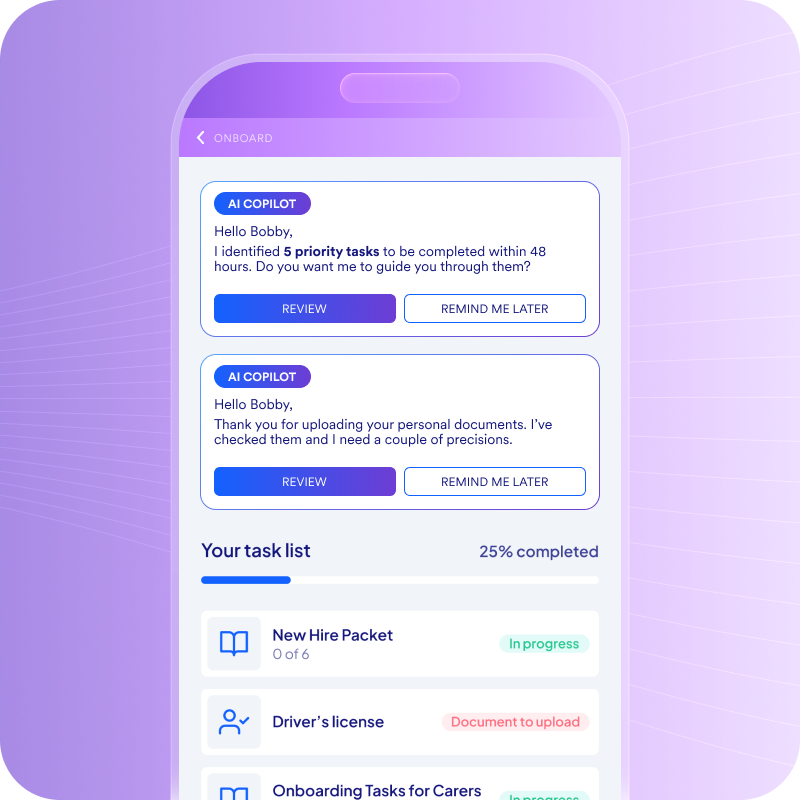
Faster ramp-up. Lower early attrition. AI onboarding built for speed, scale, and retention.
Top employers are already using Fountain’s Frontline OS to:
✅ Reduce turnover in the first 60 days
✅ Eliminate manual paperwork and task delays
✅ Accelerate new hire productivity with smarter workflows
Curious what smarter onboarding could unlock for your team?
1. Make your first hire from inside HR
Start with someone who already knows how your hiring works. An HRIS analyst, recruiting operations lead, or HR operations specialist has configured systems, seen where handoffs break, and earned trust with store or site managers. Give that person the title and the accountability, not just extra tasks, so agent design becomes their main job.
2. Set the reporting line
Have the HR engineer report to the head of talent acquisition or HR operations, not IT. The role owns hiring outcomes, so it belongs with the leader judged on them. Set a clear line to IT for security, access, and integrations, and a standing check-in with the operations leaders who see the warehouse floor or client site every day.
3. Size the team to your headcount
Scale the function with the number of frontline workers and programs you hire for. As a starting point, an organization hiring for fewer than 1,000 frontline workers can often assign the role part-time. One dedicated HR engineer fits most mid-size operations, and large or multi-client employers usually need one per region or major program.
4. Choose governed tooling
Give the HR engineer one system where workflows, agent rules, approvals, and results live together. A patchwork of tools spreads logs and decisions across systems no one person can audit. Look for configurable approval steps, override rules, audit trails, and location-level reporting before you scale any agent across sites or client programs.
5. Measure outcomes, not tickets
Judge the function on time-to-hire, recruiter capacity, no-show rate, and candidate drop-off, each tracked by location. Set an acceptable range for each before launch and review it weekly. Closed tickets or built workflows say little about whether hiring improved; outcome metrics show whether the engineer’s designs are working.
Step 4 is where most teams stall, because the tooling decides whether an HR engineer can see and control the work at all. Here’s how Fountain handles it.
Where Fountain fits in an HR engineer’s workflow
Fountain gives HR engineers a governed system to configure, approve, and monitor agent workflows. Cue, its Frontline Superintelligence, runs three talent agents: Anna, the AI Recruiter; Emma, the AI 24/7 support agent; and Sam, AI Retention.
For an HR engineer, that means:
- Faster program launches. Setup mode can configure a supported hiring and onboarding flow from a single prompt.
- Fewer manual fixes. Improve mode diagnoses issues like rising no-shows and applies only the changes the engineer approves.
- One place to audit. Configuration, approvals, and agent actions live in one system, with audit trails that can capture approval and override events, depending on the deployment.
Changes run within configured approval checkpoints, and the engineer approves workflow changes that require review. At Liveops, Cue cut time spent on manual work by 72 percent.
Name an HR engineer before you scale agents
Agents can run hiring and onboarding tasks, but someone in HR has to define the steps, set the limits, and adjust workflows when time-to-hire or no-shows rise. Teams that assign that owner now are better placed to handle more applicants without adding headcount in step with volume.
Frontline Superintelligence is the name Fountain gives its approach: Cue and its agents run the work within the approval rules your HR engineers set.
Book a demo to test one hiring or onboarding workflow with your own approval rules.
Frequently asked questions
What KPIs should an HR engineer own?
Your HR engineer should own time-to-hire, recruiter capacity (applicants handled per recruiter), interview no-show rate, and candidate drop-off. Your function is judged on these outcomes, not on tickets closed. Set a reasonable range for each in advance, and adjust your workflows when results slip outside it.
Do HR engineers need to know how to code?
Not usually. The role relies on process design, data literacy, and judgment about where humans must decide. Most configuration happens through prompts and settings rather than code.
How is an HR engineer different from an HRIS analyst or a people operations manager?
An HRIS analyst keeps HR systems and data running. A people operations manager runs HR programs and policies. An HR engineer owns how agent-run workflows work: the steps, guardrails, tests, and outcome metrics. Both roles are natural sources for the first HR engineer.
How does an HR engineer work with IT?
Workflows, guardrails, KPIs, and testing belong to your HR engineer, with clear lines to IT for security and access. The two work together to keep hires landing correctly in the HCM, payroll, and background check tools. IT doesn’t own hiring outcomes.
What risks (bias, data privacy, compliance) does an HR engineer have to control?
An HR engineer controls how agents handle risk, not what the law requires. That means testing screening rules for uneven outcomes across groups, limiting which candidate data agents can access, logging agent actions and approvals, and keeping final decisions with people. Confirm specific privacy and compliance requirements with counsel.