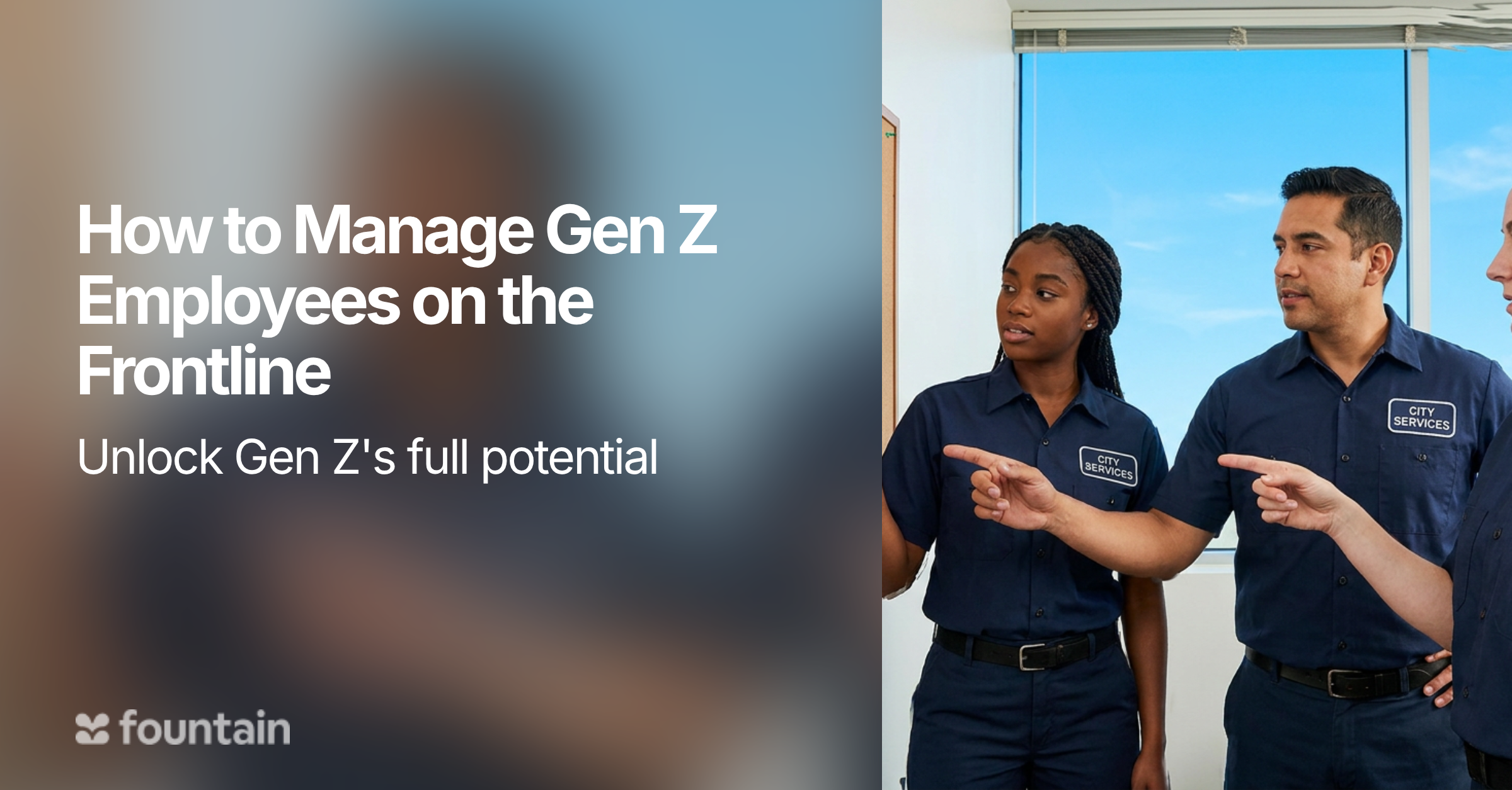
Gen Z now makes up 41% of the U.S. shift workforce, overtaking Millennials in Deputy’s analysis of more than 41 million shifts across hospitality, retail, healthcare, and services. Government data put the median age of fast-food and counter workers at 22.3, confirming the same shift from the other direction.
Managers need reliable scheduling and mobile communication across day-to-day operations, with extra support for workers early in their careers.
Frontline management differs from desk-based management because most workers rely on mobile or in-person communication, not a laptop or an inbox. Frontline managers run hourly, multi-site operations, set expectations, deliver feedback through accessible channels, run onboarding, and build schedules for people who manage their working lives from a phone.
Who Gen Z is at work
Managers should treat Gen Z’s birth year as background and focus on each worker’s experience and frontline context. The cohort is defined as people born between 1997 and 2012, putting its members between 14 and 29 in 2026 and squarely in the age band that fills counter, cashier, warehouse, and delivery roles.
For operators, managing Gen Z often means managing a first job, so prioritize role clarity and guided skill building over generational assumptions.
Some of what gets labeled “Gen Z behavior” is early-career behavior. A meta-analysis of 20 studies covering nearly 20,000 workers found generational membership explains less than 2% of the variance in workplace outcomes.
Workers aged 25 to 34 in 2024 had a median tenure of 2.7 years, against 3 years for Baby Boomers at the same age in 1983, a same-age comparison built on BLS data. Young workers have always changed jobs more often. Manage each worker by their experience and observed behavior; treat birth year as background.
The frontline part changes more than the generational part. Plan for workers who may have no desk or corporate email and who may work across multiple sites, so policies, updates, and feedback need channels workers can actually access during the workday.
Every recommendation below assumes that.
What Gen Z frontline workers expect from a job
Gen Z frontline workers weigh pay, schedule control, respect, and a visible path when considering a job. McKinsey identifies schedule flexibility and career development as top retention factors, and career development was the number one reason frontline retail employees planned to leave in 2023, ahead of pay.
Five of the top seven effective hourly retention strategies relate to scheduling. Burnout matters too: 40% of Gen Zs feel stressed or anxious all or most of the time, and 35% say their job contributes significantly to it, so boundaries and support matter as much as pay.
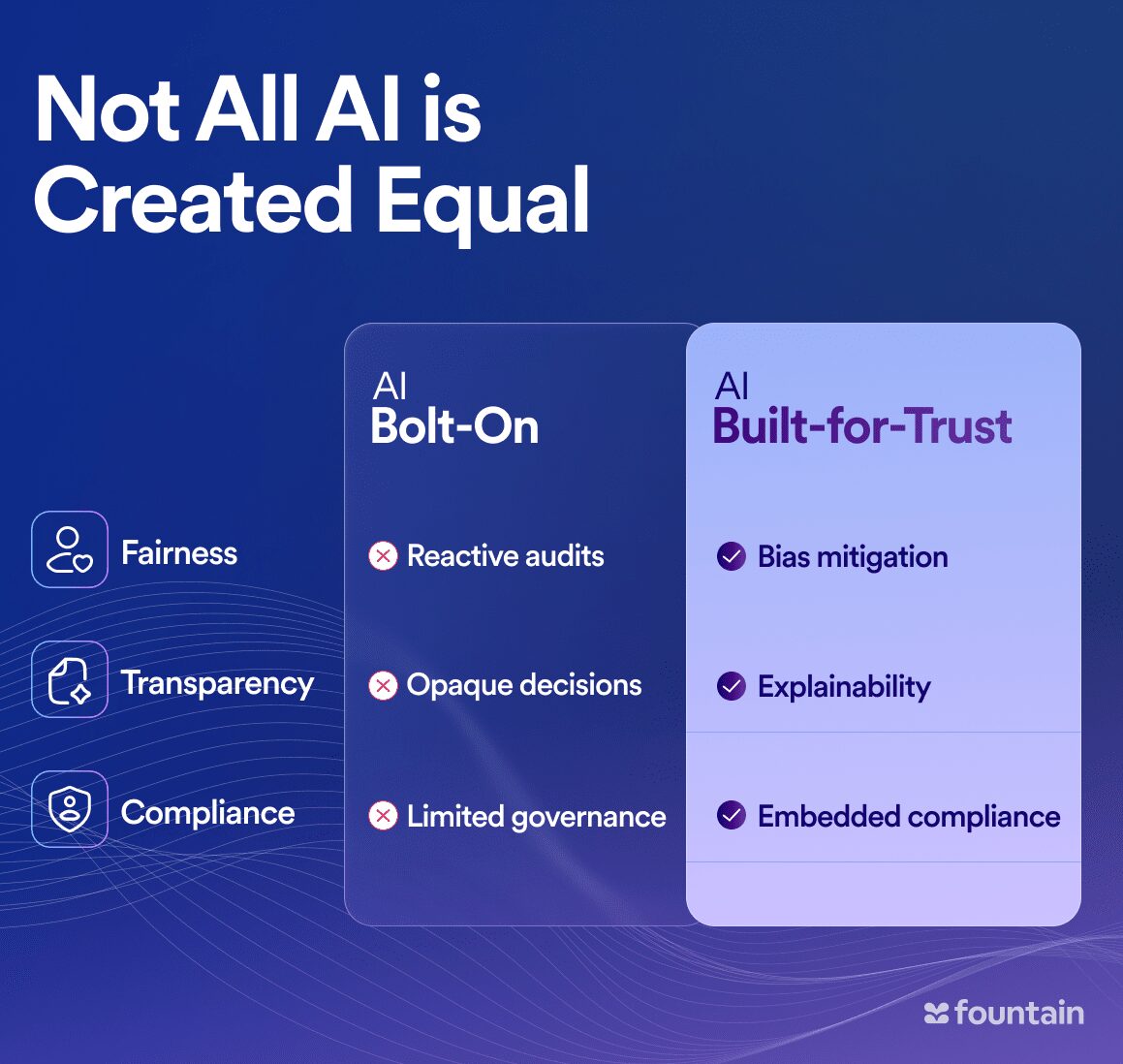
Faster decisions. Fairer outcomes. AI hiring built for compliance, speed, and scale.
Leading employers use trust-first AI to:
✅ Reduce bias and improve hiring equity
✅ Automate compliance with built-in safeguards
✅ Increase candidate engagement and completion rates
Curious how ethical AI can improve your frontline hiring?
The exits come early and cost real money. Across frontline industries, 43% of new hires leave within the first 90 days, and each replacement runs roughly $7,000. Monthly total separation rates were 4.3% in retail and 3.8% in transportation, warehousing, and utilities in July 2026, so weigh your own location-level exits against those sector benchmarks before assuming a problem is just normal turnover.
Use exit interviews and location data to connect churn with specific challenges frontline workers face: unstable schedules and unclear roles show up against measures of manager support. Role clarity, competitive pay and development, and organizational support are all associated with retention or lower quit intent, which is why the sections below build from them directly.
Tips for managing Gen Z on the front line
1. Set clear expectations, then hold people to them
Making the implicit rules explicit on Day 1, then following through when they’re missed, is the whole method. Only 46% of U.S. employees clearly know what’s expected of them at work, down 10 points since March 2020, and younger workers need clear expectations and feedback especially.
On a shift floor, unclear expectations make “I didn’t know” a predictable response.
- Spell out the job: Write down duties, priorities, deadlines, and what a good shift looks like where a worker can pull it up on a phone between customers.
- Explain the why, not just the what: Autonomy-supportive managers provide task rationales and offer choices within defined limits, which can help a food-safety rule make sense when no supervisor is watching.
- Define the guardrails, then hand over the how: Set the outcome and the checkpoints, and let the worker choose the approach inside them.
- Address a miss early and directly: A standard only holds if a missed one gets a straight, timely conversation, ideally on the same shift.
Autonomy without standards is neglect, and standards without autonomy is micromanagement; giving workers room does not lower the bar. A Liberty University doctoral study found micromanagement’s effects were severe enough that participants would leave the organization despite monetary incentives to stay.
2. Communicate and give feedback without an inbox
For Gen Z, effective workplace feedback should be frequent, specific, and two-way, and on the frontline it has to reach people who never sit at email. Feedback cadence tracks directly with engagement: 48% of employees who get feedback weekly or more are engaged, against 5% of those who get it annually or less.
- Give feedback in the flow, not once a year: Keep it short, specific, balanced with recognition, and tied to something that happened on this shift.
- Two-way by default: Ask for a worker’s read on the shift before delivering yours; only 28% of U.S. employees strongly agree their opinions count at work.
- Reach them where they are: Use mobile-first updates and check-ins for deskless staff through the same channels you’d use for communicating open shifts; email doesn’t reliably reach them.
A manager who only speaks up when something breaks trains the team to brace for bad news every time they hear from them. The gap is wide: 86% of frontline employees who rate their manager’s communication as good plan to stay, against 26% of those who rate it poor.
3. Onboard the first 90 days on their phone
Onboard frontline hires through a mobile-first 90-day process, because early exits cluster in that window and paper-and-email processes make frontline onboarding harder before a new hire even clocks in.
48% of employees who had a bad onboarding said they wanted to leave within six months, and only 12% of employees strongly agree their organization does great onboarding.
- Start before Day 1: Deliver the offer letter, paperwork, and what-to-expect to their phone the moment they accept, so nothing goes silent between the yes and the first shift.
- Make the first shift legible: Put duties, norms, who to ask, and how to reach a manager in one place they can open on the floor.
- Give them a person: Assign a buddy or mentor and schedule manager check-ins; when the manager takes an active role, employees are 3.4 times more likely to call onboarding successful.
- Sequence the ramp: Use 30-, 60-, and 90-day check-ins, the cadence SHRM recommends, so “how am I doing” always has an answer.
Mobile-first onboarding keeps the process accessible and tells a hire the operation is organized, while managers still own the welcome, the first correction, and the first thank-you.
Compliance paperwork rides the same flow: new hires can complete the W-4 and I-9 Section 1 on their phone alongside everything else, while the employer still completes I-9 Section 2 within the required three-business-day window.
4. Make flexibility real when remote isn’t an option
On the frontline, flexibility means control over the schedule, not remote work. Only 23% of remote-capable Gen Z employees even prefer fully remote work, the lowest share of any generation; what they want instead is predictable schedules and input into their hours.
In a survey of 30,000 service workers, six-month turnover was 24% with two or more weeks of schedule notice, against 39% with less than 72 hours.
- Post predictable schedules early: Two weeks’ notice beats “flexible” chaos, and a growing number of states and cities set formal advance-notice rules for hourly schedules. Confirm what applies in your location before you build a policy on it; the rules and thresholds vary and change.
- Give workers a say in the shift: Collect availability and support easy, fair swaps from the phone; 83% of young frontline workers say they’d be more likely to stay with greater schedule control.
- Keep coverage fair: Weigh worker preference against staffing need with written rules, so the same three people don’t always draw the Saturday close.
- Set boundaries on off-hours contact: Define what “available” means before flexibility turns into always-on.
Schedule control is the frontline version of the flexibility Gen Z wants, and it pays the operation back too: stable scheduling across 28 stores lifted productivity 5.1% and sales 3.3% in Gap’s randomized trial. The promise only works if the operation can keep it, so flexible scheduling has to start from real coverage rules and real headcount.
5. Give Gen Z somewhere to grow, and a reason to stay
Career development is a retention lever, and on the frontline it has to be concrete. Three in four frontline workers want promotion, but fewer than one in four achieves that goal; more than 70% have applied for advancement, while only 17% report frequent career discussions with their manager.
- Make the ladder visible: Post promotion criteria and skill requirements so advancement stops being a rumor.
- Build skills with training and a named mentor: Offer cross-training and short lessons, then assign stretch tasks when workers are ready; cross-training also gives operations backup capacity they didn’t have before.
Belonging works the same way: connect routine tasks to the outcomes they feed, and make recognition reach every shift and site consistently. Employees who strongly agree they receive valuable feedback are 48% less likely to be looking for work.
Career-path language with no development behind it and culture slogans standing in for any of this are the two ways this fails; well-being means visible resources and honest boundaries, with managers trained as what SHRM calls “resource connectors” who point people to the EAP.
How Fountain helps you manage Gen Z on the frontline
Fountain turns these moves into phone-native workflows run with one instruction. Cue, the orchestration layer, takes a plain request like “onboard the 12 hires starting Monday and flag anyone missing I-9 documents” and routes it across the agents, with managers approving offers and exceptions.
- Anna screens and scores candidates by voice, so managers see only qualified applicants.
- Emma answers candidate questions and walks new hires through I-9 and W-4 paperwork.
- Sam checks in after hire and flags retention risk.
ATS and Onboarding carry the first 90 days; Shift & Scheduling carries flexibility. At Stitch Fix, a warehouse operator, moving onboarding to the phone raised the applicant conversion rate (passing a background check and showing up day one) from 68% to 95%. Manage the person in front of you, not the birth year.
Book a demo to see Cue run onboarding and scheduling on one of your shifts.
Frequently asked questions about managing Gen Z
What is the best management style for Gen Z?
Clear standards with room to meet them. Gen Z workers may value non-hierarchical leadership and question rules that seem outdated. Explaining a rule’s rationale and offering bounded choice are autonomy-supportive practices, while checkpoints preserve accountability.
Why do Gen Z employees leave their jobs?
Career development, schedule control, pay, burnout, and purpose. A purpose-at-work finding from Deloitte’s 2025 survey found 44% of Gen Zs have left a role they felt lacked purpose, so connect routine shift tasks to customer, safety, quality, or service outcomes.
Is Gen Z harder to manage than earlier generations?
The high-rigor evidence says no. Generational membership explains under 2% of the variance in workplace outcomes, and young workers’ tenure today is close to what Boomers showed at the same age. The evidence doesn’t support treating Gen Z as uniquely difficult to manage.