Frontline hiring works like a leaky bucket. Early attrition reaches 43%, with new hires gone within the first 90 days, per the 2025 Fountain Frontline Report, so the same seats open again and again. At about $7,000 per frontline replacement, that churn keeps you refilling the same openings.
Six practices decide both halves of the problem, and the sequence below starts with shift control, the lever workers rank highest. Screening, scheduling, and paperwork run on automation underneath, with humans in the loop on every hiring decision.
What does it take to attract and retain employees?
Attraction and retention work best as one frontline funnel: get a qualified person to apply and accept through the job post, pay range, and speed of the process, then hold them past the first 90 days, where replacing a worker starts to cost real money. On the frontline, that break-even arrives in 90 days, not after a few years.
The frontline version differs from the corporate one in tempo. A corporate retention problem plays out over quarters; a frontline one can start in the first week.
Run as separate programs, attraction and retention compete for budget, recruiting buying volume while HR funds perks. Run as one funnel, they compound, because the schedule policy that keeps workers can also strengthen the job post.
Why attraction and retention fail when you run them separately
Attraction and retention fail when employers buy more applicant volume without fixing the first 90 days, or wait until disengaged workers are already leaving to act. That refills the bucket without patching it: cost-per-hire climbs, recruiters push more people into the same broken 90 days, and the vacancy count barely moves. Direct replacement costs reach 50% to 60% of annual pay, so every extra hire is costly twice over.
Retention programs often start too late. Stay bonuses at month six and annual surveys never reach a worker who checked out in week two, and half of hourly frontline workers leave within the first 120 days. By then, the decision is often already made.
The cheapest retention work happens before the offer. An accurate job post, a fast process, and a schedule the worker can live with prevent the turnover that later programs try to reverse.
6 strategies to attract and retain frontline employees
Six practices decide the outcome: shift control, transparent job posts, faster offers, structured 90-day onboarding, manager support, and visible advancement paths. Start with shift control, because schedule flexibility and predictability consistently rank among frontline workers’ highest priorities.
1. Give workers real control over their shifts
Stable, predictable schedules and real shift control are among the strongest lever you have on frontline turnover. In one survey, 75% of workers say they want a stable and predictable schedule, which puts predictability near the top of what workers weigh, alongside pay, and lets the frontline workforce plan around caregiving, school, second jobs, and health.
For a single parent working a distribution-center shift, a schedule posted two weeks out can be the difference between keeping the job and losing it to a daycare conflict.
See How Fountain Helps Teams Protect Applicant Flow and Move Faster
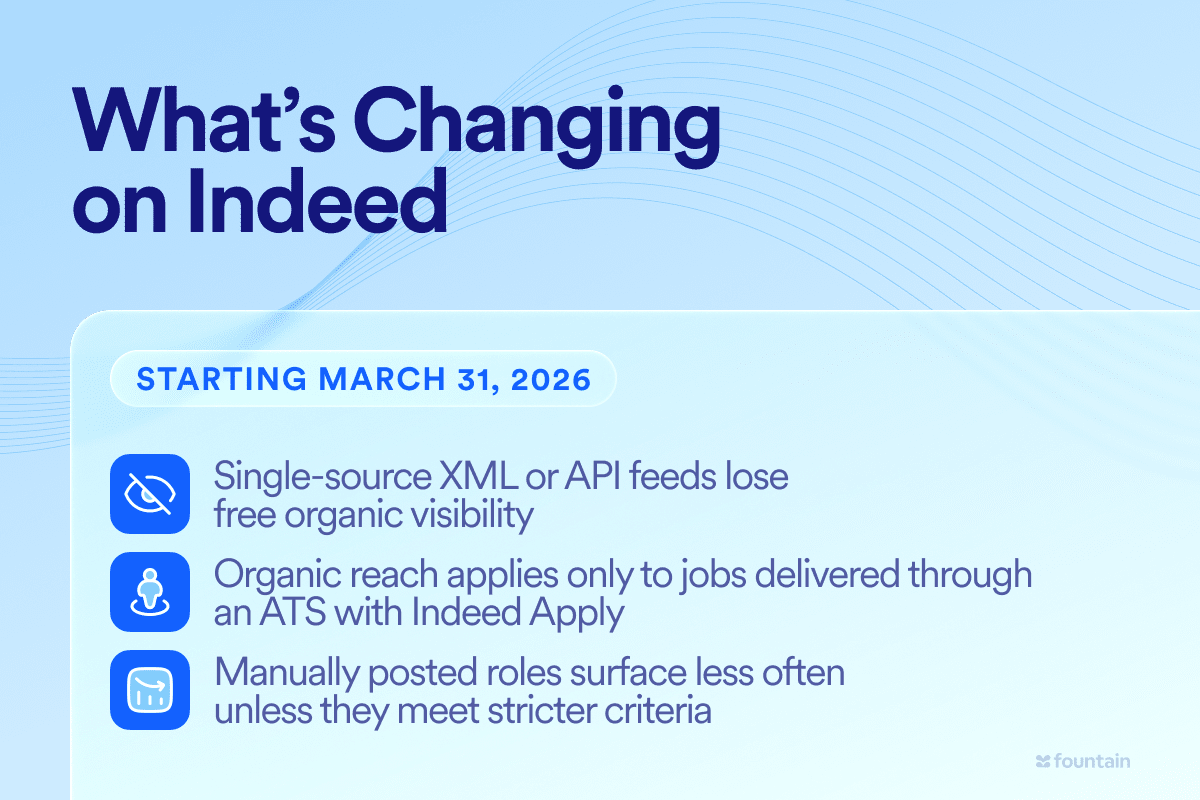
The 2026 organic visibility change will require frontline hiring teams to move quickly, strengthen their sourcing infrastructure, and rely on tools that keep applicant flow steady even as platforms update their rules. Fountain’s Frontline OS gives teams the automation, agentic AI support, and human-in-the-loop control needed to stay fully staffed without extra manual work.
Whether you need help validating your Indeed feed setup, building a more resilient sourcing mix, or improving speed from apply to interview, our team can walk you through what works and how to get ahead of these changes.
The turnover data points one way. Among retail and food-service workers, six-month turnover ran 24% for those with at least two weeks’ notice, versus 39% under 72 hours and 42% for those who had a shift cancelled the prior month. Advance notice is a measurable retention lever, not a courtesy.
Shift control takes several forms: self-scheduling to pick from open shifts, swap tools and internal marketplaces to trade without phone trees, advance posting to plan two weeks out, compressed patterns, and on-demand shifts for surges.
Remote-work advice is about where people work; for frontline work on site, flexibility is about when they work, which is why so much of that advice never applies to an hourly workforce.
In a randomized trial, Gap gave stores two weeks’ notice, stable shifts, and app-based swaps, and productivity rose 5.1% while sales rose 3.3%. But someone still has to work Friday close, and self-scheduling without guardrails hands the worst shifts to the newest workers.
Predictive scheduling and Fair Workweek laws also set advance-notice rules, statewide in Oregon and in cities like Chicago, Los Angeles, and Philadelphia, so build advance posting into the model and confirm local obligations. And no single practice works everywhere: a 2026 HBR analysis of 280 million shifts across 20 retail chains found none that predicts retention at every location.
Pilot it, measure it, and expand what works.
A workable first move: post one site’s schedule 14 days ahead with manager-approved mobile swaps, then compare that location’s 90-day retention against the region a quarter later.
2. Put pay, hours, and location in the job post
Vague job posts buy applications from people who quit the moment they learn the shift, turning attraction spend straight into attrition cost. Publishing the pay range widens the funnel the right way: 70% of organizations that post pay ranges report more applicants, from people who can actually work the job.
Clear shift and schedule details do the filtering, and federal guidance points to realistic job previews as a proven way to reduce turnover.
The first move is small: rewrite one live post to name its pay range, exact shift, and location.
Before: “Now hiring warehouse associates! We’re looking for motivated, dependable team players to join our fast-paced, growing company. We offer competitive pay, great benefits, and flexible scheduling options. Multiple shifts and locations available for the right candidates. Apply today to start your journey with us!”
After: “Warehouse associate, $18–$21/hour, working Monday–Friday from 6 a.m. to 2:30 p.m. at the distribution center, with schedules posted 14 days ahead. The application is built to finish on a phone, so mobile candidates can apply before moving on to another opening.”
The rewrite is shorter because every line does filtering work. Candidates who can’t work that shift or reach that site opt out before they cost you anything.
3. Cut the time between apply and offer
Frontline candidates often apply to several employers the same afternoon and take the first solid offer, so a slow process loses the people who were most ready to work. The delay rarely sits where you’d guess: screening backlogs and phone tag over interview times cause most of it, and chasing documents one email at a time adds the rest.
Automated screening clears the backlog, candidate self-scheduling ends the phone tag, and mobile document collection replaces the chase.
Marsden Services, a facility-services provider across more than 50 brands, cut time-to-hire from 18 days to seven and dropped a client location’s vacancy rate from 18% to 6%, with day-one retention up 16%. Standardizing one workflow across those brands, instead of rebuilding it per brand, let regional teams move that fast. Speed belongs in the retention column as much as the attraction one.
Pick one high-volume role and turn on candidate self-scheduling.
4. Treat the first 90 days as part of hiring
Hiring isn’t finished at the offer; it runs through onboarding and the first 90 days. Workers who describe onboarding as chaotic are likelier to be planning their exit, so the cheapest retention work is a first week that functions: finish paperwork before arrival so day one is about the work, give each hire a named first-week contact, and schedule a check-in within two weeks to catch problems while they’re still fixable.
Onboarding isn’t orientation; it’s the last mile of the hire, where a worker becomes productive and decides to stay.
Stitch Fix rebuilt its warehouse hiring flow and raised the share of applicants who cleared background checks and showed up on day one from 68% to 95%, with median time-to-hire falling from 21 days to nine. Treat background checks, paperwork, and day-one readiness as one funnel, and watch time-to-hire and show rate together.
Move one role’s paperwork ahead of day one.
5. Equip the frontline manager
The frontline manager owns the schedule and the first week, the two things that most often push a worker out the door. They’re also the most strained link in the chain: understaffing is the biggest stressor for frontline managers, and a stretched manager has less time for any one worker.
Give them authority to act without escalating: approve swaps, fill coverage gaps, and adjust schedules on the spot. A short, standing menu of moves like schedule adjustments and recognition lets them respond consistently.
Flexible schedules, consistent hours, employee input, and advance notice rank among the most effective frontline retention strategies, and the manager delivers them day to day. Automation can surface the coverage gap or the at-risk worker, but the manager still makes the call.
Give one site manager swap-approval authority.
6. Make the next role visible
When workers can’t see a path, development itself becomes a retention risk. A lack of advancement is a repeat driver of early departures, and the fix costs almost nothing: advertise open roles internally first with a posted policy so workers know the path is real, requery your own candidate database before buying new sourcing, and invite back alumni who left on good terms.
Tie it back to strategy 2: the second time you hire a role, the candidates already sit in your database, so that hire should cost less than the first.
Before the next sourcing spend, requery past applicants for one opening.
How to measure whether it is working
Run one scoreboard across both halves of the funnel, not a metric per program.
Start with a baseline for a single location, then track:
- Attraction: time-to-fill, offer-accept rate, and cost-per-hire, reviewed weekly during hiring pushes rather than once a quarter.
- The join: day-one show rate and 90-day retention, which show whether hiring and onboarding connect.
- Operations: shift fill rate and absenteeism, which show whether coverage holds.
Measure at the location level. Company-wide averages hide the sites where the problem lives, and one weak region can mask progress everywhere else. The location view surfaces fixable problems first, often weeks before a corporate dashboard catches them.
How Fountain helps frontline teams attract and retain employees
Fountain is built for the frontline, not a corporate applicant tracker retrofitted for hourly roles, and it runs recruiting, scheduling, onboarding, and re-engagement in one system.
Cue is the orchestration layer across all of it: a regional manager can type “Fill every open shift at store 214 this week and flag anyone at risk of no-showing,” and Cue prepares the scheduling actions, outreach, and risk flags for the manager to approve. It coordinates; the manager decides.
Underneath Cue, three live agents carry the repetitive load. Anna runs voice screening around the clock, which is what compresses the apply-to-offer gap in strategy 3. Emma answers candidate questions at any hour and walks new hires through I-9 and W-4 paperwork. Sam runs post-hire check-ins and surfaces retention signals inside the 90-day window where frontline attrition concentrates.
The agents run on products mapped to the strategies above:
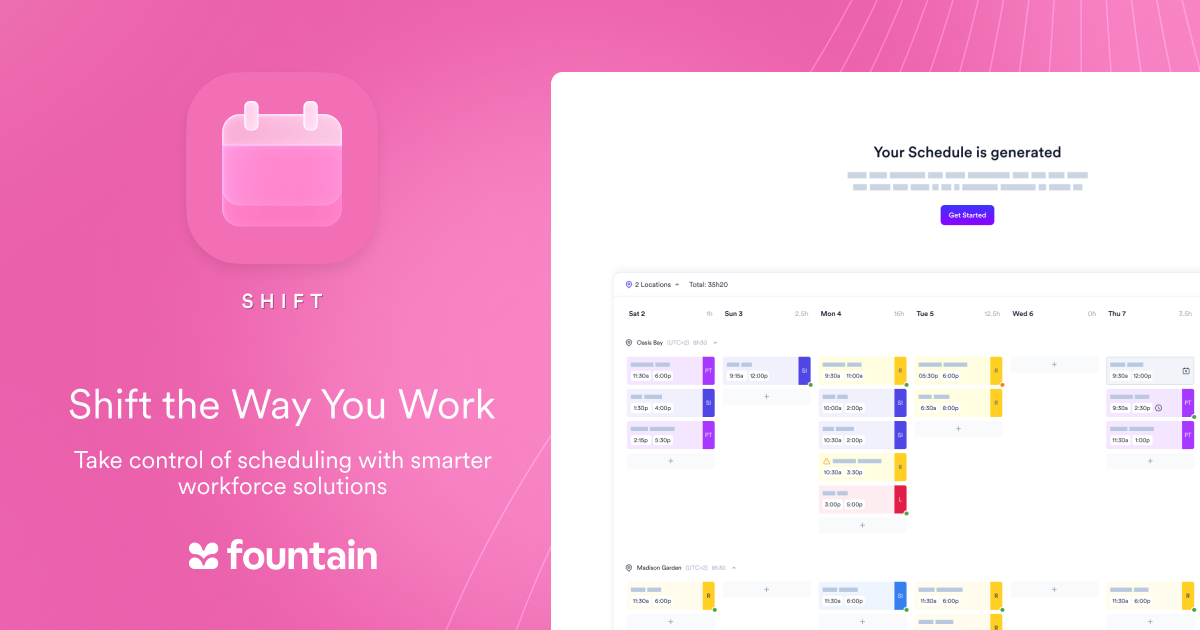
- Shift & Scheduling for strategy 1, building schedules from real-time availability with mobile swaps and configurable break, overtime, and coverage rules
- The ATS for strategies 2 and 3, with mobile-first applications, automated screening, and candidate self-scheduling
- Onboarding for strategy 4, moving paperwork ahead of arrival and tracking day-one readiness
- CRM and Sourcing for strategy 6, requerying past applicants and re-engaging alumni before new sourcing spend
Running this funnel on Fountain, Alto hired 450 drivers in six months with three recruiters at a $300 average cost-per-hire, against SHRM’s roughly $4,700 benchmark, while expanding its market five times over.
That is the leaky bucket sealed from both ends: attraction and retention run as one funnel, with scheduling, offer speed, and a functional first week as the connective tissue that keeps the same seats from reopening.
It is the operational core of Fountain’s Frontline Superintelligence. See it run against your own turnover numbers: Book a demo and start with the 14-day scheduling pilot, Anna-led screening, and paperwork cleared before day one.
Frequently asked questions about attracting and retaining employees
How do you attract and retain employees?
Post pay, hours, and location honestly, move from application to offer in days, give workers real schedule control, treat the first 90 days as part of the hire, and make the next role visible. Run those as one funnel rather than as separate recruiting and HR programs, and they reinforce each other instead of competing for budget.
Does flexible scheduling actually reduce turnover?
The evidence here is strong. Frontline retail and food-service workers with at least two weeks’ schedule notice turned over at 24% over six months, versus 39% under 72 hours’ notice, and Gap’s randomized scheduling experiment lifted store productivity 5.1%. Advance posting is a lever you can test with a site-level pilot, tracking turnover and productivity before and after.
Why do frontline employees quit in the first 90 days?
Early quits usually trace to an expectation mismatch, a poor manager fit, no visible advancement, a chaotic first week, or a schedule the worker can’t live with. 43% of frontline hires are gone by day 90, so any fix has to land early, before the offer and inside the first two weeks, rather than at a six-month stay bonus.