Vendor rosters have gotten long. Eightfold ships four named talent agents, Radancy covers five stages, and Maki names five it describes as orchestrated end to end. Across the agentic recruiting landscape, having agents stopped being the differentiator.
What almost nobody demonstrates is the part between them. A roster tells you which specialists exist, not what moves when screening hands a candidate to scheduling, what record that pass leaves, or who signs off before an offer. Whether a candidate’s answers survive a handoff decides whether they get hired or lost.
This article covers how those passes work, where they fail, and what to ask a vendor about the seams. One line holds throughout: agents run the routine work between decisions, and people keep decision authority over consequential employment outcomes.
What is a multi-agent AI system?
A multi-agent AI system is several specialist AI agents working on a task none of them owns end to end, plus a coordination layer that decides which agent acts, when, and with what information. That layer routes tasks, carries context across handoffs, and marks where a person signs off.
A single AI agent holds the whole task itself, so nothing has to survive a handoff.
Agentic AI adapts its next step to what it finds, and a multi-agent system splits that adaptive work among specialists, so every split creates something to carry. Without a layer doing the carrying, specialists repeat questions, lose candidate data, and skip approvals.
The coordination is the system, not the count of agents.
Multi-agent, single agent, or plain automation: which one your workflow needs
Not every workflow needs multiple agents, and for most the answer is no. Every added agent is another handoff to configure, monitor, and fix.
Gartner predicts over 40% of agentic AI projects will be canceled by the end of 2027, citing escalating costs, unclear business value, and inadequate risk controls. Analyst Anushree Verma’s advice is to “start by using AI agents when decisions are needed, automation for routine workflows and assistants for simple retrieval.”
| Approach | Fits when | Hiring example |
| Rules-based automation | The full path is known in advance | Trigger a background check when an offer is signed |
| Single AI agent | The path depends on what the work reveals, and one specialist can hold it | A screening agent that interviews, scores, and routes candidates |
| Multi-agent system | The path branches across specialties no single agent can hold | Sourcing to screening to scheduling to compliance to onboarding, each stage shaped by the last |
Coordination earns its cost only when the path changes based on what the system finds. Frontline hiring qualifies: knockout answers change the route, availability changes the interview slot, a background check result changes Day 1, and location changes the compliance steps.
Across thousands of applicants and hundreds of locations, coordination is what keeps candidates moving without manual exception-handling.
How agents hand work to each other
Three things move at every handoff: the context the next agent needs, the decision about which specialist acts next, and, at sensitive points, a person’s approval.
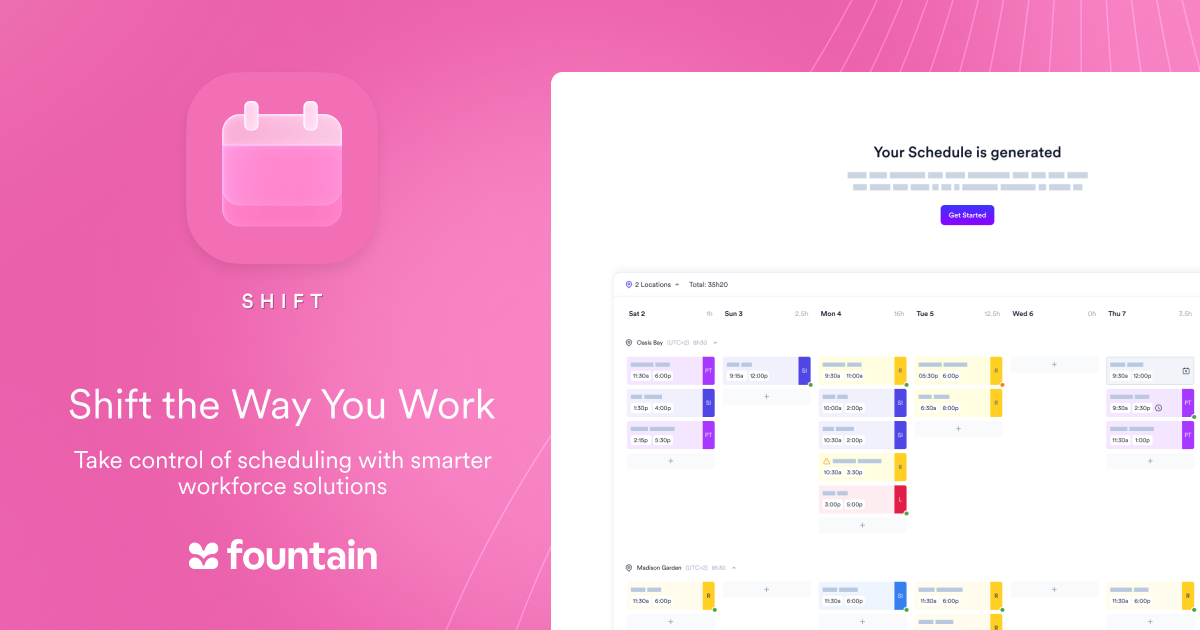
Smart, flexible scheduling built for frontline teams—because flexibility is essential, not optional.
Optimize your frontline workforce management with Fountain Shift—the all-in-one mobile scheduling solution designed to streamline operations and enhance employee satisfaction.
Automate shift creation, minimize errors, and empower your team with mobile access to schedules, time tracking, and seamless shift management. Experience the future of workforce scheduling today.
Context is the hardest. What passes between agents should be a structured, condensed package holding what the next agent needs, the way a recruiter hands a hiring manager a summary rather than a full transcript. Whatever it omits is invisible downstream: a thin package drops the candidate’s availability, knockout answers, or consent record, and nothing after it knows.
Routing decides which specialist acts next, usually with a coordinating agent assigning work and assembling results the way a team lead parcels out tasks. Its quality depends on how precisely each scope is defined, and vague scopes send work to the wrong desk.
Approval gates are where a person enters the chain, and a gate only counts if the recruiter standing at it reads the case before approving and can reverse what the system produced. Pause for a human when the next action is irreversible, regulated, or expensive; employment decisions meet all three.
The EU AI Act’s Article 14 sets a similar bar, requiring high-risk systems be designed so oversight personnel can “disregard, override or reverse the output.”
What a multi-agent hiring chain looks like end to end
An end-to-end chain moves a requisition from sourcing through screening, scheduling, a human-controlled offer, compliance, onboarding, and shift assignment, carrying context at every pass. Start with a store manager needing two Friday openers.
A sourcing agent posts the role and works applicants by text, handing screening who applied and for which role. The screening agent interviews the candidate, collects knockout answers and shift availability, and records consent. The scheduling agent matches that availability against the manager’s calendar and books the interview without re-asking anything the chain already knows.
After the interview, the offer is a human gate, because final hiring decisions belong with people. Compliance is then the most expensive pass to fumble on timing: background checks can take days, candidates get lost to competing offers inside that window, and Section 2 of Form I-9 generally has to be completed within three business days of the employee’s first day of work.
An agent that opens both the moment the offer is signed, then chases documents by text, buys back the days that decide whether the hire shows up.
Onboarding then hands a verified, Day 1-ready worker to shift scheduling, and the first shift gets assigned against verified documents rather than a manual re-entry between systems, much of what separates an agentic ATS from a traditional system of record. That final pass is where most vendor rosters stop.
SHRM reports that 2026 is the year agents move from the margins to the mainstream of recruiting, absorbing transactional work like scheduling, background checks, and onboarding logistics, so inspect how a vendor coordinates post-offer work.
Where multi-agent handoffs break
Multi-agent chains break at the seams, not inside the agents. UC Berkeley researchers built MAST, the first empirically grounded failure-mode taxonomy for these systems, from a close reading of 150 execution traces, then used it to annotate 1,642 more across seven frameworks. System design and inter-agent misalignment account for roughly three-quarters of observed failures; the underlying model accounts for far less.
Four of their 14 failure modes carry a direct hiring cost:
- Candidates answer the same question twice. Step repetition is the most common failure mode in the dataset at 15.7%. The hiring version is a candidate giving their availability to the screening agent and again to the scheduling agent, which reads as incompetence to the person on the other end and shows up in your numbers as drop-off.
- A disqualification reason never reaches your ATS. Researchers flag information withholding as one of the more fatal modes because it appears almost exclusively in runs that fail outright. When a screening agent’s reasoning stays inside the screening agent, you lose the record that makes a disputed outcome investigable, and New York City’s Local Law 144 requires bias audits and published results for covered automated employment decision tools.
- Shift preferences vanish at the scheduling handoff. Context loss leaves the receiving agent to start over or book against assumptions nobody checked, which is how a candidate who said they can’t work mornings gets a 7 a.m. interview slot.
- The workflow declares itself done before the documents are in. Premature termination closes a chain while required steps are still open, and in hiring that means the three-day I-9 clock keeps running against a file nobody is working.
The most useful question to put to a vendor is what happens when an agent fails mid-workflow: whether the chain stops, retries, reroutes, or escalates, and who gets notified. Then ask how a receiving agent validates the package it inherits, what trace each handoff leaves, and how the platform detects an agent drifting toward favoring certain candidate profiles.
Ask for each demonstrated live, not described in a deck.
Three things buyers get wrong about multi-agent systems
Three assumptions show up repeatedly in evaluations, and each leads to a worse purchase.
- Buyers treat model size and demo polish as proof of coordination. No model upgrade fixes a handoff that drops context, and Gartner estimates only about 130 of the thousands of self-described agentic AI vendors are real. Require a live demonstration of routing, context preservation, approval gates, and handoff traces before you credit the branding.
- Buyers assume a multi-agent system takes people out of the work. It doesn’t, and the market hasn’t asked it to. Only 6% of companies fully trust AI agents to autonomously run core business processes, per a July 2025 Harvard Business Review Analytic Services survey of 603 leaders. Agents absorb the routine work between decisions; people still make the decisions.
- Buyers read a longer roster as a stronger product. Every added agent is another handoff, and the documented failure modes are all consequences of dispersing work. A short chain with clean passes beats a long list of names.
A long roster is easier to market than a clean handoff, which is why it deserves the least weight in your evaluation.
How Fountain runs a multi-agent system for frontline operations
On the frontline, a stalled handoff doesn’t look like a system error. It looks like an offer signed four days ago while the I-9 sits unstarted, and then a Friday shift nobody covers. Closing that gap takes a layer that owns what moves between stages: inside Fountain’s Frontline Superintelligence, that layer is Cue, which decides which agent acts, what context it carries, and where a manager approves.
Cue coordinates three live agents:
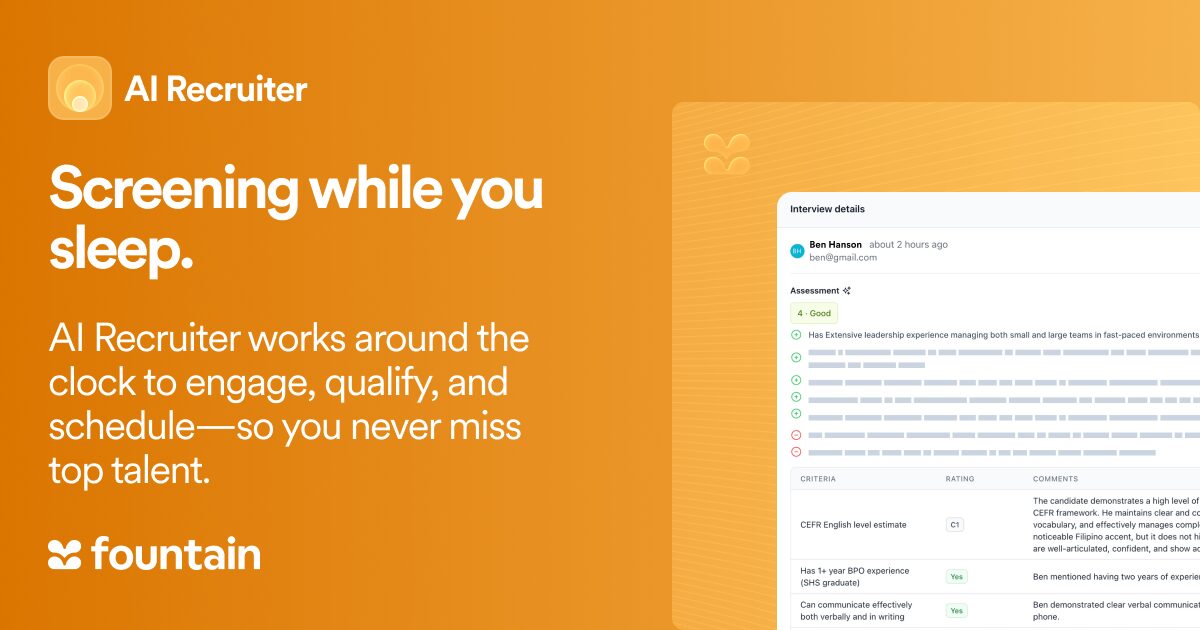
- Anna, the AI Recruiter, interviews candidates by voice and text, scores responses, and routes qualified people to hiring teams.
- Emma, AI 24/7 Support, answers the candidate and paperwork questions that otherwise stall a start date.
- Sam, AI Satisfaction, checks in after Day 1 and flags retention risk early. Managers approve every offer and exception.
Those agents act on one connected platform, so the passes stay inside a single system: Sourcing and CRM feed the ATS, which feeds screening, scheduling, document collection, Onboarding, and Shift & Scheduling. That last pass, onboarding into shift assignment, is the one most rosters never reach.
With Fountain, Alto reported hiring 450 drivers in 6 months by 3 recruiters at an average cost per hire of $300, compared with the roughly $4,700 SHRM average cited on the page.
Rosters will keep getting longer. What separates two platforms with the same agent count is whether a candidate’s answers, consent, and approval status arrive intact at the next step. Walk one of your live requisitions through every handoff with us and you will see where the chain holds and where it leaks.
Book a demo to watch Cue route a signed offer into onboarding, Anna screen a candidate by voice, and a manager approve the result.
Frequently asked questions about multi-agent AI systems
What is a multi-agent AI system in hiring?
A set of specialist AI agents covering sourcing, screening, scheduling, and compliance, coordinated by a layer that decides which agent acts, when, and with what information. That layer, more than the agents themselves, determines whether candidates move through without losing context.
Should AI agents make final hiring decisions?
No. Final hiring decisions should stay with people. The EU AI Act requires effective human oversight of high-risk systems, including the ability to disregard, override, or reverse an output, and New York City’s Local Law 144 requires bias audits and published results for covered automated employment decision tools. This is general information, not legal advice; confirm your obligations with counsel.
When does a hiring workflow need multiple agents instead of one?
When the work spans specialties no single agent can hold and each stage changes based on what the previous one found. If one agent or a plain workflow can do the job, it will do it more cheaply and reliably.