Hourly candidates don’t wait. They often compare several openings in a single session, move with the first process that responds, and leave slower employers guessing. A hiring process built for 10 roles holds up fine. The same process applied to 1,000 roles across 40 locations falls apart at every seam, and each crack costs a covered shift.
Slow hiring is the top frustration for 57% of frontline candidates, and each frontline replacement costs $7,000 in recruiting, training, and lost productivity, per the 2025 Fountain Frontline Report. Every day a role sits open translates into overtime that burns out workers and revenue lost when a location can’t open or a route goes uncovered.
Most frontline leaders already know what high-volume hiring is. The repeatable process has to hold up under volume.
What is mass recruitment?
For frontline employers, this is high-volume hiring: hiring large numbers of workers quickly through a standardized, scalable workflow that prioritizes fast, consistent hiring over individual evaluation depth.
Hourly, mobile-first work with high turnover shapes every step, especially when roles are spread across dozens or hundreds of locations. Frontline high-volume hiring differs from corporate hiring, where recruiters manage smaller, more individualized requisition loads, candidates submit résumés, and the timeline runs weeks.
Frontline high-volume hiring is résumé-free, decision cycles run in days or hours, and shift-based complexity compounds at every location. Building the right high-volume hiring strategy means designing for that reality from the first job ad to Day 1.
Why does the standard hiring process break at volume?
Frontline hiring teams often support large, distributed workforces, yet high-volume hiring on tools built for salaried desk workers creates friction. These teams often work across fragmented tools for posting, screening, scheduling, background checks, and onboarding. Those handoffs create gaps across the process.
That fragmentation produces predictable failure modes at volume.
- Screening queues back up. When applications spike and a single recruiter is reviewing thousands of candidates, that manual review becomes the bottleneck that stalls everything downstream.
- Interview standards drift. Without structured scorecards, quality varies wildly across managers and locations, so the same candidate gets advanced in one store and rejected in another.
- Approval chains stall. Every handoff between recruiter, manager, and HR adds days the candidate spends entertaining competing offers.
- Onboarding isn’t ready on Day 1. Paperwork lands on the new hire’s first shift instead of before it, and the no-show rate climbs.
The average time from application to offer in the U.S. runs 27.5 days, according to Fountain’s Redefining Frontline Operations research. Nearly a month of friction is nearly a month of unfilled shifts and overtime. Volume hiring needs a process designed for every step.
How the mass recruitment process works
Here’s how the mass recruitment process works in real life:
Step 1: Workforce planning before volume arrives
Predictable high-volume hiring starts before sourcing, with demand mapped to capacity. The teams that scramble react to open requisitions after they pile up. The teams that hold steady define needs by location and role cluster first, then match recruiter capacity and hiring-manager response times to that demand, with service-level agreements (SLAs) for each stage.
This matters because recruiter capacity is finite and already stretched. Recruiters already lose hours to scheduling and manual ATS work, and that administrative load compounds when application volume spikes.
Automation expands recruiter capacity, but only when the plan accounts for operational limits. Mapping demand to capacity up front separates a controlled ramp from a peak-season fire drill.
Step 2: A multi-channel sourcing engine
A single job board rarely feeds volume hiring by itself. Job boards can create volume, while referrals and past-applicant pools can improve intent and fit, so leaning on a single channel can leave you paying for volume without enough qualified hires. A working sourcing engine blends job boards and social campaigns with higher-intent channels such as employee referrals and re-engaged past applicants from a talent pool.
Channel quality can vary, so frontline teams should track conversion and retention by source. A direct sourcing strategy for frontline hiring weights investment toward higher-intent channels instead of buying impressions blindly.
Build every ad for mobile and front-load pay and scheduling details for each location. Pay transparency helps candidates decide faster, while stating location and schedule up front cuts the guesswork that drives drop-off. Employer brand is a sourcing-performance lever that decides whether your ad converts.
Step 3: Mobile-first applications that convert (under 5 minutes)
Volume funnels often leak first on the phone. Mobile job applications lose candidates when forms are too long or résumé-heavy, especially when they depend on desktop workflows. Drop résumé requirements in favor of skills- or availability-based intake, keep it to essential fields, and enable one-click or text-to-apply.
Reducing an application to 5 minutes or less lifts completion rates, and 60% of applicants abandon applications that feel too long, according to Fountain’s Redefining Frontline Operations research. For frontline roles, mobile candidates drop quickly when forms create friction.
Every field you cut is a candidate you keep.
Step 4: Automated screening that preserves quality
At thousands of applicants, manual screening is the bottleneck, but blunt filters cost you good hires. Use automated knockout questions for hard disqualifiers and AI ranking to surface the strongest candidates. Chatbot pre-screening can collect qualifying details, while human review on edge cases keeps a strong candidate from failing on a keyword.
Automation reduces manual screening and scheduling work, but only when the process is designed around speed and quality.
Done right, automation shifts recruiter time toward edge cases and judgment calls. Centerfield, a business-process outsourcer (BPO) drowning in applicant volume, used Fountain’s automated screening to narrow 23,000 applicants to 2,600 qualified candidates, an 88% reduction in résumés recruiters had to screen.
Humans should stay in the loop on the judgment calls. Knockout logic has no flexibility for nuance, so a candidate who can earn a required certification within a week shouldn’t be auto-rejected by a rigid filter. Effective pre-employment screening practices use automation for insight and reserve the final call for a person.
Step 5: Fast, consistent interviews
Volume interviewing only works when it’s fast and consistent. Interviewing can become a drop-off point when scheduling or evaluation slows down, so speed and standardization matter. Formats that hold up under volume include group interviews and AI voice or video screening; phone screens can work when they are paired with standardized scorecards that prevent quality drift across interviewers.
Structure protects quality while the funnel keeps moving. Use standardized questions and scorecards to keep evaluations consistent across interviewers. The scorecard keeps your 100th interview as fair as your first.
Many frontline candidates are already moving quickly through multiple applications. They often apply to several jobs at once and expect fast responses, and they have more reason to leave when a slow hiring process drags. AI scheduling tools reduce back-and-forth coordination and cut the friction that stalls the funnel.
Step 6: Faster offers with SLA-driven decisions
In frontline hiring the offer window is short because candidates are comparing multiple openings at once, so speed is the deciding factor. Hourly candidates move quickly when competing offers are available. If your post-interview decision takes 3 days, you risk extending offers to people who are already considering or accepting other offers.
The teams that win at this stage set approval SLAs for post-interview decisions and send clear offers with compensation and Day 1 attached. Communication failures are expensive.
Per the 2025 Fountain Frontline Report, 52% of frontline candidates cite ghosting or a lack of updates as a top frustration, so poor communication and slow decisions make it easier for candidates to leave the funnel. A fast, specific offer reduces ghosting in both directions. Tightening these SLAs is one of the most direct ways to reduce time-to-hire without adding headcount.
Step 7: Compliance built into the workflow
At volume, compliance should trigger automatically at the offer stage. I-9 verification and required checks, including background checks or certifications, should fire the moment an offer is signed. The multi-location, multi-state complexity only grows as you add sites and states, since E-Verify mandates vary by jurisdiction, and background-check timing and fair-chance requirements can vary as well.
Federal worksite enforcement has intensified in recent years, and the exposure grows with every hire, as Fountain’s Employer’s Guide to I-9 Audits details.
Federal I-9 penalties run from $288 up to $2,861 per form for paperwork violations, while repeat knowing-hire violations can reach $28,619 per worker, and Section 2 of the I-9 must be completed within 3 business days of the first day of work. For an employer onboarding hundreds of workers at peak, that 3-day clock running across every new hire is a real operational risk.
Automating compliance at the offer stage helps the system catch missing steps before they become violations, though specific obligations vary by jurisdiction and should be confirmed with counsel.
Step 8: Onboarding that starts before Day 1
Onboarding is a retention intervention that begins before the first shift, and it’s the most under-invested step in high-volume hiring. Per the 2025 Fountain Frontline Report, 43% of frontline new hires leave within 90 days, and workers who describe onboarding as messy are 9x more likely to plan their exit. Most of that damage is done before the new hire ever contributes.
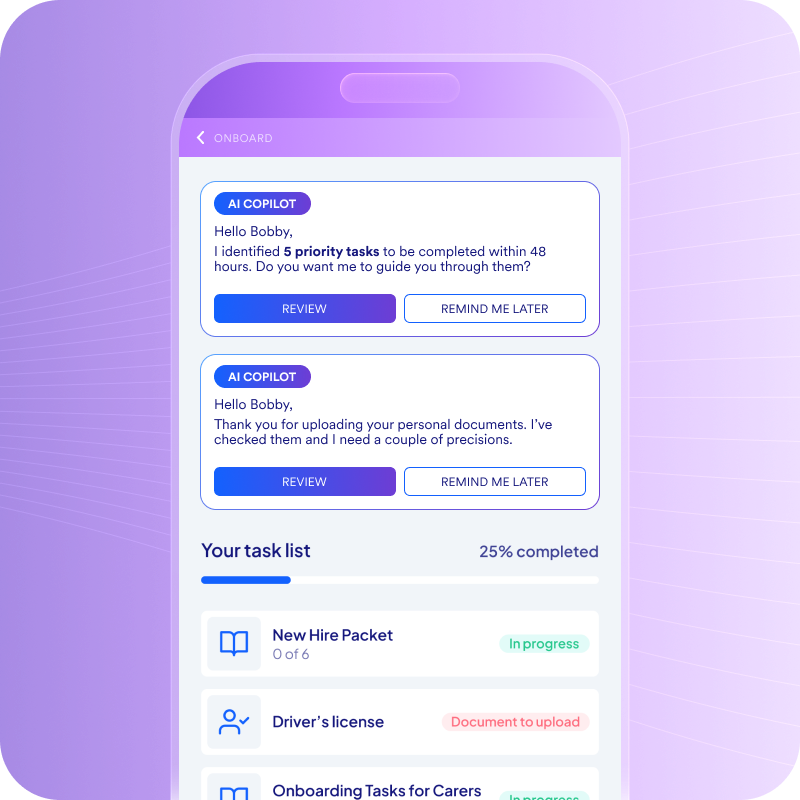
Pre-Day-1 onboarding closes the gap. Documents collected before the first shift, pre-work training delivered early, a manager introduction, and clear Day 1 instructions can reduce friction that contributes to no-shows and early attrition that wreck shift coverage.
Stitch Fix shows the effect: by optimizing its warehouse hiring with mobile-first workflows and automated screening, it lifted its Day 1 show rate from 68% to 95%. A solid employee onboarding checklist turns the first day from a paperwork ambush into a reason to stay.
Step 9: Measurement by location and funnel stage
Company-wide averages hide where the process is actually breaking. A 40-location operation with a healthy blended time-to-hire can still have 10 locations bleeding candidates, and the average will never tell you which 10.
The metrics that matter are time-to-hire, cost-per-hire, stage-by-stage conversion, mobile versus desktop drop-off, Day 1 show rate, and 90-day retention, all read at the location level.
Location-level data can reveal a 3x turnover gap across locations within the same company, per Fountain’s Agentic AI for Frontline Workforces research. That gap is invisible in a corporate dashboard and obvious in a location-level one. Teams can use these numbers to iterate. Sites with weak conversion or retention become their biggest near-term wins.
How Fountain runs the mass recruitment process
Fountain runs high-volume hiring from sourcing through Day 1 for frontline employers, and a connected system matters because the friction that kills fill rate lives in the handoffs between tools, not inside any single step. Fountain’s Frontline Superintelligence starts with Cue, the orchestration layer and single entry point to the agents: a leader can type a goal like “Hire 200 warehouse associates across 12 sites before peak” and Cue coordinates the work across Fountain.
Underneath, agents handle specific tasks while your team keeps the final call. Anna, the AI Recruiter, runs 24/7 voice and SMS screening and scoring, so candidates get an alternative to waiting for a scheduled callback. Emma, AI 24/7 Support, answers candidate questions across SMS and voice at any hour. Sam, AI Satisfaction, checks in after hire to surface retention and no-show signals before they cost a shift.
The core products beneath connect every step: Sourcing, CRM, ATS, Onboarding, and Shift & Scheduling. Bojangles, a quick-service restaurant (QSR) chain with 750 locations, cut time-to-hire from 30 days to 5.8 days. At Fetch, a last-mile delivery company, Fountain AI cut time-to-hire from 15 days to 6.5 hours.
Each of the 9 steps wins or loses a piece of your fill rate, and they hold up only when they run as one system instead of a relay race between tools. Book a demo to see it on a live workflow: hand Cue a hiring goal and watch it coordinate sourcing, screening, and onboarding while Anna screens around the clock and location-level dashboards surface the sites that leak candidates.
Frequently asked questions about mass recruitment
What is the mass recruitment process?
High-volume hiring is a standardized, repeatable workflow for hiring large numbers of frontline workers quickly. It runs from workforce planning and multi-channel sourcing through mobile-first applications, automated screening, structured interviews, fast offers, compliance, pre-Day-1 onboarding, and location-level measurement. The priority throughout is fast, consistent hiring over the deep individual evaluation typical of corporate hiring.
How is mass recruitment different from high-volume or bulk hiring?
High-volume hiring describes how employers fill dozens to thousands of roles quickly, almost always for hourly, mobile-first frontline work. The distinction that matters is between high-volume hiring and traditional corporate hiring, which is recruiter-led, résumé-based, and built for a multi-week timeline.
How long should mass recruitment take for frontline roles?
Faster than the 27.5-day U.S. average from application to offer, because hourly candidates move quickly when competing offers are available. Employers using automated hiring workflows can compress time-to-hire into single digits, often a handful of days.