Frontline hiring in the U.S. averages 27.5 days from application to offer according to Fountain’s research. Stretch that to weeks and candidates take the first concrete offer before an interview ever happens.
AI sourcing attacks that gap by finding, ranking, and engaging candidates across channels before a recruiter opens the requisition. For hourly roles, it has to support phone-first applicants, high volume, referrals, and past-applicant pools without stalling today’s pipeline.
What is AI sourcing?
AI sourcing is the use of artificial intelligence to find, rank, and engage job candidates across channels, including job boards, paid advertising, referrals, and owned talent pools, before a recruiter touches the requisition. The AI recommends candidates and handles first outreach; recruiters make the decisions. Every consequential step, from advancing a candidate to extending an offer, stays with a human.
Teams often confuse it with three adjacent things:
- AI screening, which evaluates candidates sourcing has already found: sourcing casts the net, screening sorts the catch.
- ATS automation, which is reactive; managing applications candidates choose to submit, while sourcing generates the pipeline.
- Programmatic job advertising, which automates the buying and placement of ads, which attracts applicants but doesn’t match, rank, or contact anyone.
Scheduled posting and Boolean search have existed for years. What is new is matching and engagement: systems that score candidates against role requirements, learn from recruiter feedback, and shift budget toward channels that produce hires, not clicks.
Why frontline sourcing is a different problem than corporate sourcing
Frontline sourcing runs on active, high-volume, phone-first candidates, not the passive white-collar prospects found by scraping professional profiles. Frontline applicants are already looking for work, apply in volume, and expect every step to work from a phone. Speed of communication matters more than search sophistication.
Frontline employers also hold two levers corporate teams rarely use. Talent pool reactivation turns past applicants and former workers into hires with no new ad spend; retailers retained 29,000 seasonal employees in early 2025, up from 4,000 in 2024 according to the U.S. Bureau of Labor Statistics.
Referrals are the second lever, handing recruiters warm candidates instead of anonymous inbound.
A sourcing strategy that ignores both is paying job boards for candidates the company already knows.
How AI sourcing works for frontline roles
For frontline roles, AI sourcing runs as a four-stage loop that stops short of any consequential decision:
- Discovery pulls candidates from job boards, programmatic ads, employee referrals, and past applicants sitting in owned talent pools.
- Matching scores each candidate against the role’s actual requirements, which for hourly work means availability, certifications, and location more than resume keywords.
- Agentic outreach contacts ranked candidates over SMS and WhatsApp, the channels frontline workers actually answer.
- Recruiter review gates everything consequential: outreach can run automatically, but advancing candidates, scheduling, and offers wait for human sign-off.
Start by pointing the system at one owned pool: a past-applicant segment by role and location, queued as a re-engagement campaign for recruiter review rather than waiting on net-new applicants. Contact “enrichment,” scraping profiles for emails and phone numbers, is a passive white-collar move; frontline pools already hold that data, so the only real constraint is how fast someone acts on it.
Smarter, faster hiring built for frontline teams—because efficiency is essential, not optional.
Transform your frontline hiring process with Fountain’s Agentic AI—automation that doesn’t just streamline workflows, but drives real business impact.
✅ Cut time-to-hire by 79%
✅ Save $1.2M+ in annual labor and attrition costs
✅ Improve first-year retention by 30%
Download our new white paper or request a personalized demo to see how Agentic AI delivers measurable ROI for high-volume hiring.
AI in hiring is already mainstream: Fountain’s Agentic AI research shows that 67% of recruiters use AI tools, up from 35% in 2020. The question is no longer whether to adopt it but where it fits, so test any tool against your real frontline constraints: phone-first applicants, shift availability, location, and past-applicant reactivation.
What results to expect
Six metrics tell you whether frontline sourcing is working:
- Cost-per-applicant
- Application completion rate
- Time-to-first-contact
- Applicant-to-hire conversion
- Interview and Day 1 show rates
- Time-to-fill
Reply rate matters only for re-engagement campaigns, which measure whether a dormant pool still responds.
Completion rate is the metric most teams underweight. Long, desktop-era applications create friction for candidates working from a phone, and a tool that doubles applicant flow into a slow screening process just doubles the queue.
Baseline the last 30 days on completion, time-to-first-contact, conversion, and cost-per-hire first, so gains tie to hires and bottlenecks, not clicks.
How to evaluate an AI sourcing tool
Evaluate sourcing tools for frontline fit specifically, because demos blur together. While our comparison of the best sourcing tools for 2026 goes deeper on individual vendors, these six criteria apply to all of them.
- Frontline-native design: Tools adapted from corporate recruiting carry resume-centric matching and desktop-first workflows; frontline-native tools match on availability, location, and certifications.
- Mobile-first candidate flow: Every step a candidate touches, from first text to interview scheduling, has to work on a phone, where hourly applicants actually move through hiring.
- Owned-pool reactivation: Net-new discovery is expensive, so the tool should re-engage past applicants and former workers before spending on ads.
- Human-in-the-loop controls: Anything touching a hiring decision needs recruiter review and override authority, with those actions logged.
- Full-funnel fit: Sourcing should hand off directly into screening, scheduling, and onboarding; a tool that ends at “candidate identified” leaves the slowest stages untouched.
- Integration depth: Bi-directional sync keeps candidate records in one place; our guide to integrating AI recruiting tools with an ATS covers what to verify before signing.
Pilot only tools that clear all six, and require proof of owned-pool reactivation and a clean handoff into screening and scheduling, not a list of candidates that lands in a queue.
Risks and guardrails: bias, compliance, candidate experience
AI sourcing carries civil rights obligations and legal exposure that can depend on where candidates are located, not just where the employer sits. State and local automated-hiring rules vary by jurisdiction, so legal review should happen before rollout, and employers stay responsible for their selection procedures even when a vendor’s tool makes the recommendation.
This is general information, not legal advice; confirm your obligations with counsel.
Ask vendors to show three things: scoring transparency, so a recruiter can see why a candidate ranked where they did; independent fairness audits across the full pipeline, run by an auditor with no financial stake in the vendor; and complete audit logs of every automated action, which make the first two verifiable when a regulator asks.
The rule of thumb is to automate coordination and keep hiring judgment with people:
- Safe to automate: distribution, re-engagement campaigns, candidate FAQs, and interview scheduling.
- Keep with humans: hiring decisions, exceptions, and accommodation requests.
- Log everything: automated actions, recruiter reviews, and overrides.
Most teams already work this way, keeping AI in an assistive role rather than handing it autonomous hiring authority, which is exactly what the guardrails above are for.
Why sourcing alone doesn’t fill roles faster
Downstream stages create the real stall: screening, background checks, scheduling, and candidate drop-off. For candidates comparing multiple hourly jobs, a slow scheduling window gives another employer time to hire them first.
Buying sourcing as a standalone point tool locks that stall in. Ranked candidates land in an ATS that batches them for weekly review, phone tag slows scheduling, and onboarding paperwork lives in a third system. Each handoff resets the clock and hides the delay from whoever owned the previous stage.
Recruiters spend hours shuttling records between tools instead of talking to candidates, and every hour of lag sits in the window where a competitor is texting the same person.
The fix is one connected system, where a sourced candidate flows into screening, self-scheduling, and onboarding with no re-keying and no queue between stages. Trace a candidate through your current stack and mark every manual handoff; each one is a place the clock resets.
When each stage triggers the next automatically, sourcing gains actually reach time-to-fill. When they don’t, sourcing spend just buys a bigger pile of candidates who leave before anyone calls them.
How to roll out AI sourcing without disrupting your pipeline
The lowest-risk rollout starts by baselining your current process before any purchase. Pull your last 50 hires, timestamp each stage from application to first shift, and you will see where candidates stall: screening, scheduling, or applicant volume. That baseline defines what the tool needs to fix and what “better” means in 60 days.
From there, one role at one location makes a clean pilot. Run a parallel cohort on the current process so you don’t credit the tool for a seasonal swing, then compare time-to-fill, application completion, and 30-day retention, because speed that hires people who quit in a month isn’t a win.
What beats the baseline expands to the next location; what doesn’t gets reconfigured first. Teams already using recruiting automation elsewhere in the funnel can usually run this pilot without adding headcount.
How Fountain runs AI sourcing for frontline hiring
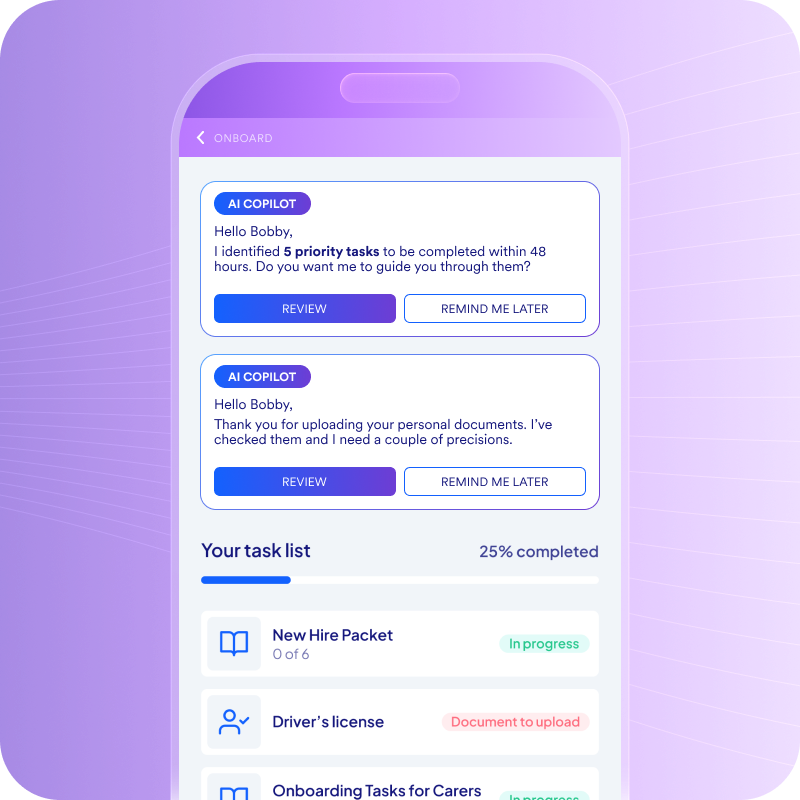
Fountain runs AI sourcing through Cue, the orchestration layer inside every Fountain product and the core of its Frontline Superintelligence. A recruiter types a prompt like “Re-engage seasonal applicants from last year, good standing only,” and Cue coordinates CRM and Sourcing to assemble the campaign: matched profiles, drafted outreach, and a recruiter-review queue, with no list exports or hand-built audience rules.
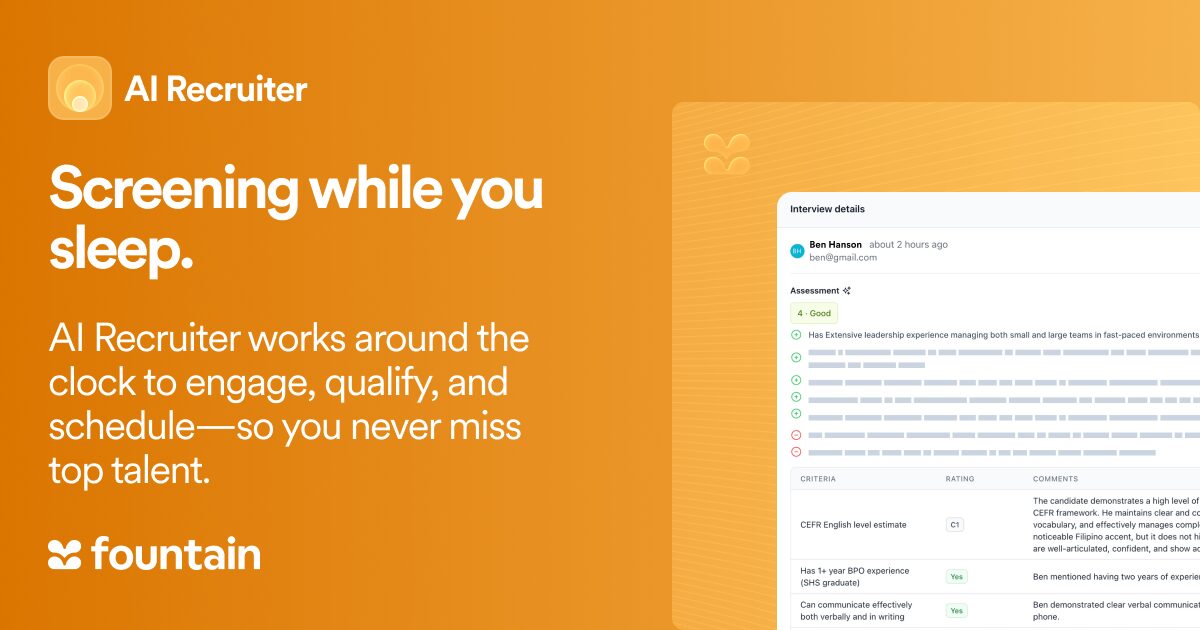
Cue orchestrates the agents that keep sourced candidates moving. Anna, the AI Recruiter, runs voice and SMS screening around the clock and pushes qualified applicants to recruiters. Emma, AI 24/7 Support, answers candidate questions and clears document blockers at every stage. Sam, AI Satisfaction, surfaces post-hire engagement and retention signals, carrying the workflow past the offer.
The agents act on the platform underneath. Fountain Sourcing runs campaigns across job boards, SMS, and paid channels with spend tracked against actual hires, while Fountain CRM holds the owned talent pool and re-engages past applicants inside the ATS, with Onboarding downstream.
Alto (the luxury-rideshare operator) used this stack to hire 450 drivers in six months with three recruiters, at a $300 average cost-per-hire and a two- to seven-day time-to-offer. That runs well under the roughly $4,700 SHRM benchmark for non-executive roles.
Against a 27.5-day market average, Alto hired from the same driver labor market faster and for less, because sourcing fed a connected funnel instead of a queue. Book a demo to see the full loop run on your roles and locations.
Frequently asked questions about AI sourcing
What is AI sourcing?
AI sourcing is the use of artificial intelligence to find, rank, and engage job candidates across channels, including job boards, paid ads, referrals, and owned talent pools, before a recruiter opens the requisition. The AI recommends and reaches out; recruiters make every hiring decision.
How is AI sourcing different from traditional sourcing?
AI sourcing automates candidate scoring, feedback-informed recommendations, and channel optimization instead of relying on manual posting, Boolean search, and one-off recruiter outreach. It scores candidates against role requirements automatically, uses recruiter feedback to improve future recommendations, and helps reallocate budget toward the channels producing hires.
Will AI sourcing replace recruiters?
No. It handles discovery, ranking, and first outreach so recruiters spend time on interviews, judgment calls, and exceptions. Many companies deliberately keep AI in an assistive role, with humans deciding who advances and who gets hired.