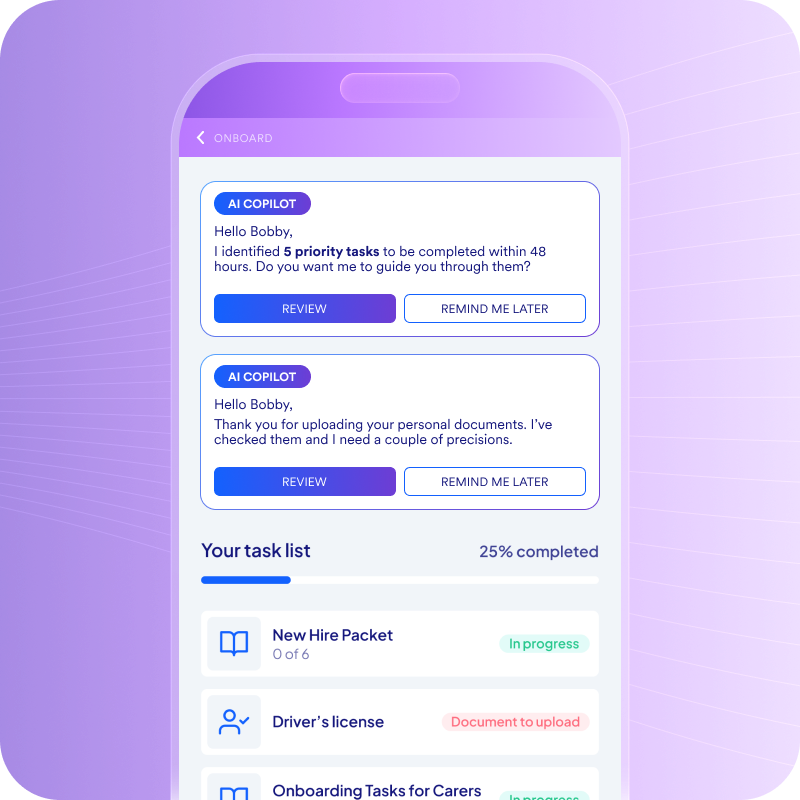
Workday’s acquisition of Paradox closed in October 2025, and it turned a product evaluation into a stack decision. Paradox built its name on Olivia, a conversational AI chatbot that automates screening, interview scheduling, and candidate communication for high-volume recruiting. Buyers evaluating Paradox now have to weigh Workday dependency and whether the platform will still match their hiring operations in 18 months.
The bigger shift sits underneath the acquisition. Software is becoming the back end of frontline recruiting, and agents are becoming the front end. The question that separates these platforms in 2026 is whose agents actually screen candidates, schedule interviews, answer questions, and run onboarding without a recruiter pushing every step.
This guide compares 8 Paradox alternatives on that standard, across the full hiring funnel.
TL;DR: Paradox AI alternatives at a glance
Eight platforms make this list, each with a different center of gravity:
- Fountain pairs an orchestration layer and three named AI agents with a platform that runs high-volume hiring, onboarding, and workforce management across quick-service restaurants (QSR), retail, logistics, and staffing.
- Workstream bundles hourly hiring, payroll, and onboarding in one platform for small-to-mid-market operators.
- Emi Labs ships a conversational recruiting agent that screens and schedules candidates over WhatsApp, Messenger, and SMS.
- Phenom spreads more than 30 AI agents across an enterprise talent experience platform with high-volume hiring capabilities.
- Hireology serves multi-location franchise businesses in automotive, healthcare, and hospitality.
- iCIMS is an enterprise applicant tracking system (ATS) carrying a new Frontline AI module from its Apli acquisition.
- SmartRecruiters (SAP) is a cloud-native enterprise ATS that SAP acquired in September 2025.
- Jobvite (Employ Inc.) is a corporate ATS with recruitment marketing strength.
The profiles below cover each platform’s agent depth, post-hire coverage, and best-fit buyer.
How we evaluated these platforms
Only 25% of TA leaders believe their current technology is very effective for high-volume hiring, per Aptitude Research. The bar for any Paradox replacement is a true frontline hiring platform: one that automates sourcing through onboarding for hourly and deskless workers across distributed locations, with mobile-first workflows built for candidates who apply from their phones.
Six dimensions separate platforms built for that reality from platforms adapted to it:
- Named agents and depth: Which agents does the platform actually ship, and what do they do? Look past “AI-powered” labels and ask whether the agent acts on outcomes (conducts the interview, completes the paperwork, fills the shift) or only reports them, and whether it orchestrates across products or stops at the feature it’s bolted onto.
- Mobile-first candidate experience: According to Appcast, mobile application share is around two-thirds overall, and higher in some frontline categories, such as 69% in warehousing and logistics and 86% among gig workers.
- Speed to offer: According to Fountain’s Agentic AI for Frontline Workforces research, agentic systems compress time-to-hire from 14+ days to 6 to 8 days. In frontline hiring, the first offer usually wins.
- Post-hire capabilities: Onboarding, compliance (I-9, E-Verify), shift scheduling, and engagement are where frontline platforms earn or lose their ROI.
- Multi-location governance: Can the platform support different workflows by brand and location while accounting for jurisdictional rules without separate instances?
- Analytics and reporting: Can your TA team pull time-to-fill, source effectiveness, and compliance completion rates without a manual spreadsheet?
Weight the first dimension heaviest. Platform gaps tend to be fixable with configuration; an agent gap means the work stays manual.
| Dimension | Fountain | Workstream | Emi Labs | Phenom | Hireology | iCIMS | SmartRecruiters (SAP) | Jobvite (Employ) |
| Named agents and depth | Orchestration layer + voice screening, 24/7 support, and post-hire agents | AI voice/video screening; no named agents | Emi, conversational screening agent | 30+ agents incl. Voice Screening Agent | Minimal: texting and automation | Frontline AI module (Apli), new | AI sourcing and screening assistants | None frontline-relevant |
| Mobile-first candidate experience | Mobile-first apply | QR text-to-apply; multilingual AI | Native SMS-first | Career sites; voice screening | TextApply; two-way texting | Mobile app | Mobile support | Not frontline-native |
| Speed to offer | Days | Days | Days via SMS automation | Varies | Days | Weeks | Weeks | Weeks |
| Post-hire capabilities | Onboarding, I-9, scheduling, CRM | Onboarding, payroll, scheduling (native) | Limited | Internal mobility AI | Onboarding, payroll handoffs | Onboarding (add-on) | CRM (add-on) | Limited |
| Multi-location governance | Brand/location/jurisdiction workflows | Multi-location | Enterprise multi-location | Enterprise multi-brand | Franchise multi-location | Enterprise global | Enterprise global | Limited |
| Analytics and reporting | Built-in TA analytics | Basic reporting | Campaign analytics | Talent experience analytics | Basic reporting | Enterprise reporting | Add-on analytics | Recruitment marketing metrics |
The rest of this guide unpacks the first row, because that’s where these platforms actually separate.
8 of the Best Paradox AI Competitors for Frontline Hiring
1. Fountain
Fountain pairs an agentic orchestration layer with an integrated frontline platform, the combination it calls Frontline Superintelligence. The orchestration layer is the single entry point to every agent on the platform.
Underneath it, AI voice screening runs first-round interviews 24/7, scores candidates against customer-defined criteria, and routes qualified applicants to hiring managers for final review. A 24/7 candidate support agent answers questions over SMS, voice, and web chat at every stage, including Chat Apply and Day 1 paperwork. A post-hire engagement agent surfaces retention risk while managers can still act.
The agents operate on a platform purpose-built for frontline hiring: ATS, Onboarding, customer relationship management (CRM), Sourcing, and Shift & Scheduling. Fountain customers hire over 1.2 million workers annually across 78 countries, and native connectors for UKG, SAP, ADP, and Workday mean the platform extends an existing HR stack rather than replacing it.
Why does Fountain win for teams leaving Paradox?
Each Paradox gap maps to an agent, not a feature claim. Recruiters run funnels across hundreds or thousands of locations, so the orchestration layer turns a plain-English goal into coordinated tasks across sourcing, screening, scheduling, and onboarding.
Candidates prefer AI-led first conversations: 74% of frontline workers prefer AI-driven interviews, per the 2025 Fountain Frontline Report, so voice screening handles the first round around the clock with hiring teams staying human-in-the-loop on final decisions. Candidates need answers at 2 a.m., not during recruiter office hours, so the support agent responds instantly at every stage.
And because Paradox concentrates on the pre-hire conversation, the post-hire agent covers ground that Olivia’s workflow tends to leave to other systems, checking in from Day 1 and flagging flight risk early.
The platform underneath holds its own: 85% of Fountain candidates apply via mobile, Onboarding handles I-9 completion with remote authorized representative support, E-Verify, and compliance tracking, and the CRM re-engages past applicants and seasonal workers without new sourcing spend.
Key features:
- The orchestration layer: Type a goal in plain English (“Hire 30 crew members across my Dallas locations before Friday” or “Rehire last year’s seasonal team, good standing only”) and it breaks the goal into tasks across the platform, asks for approval where needed, and reports what changed.
- The agents underneath it: Voice screening runs first-round interviews 24/7 and routes scored candidates to managers, while candidate support covers questions all the way through onboarding paperwork. Post-hire feedback runs over voice and SMS, a category many platforms in this comparison don’t cover.
Each layer works on its own; the orchestration layer is what fuses them into a single workflow.
Proof points:
- Bojangles (QSR, 750 locations across the Southeastern U.S.) cut time-to-hire 80%, from 30 days to 5.8, and saved 230 recruiting hours in 2022 through automated messaging.
- Fetch (last-mile delivery) cut time-to-hire 95% with Fountain AI, from 15 days to 6.5 hours.
- Stitch Fix (retail fulfillment) raised the share of hires who pass background checks and show up on Day 1 from 68% to 95%.
- Liveops (virtual contact center staffing) runs a 44,000:1 applicant-to-recruiter ratio with a 100% fill rate.
That spread covers the four verticals this list is built for: QSR, retail, logistics, and staffing.
Best for:
TA directors and operations leaders at QSR, retail, logistics, and staffing organizations hiring at high volume who need one platform from sourcing through workforce management, without ripping out their existing HRIS. If most of your hiring is salaried corporate roles, a corporate ATS will serve you better.
2. Workstream
Workstream is designed specifically for hourly and deskless workers across restaurants, retail, healthcare, and logistics. Its AI layer is screening-deep rather than agent-deep: multilingual voice and video screening built into the apply flow, with no named agents operating across the platform. The draw is consolidation, with hiring, onboarding, payroll, and scheduling in one system.
The all-in-one model eliminates separate hiring, payroll, and scheduling vendors, the multilingual screening supports diverse frontline workforces.
The catches:
There’s no agent layer or orchestration, so AI stays embedded screening rather than autonomous execution; the bundled model is designed as an HRIS replacement, which forces a rip-and-replace decision; it isn’t built for enterprise-scale governance; and pricing isn’t published.
Best for:
QSR, retail, healthcare, and logistics operators with 10 to 200 locations who want a single bundled system covering hiring through payroll.
3. Emi Labs
Emi Labs is built around a single conversational agent: Emi screens and schedules candidates over WhatsApp, SMS, and Messenger, matching how frontline candidates already communicate. That focus is both the appeal and the limit. Emi Labs’ Y Combinator profile lists Walmart, Burger King, Starbucks, and 7-Eleven as customers.
The catches:
It is a single-agent product focused on screening and scheduling, without an orchestration layer or native post-hire capabilities, so onboarding, payroll, and scheduling typically require separate systems. It is also a leaner vendor than most on this list, so validate implementation and support capacity for North American enterprise rollouts.
Best for:
Enterprise QSR and retail organizations that prioritize SMS-first candidate communication and want conversational AI without the Workday dependency.
4. Phenom
Phenom is an enterprise Talent Experience Management (TXM) platform that has gone wide on agents: more than 30 across the talent lifecycle, including a Voice Screening Agent for automated phone screens. Breadth and frontline depth are different things, though. The agents serve the TXM suite across corporate and frontline populations rather than running an end-to-end hourly funnel.
The platform integrates with existing ATS and HRIS infrastructure rather than replacing it, and it covers corporate and frontline hiring populations in one system, with internal mobility AI that matches existing employees to open roles.
The catches:
The agents are bound to the features they sit in rather than orchestrated toward a hiring outcome; there’s no native payroll or shift scheduling; and enterprise pricing and implementation complexity put it out of reach for most mid-market QSR or retail operators.
Best for:
Large enterprises needing AI-driven candidate personalization across both corporate and frontline hiring populations, with existing ATS and HRIS infrastructure in place.
5. Hireology
Hireology is built for multi-location and franchise businesses in healthcare, automotive, hospitality, and retail. Its agent story is the thinnest of the major vertical players by design: two-way texting, TextApply, and workflow automation rather than AI that interviews candidates or completes onboarding. The value concentrates in vertical-specific compliance and franchise workflows.
It consistently ranks among the easiest-to-use recruitment platforms, published pricing with multiple service tiers removes procurement friction, and the automotive, healthcare, and hospitality focus comes with purpose-built franchise workflows, electronic document collection, and integrated background checks.
The catches:
The minimal agent layer means automation and texting rather than AI that conducts interviews or runs onboarding; the compliance-oriented approach can add friction where hourly hiring speed matters most; and the mid-market positioning doesn’t stretch to enterprise-scale operations.
Best for:
Multi-location franchise operators in automotive, healthcare, and hospitality with 10 to 200 locations who value published pricing and vertical-specific workflows.
6. iCIMS
iCIMS is an enterprise ATS used by over 4,000 companies, including approximately 40% of the Fortune 100. Its frontline agent story is the newest on this list: iCIMS acquired Apli in September 2025 and launched the resulting iCIMS Frontline AI module in its Spring 2026 release, bringing multilingual conversational hiring to a platform that historically had no native voice interviewing.
For frontline-heavy organizations, the open question is whether a corporate ATS stretched to hourly hiring can match purpose-built speed.
The installed base comes with established enterprise security and procurement posture, and the UNIFi application programming interface (API) framework connects roughly 800 partner solutions, which keeps connector-building requirements low.
The catches:
The Frontline AI module is new, with limited publicly documented results in live frontline deployments so far; G2 reviewers cite limited customization, a learning curve, and navigation challenges; implementation timelines typically run months rather than weeks; and pricing is enterprise-level and unpublished.
Best for:
Fortune 500 organizations with existing iCIMS corporate hiring deployments who want a single vendor across both knowledge-worker and frontline populations.
7. SmartRecruiters (SAP)
SmartRecruiters is a cloud-native enterprise ATS that became part of SAP in September 2025. Its AI assistants handle sourcing and screening within an enterprise recruiting motion, which makes the platform a case of enterprise recruiting adapted downmarket rather than frontline-native design.
For enterprises standardizing on SAP, it’s the natural consolidation path, with mature recruiting depth for global organizations and pre-built integrations through its marketplace.
The catches:
The AI assistants stop at sourcing and screening, with no agents for interviews, onboarding, or post-hire work; the post-acquisition integration roadmap is still taking shape, so ask for it in writing during evaluation; CRM is an add-on; and there’s no native payroll or shift scheduling for frontline use cases.
Best for:
Large enterprises already in the SAP ecosystem that are consolidating their talent acquisition stack.
8. Jobvite (Employ Inc.)
Jobvite is an applicant tracking system with recruitment marketing strength, sitting in the Employ Inc. portfolio alongside JazzHR and Lever. Its automation is built around social distribution and campaign workflows rather than a frontline hiring agent, and NXTThing RPO, Employ’s recruitment process outsourcing (RPO) subsidiary, covers high-volume needs with people rather than agents.
Recruitment marketing automation and employer branding tooling are the strengths, NXTThing RPO provides an outsourced high-volume recruiting path recognized as an Everest Group Star Performer in 2025, and the multi-brand portfolio covers different market segments.
The catches:
The application-centric architecture limits cross-role visibility, a structural mismatch for frontline operators who redeploy candidates across roles and locations; there are no frontline-native mobile workflows (text-to-apply, QR code apply) and no AI agents; with G2 reviewers reporting and customization limitations.
Best for:
Organizations focused on corporate recruitment marketing and employer branding, not frontline hiring at volume.
How Fountain runs frontline hiring after Paradox
Fountain’s answer to the post-acquisition question is Frontline Superintelligence: intelligence that runs frontline work rather than reporting on it. Cue is the orchestration layer above every agent and product, and the single entry point to the platform. A TA leader types “Staff every open weekend shift across my Southeast locations before Thursday” and Cue routes the work across sourcing, screening, scheduling, and onboarding, asking for approval where it matters.
Many platforms focus on pre-hire automation; fewer offer orchestration plus post-hire workflows in one system.
Three named agents run under Cue:
- Anna is the voice screening agent profiled above, conducting interviews 24/7, scoring responses, and routing qualified candidates to managers with recruiters staying in the loop on final calls.
- Emma answers candidate questions across SMS, voice, and web chat from first application through Day 1 paperwork.
- Sam takes the pulse of new hires through their first weeks on the job and flags retention risk early enough for managers to act.
All three are live as of April 2026, and Sam works the post-hire territory that conversational screening tools like Olivia typically leave to other systems.
Book a demo to see the agent layer on a live workflow: watch Cue break a hiring goal into orchestrated tasks, listen to Anna run a screening call, and walk through the Day 1 paperwork flow Emma supports.
Frequently asked questions about Paradox AI alternatives
Is Paradox still a standalone product after the Workday acquisition?
The Paradox brand and Olivia remain in market, but the product now sits inside Workday’s portfolio and its post-hire roadmap runs through Workday Recruiting. Buyers outside the Workday ecosystem should ask for an independent roadmap commitment before signing.
What is the best Paradox AI alternative for frontline hiring?
For most frontline operators, Fountain is a strong alternative because it pairs a conversational layer with capabilities Paradox doesn’t cover natively: orchestration through Cue, voice interviews, onboarding with I-9 and E-Verify, shift scheduling, and post-hire retention signals, while staying neutral across HCM systems. As always, validate the fit against your own requirements in a pilot.
Can a frontline hiring platform integrate with my existing HCM without replacing it?
Yes, and it should. Fountain connects natively to UKG, SAP, ADP, and Workday HCM systems. Phenom integrates with major enterprise ATS platforms. Workstream is the exception: its bundled model is positioned to replace point tools rather than plug into them.